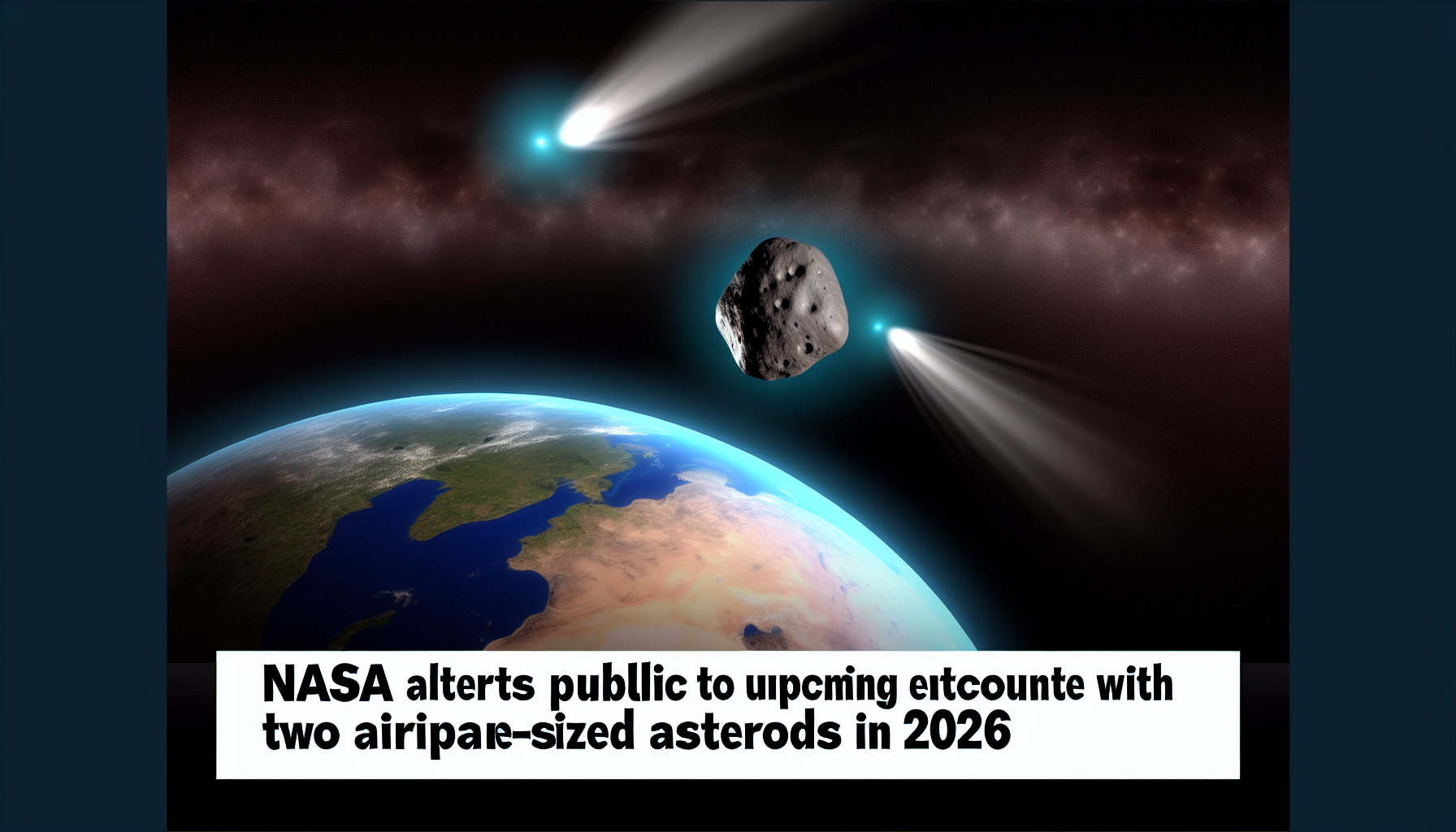

In an exciting update for space enthusiasts and the general public alike, NASA has confirmed that two airplane-sized asteroids will make a notably close approach to Earth on April 27, 2026. Designated as 2026 HJ3 and 2026 HR, these near-Earth objects (NEOs) are set to pass millions of miles away from our planet, posing no risk of impact. Although the size of these asteroids may invoke concern, scientists underscore the importance of ongoing monitoring and research in planetary defense.
The Nature of NEOs
Near-Earth objects are celestial bodies such as comets and asteroids that have been nudged by the gravitational attraction of nearby planets into orbits that allow them to enter the vicinity of Earth. NASA, along with other space agencies, has a dedicated program to track and study these objects to assess any potential risks they may pose to our planet.
Size and Characteristics of 2026 HJ3 and 2026 HR
Both 2026 HJ3 and 2026 HR are categorized as asteroid-sized objects, with dimensions comparable to that of a commercial airplane. While specific measurements for these asteroids have not been disclosed, typical airplane-sized asteroids range from about 30 to 100 feet in length, a size that is significant enough to warrant attention but not large enough to cause catastrophic damage if they were to collide with Earth.
The two asteroids are part of a broader class of objects that NASA routinely monitors. Their trajectories are calculated with precision to ensure accurate predictions of their paths as they approach Earth. This data is crucial for understanding the long-term behavior of these celestial visitors and for preparing for potential future threats.
Monitoring and Tracking Efforts
NASA employs a comprehensive system of observatories and telescopes around the globe to keep a close eye on NEOs. The agency’s Near-Earth Object Observations (NEOO) program is specifically designed to identify, track, and characterize NEOs to mitigate any possible threat to Earth.
Refining Trajectory Models
One of the key components of NASA’s monitoring efforts involves refining trajectory models for each identified asteroid. This process involves:
- Data Collection: Gathering data from various telescopes and observational platforms.
- Mathematical Modeling: Using advanced algorithms and physics to predict the asteroid’s future position with high accuracy.
- Risk Assessment: Evaluating potential impact scenarios based on the refined trajectories.
With 2026 HJ3 and 2026 HR, NASA has indicated that their paths have been well established, and there is no cause for alarm. The agency’s preparedness and proactive measures serve as a testament to the importance of planetary defense initiatives.
Public Engagement and Awareness
NASA’s announcements regarding NEOs, including the upcoming flyby of 2026 HJ3 and 2026 HR, play a vital role in public awareness and education. As the agency continues to monitor the skies, it also seeks to engage the public through:
- Educational Outreach: Programs designed to inform students and educators about asteroids and space science.
- Social Media Updates: Regular updates via social media platforms to keep the public informed of new discoveries and ongoing research.
- Public Events: Opportunities for the public to participate in discussions, webinars, and stargazing events.
By fostering a better understanding of NEOs, NASA hopes to cultivate a sense of curiosity and responsibility regarding our planet’s safety and the vast universe we inhabit.
What Happens Next?
As we approach the date of the close flyby, NASA will continue to share detailed updates about 2026 HJ3 and 2026 HR. This includes real-time tracking information and educational resources that outline the significance of such events in the context of planetary defense and space exploration.
The Importance of Planetary Defense
While the close approach of 2026 HJ3 and 2026 HR is not a cause for concern, it serves as a reminder of the importance of planetary defense. The potential for larger asteroids to impact Earth highlights the need for continued vigilance and preparedness:
- Research and Development: Ongoing studies into asteroid deflection techniques and impact mitigation strategies.
- International Cooperation: Collaboration between space agencies worldwide to share data and best practices in monitoring NEOs.
- Public Policy: Advocacy for policies that support funding for NEO research and planetary defense initiatives.
By understanding the risks and maintaining proactive measures, we can better protect our planet from potential threats from space.
Conclusion
The upcoming close approach of the two airplane-sized asteroids, 2026 HJ3 and 2026 HR, is a noteworthy event that highlights the ongoing efforts of NASA and the scientific community to monitor near-Earth objects. With no risk of impact, this event serves as an opportunity for education and engagement regarding the importance of planetary defense.
As we look forward to April 27, 2026, it is essential to remember the critical role that organizations like NASA play in safeguarding our planet and advancing our understanding of the universe. By remaining informed and engaged, the public can contribute to the dialogue surrounding space exploration and planetary safety.