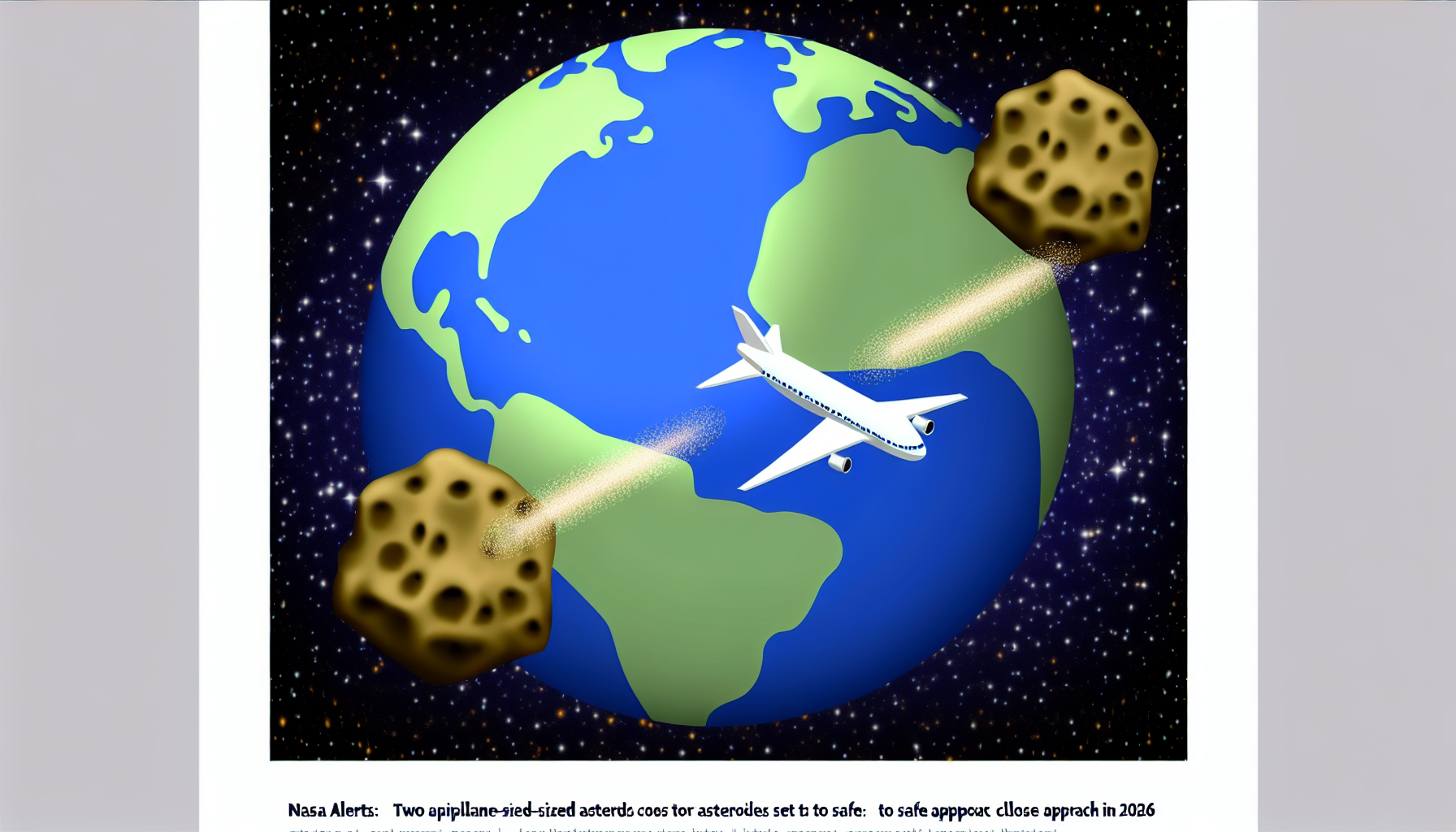

In a notable announcement, NASA has confirmed that two near-Earth asteroids, designated 2026 HJ3 and 2026 HR, are on a trajectory that will bring them close to our planet on April 27, 2026. Despite their impressive size, comparable to that of commercial airplanes, both asteroids will pass by Earth at a safe distance, with no risk of impact. This close approach offers an exciting opportunity for scientists and astronomers to study these celestial objects, as well as a reminder of the importance of monitoring near-Earth objects (NEOs).
Understanding Near-Earth Objects
Near-Earth objects are defined as comets and asteroids that have been nudged by the gravitational attraction of nearby planets into orbits that allow them to enter the Earth’s neighborhood. NASA and other space agencies around the globe work tirelessly to identify, track, and characterize these objects to assess any potential risks they may pose.
The study of NEOs is crucial, as some of these objects can be hazardous to Earth. In fact, NASA categorizes asteroids based on their size, composition, and proximity to Earth. According to the agency’s classification system, asteroids larger than 140 meters that come within 1.3 astronomical units (AU) of the Earth are considered potentially hazardous. However, the two asteroids scheduled for close approach in April 2026 fall into the standard flyby category, indicating they do not pose any threat to our planet.
Close Encounter Details
The upcoming close approach of asteroids 2026 HJ3 and 2026 HR is particularly noteworthy for several reasons:
- Size: Both asteroids are similar in size to commercial airplanes, making them significant objects of interest for scientific study.
- Safe Distance: They will pass millions of miles away from Earth, ensuring that there is no risk of collision.
- Regular Monitoring: NASA scientists continuously monitor these objects, refining trajectory models to predict their paths accurately.
- Public Awareness: This event serves as an opportunity to engage the public in discussions about planetary defense and the monitoring of near-Earth objects.
NASA’s Planetary Defense Strategy
NASA has developed a robust planetary defense strategy that includes tracking and characterizing NEOs. The agency uses a combination of ground-based and space-based telescopes to monitor the skies for these objects. The Near-Earth Object Observations (NEOO) program plays a crucial role in detecting and tracking asteroids and comets that come close to Earth.
Through advanced technology and data analysis, NASA can refine the orbits of NEOs, predict their future positions, and assess any potential risk they may pose to Earth. This ongoing effort ensures that scientists are well-prepared to respond to any potential threat from an asteroid or comet in the future.
The Importance of Public Engagement and Education
Events like the close approach of asteroids 2026 HJ3 and 2026 HR provide an excellent opportunity for public engagement and education about space and science. NASA encourages individuals and communities to learn more about NEOs, planetary defense, and the ongoing efforts to keep our planet safe.
Educational programs and outreach initiatives can help foster a better understanding of the universe and the science behind monitoring asteroids. By informing the public about these astronomical events, NASA aims to inspire the next generation of scientists and engineers who will continue to explore and protect our planet.
Monitoring and Tracking NEOs
NASA’s ability to monitor near-Earth objects relies on a sophisticated network of observatories and telescopes. The Pan-STARRS (Panoramic Survey Telescope and Rapid Response System) and the Space Surveillance Telescope (SST) are two vital components in detecting and tracking asteroids. These systems utilize advanced imaging techniques to scan the night sky for new objects and gather data on their orbits.
Once a new NEO is detected, a team of scientists and astronomers works to gather as much information as possible about its size, shape, composition, and trajectory. This data is essential for determining whether an asteroid poses a potential risk to Earth and for planning any necessary mitigation strategies.
The Role of International Collaboration
NASA collaborates with various international space agencies to enhance the global effort in monitoring near-Earth objects. Organizations such as the European Space Agency (ESA), Russian Federal Space Agency (Roscosmos), and others share data and resources to improve tracking accuracy and response strategies.
This collaboration is vital, as the global nature of space exploration and planetary defense requires coordinated efforts. By working together, nations can better prepare for potential asteroid threats and share knowledge and technology to improve detection and tracking capabilities.
Future Implications of NEO Monitoring
The continued monitoring of near-Earth objects like 2026 HJ3 and 2026 HR not only helps protect Earth but also opens new avenues for exploration and scientific discovery. Understanding the composition and behavior of asteroids can provide insights into the early solar system and the formation of planetary bodies.
Moreover, studying NEOs can lead to advancements in resource utilization. Some asteroids contain valuable materials such as metals and water, which could be critical for future space missions and even for sustaining human life in space exploration.
Conclusion
The confirmation of the close approach of asteroids 2026 HJ3 and 2026 HR serves as a reminder of the dynamic nature of our solar system and the importance of monitoring near-Earth objects. Through ongoing research and collaboration, NASA and its international partners are committed to safeguarding our planet from potential asteroid threats while also enhancing our understanding of the universe.
As we approach the date of the close encounter, the scientific community will undoubtedly be eager to observe and analyze these asteroids, furthering our knowledge of these fascinating celestial bodies. Public interest in such events is also vital, as it encourages engagement with science and the exploration of our universe.