
“`html
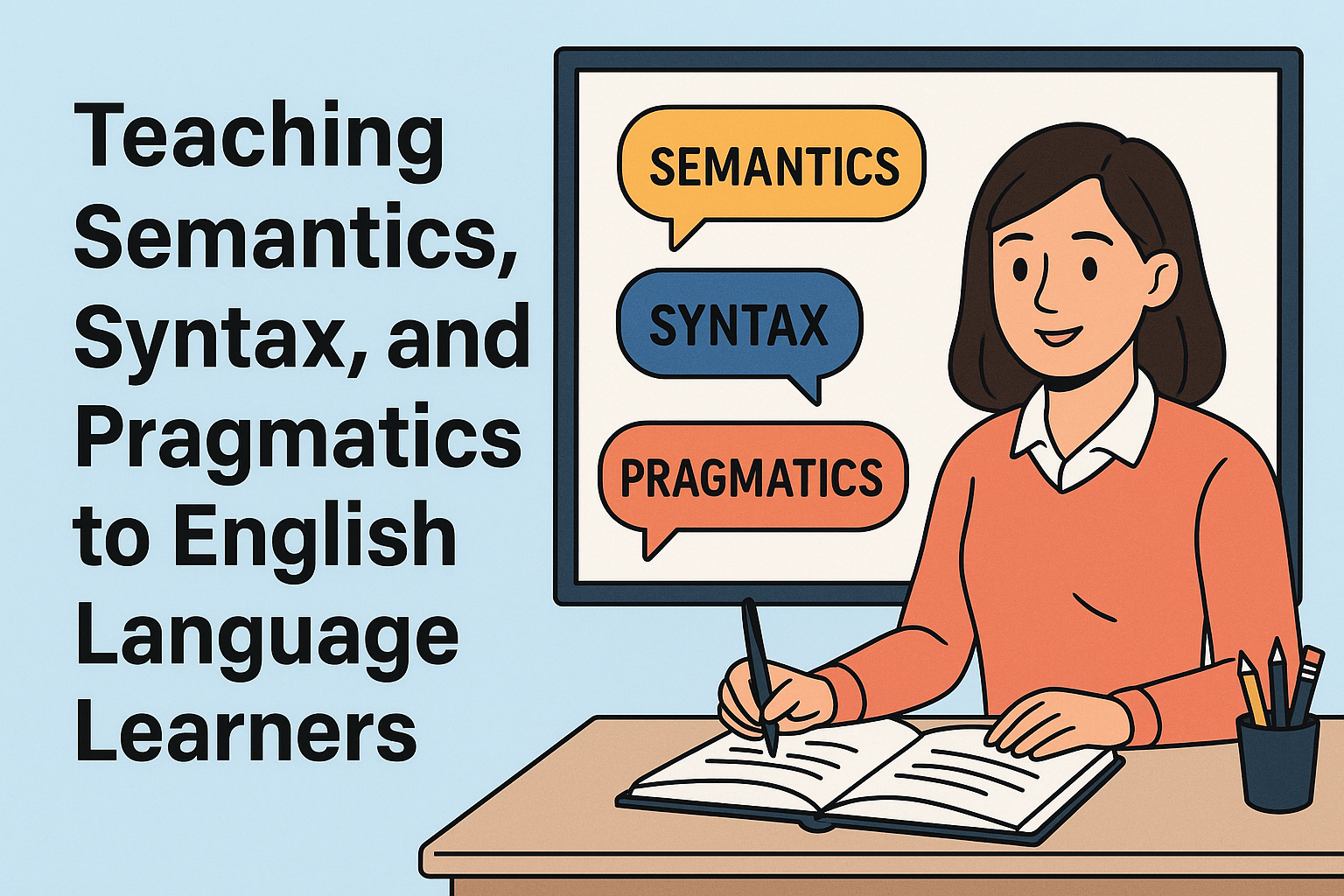
When it comes to teaching English language learners, educators face the challenging task of imparting not only vocabulary and grammar but also the subtler aspects of language. Among these, semantics (the meaning of words and phrases), syntax (the structure of sentences), and pragmatics (the context of language use) form the foundation of effective communication. Understanding these three pillars is essential for any educator aiming to equip their students with the skills needed to navigate both academic and social situations in English.
Understanding Semantics: The Meaning Behind Words
Semantics is the study of meaning in language. For English language learners (ELLs), grasping semantics is crucial as it enables them to understand what is being communicated, beyond the mere words. One of the first challenges learners encounter is the concept of polysemy—where a single word has multiple meanings. Take the word “bank,” for instance. Depending on context, it can refer to a financial institution or the side of a river. Without a solid understanding of semantics, ELLs may miss the intended meaning entirely.
To effectively teach semantics, educators can utilize a variety of strategies. For example, incorporating visual aids such as images, videos, and realia can help students associate words with their meanings. Additionally, using semantic mapping—where students create visual representations of words and their meanings—can be particularly effective. For instance, the word “run” can be broken down into various contexts: running as a physical activity, running a program, or running out of time. Encouraging students to explore these meanings in collaborative group settings can foster deeper understanding.
Challenges in Teaching Semantics
Teaching semantics goes beyond mere vocabulary acquisition. Many ELLs face challenges influenced by their native languages, which may not have direct equivalents for certain English words or phrases. For instance, concepts like “freedom” may carry different connotations in various cultures. This necessitates a culturally responsive approach, where educators acknowledge and address these differences to help students grasp abstract meanings.
Additionally, idiomatic expressions often confuse learners. Phrases that are common in English, such as “bite the bullet” or “let the cat out of the bag,” can leave ELLs puzzled. To bridge this gap, educators can create a database of idioms and their meanings, using contextual illustrations to make sense of these phrases in a relatable manner.
Simplifying Syntax: Building Strong Sentence Structures
Syntax involves the arrangement of words to create well-structured sentences. In English, this often follows a Subject-Verb-Object (SVO) order. For ELLs, mastering syntax is vital for clear communication. Many learners come from languages with different syntactic structures, which can lead to confusion. For example, in languages such as Japanese, the sentence structure follows a Subject-Object-Verb (SOV) pattern, which can lead to errors in English sentence construction.
To teach syntax effectively, educators can begin with simple sentences before gradually introducing more complex structures. Techniques such as sentence combining—where students take two shorter sentences and combine them into one—can help reinforce understanding of syntax. For example, turning “The dog barked. The cat ran away.” into “The dog barked, and the cat ran away.” encourages students to think about how sentences can relate to one another.
Furthermore, incorporating games and interactive activities can enhance learning. Activities such as “sentence scrambles,” where students must rearrange words to form coherent sentences, make the learning process engaging and fun. Integrating technology, such as grammar-checking software or interactive grammar games, can provide instant feedback and reinforce learning. (See: Understanding semantics in language.)
Advanced Syntax: Understanding Complex Sentence Structures
As students progress, introducing them to complex sentences can help them express more nuanced thoughts. Educators can explain the use of subordinate clauses and conjunctions, demonstrating how they can enhance writing and speaking. For example, using a sentence like “Although it was raining, we decided to go for a walk” showcases how additional information can be included without losing clarity.
Encouraging students to practice writing complex sentences through prompts or journaling can be beneficial. Providing constructive feedback on sentence structure can also help ELLs develop their skills over time, allowing them to express themselves more effectively in English.
Mastering Pragmatics: Navigating Context and Intent
Pragmatics is arguably the most complex of the three components. It focuses on how context influences the interpretation of language. For ELLs, pragmatics involves understanding cultural nuances, social cues, and the speaker’s intent. For instance, the phrase “Could you open the window?” might be intended as a polite request rather than a literal question. Educating learners about such subtleties can greatly improve their conversational skills and comprehension.
One effective way to teach pragmatics is through role-playing scenarios that simulate real-life conversations. By engaging in role-plays, students can practice how to respond appropriately based on social dynamics, such as formal versus informal situations. For example, contrasting a job interview with a casual gathering among friends can illustrate how language use changes based on context.
Additionally, discussing idiomatic expressions and cultural references can deepen ELLs’ understanding of pragmatic language. For instance, phrases like “kick the bucket” (to die) may not translate literally, and understanding these can help students navigate conversations more smoothly. Educators should encourage discussions about cultural differences and expectations in communication styles, allowing students to feel more confident and competent in various contexts.
Common Pragmatic Challenges in ELLs
ELLs often encounter pragmatic challenges that can hinder their communication skills. For instance, the use of humor varies significantly across cultures, and what is funny in one culture may be offensive in another. Educators can address this by discussing humor in various contexts, providing students with examples of culturally appropriate jokes or humorous anecdotes.
Furthermore, politeness strategies differ worldwide. In some cultures, directness is preferred, while in others, indirectness is the norm. Teaching students how to navigate these differences is essential. Role-playing exercises can help them practice these skills in a safe environment, making them more adept at adjusting their language according to the audience and setting.
Integrating All Three Components: A Holistic Approach
While semantics, syntax, and pragmatics can be taught individually, integrating these elements provides a more holistic approach to teaching English language learners. An effective lesson plan should consider how all three components interact in real communication. For example, during a discussion about a story, a teacher could ask students to identify the main idea (semantics), analyze sentence structures in key passages (syntax), and discuss the characters’ motives and intended meanings behind their dialogues (pragmatics). (See: Health literacy and language understanding.)
Project-based learning can be a powerful method to integrate these elements. For instance, having students create a news report can encompass semantic vocabulary relevant to the topic, syntactical accuracy in constructing sentences, and pragmatic skills in understanding how to present information effectively and appropriately to an audience.
Additionally, incorporating multimedia resources, such as films and podcasts, can expose students to authentic language use. These tools can provide examples of how semantics, syntax, and pragmatics function together in real-world settings. As students analyze dialogue from movies or listen to native speakers, they can observe language in action, reinforcing their understanding of these concepts.
The Role of Technology in Language Teaching
In today’s digital age, technology plays a significant role in teaching English language learners. Numerous online platforms and applications offer resources that target semantics, syntax, and pragmatics. For instance, websites like Duolingo and Quizlet can reinforce vocabulary and grammar through interactive exercises.
Moreover, virtual classrooms can connect ELLs with native speakers, providing opportunities for conversation practice and real-time feedback. Language exchange programs, where learners can chat with native English speakers while helping them practice another language, can be particularly beneficial. This reciprocal learning environment allows students to apply their knowledge in practical settings, enhancing both their confidence and competence.
Educators can also leverage video conferencing tools to host discussions with guest speakers from diverse backgrounds, offering students a broader perspective on language use in various contexts. This exposure not only enriches their understanding of semantics, syntax, and pragmatics but also fosters cultural awareness and sensitivity.
Current Relevance and Future Directions
As the world becomes increasingly interconnected, the ability to communicate effectively in English is more important than ever. Understanding semantics, syntax, and pragmatics is essential for ELLs as they navigate academic environments and participate in global conversations. This relevance underscores the need for educators to adopt current research-based strategies and remain adaptable to the evolving needs of their students.
Furthermore, as educational policies shift towards inclusivity and culturally responsive pedagogy, teachers must be equipped to address the unique challenges faced by ELLs. Continuous professional development and collaboration among educators can foster innovation in teaching practices that support language learning.
Frequently Asked Questions (FAQ)
What are the best strategies for teaching ELLs semantics?
Some effective strategies include using visual aids, creating semantic maps, and providing context through real-life examples. Engaging students in discussions about word meanings and encouraging them to explore multiple meanings can also enhance their understanding. (See: Challenges faced by English language learners.)
How can teachers support ELLs in mastering syntax?
Teachers can support ELLs by starting with simple sentence structures and gradually introducing complexity. Activities like sentence combining and sentence scrambles can be beneficial. Additionally, providing constructive feedback on writing can help students refine their syntax skills.
What are some examples of pragmatic challenges faced by ELLs?
ELLs may struggle with understanding cultural references, idiomatic expressions, and the nuances of politeness in conversation. Role-playing and discussions about these topics can assist learners in becoming more adept at navigating social interactions.
How can technology enhance the language learning experience for ELLs?
Technology can provide interactive learning experiences and facilitate real-time communication with native speakers. Online platforms and language exchange programs allow for practice and feedback, while multimedia resources expose students to authentic language use.
What is the importance of cultural awareness in teaching ELLs?
Cultural awareness helps teachers understand the backgrounds and experiences of their students, enabling them to create a more inclusive learning environment. This understanding can improve communication and foster a sense of belonging for ELLs in the classroom.
In summary, the journey of teaching English language learners about semantics, syntax, and pragmatics is multifaceted and rewarding. By employing diverse strategies and integrating technology, educators can provide ELLs with the tools they need to thrive in their language learning journey. The more we understand and embrace these components, the better positioned our students will be to communicate with confidence and clarity in an increasingly globalized world.
“`
Trending Now
Frequently Asked Questions
What are semantics, syntax, and pragmatics in language learning?
Semantics refers to the meaning of words and phrases, syntax involves the structure of sentences, and pragmatics focuses on the context of language use. Together, these elements are essential for effective communication, particularly for English language learners.
How can I teach semantics to English language learners?
To teach semantics effectively, educators can use visual aids, semantic mapping, and collaborative group activities. This helps students understand multiple meanings of words and how context influences interpretation, enhancing their overall comprehension.
What challenges do English language learners face in understanding semantics?
English language learners often struggle with semantics due to polysemy, where words have multiple meanings. Additionally, their native languages may lack direct equivalents for certain English terms, making it difficult to grasp nuances in meaning.
Why is understanding semantics important for English language learners?
Understanding semantics is crucial for English language learners as it enables them to comprehend deeper meanings beyond mere vocabulary. This skill is essential for navigating both academic and social interactions effectively in English.
What strategies can educators use to teach syntax to ELLs?
Educators can teach syntax by using sentence diagrams, modeling sentence structure, and providing practice through writing exercises. These strategies help ELLs grasp the rules of sentence formation and improve their overall language proficiency.
What did we miss? Let us know in the comments and join the conversation.