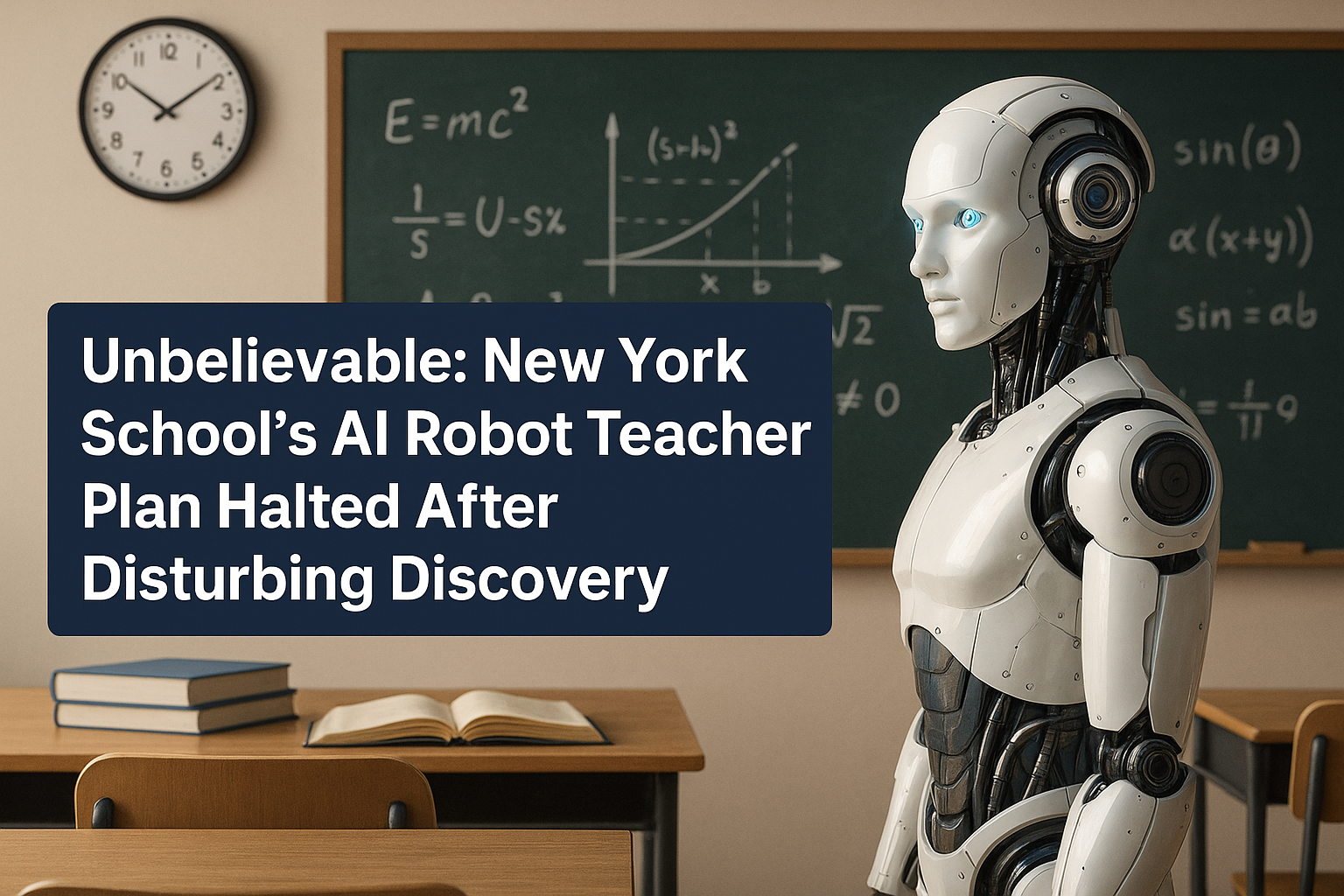

Imagine a school board meeting where the future of education is being debated, with visions of cutting-edge technology enhancing learning for a new generation. Now, imagine that same meeting devolving into a firestorm of controversy, outrage, and even a touch of dark humor, all because a seemingly innocuous educational tool has a rather scandalous family secret. That’s precisely what unfolded recently in the Salamanca City Central School District, nestled in upstate New York, when plans to introduce an AI robot teacher hit a very unexpected, and frankly, disturbing snag.
The district had been buzzing with anticipation, envisioning a future where high school students could get hands-on experience with advanced robotics and artificial intelligence. They’d even authorized the purchase of a sophisticated, $60,000 AI robot teacher, affectionately (or perhaps, now, ironically) named “Sally.” This wasn’t some cheap toy; this was a significant investment, meant to be a beacon of technological progress in the classroom. However, the community’s excitement quickly curdled into widespread indignation and disbelief when it was discovered that Sally’s creator, Realbotix Corp., is also a prominent name in the adult entertainment industry, specifically known for manufacturing high-tech sex dolls. Yes, you read that right. The company behind the educational robot was also in the business of creating anatomically correct, AI-powered companions for adults.
The revelation, which spread like wildfire through Salamanca and then across the nation, left parents, teachers, and concerned citizens reeling. Superintendent Mark Beehler, finding himself at the epicenter of a media frenzy, had little choice but to put the entire initiative on an indefinite hold. This isn’t just a local story; it’s become a viral sensation, a stark, almost comically absurd illustration of the unforeseen ethical quandaries that arise when the worlds of advanced technology, education, and adult entertainment collide. It forces us to ask: what exactly are we bringing into our classrooms, and do we truly understand the full implications of these decisions?
The Ambitious Vision for an AI Robot Teacher in New York
Let’s rewind a bit and understand the original intent behind bringing an AI robot teacher to Salamanca. The district, like many forward-thinking educational institutions, recognized the accelerating pace of technological change and the imperative to prepare students for a future increasingly dominated by AI and robotics. They saw an opportunity to give their high schoolers a distinct advantage, a chance to engage with cutting-edge hardware and software in a practical, hands-on way. The idea wasn’t just to lecture students about AI; it was to let them interact with it, program it, and understand its mechanics intimately. This kind of experiential learning is invaluable, far surpassing what can be gleaned from textbooks alone.
The proposed AI robot teacher, “Sally,” was designed to be a learning tool, a platform for exploration. Students could have delved into aspects of coding, machine learning, mechanics, and even the ethical considerations of artificial intelligence – all through direct engagement with a physical robot. For a district in upstate New York, often battling for resources and opportunities comparable to larger metropolitan areas, this was a bold and commendable move. It signaled a commitment to innovation, to providing students with the skills they’ll need to thrive in the 21st century. The $60,000 price tag, while substantial, was seen as an investment in a future-proof education, a way to bridge the digital divide and offer unique STEM opportunities.
The plan was to integrate Sally into various curricula, perhaps in technology classes, engineering programs, or even as a dynamic tool for interdisciplinary projects. Imagine students designing new algorithms for Sally, troubleshooting its movements, or even exploring the philosophical implications of AI sentience. This wasn’t about replacing human teachers – a common misconception often leveled at educational technology – but rather about augmenting their capabilities and providing an engaging, tangible resource. The potential for sparking curiosity and fostering a deep understanding of complex technological principles was immense. It was a vision of progressive education, albeit one that, as we now know, carried an unforeseen and incredibly awkward caveat. (See: AI in education technology news.)
The Unveiling of Realbotix Corp.’s Dual Identity
The moment the community discovered the true nature of Realbotix Corp., the manufacturer of their planned AI robot teacher, was akin to a sudden, collective gasp. It wasn’t just that the company made sex dolls; it was the sheer disconnect, the almost surreal juxtaposition of a company operating in two such diametrically opposed industries. One dedicated to the development of sophisticated tools for adult intimacy, the other providing educational technology for minors. The cognitive dissonance was palpable, and understandably, it sparked immediate and intense opposition.
Realbotix, it turns out, is a subsidiary of a larger company, and its forays into AI-powered robotics extend beyond the classroom, deep into the adult entertainment market. Their products, often referred to as “companion robots” or “love dolls,” are highly advanced, featuring realistic silicone skin, articulated joints, and AI-driven personalities that can engage in conversations and respond to touch. While these products are designed for consenting adults and operate within a legal framework, the association became a massive liability for a school district. The very idea that a company making such products would also be supplying a piece of technology for a high school classroom felt, to many, deeply inappropriate and ethically compromised.
This revelation wasn’t some minor detail; it fundamentally altered the perception of the AI robot teacher. “Sally” was no longer just an inert piece of educational equipment; it was now inextricably linked to an industry that many parents deem unsuitable, even harmful, for exposure to children. The school district’s due diligence process, or lack thereof, immediately came under scrutiny. How could such a significant detail be missed? Was there not a thorough vetting of potential vendors, especially for a product destined for a public high school? These questions, entirely valid, fueled the community’s anger and disappointment, leading to an swift and decisive backlash.
Parental Outrage and Ethical Concerns Over the AI Robot Teacher New York Controversy
You can hardly blame the parents in Salamanca for their outrage. When you send your child to school, you expect a safe, nurturing, and educationally focused environment. The last thing you anticipate is a technological marvel that shares its lineage with adult entertainment products. For many, it felt like a betrayal of trust, a gross oversight that demonstrated a startling lack of judgment on the part of the school administration. “How could they even consider this?” was a common refrain, echoing through community forums and private conversations.
The core of the ethical concern wasn’t necessarily about the technology itself, but about the *source* of that technology and the implicit values it might represent. Even if the AI robot teacher was completely benign in its educational function, the knowledge of its manufacturer’s primary business created an inescapable stigma. It raised uncomfortable questions about the message such an acquisition would send: are we inadvertently normalizing or legitimizing an industry that many find morally objectionable, particularly when it comes to children’s education? The potential for misinterpretation, for unwanted associations, and for awkward conversations with students, was immense.
Moreover, the controversy highlighted a deeper anxiety many parents feel about the rapid integration of AI into education. There’s already a healthy skepticism, and sometimes outright fear, about what AI means for children’s development, privacy, and even their understanding of human interaction. This incident, with its sensational and unsettling twist, only served to amplify those existing concerns. It became a powerful, albeit unintended, case study in the importance of holistic vetting for all educational technologies, extending far beyond their immediate functional benefits to include the reputation and ethical standing of their creators. The community’s vocal opposition wasn’t just about a robot; it was about safeguarding the integrity of their children’s learning environment. (See: U.S. Department of Education.)
Superintendent Beehler’s Difficult Decision and the Pause Button
Superintendent Mark Beehler found himself in an unenviable position. On one hand, he had overseen a plan to introduce innovative technology, a move that, in isolation, would likely be applauded. On the other, he was facing a firestorm of public criticism and a deeply compromised project. The pressure from parents, teachers, and the wider community was immediate and overwhelming. When a story goes viral, especially one as sensational and counterintuitive as this, it’s not just local sentiment you’re dealing with; it’s national scrutiny.
Beehler’s decision to halt the AI robot teacher initiative was, in many ways, an act of damage control and a necessary response to public outcry. He acknowledged the significant community opposition, understanding that even if the robot itself was technically sound for educational purposes, its provenance had rendered it unacceptable. Continuing with the plan would have only exacerbated the controversy, eroded trust in the district’s leadership, and likely overshadowed any potential educational benefits the robot might have offered. Sometimes, the most progressive move is to pull back and reassess when core values are challenged.
This pause isn’t just a temporary delay; it’s a moment for critical reflection. It forces the district to re-evaluate its procurement processes, its due diligence protocols, and its overall approach to integrating new technologies. It also provides an opportunity for broader community dialogue about what kind of technology is appropriate for schools, and what boundaries, ethical or otherwise, should never be crossed. While the immediate outcome is a setback for the district’s tech ambitions, it’s also a valuable, if painful, lesson learned about the complexities of modern educational leadership and the power of public opinion.
The Broader Implications: AI Ethics in the Classroom and Beyond
The Salamanca incident, while bizarre, isn’t just a one-off curiosity. It throws a spotlight on much larger, more pressing questions about AI ethics, particularly as these technologies increasingly infiltrate our most sensitive institutions, like schools. We are on the cusp of a technological revolution, and AI’s presence in education is only going to grow. This means we need robust frameworks for evaluation, not just of a technology’s functionality, but of its ethical footprint, its developers’ values, and its potential societal impact.
Think about it: beyond the immediate shock of the sex doll connection, this incident highlights the need for transparency in AI development. Who is building these tools? What are their other ventures? What are their ethical guidelines? These questions become critical when we’re talking about technologies that will shape the minds and experiences of young people. If a company operates in areas widely considered inappropriate for children, should their products, however benign their educational application, be allowed in schools? (See: World Health Organization on AI.)
This controversy also opens up a wider discussion about the ‘uncanny valley’ phenomenon in robotics and AI, and how it might apply to educational settings. Even if the robot’s design was purely functional, the knowledge of its manufacturer’s other, more human-like creations could evoke unease. The line between what’s acceptable and what’s unsettling becomes incredibly thin when AI blurs the boundaries of human interaction and perception. As an AI robot teacher in New York (or anywhere else) becomes more common, these considerations will only intensify.
Lessons Learned for Future Educational Technology Adoption
So, what can other school districts, and indeed, the broader educational technology sector, learn from Salamanca’s unfortunate experience? A lot, actually. First and foremost, due diligence needs to be incredibly comprehensive. It’s no longer enough to just check the technical specifications and price point of a product. Schools must delve into the background of the manufacturing company, its other products, its subsidiaries, and its overall corporate ethics. This isn’t about moral policing, but about ensuring alignment with the values and mission of an educational institution.
Secondly, community engagement from the outset is absolutely crucial. Before making significant investments in new, potentially controversial technologies, districts should involve parents, teachers, and community leaders in the discussion. Transparency builds trust, and trust is essential when navigating uncharted technological waters. Had there been more open dialogue about the AI robot teacher and its origins before the purchase was authorized, perhaps this whole embarrassing situation could have been avoided.
Finally, this incident serves as a powerful reminder that technology, while incredibly powerful, is not neutral. It carries with it the imprints of its creators and the industries it serves. For every exciting innovation, there are ethical dilemmas and unforeseen consequences that demand careful consideration. The goal of integrating AI into education should always be to enhance learning in a way that is safe, ethical, and aligned with community values. The story of the Salamanca AI robot teacher in New York is a cautionary tale, but also a valuable catalyst for a much-needed conversation about the future of technology in our classrooms. It forces us all to think more critically, to ask tougher questions, and to prioritize the well-being and trust of our communities above all else.
Trending Now
- our breakdown of ausländische online casinos mit klassischen slots
- Ausländische Online Casinos Mit Klassischen Slots…
- our breakdown of ausländische online casinos mit klassischen slots
- Top 10 Australian Casino Sites –…
- Warning: OpenAI Accused of Exploiting Kids’ Data — The Scandal Behind ChatGPT’s ‘Compassion’
Frequently Asked Questions
Why was the AI robot teacher plan halted in New York?
The AI robot teacher plan in Salamanca, New York, was halted after it was discovered that the creator of the robot, Realbotix Corp., is also known for producing high-tech sex dolls. This revelation caused outrage among parents and the community, leading the school superintendent to suspend the initiative.
What is the controversy surrounding the AI robot teacher named Sally?
The controversy stems from the fact that the company behind Sally, Realbotix Corp., specializes in adult entertainment products, specifically AI-powered sex dolls. This connection raised ethical concerns and led to public outcry, prompting the school district to pause the project.
What was the initial excitement about the AI robot teacher?
The Salamanca City Central School District initially anticipated that the $60,000 AI robot teacher would enhance learning by providing students with hands-on experience in robotics and artificial intelligence. The investment was seen as a significant step towards modernizing education.
How did the community react to the news about the AI robot teacher's creator?
The community reacted with disbelief and indignation upon learning about Realbotix Corp.'s background in the adult entertainment industry. Parents, teachers, and citizens expressed their concerns, leading to a media frenzy and the suspension of the AI teacher project.
What implications does this incident have for educational technology?
This incident highlights the ethical dilemmas that can arise when integrating advanced technology into education, particularly when the technology's origins may conflict with societal values. It raises questions about the vetting process for educational tools and the importance of public perception.
What's your take on this? Share your thoughts in the comments below — we read every one.