

“`html
In the realm of education, crafting effective test questions is vital for assessing student understanding and promoting higher-order thinking. One of the most influential frameworks for this purpose is Bloom’s Taxonomy. Developed in the 1950s by Benjamin Bloom and his colleagues, this taxonomy categorizes cognitive skills and provides educators with a structured approach to formulating test questions. By leveraging Bloom’s Taxonomy, teachers can enhance their assessments to better gauge student learning and foster critical thinking skills.
The Foundations of Bloom’s Taxonomy
Bloom’s Taxonomy originally comprised six levels of cognitive skills, listed from the simplest to the most complex: Knowledge, Comprehension, Application, Analysis, Synthesis, and Evaluation. This hierarchy serves as a guide for educators to design assessments that not only measure factual recall but also encourage deeper understanding and intellectual engagement.
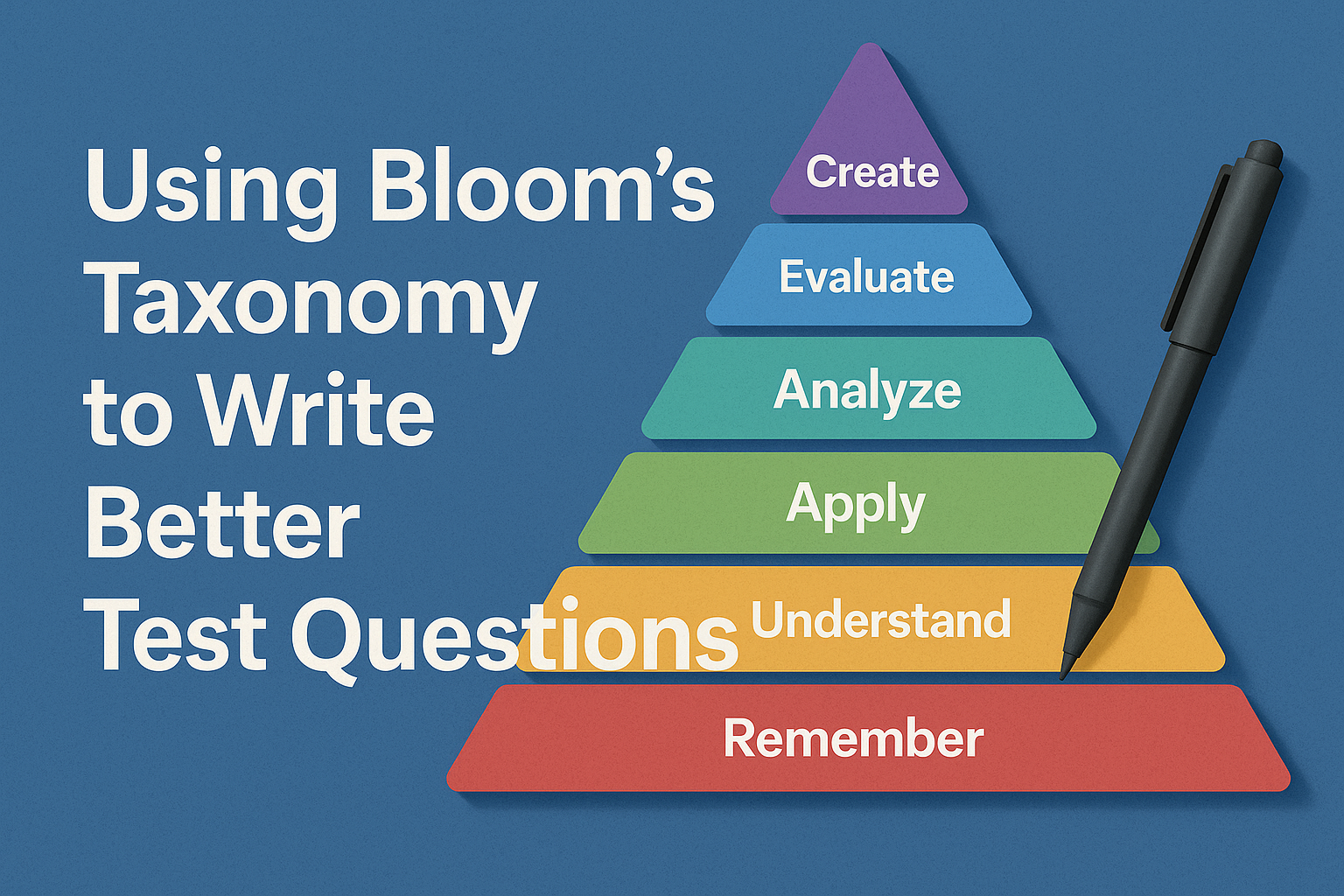
In 2001, a revised version of Bloom’s Taxonomy was released, which updated some of the terminology and reordered the levels to better reflect how people learn. The six levels in the revised version are: Remember, Understand, Apply, Analyze, Evaluate, and Create. This modern adaptation emphasizes the importance of higher-order thinking and creativity in the learning process, making it increasingly relevant to contemporary education.
The Importance of Well-Written Test Questions
Test questions do more than just evaluate student knowledge; they shape the learning experience. Well-designed Bloom’s Taxonomy test questions can motivate students to engage more deeply with the material, encouraging them to think critically and make connections between concepts. By contrasting this with poorly constructed questions, which often lead to surface-level thinking or confusion, it becomes apparent why educators should prioritize effective question design.
Moreover, using Bloom’s Taxonomy provides a consistent framework for teachers, enabling them to align assessments with learning objectives and standards. This alignment is crucial in ensuring that assessments accurately reflect the skills and knowledge students are expected to acquire. Ultimately, the goal is not just to assess what students know, but how well they can apply, analyze, and evaluate that knowledge in various contexts.
Crafting Questions at Each Level of Bloom’s Taxonomy
To effectively use Bloom’s Taxonomy in creating test questions, educators can follow specific guidelines tailored to each cognitive level. Here’s a closer look at how to formulate Bloom’s Taxonomy test questions for each stage:
1. Remembering
At this foundational level, questions should focus on recalling facts and basic concepts. These can include:
- Multiple choice questions asking for definitions or key terms.
- Short answer questions requesting specific information.
- True/false questions about essential facts.
For example, a question might ask, “What is the capital of France?” This question assesses the student’s ability to remember factual information.
2. Understanding
Next, questions at the understanding level should assess comprehension of the material. Here, educators can use: (See: Bloom's Taxonomy overview.)
- Questions that require students to explain concepts in their own words.
- Matching questions that pair terms with their definitions.
For example, asking students to summarize the main themes of a story prompts them to demonstrate their understanding without merely recalling facts.
3. Applying
At the application level, students need to use their knowledge in new situations. Questions might include:
- Scenario-based questions that require students to apply concepts to real-world situations.
- Problems that involve calculations or the use of formulas.
For instance, a question could ask, “How would you use the Pythagorean theorem to find the length of a side in a right triangle?” This requires students to apply learned concepts to solve a problem.
4. Analyzing
Analytical questions prompt students to break down information into parts and explore relationships. This can be achieved through:
- Questions that ask students to compare and contrast different ideas or theories.
- Case studies that require students to analyze a situation and identify causes and effects.
An example might be, “What are the differences between classical conditioning and operant conditioning in behaviorism?” This encourages students to dissect and evaluate differing psychological theories.
5. Evaluating
At the evaluation level, students should make judgments based on criteria. They can be assessed through: See also teaching critical thinking tips.
- Questions that ask students to defend a position on a controversial issue.
- Assignments that require critiques of theories or practices.
An example question could be, “Evaluate the effectiveness of social media as a tool for political activism. What are the strengths and weaknesses?” This encourages students to think critically about current events and form reasoned opinions.
6. Creating
Finally, the highest level of Bloom’s Taxonomy invites students to create new ideas or products. Questions at this level can involve:
- Projects where students design experiments or develop new theories.
- Creative assignments that require students to write a story or develop a marketing strategy.
A question example here might be, “Design a community service project that addresses a local issue. Explain your plan and how it will benefit the community.” This encourages innovation and practical problem-solving.
Aligning Test Questions with Learning Objectives
Creating effective Bloom’s Taxonomy test questions isn’t just about writing questions; it’s also essential to ensure that they align with the overall learning objectives of the course. This alignment helps reinforce the skills and knowledge that students are expected to acquire throughout the learning process. (See: U.S. Department of Education on Bloom's Taxonomy.)
To achieve this, educators should start by clearly defining their learning objectives. What do you want your students to know by the end of the unit? Once these objectives are established, educators can map their test questions to the applicable levels of Bloom’s Taxonomy. This practice guarantees that assessments reflect the complexity of thinking and learning you aim to cultivate.
Furthermore, aligning test questions with learning objectives not only aids in measuring student performance but also enhances instructional strategies. When teachers recognize which levels of cognitive skill students are struggling with, they can adjust their teaching methods accordingly to address those areas.
Current Relevance of Bloom’s Taxonomy in Education
As education evolves, so too does the application of Bloom’s Taxonomy. In a world increasingly focused on critical thinking, creativity, and problem-solving skills, this framework remains incredibly relevant. Schools are now placing greater emphasis on developing 21st-century skills, and Bloom’s Taxonomy serves as an excellent guide in this endeavor.
Moreover, technology has introduced new dimensions to assessment strategies. Online quizzes and testing platforms allow for a wider array of question types, making it easier for educators to create varied and engaging Bloom’s Taxonomy test questions. This technological integration not only enriches the assessment process but also aligns with the modern educational landscape that values interactive and adaptable learning experiences.
Practical Tips for Writing Better Test Questions
To fully leverage Bloom’s Taxonomy in writing test questions, consider the following tips:
- Use clear language: Avoid jargon or overly complex phrasing. Ensure your questions are straightforward and easily understood by students.
- Be specific: Vague questions lead to confusion. Make sure your questions are precise, specifying exactly what you are asking.
- Incorporate real-world scenarios: Whenever possible, relate questions to real-world situations or problems. This not only enhances engagement but also fosters critical thinking.
- Balance question types: Strive for a mix of question types across the different levels of Bloom’s Taxonomy. This variety helps assess a broader range of skills.
- Review and revise: Always review your questions for clarity and alignment with learning objectives. Don’t hesitate to revise based on feedback or testing outcomes.
By following these strategies, educators can create a more effective and meaningful assessment experience that encourages deeper learning and understanding. For more on this, see the silent threat of AI.
The Future of Assessment with Bloom’s Taxonomy
The landscape of education is continuously changing, with an increasing emphasis on personalized learning, technology integration, and competency-based education. As this evolution unfolds, Bloom’s Taxonomy will likely continue to play an integral role in developing effective assessment strategies. Its adaptable nature allows it to accommodate new teaching methodologies and emerging technologies.
As educators look to the future, they will need to remain conscious of the diverse needs of learners. This means that assessments must not only challenge students but also provide opportunities for growth and mastery of skills. By utilizing Bloom’s Taxonomy as a guiding framework, teachers can craft assessments that are not only effective but also enriching for students.
In summary, using Bloom’s Taxonomy to write better test questions offers educators a powerful tool for enhancing assessment quality. By understanding the hierarchy of cognitive skills and crafting questions that align with learning objectives, teachers can promote a deeper understanding of material and foster essential critical thinking skills in their students. As we move forward, the relevance of this framework will undoubtedly persist in shaping the future of education. (See: Harvard's resources on Bloom's Taxonomy.)
Examples of Bloom’s Taxonomy Test Questions by Subject
Understanding how to apply Bloom’s Taxonomy across various subjects can provide clarity and practical insight for educators. Here’s a breakdown of sample questions tailored to different subjects:
Mathematics
- Remembering: “What is the formula for the area of a circle?”
- Understanding: “Explain why the Pythagorean theorem works.”
- Applying: “If a circle has a radius of 3 cm, what is its area?”
- Analyzing: “Compare the slopes of two linear equations.”
- Evaluating: “Critique a method for solving quadratic equations.”
- Creating: “Design a new game that involves using basic geometry principles.”
Science
- Remembering: “What are the three states of matter?”
- Understanding: “Describe the process of photosynthesis in your own words.”
- Applying: “How would you apply Newton’s laws to explain why a bicycle moves?”
- Analyzing: “Analyze the impact of pollution on local ecosystems.”
- Evaluating: “Evaluate the effectiveness of renewable energy sources.”
- Creating: “Design an experiment to test the effects of temperature on enzyme activity.”
History
- Remembering: “When did World War II begin?”
- Understanding: “Summarize the causes of the American Civil War.”
- Applying: “How would you apply lessons from the past to current events?”
- Analyzing: “Analyze the differences between two historical movements.”
- Evaluating: “Evaluate the significance of the Civil Rights Movement.”
- Creating: “Create a timeline of major events during the Cold War.”
Frequently Asked Questions about Bloom’s Taxonomy Test Questions
What is the primary purpose of using Bloom’s Taxonomy in education?
The main purpose is to provide a structured framework that helps educators create assessments that not only evaluate knowledge but also encourage higher-order thinking skills.
How can I ensure my test questions align with Bloom’s Taxonomy?
Begin by clearly defining your learning objectives. Then, categorize your questions based on the cognitive levels of Bloom’s Taxonomy, ensuring a balance across all levels.
Can Bloom’s Taxonomy be applied to non-traditional subjects?
Absolutely! While it is often used in core subjects, Bloom’s Taxonomy can be applied across all disciplines, including arts, physical education, and vocational subjects, to foster critical thinking and creativity.
What are some common pitfalls to avoid when creating test questions using Bloom’s Taxonomy?
Common pitfalls include writing vague questions, overloading questions with multiple concepts, and not aligning questions with learning objectives. Staying clear and focused is key.
How can technology enhance the use of Bloom’s Taxonomy in assessments?
Technology allows for diverse question formats, interactive assessments, and immediate feedback, making it easier to implement Bloom’s Taxonomy principles in a dynamic learning environment.
“`
Trending Now
Frequently Asked Questions
What is Bloom's Taxonomy and why is it important?
Bloom's Taxonomy is a framework developed in the 1950s that categorizes cognitive skills into levels of complexity. It is important because it helps educators create effective test questions that assess not only factual recall but also promote higher-order thinking and deeper understanding among students.
How can Bloom's Taxonomy improve test questions?
By using Bloom's Taxonomy, educators can design test questions that encourage critical thinking and intellectual engagement. The taxonomy guides teachers in formulating questions that span from basic knowledge to complex analysis, ensuring a comprehensive assessment of student learning.
What are the six levels of Bloom's Taxonomy?
The six levels of Bloom's Taxonomy, in its revised version, are Remember, Understand, Apply, Analyze, Evaluate, and Create. This hierarchy helps educators structure assessments that foster higher-order thinking and creativity in students' learning processes.
Why are well-written test questions essential in education?
Well-written test questions are essential because they shape the learning experience and motivate students to engage deeply with the material. Effective questions drive critical thinking and help students make connections, while poorly constructed questions can lead to confusion and surface-level thinking.
How does Bloom's Taxonomy facilitate critical thinking?
Bloom's Taxonomy facilitates critical thinking by providing a structured approach for educators to design assessments that challenge students at various cognitive levels. This encourages learners to analyze, evaluate, and create, thus promoting a deeper understanding of the subject matter.
Have you experienced this yourself? We’d love to hear your story in the comments.



