

Learn what equivalent fractions are and how they’re taught at school. You’ll find examples of fractions equivalent to 8/12, 1/3, 5/6, and more.
What are equivalent fractions?
Some fractions can be turned into simpler ones. This is because it makes it easier to understand and read the fraction. These are known as equivalent fractions. You can always convert an equivalent fraction back to the original by multiplying the numerator and denominator by the identical number.
You wonder how’s that possible? Let’s look at the example below. The fractions 1/4 and 2/8 have different numerators and denominators. But, if you look at the bars, the same amount has been shaded overall – one-quarter of an amount.
This means that 1/4 and 2/8 are equivalent fractions as they show the exact amount
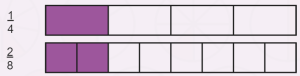
A fraction can have multiple equivalent ones. For example, 2/3 is a fraction equivalent to 8/12, 6/9, 4/6, and so on.
What you’ll find on this page
Now that we’ve established what equivalent fractions are let’s dive deeper and see what else children will learn. Read on to find out:
- examples of equivalent fractions;
- how to find equivalent fractions of a given fraction;
- how to order fractions with different denominators;
- a guide to what your child will learn about equivalent fractions each year throughout KS2;
- supporting resources to help you teach in the classroom or at home;
- some example problems which children can try solving.
When it comes to this page, you’ll find a mixture of questions being answered. Questions such as what equivalent fractions are, how to do an equivalent fraction, or how to find equivalent fractions can all be answered within this teaching wiki.
You’ll also be able to find resources that help with any classroom or living room being full of fractions being displayed. Fun activities such as challenge cards can bring exciting and engaging content to your teaching world, and worksheets can be distributed across three difficulty levels – lower, middle, and higher.
You’ll find a great example of teacher-made resources available for the ordinary classroom or living room on this page. In addition, you’ll be able to dive deep into what teachers across the country feel about equivalent fractions’ meaning and needs in any learning environment. This is why this teaching resource/wiki is so essential.
Examples of Equivalent Fractions
Children will often come across some commonly used fractions while solving maths problems. This is because the curriculum requires them to be able to write the equivalent fractions of 1/2, 1/4, and 3/4, for example. But these are not all.
Let’s have a look at examples of some equivalent fractions.
Fractions equivalent to 1/2: 2/4, 3/6, 4/8, 5/10 and so on …
Fractions equivalent to 1/3: 2/6, 3/9, 4/12, 5/15 and so on …
Fractions equivalent to 2/3: 4/6, 6/9, 8/12, 10/15 and so on …
Fractions equivalent to 1/4: 2/8, 3/12, 4/16, 5/20 and so on …
Fractions equivalent to 2/4: 4/8, 6/12, 8/16, 10/20 and so on …
Fractions equivalent to 3/4: 6/8, 9/12, 12/16, 15/20 and so on …
Fractions equivalent to 1/5: 2/10, 3/15, 4/20, 5/25 and so on …
Fractions equivalent to 2/5: 4/10, 6/15, 8/20, 10/25 and so on …
Of course, learning these by heart would be incredibly tricky and pointless. Equivalent fractions calculators also exist, but pupils won’t use them as part of the learning process.
Instead, it’s better to learn the method of finding equivalent fractions. By doing this, children can find the equal values of any given fractions. Let’s have a look.
How to Find Equivalent Fractions of a Given Fraction
When given a fraction, the easiest way of finding its equivalent values is by multiplying the numerator and denominator by the same number.
For example, let’s find three equivalent fractions to 2/3.
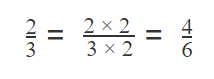
First, try multiplying the numerator and denominator by the number two – see the equations below. We can say that 4/6 is an equivalent fraction to 2/3.
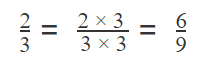
Now, let’s try multiplying the numerator and denominator of 2/3 by the number three this time. Again, we can say that 6/9 is an equivalent fraction to 2/3
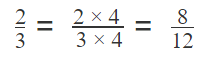
Finally, let’s multiply the fraction’s numerator and denominator by four. You’ll find that 2/3 is one of the fractions equivalent to 8/12.
After looking at these examples, there are a few essential things to remember:
- When finding the equivalent fractions, it’s essential to multiply the numerator and denominator by the same number. Multiplying only one of them won’t give you the correct answer.
- Fractions have multiple numbers of equivalent fractions. As long as you multiply the numerator and denominator by a whole number, you’d continue to get more and more equivalent fractions
- We’ve found three equivalent fractions equivalent to 2/3. But you can say that 2/3, 4/6, and 6/9 are also fractions equivalent to 8/12. So, the equivalence goes both ways.
How to Order Fractions with Different Denominators
In primary school, pupils will learn to order fractions with different denominators. And how does this link to equivalent fractions?
To order fractions with different denominators, you need to change them to be the same. And to do this, you must multiply the numerator and the denominator by the same number. Sounds familiar? Exactly, children do this when finding equivalent fractions.
So, pupils will use their knowledge of equivalent fractions to order fractions with different denominators. Let’s look at an example and the step-by-step guide of how that’s done.
Example: Let’s put in order the fractions below.
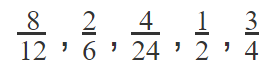
- The first thing you need to do is change all the denominators to be the same. This means you need to find a common denominator. In this case, 24 is the lowest common denominator.
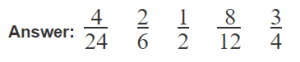
- Then, you need to multiply all fractions so that their denominator is 24. For 8/12, you need to multiply the numerator and denominator by two, for 2/6 – by four, 1/2 – by 12, and 3/4 by six. 4/24 stays the same, as its denominator is already 24.

- All fractions have the same denominator, so that you can put them in order from the smallest to the largest. Remember, you need to write the original fractions in your answer. See below.
When will my child learn about equivalent fractions?
Children will initially start learning about the concept of equivalence in year 3. They’ll first use diagrams to recognize and show equivalent fractions with small denominators.
Using pictorial representations such as the ones below is an excellent way of introducing young learners to the concept and showing them that equivalent fractions represent the same amount.
In year 4, pupils will start learning about decimals. This means they’ll know, for example, that 0.5 is equivalent to 1/2. By the end of year 4, the maths curriculum requires children to be able to:
- Recognize and write decimal equivalents of any number of tenths or hundredths.
- Recognize and write decimal equivalents to 1/2, 3/4, and 1/4.
- Use diagrams to recognize and show families of common equivalent fractions.
Using diagrams in LKS2 will help children visualize and learn about equivalent fractions more practically. So they can understand the why and how rather than just learning the theory.
When pupils get to year 5, they already have the essential knowledge, so that’s when they’ll learn to find equivalent fractions without using diagrams. Throughout the year, children will practice the following:
- Solving problems involves knowing decimal and percentage equivalents of 1/2, 1/4, 1/5, 2/5, and 4/5.
- Solving problems involving fractions with a denominator of a multiple of 10 or 25 and relating these fractions to their decimal equivalents.
In year 6, pupils will expand their knowledge of equivalent fractions further. That’s when they’ll learn to simplify fractions – reducing the numerator and denominator as much as possible. They’ll know that’s a way of finding equivalent fractions.
By the end of KS2, they’ll also use the concept of equivalent fractions to add and subtract fractions with different denominators and mixed numbers. That’s because pupils would already know how to convert the fractions, so they all have the same denominator.
Why is it vital to have a good understanding of equivalent fractions?
The knowledge of equivalent fractions is applied when completing various maths calculations. Here are just a few instances in which children will find a practical application of their equivalent fractions knowledge.
As mentioned above, children will need to understand the concept of equivalence to add and subtract fractions with unlike denominators. That’s important because they’ll be tested to complete these calculations at school.
Another reason why having a good understanding of equivalent fractions is vital is because pupils will often need to simplify fractions before writing the final answer to problems. If children don’t understand equivalence, they’ll struggle to understand how and why fractions are simplified.
Knowing how to find equivalent fractions is also needed when comparing and ordering fractions. That’s because they’ll often be asked to compare fractions with different denominators. To solve the problem, they’ll need to ensure the denominators are the same, and understanding equivalent fractions is the key to that.