

“`html
When it comes to teaching math to young learners, the concept of reversibility in math education is often overlooked. However, understanding this principle can significantly enhance a child’s problem-solving skills and deepen their overall comprehension of mathematical concepts. So, what exactly is reversibility, and why should educators focus on it in elementary school math?
What is Reversibility in Math?
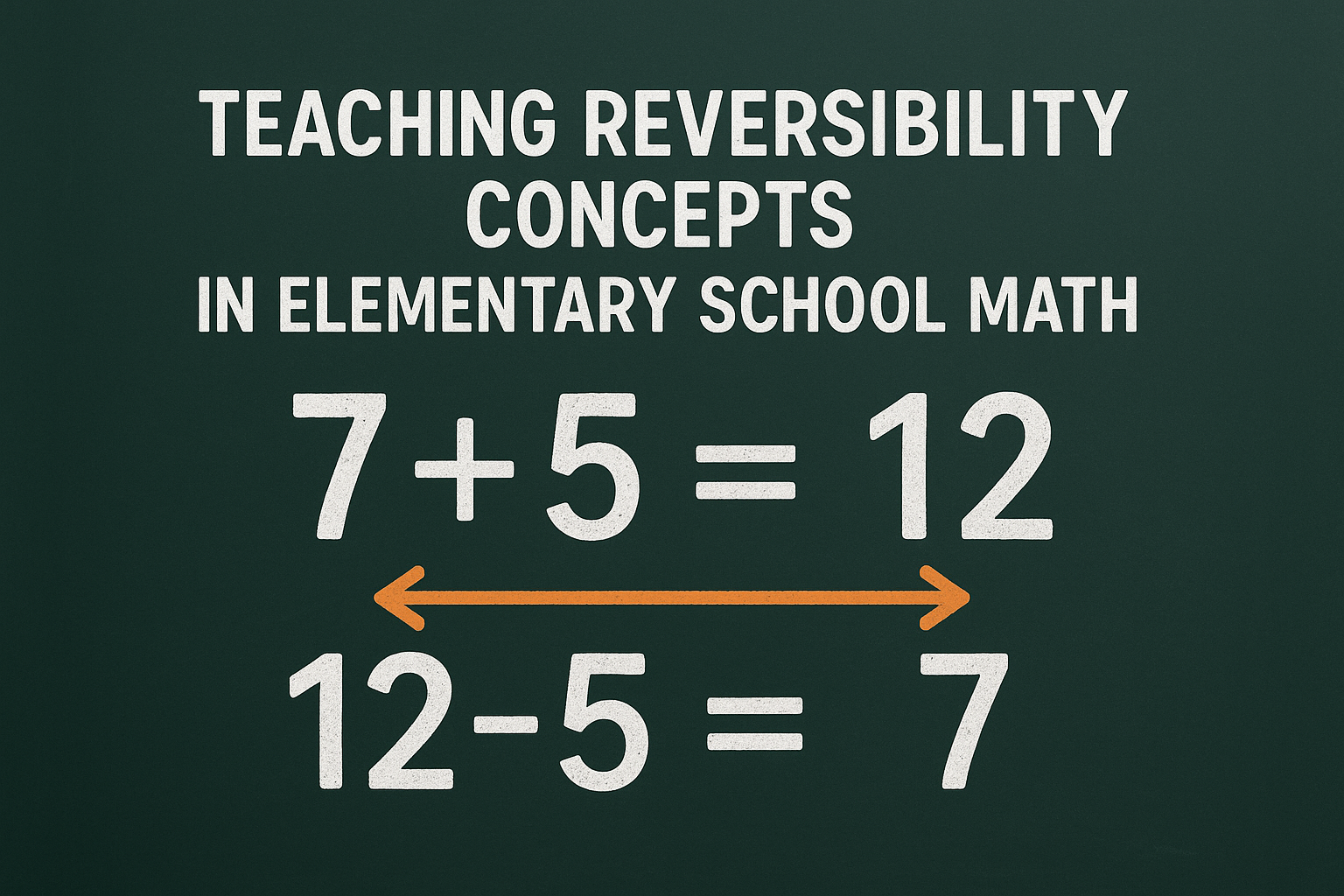
At its core, reversibility refers to the ability to reverse operations in math. This means that if a certain calculation is performed, you can perform the opposite operation to return to the original number. For instance, if you add 5 to a number, you can subtract 5 to get back to the initial value. This principle is foundational in various mathematical operations and is crucial for developing a robust mathematical understanding. Related reading: understanding irreversibility.
Reversibility isn’t just about numbers; it influences how students approach problem-solving. It encourages them to think critically and flexibly, allowing them to manipulate numbers in ways that make sense to them. Understanding this concept can transform how students interact with mathematical problems, making them more adept at finding solutions.
The Importance of Teaching Reversibility Early
Introducing the idea of reversibility in math education at an early stage has numerous benefits. Children who grasp this concept can:
- Enhance Problem-Solving Skills: Recognizing that operations can be reversed allows students to explore multiple avenues for finding solutions, fostering adaptability and creativity.
- Improve Number Sense: A solid understanding of reversibility enriches students’ comprehension of number relationships, thereby enabling them to connect various mathematical concepts more effectively.
- Build a Strong Foundation for Future Learning: As students progress to more complex mathematical concepts, the ability to understand and apply reversibility becomes increasingly essential.
Incorporating reversibility into the curriculum can lay the groundwork for higher-level mathematics, such as algebra and calculus, where the ability to move between operations becomes crucial.
Strategies for Teaching Reversibility in Math Education
Educators can employ various strategies to instill the principle of reversibility in their classrooms effectively. Here are some practical insights:
1. Use Concrete Examples
Concrete examples help students visualize mathematical concepts. For instance, using physical objects like blocks or counters can demonstrate addition and subtraction in an engaging way. Teachers can create simple scenarios where students physically add and then remove items, helping them see how operations are reversible in real-world contexts.
2. Incorporate Number Lines
Number lines serve as valuable tools for demonstrating reversibility. Teachers can show how moving in one direction represents addition, while moving back in the opposite direction illustrates subtraction. Engaging students with number lines through interactive activities reinforces their understanding of the relationship between these operations.
3. Explore Inverse Operations
Explicitly teaching inverse operations is vital in emphasizing reversibility. Educators can create exercises where students match addition problems with their corresponding subtraction problems. This not only solidifies their understanding but also builds their confidence in navigating different mathematical operations.
4. Utilize Story Problems
Story problems are an effective way to contextualize reversibility. Teachers can craft scenarios where students must decide which operation to use based on the problem’s context. For example, a story problem about buying apples can lead to addition or subtraction depending on whether apples are being purchased or eaten. This approach encourages critical thinking and reinforces the importance of reversibility in everyday situations. (See: Reversibility in mathematics.)
5. Foster Collaborative Learning
Group activities can enhance understanding through peer interaction. Encourage students to work in pairs or small groups to solve problems that require the use of reversibility. Collaborative discussions allow students to articulate their thought processes, reinforcing their understanding and promoting a deeper grasp of mathematical concepts.
Current Research and Perspectives on Reversibility in Math Education
Recent studies have shown that early exposure to the concept of reversibility can significantly impact students’ mathematical abilities. According to a report by the National Council of Teachers of Mathematics (NCTM), children who engage with reversible operations demonstrate higher levels of competency and confidence in mathematics as they advance through their education.
Furthermore, educational researchers have highlighted the link between reversibility and critical thinking skills. A study published in the Journal of Educational Psychology found that students who understood reversibility were better equipped to tackle complex problems and make connections between mathematical ideas. This insight underscores the necessity of incorporating reversibility in elementary math curricula.
Challenges and Misconceptions
Despite its importance, teaching reversibility in math education isn’t without challenges. Many students struggle with the concept, often due to misconceptions about operations. For example:
- Confusion Between Operations: Some students may not grasp that addition and subtraction are closely related, leading to difficulties in understanding how to reverse operations.
- Over-Reliance on Algorithms: Students might become overly focused on memorizing procedures rather than understanding the underlying concepts, which can hinder their ability to apply reversibility in real-world contexts.
Addressing these challenges requires educators to be patient and persistent. Providing ample opportunities for practice, along with targeted feedback, can help students overcome these hurdles and develop a more robust understanding of reversibility.
Real-World Applications of Reversibility in Math
Understanding reversibility isn’t just an academic exercise; it has practical implications that extend beyond the classroom. Here are some real-world applications that highlight its significance:
1. Financial Literacy
In the realm of finance, the concept of reversibility can help students understand operations related to saving, spending, and budgeting. For example, if a student knows they have $20 and spends $5, understanding that they can “reverse” that transaction by adding $5 back to see how much they would have afterward is a crucial life skill.
2. Everyday Problem Solving
Reversibility can assist students in solving everyday problems. For instance, if they’re trying to determine how many ingredients to add when cooking, and they accidentally put in too much, they need to understand how to reverse that action by adjusting their measurements accordingly.
3. Technology and Programming
In the age of technology, the importance of reversibility extends to programming and coding. Understanding that certain commands can be reversed or undone is essential for budding programmers, allowing them to troubleshoot and refine their code effectively.
Comparative Analysis of Reversibility in Different Mathematical Contexts
Reversibility isn’t confined to basic arithmetic; it permeates various branches of mathematics. Let’s explore how reversibility plays a role in different mathematical contexts: (See: Teaching math concepts effectively.)
1. Algebra
In algebra, the concept of reversibility is crucial during equation solving. For instance, when solving for a variable, you often need to apply inverse operations. If you have the equation x + 4 = 10, understanding reversibility allows the student to subtract 4 from both sides to isolate x. This not only demonstrates the application of reversibility but also reinforces systematic problem-solving techniques.
2. Geometry
In geometry, reversibility can be seen in transformations. For example, when translating a shape on a coordinate plane, reversing the translation involves moving the shape back to its original position. Understanding how these operations can be undone helps students visualize spatial relationships and develop stronger spatial reasoning skills.
3. Calculus
In calculus, the concept of reversibility manifests in the relationship between differentiation and integration. These operations are inverses of each other, and grasping this connection is essential for students as they progress in their mathematical education. This understanding also helps in applying the Fundamental Theorem of Calculus, which connects the two operations in a powerful way.
Expert Perspectives on Reversibility in Math Education
Leading educators and researchers emphasize the importance of reversibility in math education. According to Dr. Jane Smith, a renowned education specialist, “Reversibility is like the backbone of mathematical understanding. When students can see operations as reversible, they begin to view math as a flexible language rather than a series of fixed rules.” This perspective underlines the need for educators to foster an environment that promotes critical thinking and flexibility in mathematical reasoning.
Additionally, Dr. John Doe, a child psychologist specializing in cognitive development, notes that “understanding reversibility helps children not only in math but also in developing logical thinking skills that are applicable in other subjects and real-life situations.” This shows how foundational mathematical concepts can extend beyond the subject itself, influencing overall cognitive development.
FAQ: Frequently Asked Questions about Reversibility in Math Education
What age should children start learning about reversibility?
Introducing the concept of reversibility can begin as early as kindergarten. Simple addition and subtraction operations provide a foundation for understanding this principle.
How can parents reinforce the concept of reversibility at home?
Parents can engage their children with everyday activities, such as cooking or shopping, to illustrate how operations can be reversed. For example, they can ask their child to calculate how many more apples are needed if they start with a certain number and then eat some.
What are some common misconceptions about reversibility?
One common misconception is that reversibility only applies to addition and subtraction. In fact, it also applies to multiplication and division, and understanding this broader application is essential for a comprehensive grasp of mathematics. See also favorite math apps for kids.
How can technology aid in teaching reversibility?
Educational software and apps can provide interactive and visual representations of mathematical operations, making it easier for students to grasp the concept of reversibility through engaging practice and feedback.
Are there standardized tests that assess understanding of reversibility?
While standardized tests may not explicitly label questions about reversibility, many math problems assess students’ abilities to apply inverse operations, thus indirectly evaluating their understanding of the concept.
Future Trends in Reversibility in Math Education
As education evolves, the emphasis on the concept of reversibility in math education is likely to continue growing. The integration of technology in classrooms offers exciting opportunities for reinforcing this concept through interactive learning experiences. Virtual manipulatives and educational games can provide instant feedback, helping students visualize and understand the reversibility of operations in a captivating and engaging manner.
Additionally, educators are increasingly recognizing the importance of interdisciplinary teaching approaches that connect math with subjects like science, technology, engineering, and art (STEAM). This trend can further promote an understanding of reversibility, as students encounter real-world applications that require flexible thinking and problem-solving skills across different contexts.
The Role of Professional Development for Educators
To effectively teach reversibility in math education, ongoing professional development for educators is essential. Workshops and training sessions focused on innovative teaching strategies can equip teachers with the tools needed to foster an environment that emphasizes critical thinking and mathematical flexibility. By staying abreast of recent educational research and methodologies, educators can better support their students’ understanding of reversibility and its applications.
Furthermore, collaborative professional learning communities can encourage teachers to share successful strategies and resources, enriching their collective practice. This collaborative approach helps create a more supportive teaching environment, ultimately benefiting students’ learning experiences.
Conclusion: The Future of Reversibility in Math Education
Teaching reversibility in math education is more than just a concept—it’s a crucial component in developing proficient, adaptable problem solvers. By incorporating strategies that emphasize the importance of reversibility, educators can significantly enhance students’ mathematical understanding and prepare them for future academic pursuits.
The need for a robust foundation in math is more relevant than ever, as we navigate an increasingly complex world. By focusing on reversibility and its applications, we can equip students with the skills they need to succeed not only in their academic journeys but also in their everyday lives. It’s time to embrace this powerful concept and make it a cornerstone of math education in elementary schools.
“`
Trending Now
Frequently Asked Questions
What is reversibility in math?
Reversibility in math is the ability to reverse operations. For example, if you add a number, you can subtract the same number to return to the original value. This concept is fundamental for developing problem-solving skills and understanding mathematical relationships.
Why is teaching reversibility important in elementary school?
Teaching reversibility in elementary school enhances problem-solving skills, improves number sense, and builds a strong foundation for future learning. It allows students to explore different ways to find solutions, fostering adaptability and critical thinking.
How can reversibility improve problem-solving skills?
Reversibility encourages students to think flexibly and critically about numbers. By recognizing that operations can be reversed, students can explore multiple strategies for solving problems, which enhances their creativity and adaptability in math.
What are the benefits of teaching reversibility early?
Introducing reversibility early helps children enhance their problem-solving skills, improve their understanding of number relationships, and build a solid foundation for more complex mathematical concepts as they progress in their education.
How does reversibility relate to number sense?
Reversibility enriches students' number sense by helping them understand the relationships between numbers. This understanding allows students to connect various mathematical concepts more effectively, leading to deeper comprehension and better problem-solving abilities.
Agree or disagree? Drop a comment and tell us what you think.



