
“`html
Every parent or educator has experienced that moment of cognitive growth when a child suddenly grasps a new concept. One of those pivotal milestones is the development of children conservation skills. This ability, which refers to a child’s understanding that certain properties of objects remain consistent despite changes in their form or appearance, plays a vital role in cognitive development. Knowing when these skills emerge can help foster a supportive learning environment.
The Foundation: What Are Conservation Skills?
Conservation skills can be defined as the understanding that quantity, volume, and number do not change even when their shape or appearance does. For example, consider a simple scenario where a child sees two identical balls of clay. If one ball is flattened into a pancake shape, a child lacking conservation skills may believe the flat piece has less clay than the round one. Children conservation skills allow children to recognize that both shapes still contain the same amount of clay.
This concept is rooted in Jean Piaget’s theory of cognitive development, specifically in the concrete operational stage, which typically occurs between the ages of 7 and 11. During this stage, children begin to think logically about concrete events and develop a better understanding of the world around them.
The Developmental Timeline of Conservation Skills
Understanding when children develop conservation skills is essential for parents and educators. Piaget identified several stages of development, and conservation skills emerge at various points in those stages. Let’s break down this timeline:
1. Sensory-Motor Stage (Birth to 2 years)
During the sensory-motor stage, infants learn about the world through their senses and actions. At this age, children are starting to develop basic motor skills and can engage with their environment, but they lack the cognitive ability to understand conservation. They see the world in a very immediate and concrete manner.
2. Pre-Operational Stage (2 to 7 years)
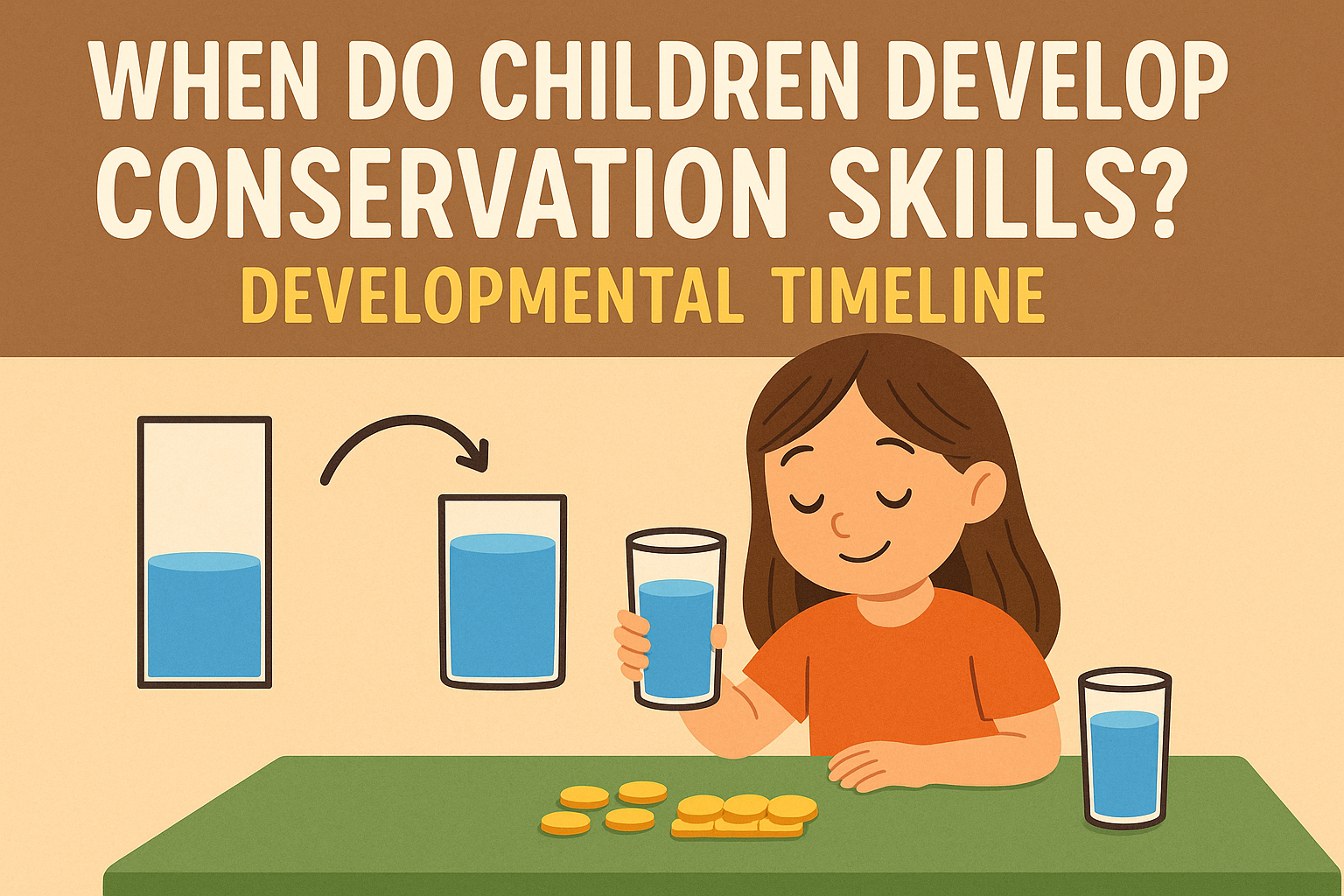
The pre-operational stage is characterized by symbolic play and egocentric thinking. Children often struggle with understanding the concept of conservation during this time. For example, they may think that pouring water from a short, wide glass into a tall, narrow one changes the amount of water, demonstrating a lack of conservation skills.
Between ages 4 and 6, children begin to develop some early forms of conservation skills, particularly in terms of number and length. For example, they may start to understand that if two rows of objects are equal in number, spreading one row apart doesn’t change the total amount, although this understanding is often shaky.
3. Concrete Operational Stage (7 to 11 years)
By the time children reach the concrete operational stage, they begin to master conservation skills more consistently. This is when they can understand that altering an object’s shape doesn’t change its quantity. For example, they can reliably state that a flattened ball of clay and a rounded one still represent the same amount of clay. Commonly, children also grasp conservation of volume (e.g., liquid in different-shaped containers) and mass (e.g., cutting a piece of bread in half). (See: Understanding conservation in psychology.)
Interestingly, Piaget indicated that the mastery of these skills varies slightly among children. While some may grasp the concept earlier, others may need additional time and support. Thus, cognitive abilities are not a race, but rather a journey.
4. Formal Operational Stage (12 years and up)
In the formal operational stage, adolescents and older children develop the ability to think abstractly and systematically. They can apply conservation principles to hypothetical and abstract situations. For example, they might engage in discussions about theoretical conservation in mathematical problems or engage in scientific reasoning that involves conservation concepts.
While conservation skills are firmly established by this stage, the foundational understanding is built during the earlier stages. Each of these stages is significant, and the skills learned will be critical in more advanced academic and real-world settings.
Factors Influencing the Development of Conservation Skills
While the developmental timeline provides a general framework, several factors can influence the acquisition of children conservation skills. Understanding these can help parents and educators better support children in their learning:
- Environment: Children who grow up in stimulating environments tend to develop cognitive skills at a faster rate. Activities that promote exploration, such as play-based learning and hands-on experiences, can significantly impact conservation skills.
- Educational Approaches: The methods teachers use can either hinder or support the development of these skills. Using manipulatives or engaging children in group activities often yields better results in teaching conservation concepts.
- Language Development: Language skills play a crucial role in cognitive development. Children with a rich vocabulary and strong communication skills tend to have better success in understanding conservation principles.
- Individual Differences: Each child has a unique cognitive profile. Factors such as temperament, personality, and personal interests can also play a role in how they grasp these concepts.
Practical Strategies to Foster Conservation Skills
Parents and educators can adopt various strategies to nurture children conservation skills. Here are some effective methods:
1. Use Concrete Manipulatives
Hands-on experiences with physical objects are invaluable. Use items like blocks, playdough, or liquid measuring cups to illustrate conservation concepts. For example, you can use two identical cups of water and then pour one into a taller, thinner cup, prompting children to discuss whether the amount has changed.
2. Incorporate Play-Based Learning
Children learn best when they are engaged and having fun. Incorporate games and activities that require problem-solving and critical thinking. Scavenger hunts, sorting games, and interactive storytelling can help reinforce these skills.
3. Encourage Open Dialogue
Ask open-ended questions that compel children to explain their reasoning. For instance, “Why do you think there is more juice in this tall glass than in the short one?” This encourages a deeper understanding as they articulate their thought processes.
4. Provide Repetitive Experiences
Repetition helps solidify learning. Repeatedly exposing children to conservation tasks in different contexts can help strengthen their understanding. For example, you can have children measure various liquids in different containers multiple times.
The Importance of Conservation Skills in Everyday Life
Why should we care about children conservation skills? The significance of these skills stretches beyond academic achievement; they are fundamental to everyday decision-making, problem-solving, and logical reasoning. Mastery of conservation skills can significantly influence a child’s mathematical ability, helping them understand concepts of addition, subtraction, fractions, and geometry. (See: CDC on child development milestones.)
Moreover, the principles of conservation extend into real-world applications. For instance, understanding the relationship between shape and volume can aid children in the kitchen while cooking, while recognizing the constancy of number can be beneficial when budgeting or planning.
Current Relevance and Future Implications
As we move into an increasingly complex world, fostering children conservation skills may be more critical than ever. The cognitive skills developed through understanding conservation can empower children to tackle real-world challenges. The rise of technology demands analytical thinking and problem-solving abilities, both of which are strengthened through a solid foundation in conservation principles.
Moreover, the growing emphasis on STEM (Science, Technology, Engineering, and Mathematics) in education highlights the importance of developing strong foundational cognitive skills from a young age. As educators and parents, recognizing the developmental timeline for conservation skills is essential in preparing the next generation for future challenges.
Real-World Applications of Conservation Skills
Let’s explore how children conservation skills play out in practical, everyday scenarios. These skills enable children to navigate their daily lives with greater confidence and reasoning. For instance, while shopping for groceries, children can use their understanding of quantity when comparing prices, understanding that a larger container may not always provide a better value than multiple smaller containers. They learn to think critically and evaluate options based on their understanding of conservation.
Furthermore, in science education, conservation skills are crucial. Children engaging in experiments learn to measure and compare substances, allowing them to grasp concepts like density and volume. Recognizing that changing the shape or size of an object doesn’t affect its mass or volume helps them understand scientific principles in a more profound way. This foundational knowledge becomes a stepping stone toward more complex scientific ideas in later education.
Expert Insights on Fostering Conservation Skills
Many child development experts emphasize the importance of early education in fostering children conservation skills. Dr. Linda Smith, a prominent developmental psychologist, suggests that hands-on learning experiences are invaluable during the early years. “Children are naturally curious,” she states. “When we engage them in activities that require them to manipulate and experiment, we foster not just conservation skills, but a love for learning and discovery.”
Experts encourage caregivers to cultivate environments that promote inquiry-based learning, where children feel empowered to ask questions and seek answers. This proactive approach not only boosts conservation skills but also nurtures children’s overall cognitive abilities.
FAQs About Children Conservation Skills
1. At what age do children typically start to understand conservation skills?
Children generally begin to develop basic conservation skills between the ages of 4 and 7, with a more robust understanding emerging during the concrete operational stage (7 to 11 years).
2. How can I tell if my child has developed conservation skills?
Look for signs such as their ability to accurately compare quantities, understand that changing the shape of objects does not affect their amount, and make reasoned judgments about physical properties.
3. What activities can help enhance my child’s conservation skills?
Activities such as sorting games, measuring liquids, and engaging in constructive play with building blocks all help develop conservation skills. These experiences allow children to see and manipulate different objects and learn through exploration.
4. Can conservation skills be taught or improved later in life?
Yes, while foundational skills are developed during early childhood, older children and even adults can improve their understanding of conservation through targeted educational activities and real-world applications.
Encouraging Lifelong Learning Through Conservation Skills
In a world that continually evolves, equipping children with children conservation skills lays the groundwork for future education and adaptability. These skills not only support academic pursuits but also encourage independent thinking and problem-solving abilities that will be invaluable throughout their lives. By focusing on fostering these skills, parents and educators can ensure that children are well-prepared to face various challenges in a rapidly changing environment.
In summary, understanding when and how children develop conservation skills can shape the way we engage with young learners. By providing a supportive environment filled with opportunities for exploration and reasoning, we can help nurture their cognitive growth and equip them with the necessary skills to thrive in a complex world. After all, these early experiences lay the groundwork for their lifelong learning journey.
“`
Trending Now
What did we miss? Let us know in the comments and join the conversation.