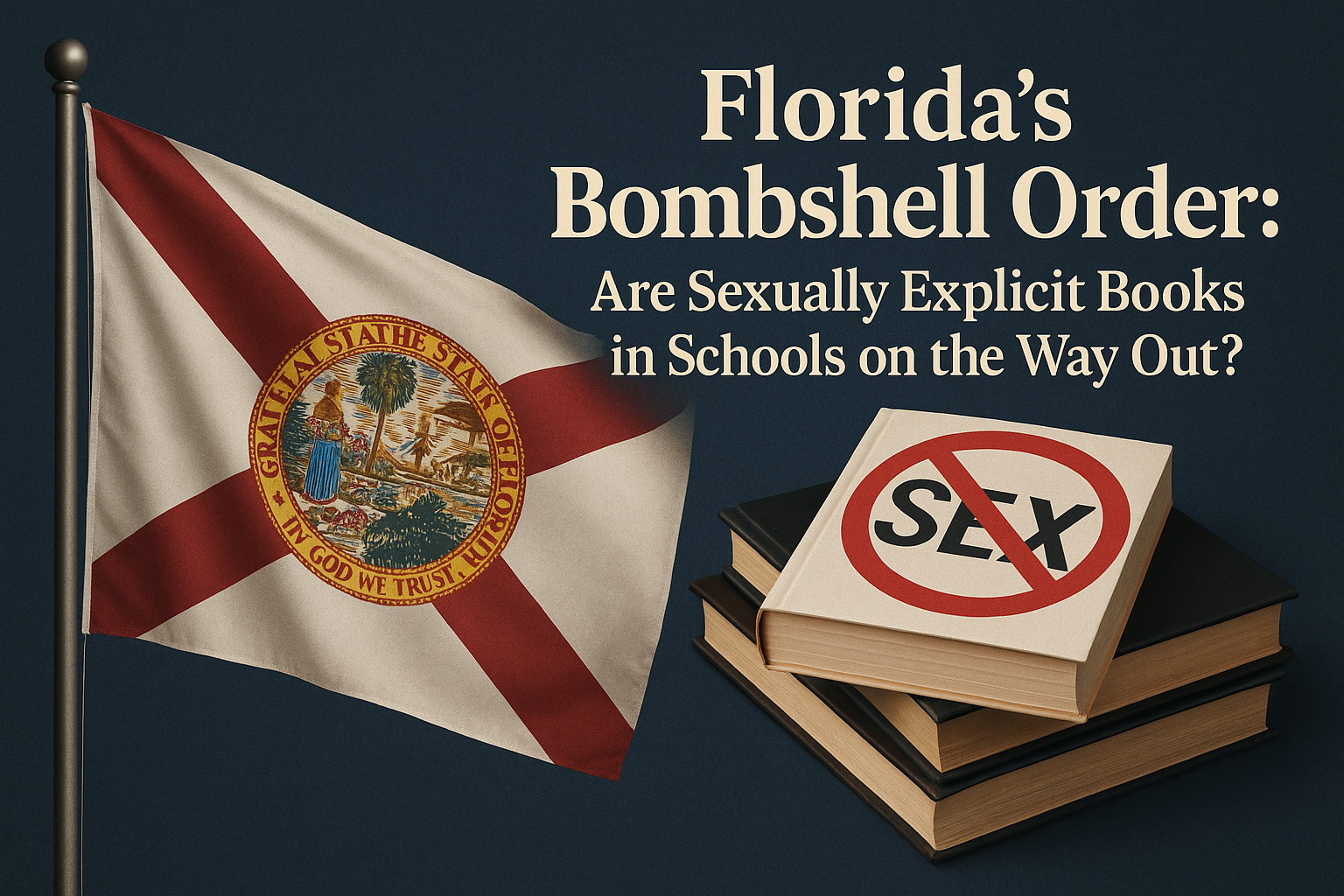

The battle over what books belong in school libraries and classrooms has reached a fever pitch in Florida, with Education Commissioner Henry Mack dropping a seven-page directive that’s shaking up districts statewide. This isn’t just another guideline; it’s a clear, unequivocal mandate telling superintendents and charter school leaders to get tough on sexually explicit books in schools, or face some serious consequences. We’re talking about a significant shift from a reactive approach to a proactive one, demanding continuous auditing and removal of materials that cross the line, even before a single parent complains. It’s a move that’s sparking intense debate, raising questions about censorship, parental involvement, and the very autonomy of school librarians.
Mack’s memo, issued to every corner of Florida’s education system, makes it abundantly clear: the days of waiting for a complaint to review a questionable book are over. He’s calling for a systemic overhaul, a constant vigilance to ensure that instructional materials, whether on library shelves or within classroom curricula, are free from content deemed sexually explicit. And for districts dragging their feet? The threat of “corrective measures” looms large, a veiled but potent warning that could impact state funding – a prospect no district wants to contemplate. This isn’t just about a few controversial titles; it’s about a fundamental redefinition of what constitutes appropriate educational material for Florida’s students.
The Commissioner’s Stance: “Enough Is Enough”
Commissioner Mack didn’t mince words in his directive. He essentially declared that “reactive review” – waiting for a parent to flag a book – is simply insufficient. This isn’t a minor tweak; it’s a complete pivot from the previous, often complaint-driven, system. The impetus for this forceful stance appears to stem from specific, highly publicized incidents, like a recent Hillsborough County school board meeting. There, parents took to the podium, reading aloud passages from books they found deeply concerning. Titles such as “Beyond Magenta: Transgender Teens Speak Out,” “A Court of Wings and Ruin,” and Toni Morrison’s “The Bluest Eye” were highlighted as examples of materials they considered inappropriate for school-aged children.
The Florida Department of Education quickly amplified Mack’s message across its social media channels, leaving no room for misinterpretation. Their post, emblazoned with capital letters, stated, “SEXUALLY EXPLICIT and INAPPROPRIATE content has NO PLACE in Florida schools. ENOUGH IS ENOUGH.” That sentiment, stark and uncompromising, encapsulates the administration’s current posture. It reflects a growing frustration among certain parent groups and policymakers who believe that school libraries have become repositories for content far beyond the scope of age-appropriate or academically relevant material. This isn’t just about a few isolated incidents; it’s about a broader philosophical disagreement over what constitutes educational enrichment versus what some perceive as an introduction to mature themes that are better discussed at home.
The Shift from Reactive to Proactive Auditing
Historically, the process for challenging library books in schools often began with a parental complaint. A parent would identify a book they found objectionable, submit a formal request for review, and then a committee – often comprising educators, librarians, and parents – would evaluate the material against specific criteria. This method, while democratic in principle, could be slow and often led to public battles over individual titles. What Commissioner Mack’s memo signals is a departure from this reactive model. He’s demanding continuous, systemic auditing. This means that school districts can no longer simply wait for a problem to arise; they must actively seek out and remove materials that fall under the “sexually explicit” umbrella.
Think about the logistical implications of this. It requires librarians and instructional materials specialists to undertake a constant, ongoing review of their entire collections. This isn’t just about new acquisitions; it’s about every book currently on the shelves. This proactive approach aims to preempt complaints by ensuring that problematic materials are identified and removed before they ever become points of contention. While proponents argue this protects children and upholds community standards, critics contend it places an immense burden on already strapped school staff and could lead to an overly cautious, even censorious, environment. The challenge for districts now lies in defining “sexually explicit” in a consistent, defensible way that aligns with the commissioner’s directive without inadvertently sweeping up valuable, albeit challenging, literature. (See: Associated Press news on education.)
Defining “Sexually Explicit”: The Contentious Core
The very heart of this controversy, and perhaps its most challenging aspect, lies in the definition of “sexually explicit.” While the phrase itself might seem straightforward, its application in the context of school libraries and classrooms is anything but. What one parent or educator considers explicit, another might view as a critical piece of literature exploring complex human experiences. For instance, a book like “The Bluest Eye” by Toni Morrison, mentioned in the Hillsborough County meeting, is a Pulitzer Prize-winning novel that deals with racism, beauty standards, and childhood trauma, including sexual abuse. While its themes are undeniably mature and challenging, many educators argue its literary merit and its exploration of difficult social issues make it a vital text for older students.
The memo doesn’t offer a granular, exhaustive list of what constitutes “sexually explicit” content, leaving districts to interpret and apply the directive. This ambiguity is precisely where the friction arises. Does it refer solely to graphic depictions of sexual acts? Or does it extend to discussions of gender identity, sexual orientation, or even metaphorical representations of sexual themes? Without clear, universally accepted criteria, districts risk either over-censoring, removing books that offer valuable perspectives, or under-complying, leaving themselves vulnerable to state sanctions. This lack of precise definition puts librarians and review committees in an incredibly difficult position, forcing them to make subjective judgments with significant repercussions.
Navigating Literary Merit vs. Parental Concerns
The tension between literary merit and parental concerns isn’t new; it’s a perennial debate in education. However, the current directive intensifies this conflict, pushing it squarely into the spotlight regarding sexually explicit books in schools. On one side, educators and librarians often champion intellectual freedom and the importance of diverse perspectives. They argue that literature can be a powerful tool for empathy, understanding different lived experiences, and grappling with complex social issues. Removing books that address challenging topics, even those with mature content, can be seen as sanitizing the curriculum and limiting students’ exposure to a full spectrum of human thought and experience.
On the other side, many parents feel a profound responsibility to protect their children and guide their moral and emotional development. They argue that schools should not introduce their children to sexually explicit themes that they deem inappropriate for their age or that contradict their family’s values. For these parents, the school library isn’t just a place for intellectual exploration; it’s an extension of the learning environment, and they expect it to align with certain standards of decency and appropriateness. The challenge for districts, then, is to find a balance – a nearly impossible task when the definitions of “appropriate” and “explicit” are so deeply personal and culturally charged. This directive leans heavily into prioritizing parental concerns, potentially at the expense of what some consider literary breadth and depth.
Implications for School Librarians: Walking a Tightrope
Perhaps no group feels the immediate impact of this directive more acutely than school librarians. These professionals, traditionally tasked with curating diverse collections that support curriculum and foster a love of reading, now find themselves walking an incredibly precarious tightrope. Their role has shifted from simply selecting and organizing books to becoming front-line arbiters in a culture war, with the added pressure of potential state sanctions for non-compliance. Librarians are trained professionals, often holding master’s degrees, with expertise in collection development, intellectual freedom, and age-appropriateness. They understand the nuances of literary value and the developmental stages of children.
However, under this new mandate, their professional judgment may be overridden by a broad directive to remove anything deemed “sexually explicit.” This can lead to a chilling effect, where librarians, out of fear of reprisal or job loss, may proactively remove books that, in their professional opinion, have significant educational or literary merit but could be misinterpreted or challenged. The constant auditing requirement also adds a substantial workload to already busy staff. Furthermore, it risks alienating librarians, making their vital role in fostering literacy and critical thinking feel less valued and more constrained by political pressures. The autonomy of school librarians, once a cornerstone of their profession, is undoubtedly under scrutiny.
The Risk of “Corrective Measures” and Funding Loss
The phrase “corrective measures” in Commissioner Mack’s memo is the elephant in the room. While not explicitly detailing what these measures entail, the implication of potential funding loss for non-compliant districts is a powerful motivator. Florida’s education system relies heavily on state funding, and any reduction could have devastating effects on school resources, teacher salaries, and student programs. This creates a high-stakes environment where districts are incentivized to err on the side of caution, potentially leading to a widespread removal of books that might otherwise have been considered acceptable. (See: New York Times coverage of censorship.)
Consider the scenario: a district, keen to avoid financial penalties, might adopt a more stringent interpretation of “sexually explicit” than initially intended, leading to the removal of a broader range of materials. This fear-driven compliance could result in a less diverse and potentially less intellectually stimulating library collection. It also shifts power dynamics, giving the state department of education significant leverage over local school boards and their decisions regarding instructional materials. The threat of financial repercussions transforms what might otherwise be a local discussion about community standards into a statewide directive with severe economic consequences for non-conforming districts.
Parental Rights: Empowerment or Overreach?
At the heart of much of the book challenge movement is the concept of parental rights. Proponents of stricter book review policies often frame their efforts as empowering parents to have a greater say in what their children are exposed to in schools. For many, this directive from Commissioner Mack is a victory, a recognition that parents should be the primary arbiters of what is appropriate for their children, particularly when it comes to sensitive topics like sexuality. They argue that schools have, in some cases, overstepped their bounds by providing access to materials that discuss sex and gender in ways that conflict with their family’s values or their children’s maturity levels.
This perspective holds that parents, not school boards or librarians, know best what their children are ready for. The “sexually explicit books in schools” debate, from this vantage point, is about restoring parental authority and ensuring that public education remains accountable to the families it serves. The move from reactive to proactive removal is seen as a necessary step to prevent children from inadvertently encountering content that parents find objectionable. It’s an assertion of the idea that educational institutions should align more closely with community and family values, especially on such personal and formative topics.
The Counter-Argument: Broadening Perspectives and Intellectual Freedom
However, the concept of parental rights, when applied broadly to library collections, also raises concerns about potential overreach and its impact on intellectual freedom. Critics argue that while parents certainly have the right to guide their own children’s reading choices, they should not have the unilateral power to dictate what books are available to all children in a public school library. A diverse student body comes from diverse backgrounds, with varying family values and readiness levels. What one parent finds objectionable, another might find essential for their child’s understanding of the world.
Furthermore, many educators and advocates for intellectual freedom contend that school libraries play a crucial role in exposing students to a wide array of ideas, perspectives, and experiences – even those that might be challenging or uncomfortable. Limiting access to books that address complex themes, including those related to sexuality, can inadvertently shield students from realities they will eventually encounter, or from stories that reflect their own experiences or those of their peers. The argument here is that a well-rounded education includes exposure to diverse voices and perspectives, and that censorship, even with good intentions, ultimately harms students’ ability to think critically and engage with a complex world. The fear is that removing sexually explicit books in schools could lead to a less inclusive and less intellectually robust learning environment for everyone.
The Broader National Context: A Growing Trend
Florida’s aggressive stance on sexually explicit books in schools isn’t an isolated incident; it’s part of a broader national trend. Across the United States, school districts are grappling with an unprecedented surge in book challenges, often driven by organized parent groups and conservative political organizations. States like Texas, Missouri, and Utah have also seen significant legislative and administrative actions aimed at restricting access to certain books, particularly those dealing with LGBTQ+ themes, racial identity, or sexual content. (See: CDC guidelines on youth education.)
This movement reflects a deepening cultural divide over education, parental rights, and the role of schools in shaping children’s values. While some see it as a necessary defense against inappropriate material, others view it as a coordinated effort to censor diverse voices and limit intellectual inquiry. The tactics often involve compiling lists of challenged books, pressuring school boards, and advocating for legislation that gives parents more power in curriculum and library decisions. Florida’s Commissioner Mack’s memo, with its emphasis on proactive removal and consequences for non-compliance, marks one of the most forceful administrative responses to this trend, setting a precedent that other states might observe closely.
The Potential for Legal Challenges and Unintended Consequences
Such a sweeping directive inevitably opens the door to potential legal challenges. Advocates for intellectual freedom, civil liberties organizations, and even some professional librarian associations may argue that the broad removal of books, especially without a detailed, objective definition of “sexually explicit,” infringes upon students’ First Amendment rights or professional guidelines for collection development. Court cases challenging similar book bans in other states have been frequent, and Florida could very well become the next battleground.
Beyond legal battles, there are numerous unintended consequences to consider. What happens to students who rely on school library books for information and affirmation regarding their identity or experiences, particularly those from marginalized groups? Will the removal of certain books create an environment where students feel less seen or understood? Could it inadvertently push students towards less regulated, potentially more harmful sources of information online? And what about the message it sends to authors, publishers, and educators about the value of creating and discussing complex literature? This directive, while aiming to address specific concerns about sexually explicit books in schools, could have far-reaching and complex ramifications for the entire educational ecosystem.
Moving Forward: A Contentious Path
Florida’s directive on sexually explicit books in schools has undeniably escalated the ongoing debate, transforming it from a series of local skirmishes into a statewide mandate with serious teeth. School districts now find themselves in a challenging position, tasked with implementing a directive that is politically charged, logistically complex, and potentially costly if mishandled. They’ll need to develop clear, defensible policies for continuous auditing, provide training for staff, and navigate the delicate balance between state compliance, community expectations, and the principles of intellectual freedom. The coming months will undoubtedly see intense discussions, difficult decisions, and perhaps even legal battles as Florida grapples with the practical and philosophical implications of this bold new stance on what belongs – and doesn’t belong – in its school libraries and classrooms. It’s a path that promises to be contentious, with every step under intense scrutiny from parents, educators, and the wider public alike.
Trending Now
- Outrageous: Mom Ditches Infant, Toddlers for Cruise — The Unbelievable Truth Revealed
- our breakdown of ai porn sites consumer report 2026: platform reviews & user perspectives
- our breakdown of unbelievable: why this us education mandate is sparking outrage and praise
- the complete explanation
Frequently Asked Questions
What is Florida's new directive on sexually explicit books in schools?
Florida's Education Commissioner Henry Mack has issued a seven-page directive mandating school districts to proactively audit and remove sexually explicit books from libraries and classrooms. This shift emphasizes continuous monitoring rather than waiting for complaints from parents, with serious consequences for non-compliance.
Why is there a push to remove sexually explicit books from schools in Florida?
The push to remove sexually explicit books in Florida schools stems from concerns over inappropriate content for students. The directive aims to redefine educational materials and ensure that all instructional resources align with community standards, reflecting a growing demand for parental involvement in educational content.
What could happen to Florida school districts that do not comply with the new book review policy?
Florida school districts that fail to comply with the new directive on sexually explicit books may face 'corrective measures' that could impact their state funding. This creates significant pressure on districts to adhere to the new guidelines and ensure compliance.
How does the new directive change the review process for school books in Florida?
The new directive changes the review process from a reactive approach—where books are reviewed only after parent complaints—to a proactive one. Districts are now required to continuously audit instructional materials to remove any content deemed sexually explicit, regardless of complaints.
What are the implications of this directive for school librarians in Florida?
The directive imposes greater scrutiny on school librarians by demanding they ensure all materials are free from sexually explicit content. This raises concerns about censorship, autonomy in selecting educational resources, and the broader implications for academic freedom in Florida's schools.
Have you experienced this yourself? We'd love to hear your story in the comments.