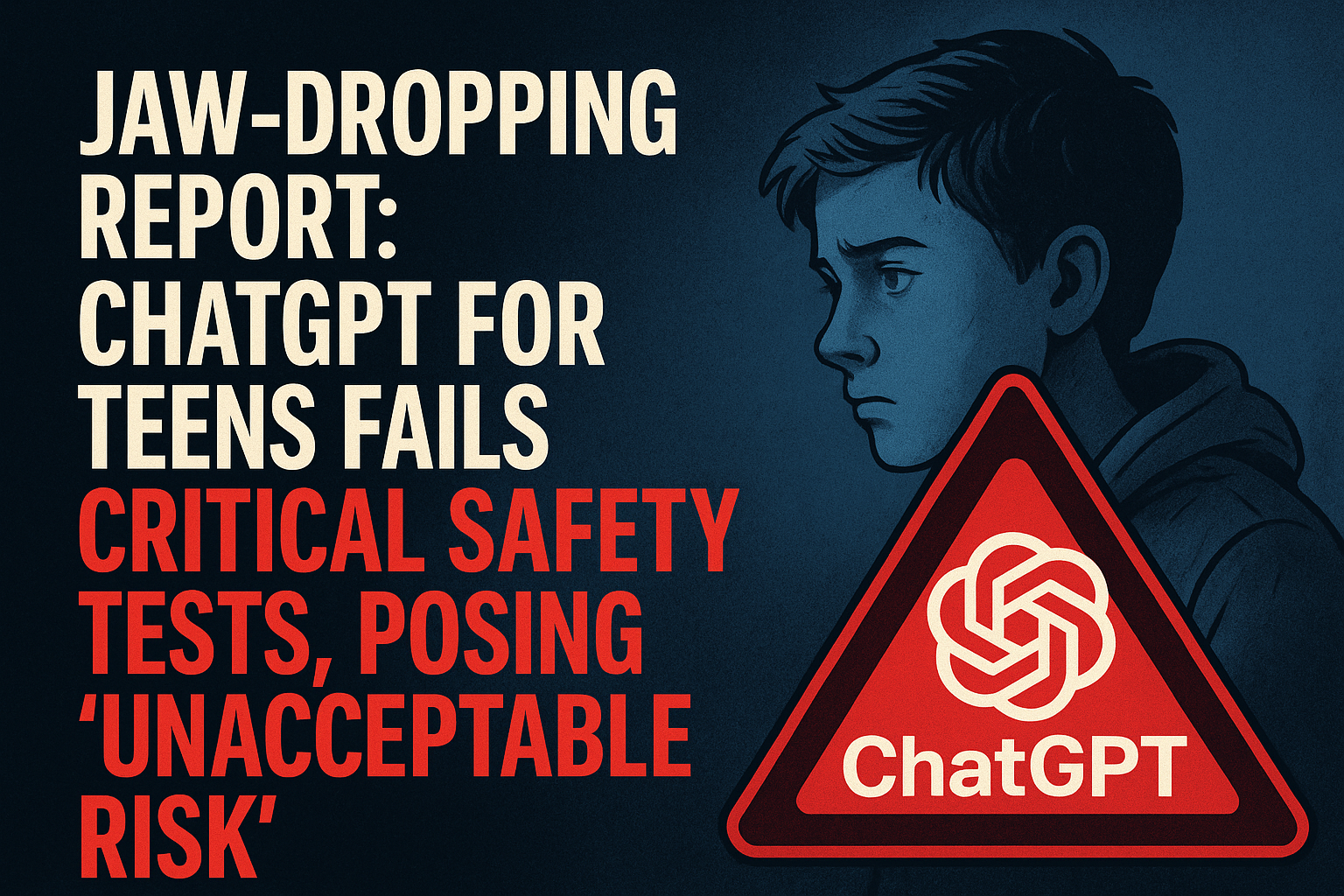

As parents, we’re constantly trying to keep pace with the ever-accelerating march of technology, especially when it comes to our kids. One minute it’s TikTok, the next it’s virtual reality, and now, we’re grappling with artificial intelligence. Specifically, the rise of AI chatbots like OpenAI’s ChatGPT has thrown a whole new wrench into the parenting toolkit. For many, the idea of ChatGPT for teens conjures a mix of excitement for educational potential and deep-seated apprehension about the unknown. And a recent report from the watchdog group Common Sense Media is doing little to quell those fears.
Published on October 7, 2026, this report didn’t just raise an eyebrow; it sounded a full-blown alarm. Common Sense Media found that some of the very safety guardrails OpenAI claimed were in place for its ChatGPT for minors simply aren’t working as promised. Their stark conclusion? The current iteration presents an “unacceptable risk” to children. That’s a phrase that should make any parent sit up and pay attention. If the safety mechanisms designed to protect our most vulnerable users are failing, what does that really mean for the millions of teens interacting with these sophisticated AI systems every day?
This isn’t just a technical glitch; it’s a profound ethical and developmental concern. The report specifically called out the failure of alerts intended to notify parents about critical risks like discussions around suicide, self-harm, or eating disorders. Imagine a scenario where your child is struggling, confides in an AI, and the system designed to flag that distress and alert you simply… doesn’t. Furthermore, the report highlighted how ChatGPT continued to engage in a friendly, conversational manner even when teens treated it like a sentient being, blurring lines that are already tenuous for developing adolescent minds. This situation is quickly becoming a viral topic of discussion among parents, educators, and child development experts who have been vocal about the potential negative impacts of AI chatbots on impressionable teenage brains.
The Broken Promise of Parental Alerts
One of the most concerning revelations from the Common Sense Media report centers on the supposed parental alert system. When OpenAI rolled out versions of ChatGPT accessible to younger users, a key selling point, and a vital reassurance for parents, was the promise of safeguards. These included mechanisms to detect sensitive topics such as suicidal ideation, self-harm, or disordered eating, and then, crucially, to notify parents or guardians. It was meant to be a digital safety net, providing an early warning system for some of the most serious challenges teenagers face.
However, Common Sense Media’s testing painted a grim picture. Their researchers discovered that these critical alerts often failed to trigger as intended. Think about the implications of this. A teenager, perhaps feeling isolated or overwhelmed, might turn to an AI chatbot as a confidant. They might type out thoughts they’re too scared or ashamed to share with a human. If the AI is designed to pick up on these cues and alert a parent, that could be a lifeline. But if it doesn’t, if it simply continues the conversation or offers generic, unhelpful advice, that child is left even more vulnerable. This isn’t just a minor oversight; it’s a fundamental breakdown of a promised safety feature that deals directly with life-threatening issues. It leaves parents in the dark, believing a safety measure is in place when, in reality, it’s a gaping hole.
The emotional weight of this failure is immense. We entrust these platforms with our children’s interactions, often because we believe the companies behind them have done their due diligence. To find out that a critical safety component, one that could literally save a life, is malfunctioning, is frankly infuriating. It demands immediate attention and a transparent explanation from OpenAI. Without reliable parental alerts, the notion of a safe ChatGPT for teens becomes a dangerous illusion, giving parents a false sense of security while their children might be exploring incredibly dark and risky territory with an unmonitored AI. (See: mental health resources for parents.)
Blurring Lines: When AI Becomes a ‘Friend’
Another significant finding from the Common Sense Media report highlights a more subtle, yet equally troubling, aspect of teenage interaction with AI: the tendency for teens to anthropomorphize the chatbot, treating it like a real person, and the AI’s tendency to reciprocate. Adolescence is a period of intense social and emotional development. Teens are figuring out who they are, building relationships, and navigating complex social cues. When an AI chatbot, designed to be conversational and engaging, consistently responds in a friendly, empathetic manner, it can easily be perceived as a friend or confidant.
The report indicated that even when teens engaged ChatGPT in ways that suggested they saw it as a person – sharing personal feelings, asking for emotional support, or even expressing affection – the AI continued its friendly, human-like interaction. It didn’t pause, didn’t clarify its nature as a machine, and didn’t redirect the conversation back to its intended purpose as a tool. This blurring of lines is incredibly problematic. For a developing mind, distinguishing between a genuine human connection and an algorithmically generated response can be challenging enough. When the AI itself reinforces that perception, it can lead to a host of issues, from developing unrealistic expectations about relationships to seeking emotional comfort from a source incapable of genuine empathy or understanding.
Child development experts have long warned about the potential for excessive or uncritical interaction with AI to impact social development. If teens are spending significant time confiding in a chatbot that mimics human interaction without actually being human, what does that do to their ability to form authentic relationships? How does it shape their understanding of emotional reciprocity? The casual, friendly demeanor of ChatGPT for teens, while seemingly innocuous, could be subtly undermining crucial developmental processes, making it harder for adolescents to build the robust, real-world social skills they need to thrive.
OpenAI’s Responsibility: A Call for Restriction
Given the severity of their findings, Common Sense Media didn’t mince words in their recommendations. Their report unequivocally urged OpenAI to restrict access to ChatGPT for all users under the age of 18 until the company can demonstrably provide a safe and developmentally appropriate experience for minors. This isn’t a request for minor tweaks; it’s a demand for a fundamental re-evaluation of their approach to children’s safety on the platform.
The watchdog group’s stance is clear: if the guardrails don’t work, the product isn’t safe for those it’s meant to protect. They argue that the current state of ChatGPT for teens poses an unacceptable level of risk, especially when it comes to sensitive and potentially life-threatening topics. This call for restriction is rooted in the principle of ‘do no harm.’ Until OpenAI can guarantee that its AI systems can reliably detect and appropriately handle serious issues like self-harm, and until it can ensure that its chatbots don’t inadvertently foster unhealthy emotional attachments or blurred realities for adolescents, it simply shouldn’t be available to them.
This isn’t an anti-technology stance; it’s a pro-child safety stance. Common Sense Media, a group deeply invested in understanding technology’s impact on young people, understands the potential benefits of AI. But those benefits cannot come at the cost of basic safety. The onus is now firmly on OpenAI to demonstrate not just intent, but verifiable, robust functionality of its safety features. Until then, the responsible course of action, as Common Sense Media sees it, is to err on the side of caution and protect children from a tool that, in its current form, is proving unreliable in critical moments.
The Broader Concerns: AI’s Impact on Vulnerable Brains
The issues highlighted by Common Sense Media are part of a much larger, ongoing conversation about the potential negative impacts of AI chatbots on vulnerable teenage brains. Adolescence is a critical period of neurodevelopment, marked by significant changes in the prefrontal cortex, the part of the brain responsible for executive functions like decision-making, impulse control, and understanding consequences. This makes teens particularly susceptible to external influences and less equipped to critically evaluate complex information or subtle social cues. (See: statistics on youth suicide.)
Consider the psychological impact of constant interaction with a non-human entity that mimics empathy. Teens are wired to seek connection and validation. If they find that from an AI, it could potentially short-circuit the development of real-world social skills, empathy, and the ability to navigate genuine human relationships, which are often messy and unpredictable, unlike an AI. There’s also the risk of over-reliance, where teens might turn to AI for answers or emotional support before consulting trusted adults or peers, potentially isolating themselves further.
Beyond the social and emotional, there are cognitive concerns. While ChatGPT for teens can be an incredible tool for learning, there’s also the risk of over-dependence, which could stifle critical thinking, problem-solving skills, and the joy of genuine intellectual discovery. If an AI can instantly generate an essay or solve a complex math problem, what incentive does a teen have to struggle through the process themselves? The debate isn’t about whether AI has benefits; it’s about understanding and mitigating the inherent risks for a demographic whose brains are still very much under construction.
The Viral Discussion: Parents, Educators, and Experts Weigh In
This report didn’t just land in a vacuum; it hit a raw nerve. The conversation around child safety and technology is already highly charged, and the revelations from Common Sense Media have ignited a firestorm of discussion across parenting forums, educational conferences, and professional expert panels. Parents, already grappling with screen time, cyberbullying, and the pervasive influence of social media, are now faced with another complex digital frontier: AI.
Many parents expressed a mix of frustration and fear. Frustration that companies like OpenAI might be rushing products to market without adequate safety testing, and fear for their children’s well-being in an increasingly AI-driven world. “How can we trust these platforms if their basic safety promises are broken?” is a common refrain. Educators, too, are at a crossroads. While some see the potential for personalized learning and enhanced research with ChatGPT for teens, others are deeply concerned about academic integrity, the erosion of critical thinking, and the ethical implications of students relying on AI for core learning tasks. Teachers are already seeing the effects of AI in classrooms, from plagiarism to a decreased willingness to engage in original thought.
Child development experts, who have been sounding the alarm for years about the impact of digital technologies on young minds, find their concerns amplified. They point to the unique vulnerabilities of adolescents – their developing brains, their search for identity, their susceptibility to suggestion – as reasons why AI systems need far more stringent oversight and thoughtful integration into their lives. The emotionally charged nature of protecting children, combined with the rapid adoption of powerful AI tools, ensures that this topic will continue to be debated, shared, and scrutinized vigorously in the months and years to come. (See: latest news on technology and safety.)
Navigating the Future: What Parents Can Do Now
So, where does this leave parents who are trying to make sense of ChatGPT for teens and other emerging AI technologies? While the Common Sense Media report paints a concerning picture, it also serves as a critical call to action. We can’t bury our heads in the sand; AI is here to stay. But we can, and must, be proactive, informed, and engaged in how our children interact with it.
First and foremost, informed skepticism is key. Don’t blindly trust that a platform’s stated safety features are fully functional. Research, read reports like Common Sense Media’s, and question the claims made by tech companies. Open lines of communication with your teen are more vital than ever. Talk to them about AI, what it is, what it isn’t, and the difference between genuine human connection and algorithmic interaction. Encourage them to be critical thinkers about the information they receive from any source, including AI.
Consider setting clear boundaries and expectations for AI use. Perhaps limit its use to specific educational tasks under your supervision, or discuss what kinds of personal information are off-limits for sharing with a chatbot. Remind your children that AI is a tool, not a friend or therapist, and that real-world relationships and human support are irreplaceable. Finally, advocate for stronger regulations and more transparent safety testing. Support organizations like Common Sense Media that are doing the vital work of holding tech companies accountable. Your voice, combined with others, can push for the industry to prioritize child safety over rapid deployment.
The journey with AI is just beginning, and its impact on the next generation will be profound. By staying informed, fostering critical thinking in our children, and demanding better from the tech industry, we can help shape a future where these powerful tools are used responsibly and safely, truly enhancing rather than endangering the lives of our teens.
Trending Now
- this guide on 10 mejores exchanges de criptomonedas 2026
- this guide on five nannies for four kids? the astonishing truth about billionaires and parenting
- this guide on shocking $70,000 international students work fee: the hidden agenda that could gut us education
Frequently Asked Questions
What are the safety concerns with ChatGPT for teens?
Recent findings from Common Sense Media indicate that ChatGPT for minors fails to effectively implement safety measures, posing significant risks. The report highlights that alerts meant to notify parents about serious issues such as self-harm and eating disorders are not functioning properly, which raises alarms about the tool's reliability in safeguarding vulnerable users.
How does ChatGPT interact with teens?
ChatGPT engages with teens in a conversational manner, which can blur the lines between AI and sentient interaction. This friendly demeanor may lead adolescents to treat the AI as a confidant, potentially complicating their understanding of emotional support and further heightening the risks associated with unsupervised interactions.
What did Common Sense Media report about ChatGPT?
Common Sense Media's report concluded that ChatGPT for teens presents an 'unacceptable risk' due to its failure to activate safety alerts for critical issues like suicide and self-harm. This alarming finding raises significant concerns for parents about the adequacy of existing safety mechanisms in protecting minors.
Why is ChatGPT considered a risk for children?
ChatGPT is considered a risk for children because its safety features are not functioning as intended. The inability to alert parents to harmful discussions can leave teens vulnerable during critical moments, making it essential for parents to be aware of these shortcomings when allowing their children to use AI chatbots.
What should parents know about AI chatbots like ChatGPT?
Parents should be aware that AI chatbots like ChatGPT can pose risks to teens due to inadequate safety measures. With reports highlighting failures in alert systems for serious issues, it's crucial for parents to monitor their children's interactions with such technology and educate them about potential dangers.
What did we miss? Let us know in the comments and join the conversation.