Pedagogue Blog

Diverse Conversations: The Globalization of Higher Education

Visit the website of your favorite college or university, find the search box and type in the words “international programs,” “study abroad,” or something to this effect. What you will find out is that odds are, your favorite institution has a department that serves as the international arm of the university, developing partnerships with countries and organizations around the world. They are part of one of the biggest trends to hit today’s modern university. The trend that I speak of is commonly referred to as the “globalization of higher education.” For this week’s installment of “Diverse Conversations,” I interviewed Dr. George B. Forsythe, President of Westminster College, concerning the “globalization of higher education.” During his presidency, this private undergraduate liberal arts college has been transformed into a global leadership community nationally ranked for its diversity.

Q: What do scholars mean when they speak of the “globalization of higher education?”

A: There are several ways to look at globalization of higher education. (1) Academic Content—students need to know about and understand the world and American’s place in the global community. Colleges and universities respond by adding “global awareness” to their curricular outcome goals, including “global perspectives” across the curriculum, or adding specific programs in global studies, international studies, or transnational studies. (2) Educational Process—Colleges and universities provide a rich array of study abroad or study away experiences to students which are designed to immerse them in another culture. (3) Community Building—Colleges and universities recruit students from around the world in order to build the global community on campus where students live and learn together as global citizens. (4) Global Reach—Colleges and universities establish a physical and/or virtual presence in the international market. At Westminster, we are aggressively pursuing the first three, with major emphasis on creating a global community in America’s heartland, with 16% of our undergraduates coming from 75 different countries.

Q: What exactly is a global university?

A: I suspect when people use this term, they mean what I am suggesting in number 4 above. A global university is one that has a global presence, with physical campuses throughout the world and/or a virtual presence through distance learning. I also suspect it means the faculty and students are drawn from around the world.

Q: How can a U. S. college or university become a global institution while also staying true to its mission?

A: Westminster College was founded in Fulton, Missouri, to prepare citizens for useful service to the community through a high quality liberal arts education. We remain true to that mission, 162 years later, but our understanding of “the community” has expanded beyond the city, county, and state to the wider world. We have stayed true to our mission, but our sense of citizenship and community have become much broader, and for good reason.
The world is increasingly interconnected technologically and economically, and educated citizens today must understand the implications of these interconnections and must be able to respond effectively to this reality. Americans must be globally engaged if we are to preserve our democratic values and maintain the standards of living that continue to attract people of every nationality to our shores. Higher education, if it is truly “higher,” must help students develop a global understanding about current tensions and possible solutions. Staying true to our mission means we must help students look beyond the campus and see the world.

Q: What do students gain from being part of a global institution?

A: A college or university that is a global community opens students to new points of view, challenges their thinking about themselves and their world, and sets the stage for personal and professional growth. Exposure to people from different cultures helps students gain an appreciation for their own culture and equips them with the skills to succeed in a global economy. It also makes life more interesting and meaningful. It’s fun. I think Former Yale President, Kingman Brewster’s, comment about the value of a liberal education applies equally to the value of global learning communities: ”Perhaps the most fundamental value of a liberal education is that it makes life more interesting. It allows you to think things which do not occur to the less learned, it makes it less likely that you will be bored with life.”

At Westminster College, we have found that the global community we have assembled has enriched our learning environment in so many ways. International students and U.S. students work together in every area of campus life—academics, research, student government, Greek life, leadership and service, and athletics. Our students form friendships on campus that lead to many local and international service activities. In many ways, the community is the curriculum, as students from around the country and throughout the world live and learn together.

To illustrate our approach, in addition to traditional study abroad and international travel courses, which we offer in abundance, we also have created a program called Take-a-Friend-Home, which is designed to foster deep friendships between international and U.S. students and provide for significant cultural immersion. This program provides the funding for international and U.S. students to travel to each other’s homes during summer and winter breaks. Participation is limited, and students compete for this program by writing a curriculum that outlines what each will learn from the experience. Before they travel, they take a for-credit course that prepares them for cultural immersion; when they return, they write a reflection paper and share their experiences with the College community.

Q: What do you think other institutions can learn from what’s happening with the globalization of higher education?

A: In the 21st Century, “global education” is redundant—if it isn’t global, it isn’t an education. Both in terms of content and process, students will be better prepared for the challenges they will face after college if their education is global. College graduates must possess the knowledge, skills, and habits of mind that will allow them to thrive in a global community.

Well, that concludes my interview with President George B. Forsythe. I would like to thank him for taking time out of his busy schedule to speak with us.

 

The Key to STEM Achievement: Answering the Question

‘When Am I Going to Use This?’

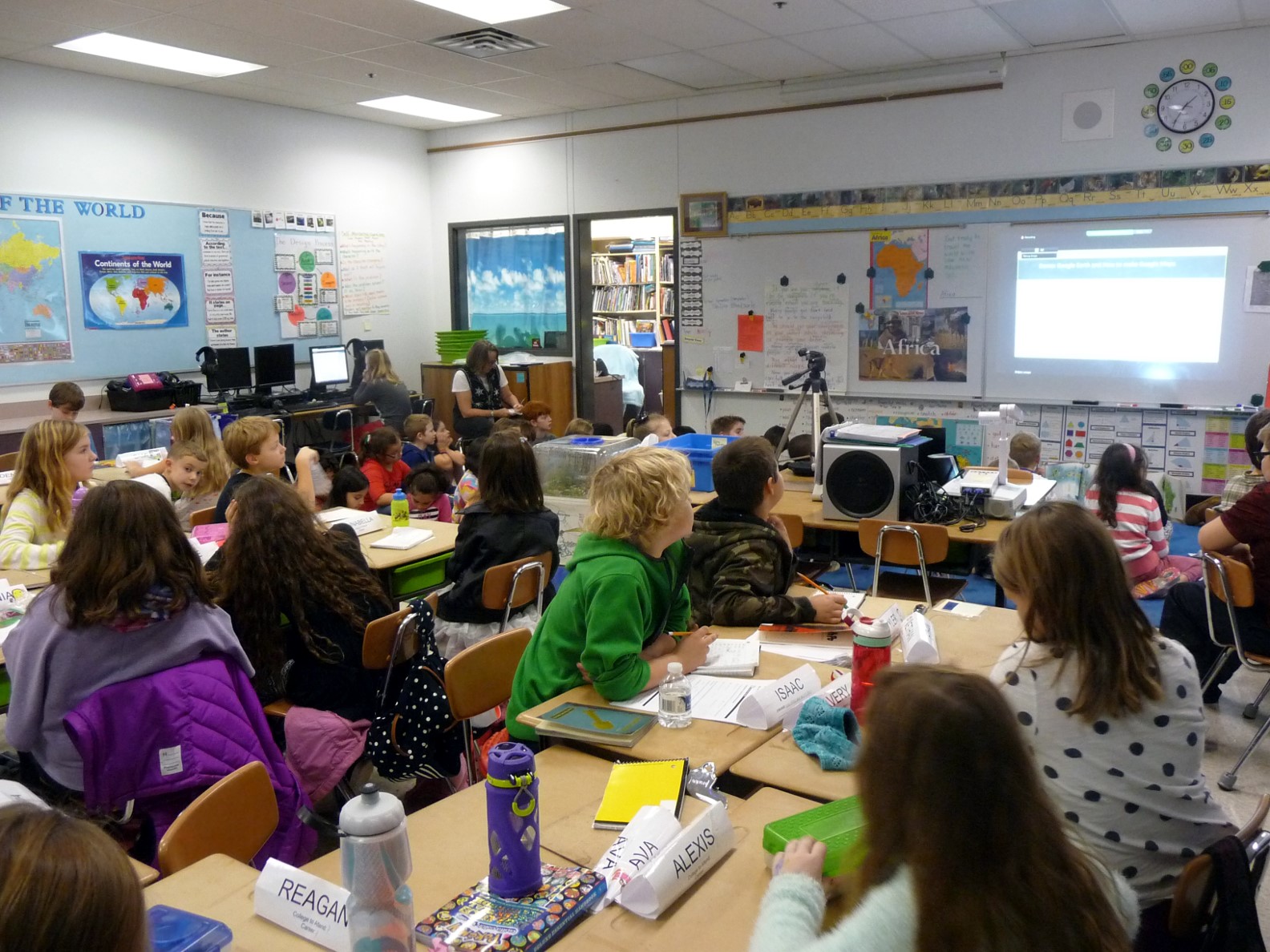
In Maureen Foelkl’s classroom at Chapman Hill Elementary School in Salem, Oregon, second and third grade students designed solutions to seasonal flooding and erosion in their community with the help of actual engineers in the field.

The project won Foelkl the Presidential Award of Excellence in Math and Science Teaching. While working on it her students learned about complicated concepts such as how a flood plain works, how structures can keep water out, and what kinds of materials can hold water in.

Foelkl invited civil engineers to talk with her students about these topics either in person or through interactive conversations that took place online. Her students then designed and tested their own prototype structures for mitigating the effects of or for withstanding a flood.

Foelkl, who is now an independent contractor writing science, technology, engineering, and math (STEM) curriculum for multiple organizations, says her students were highly engaged throughout the project. Having outside experts speak with them “brought authenticity to the lesson,” she says. “My students asked questions that I could not begin to answer.”

She adds: “No textbook I know can come close to interacting with students in that fashion.”

Making It Real

Research suggests the No. 1 reason students avoid STEM-related courses or careers is because they don’t see the relevance of what they are learning. In other words, there is a huge gap between what is happening in the classroom and in the real world.

Clearly, it’s time for a new approach—and Foelkl and many others have found that connecting students with actual STEM professionals helps make these subjects come alive in ways that a textbook just can’t replicate.

In Oregon, the state has created nearly a dozen STEM Partnerships, or regional hubs in which leaders from the education, business, and nonprofit communities come together to design community-based solutions to their STEM workforce challenges.

The South Metro-Salem STEM Partnership is one such hub, which serves districts in the Salem and Portland areas—accounting for about 25 percent of the state’s students. A key element of their effort is Oregon Connections, which is connecting students (and teachers) with industry experts. These STEM-related professionals come into the classroom either in-person or virtually to make science and math more meaningful for students.

“To me, the most important thing is making it real,” says Melissa Dubois, director of the South Metro Salem STEM Partnership. “We don’t get the innovations we get by magic. You don’t get an iPhone because it just materialized from nowhere; there are people with skills and expertise who have a really great time trying to dream up and build these kinds of products.”

Through Oregon Connections, teachers can request scientists, engineers, and other STEM-related experts to visit their classrooms in person or through an online conversation to talk about the work they do and why it’s important. The online conversations are powered by Nepris, which matches teachers with STEM experts from anywhere in the country and also hosts the video conferences.

Teacher, Maureen Foelkl, guides her third graders from Chapman Hill Elementary School in Salem, Oregon through a STEM lesson and brings in industry experts to her class virtually using Nepris or for in-class visits using Oregon Connections.

“I have been using Oregon Connections extensively over the past three years,” says Dylan McCann, a sixth grade math and science teacher at Twality Middle School in Tigard, Oregon. “We’ve met virtually with programmers, military defense engineers, naval architects, and pilots. My students have had the opportunity to see actual professionals using concepts we have been learning in the classroom—and that gives them an answer to the age-old question: ‘When am I ever going to use this?’”

Opening Students’ Eyes to New Possibilities

Besides making STEM topics more engaging and relevant for students, bringing industry experts into the classroom also opens students’ eyes to new career choices they might never have considered before. And, having the entire world of professionals at their fingertips through Nepris means there are virtually no limits on whom they can talk to.

Dubois says it’s important for students to know that the things they love to do could lead directly to a career: “If you’re an outdoor kind of kid, there’s a role for you. Do you love exploring the woods after school? There are people who do this for a living, and it’s a really important job, because it helps us manage our resources and be good stewards of the environment.”

That personal connection, now fulfilled by Oregon Connections, seems to be missing in many classrooms, she adds. And even though it might only be 30 minutes with somebody on a giant screen through the Nepris connection or a short in-person visit arranged by the partnership, “it’s far more impactful than the teacher saying, ‘You could be an engineer when you grow up.’” When students are exposed to actual professionals who are doing this work on a daily basis, those are the things they remember. They remember the people, not the words.”

The Oregon Connections program has “opened doors to occupations that hone in on students’ interests,” Foelkl says. “I have my students tell me at the beginning of the year what they might want to do after high school. The most frequent answers used to be a veterinarian, a zookeeper, a teacher, or someone in the military. These are all grand occupations, but somewhat limiting.” After hearing from STEM professionals, she says, “I had students tell me they want to work on plane engines, become a chemical engineer, become an inventor and open their own business, teach others about how to stay safe, lead environmental causes, write their own code—and still care for animals.”

Students in Maureen Foelkl’s third-grade class at Chapman Hill Elementary School in Salem, Oregon designed solutions to flooding and erosion with help from professionals linked to their class through Oregon Connections.

Seeing STEM professionals who look like them also helps address a lack of equity in these fields.

“I purposely try to bring in professionals who can personally connect with my young girls and students of color,” McCann says. “I think it is extremely important to give students in the underrepresented demographics (role models) they can look up to and have conversations with. For instance, last year my students were learning about thermal energy transference, and I had a young African American woman talk to my students about what it’s like to design, build, and test rockets—and what it’s like to get to blow things up for a living. She spoke about her journey as an African American woman (in a STEM-related field), and she showed my students that with perseverance and a great attitude, they can achieve anything they ever want.”

He concludes: “Giving my students the opportunity to connect with real people using what we are learning in class every day is invaluable. Without this real-world exposure, there is no context to what we are doing in the classroom. I have seen my students remember concepts and maintain excitement for careers they never thought possible, years after a visit with a professional. Bringing professionals into my classroom will continue to be a part of my teaching strategy for years to come.”


10 techniques to ensure that your lessons are as dull as dish water

**The Edvocate is pleased to publish guest posts as way to fuel important conversations surrounding P-20 education in America. The opinions contained within guest posts are those of the authors and do not necessarily reflect the official opinion of The Edvocate or Dr. Matthew Lynch.**

By Kelly Walsh

Seriously, it’s our Job to Inspire Learning?

We’ve all heard of or witnessed so many of these tired old approaches to delivering lessons. If you do happen to witness other educators sucking the will to learn out of students, please don’t just sit idly by. Weep openly, gnash your teeth, moan and shake our head, or maybe even wail loudly and pound your fists against the wall.

Here are some of the many unfortunate ways in which students everywhere are being disenchanted, disaffected, discouraged, disavowed, disarmed, disturbed, disgruntled and disingenuously served by some of our colleagues, who apparently feel that it is simply not their job to inspire learning or motivate students …

  1. Frequently lecture endlessly throughout the entire class session, expecting students to learn by scribbling notes as fast as they can.
  2. Don’t provide any activities that allow students to get up and move (a particularly heinous act for younger students).
  3. Have students read or work on problems alone in their chairs for the entire class session (as one of my elementary teachers used to say, “Read, Damn it, Read!” Good times.).
  4. Create online video lessons that basically just repeat what’s in the text book.
  5. Never give any group lessons or collaborative assignments.
  6. Create “digital lessons” in the form of narrated PowerPoint slides, reading verbatim from the text in the slides.
  7. Avoid all forms of formative assessment.
  8. Let Teacher’s Assistants give the bulk of the lectures, during which they frequently just rewrite content from the text on the board and attempt to explain it (not to mention the occasional indiscernible accent, which may not be ‘PC’ to say, but is nevertheless simply not fair to students).
  9. Rarely encourage interaction and dialogue (those *&^# students really should just sit there and listen!).
  10. Never taking a moment to recognize your students as individuals and reward them with gratitude, appreciation, and recognition of effort.

If you do come across this unfortunate situation, you might consider printing this article out and slipping it under that colleague’s door or in their mail box. Maybe, just maybe, they’ll check out some of these resources to try to change their ways (we can all dream can’t we?):

This post originally appeared on Emerging EdTech, and was republished with permission.

Read all of our posts about EdTech and Innovation by clicking here. 

________________________

Kelly Walsh is Chief Information Officer at The College of Westchester, in White Plains, NY, where he also teaches. In 2009, Walsh founded EmergingEdTech.com. As an education and instructional technology advocate, he frequently delivers presentations on a variety of related topics at schools and conferences across the U.S. Walsh is also an author, and online educator, regularly running Flipped Class Workshops online. His eBook, the Flipped Classroom Workshop-in-a-Book is available here. Kelly also writes, records, and performs original music … stop by kwalshmusic.com and have a listen!

Understanding Three Key Classroom Management Theories

By Tricia Hussung

How teachers manage their classrooms is an important part of achieving an effective learning environment. Educators know that all students learn differently, and choosing the right instructional style can mitigate behavioral issues and make good instruction possible. According to the National Comprehensive Center for Teacher Quality, a significant body of research also demonstrates that classroom organization and the ability to effectively manage student behavior “significantly influence the persistence of new teachers in teaching careers.” Within this context, it is clear that instructional theory and classroom management strategies are among the most important aspects of teacher education.

While classroom management theory is constantly evolving, there are three key theorists who stand out when it comes to modern education. Throughout the 20th and 21st centuries, experts like B.F. Skinner, William Glasser and Alfie Kohn revolutionized the ways that teachers deliver education. Understanding their theories can help educators define their own classroom management methods and make decisions about how to best approach interactions with students.

1200x75-classroommngment-subheader1-huss

B.F. Skinner’s contribution to learning theory can’t be overstated. His work is based upon the idea that learning is a function of change in overt behavior. According to Skinner, changes in behavior are a result of individuals’ responses to events, or stimuli, that occur in their environment. When a stimulus-response (S-R) pattern is rewarded, the individual is conditioned to respond similarly in the future. The key to Skinner’s theory is reinforcement, or anything that strengthens the desired response. This could include praise, good grades, a reward or even a feeling of accomplishment. Of course, negative reinforcement occurs when a stimulus results in increased response when it is withdrawn. The central tenet of Skinner’s work is that positively reinforced behavior will reoccur. This is why information is presented in small amounts. Responses can be reinforced, and reinforcement will be applied to similar stimuli.

Skinner’s work in operant conditioning has been integrated into both classroom management and instructional development. When applied to programmed instruction, the following should occur:

  • Practice should occur in a question-answer format that exposes students to information gradually through a series of steps.
  • The learner should respond each time and receive immediate feedback.
  • Good performance should be paired with secondary reinforcers like praise, prizes and good grades.
  • Instructors should try to arrange questions by difficulty so the response is always correct, creating positive enforcement.

There are many obvious ways that Skinner’s work has been directly incorporated into modern school systems. Though rewards were utilized for good behavior long before Skinner, many behavior management systems utilized in today’s classrooms are influenced by his theories. Teachers utilize immediate praise, feedback or rewards when seeking to change problematic student behavior, and some even use “token economies” to reward students in a systematic way.

1200x75-classroommngment-subheader2-huss

William Glasser coined the term “choice theory” in 1998. In general, this theory states that all we do is behave. Glasser suggests that almost all behavior is chosen, and we are driven by genetics to satisfy five basic needs: survival, love and belonging, power, freedom and fun. In choice theory, the most important need is love and belonging because connectedness with others is required as a basis in satisfying all other needs. The classroom should therefore be a needs-satisfying place for students.

Glasser’s work impacts learning theory in a variety of ways. It has been utilized in schools across the globe and has changed the ways that teachers deliver instruction.

First, Glasser identifies teachers as managers who need to work effectively if they want to successfully teach their students. The role of teachers as managers requires them to guide students in understanding that working hard and being obedient is worth it and will have a positive influence on their lives. Teachers can achieve this through developing positive relationships with students and creating active, relevant learning experiences that enable students to demonstrate mastery and success.

When it comes to developing lessons, teachers who practice choice theory work to make sure that student classroom activities are designed to satisfy the students’ needs. This allows learning to increase while diminishing disruption. Students are able to “connect, feel a sense of competence and power, have some freedom, and enjoy themselves in a safe, secure environment,” according to Funderstanding. There are three common characteristics of classrooms and schools that apply choice theory:

  • Coercion is minimized because it never inspires quality. Students aren’t “made” to behave using rewards and punishments. Instead, teachers build positive relationships with their students and manage them.
  • Teachers focus on quality. They expect mastery of concepts and encourage students to redo their work and try again until they have demonstrated competence and high-quality work. The emphasis is on deep learning through application.
  • Self-evaluation is common. Students are provided with helpful information and take ownership of their learning by evaluating their own performance. This promotes responsibility and helps students reach goals while becoming skilled decision-makers who are actively involved in their own education.

1200x75-classroommngment-subheader3-huss

Alfie Kohn’s work critiques many aspects of traditional education, namely the use of competition or external factors as motivation. Kohn maintains that societies based on extrinsic motivation always become inefficient over time. He questions the hierarchical structures at work in mainstream education. Positions of authority are “unnaturally scarce,” and such systems assume that all people have a competitive nature. He argues that positive enforcement only encourages students to seek out more positive enforcement, rather than truly learn. Kohn believes that the ideal classroom emphasizes curiosity and cooperation above all, and that the student’s curiosity should determine what is taught. Because of this, he argues that standards should be kept very minimal and is critical of standardized testing. Kohn also argues that a strict curriculum and homework are counterintuitive to student needs. When it comes to classroom management, Kohn believes that most teachers rely too heavily on extrinsic motivation rather than more intrinsic factors. He suggests teachers keep cooperation in mind because when curiosity is nurtured, rewards and punishments aren’t necessary.

To implement Kohn’s approaches in the classroom, teachers can allow students to explore the topics that interest them most. Students “should be able to think and write and explore without worrying about how good they are,” he suggests. In general, Kohn believes that there is too much emphasis on achievement rather than the learning process. He emphasizes that not all students learn at the same pace, and standards do not take this into account. In general, Kohn believes in classrooms where the student is at the center of everything. Ideally, such a classroom would feature:

  • Multiple activity centers with various classroom structures for group work
  • Displays of student projects
  • Students exchanging ideas
  • A respectful teacher mingling with students
  • Students excited about learning and actively asking questions
  • Multiple activities occurring at the same time

In terms of modern school systems, Kohn’s approaches are more consistent with those used in elementary classrooms. The key element is a “shift from a quiet, well-managed classroom to one that is lively and features an emphasis on student learning,” explains Thomas Hanson on OpenEducation.net.

1200x75-classroommngment-subheader4-huss

When educators are able to focus on classroom organization as a means of behavior management, they achieve better results for students. If you are interested in education topics like this, consider the online Master of Education from Husson University. Graduate-level education is ideal for teachers looking to advance their career and become leaders in the classroom and beyond. In addition, this degree program is ideal for individuals interested in becoming curriculum/instructional specialists, corporate trainers, course designers, education policy developers or adjunct faculty members.

Regardless of your professional focus, Husson’s program helps educators develop successful learning techniques through an inquiry-based approach. You can learn more about this fully online program here.

Will guns on campus lead to grade inflation?

Jessica Smartt Gullion, Texas Woman’s University

Editor’s note: This is an updated version of an article first published on April 27, 2015

Texas college professors may soon face a dilemma between upholding professional ethics and protecting their lives.

On Thursday, December 10, a task force at the University of Texas at Austin recommended restricting guns in residence halls, at sporting events and in certain laboratories, but allowed them in classrooms.

The 19-member task force was set up following a “Campus Carry” law passed by the state in Spring 2015. The law, which will come into effect on August 1, 2016, will allow people with handgun licenses to carry concealed firearms on college campuses.

With the recommendation to allow firearms in classrooms, a question coming up for many academics is whether they would be forced to give As to undeserving students, just so they can avoid being shot.

This is not as far fetched as it sounds. In my five years as a college professor, I have had experience with a number of emotionally distressed students who resort to intimidation when they receive a lesser grade than what they feel they deserve.

Threats on campus

Here is an example of one such threatening experience: one evening in a graduate course, after I handed back students’ papers, a young woman stood up and pointed at me. “This is unacceptable!” she screamed as her body shook in rage.

She moved toward the front of the class waving her paper in my face and screamed again, “unacceptable!” After a heated exchange, she left the room, and stood outside the door sobbing.

All this was over receiving a B on a completely low-stakes assignment.

What followed was even more startling. The following week, the student brought along a muscle-bound man to class. He watched me through the doorway window for the entire three hours of the class, with his arms folded across his chest.

And if this wasn’t enough, the young woman’s classmates avoided me on campus because, they said, they were afraid of getting caught in the crossfire should she decide to shoot me.

After that, every time she turned in a paper I cringed and prayed that it was good so that I wouldn’t have to give her anything less than an A.

Guns on campus could create an environment of fear.
Gun image via www.shutterstock.com

Learning from this experience, now I give papers back only at the end of the class or just “forget” to bring them with me.

I was lucky that the student didn’t have a gun in my classroom. Other professors have not been so lucky.

In 2014 a student at Purdue shot his instructor in front of a classroom of students. In another incident in 2009, a student at Northern Virginia Community College tried to shoot his math professor on campus. And, in 2000, a graduate student at the University of Arkansas shot his English professor.

In each of these states, carrying handguns on campus was illegal at the time of the shooting, although a bill was introduced in Arkansas earlier this year to allow students to carry guns.

Grade inflation

Despite these and other shootings, a new trend has emerged across the US that supports guns on college campuses.

Nine states allow firearms onto college campuses and 11 states are now considering similar legislation.

We know that some students will carry guns whether it is legal or not. One study found that close to five percent of undergraduates had a gun on campus and that almost two percent had been threatened with a firearm while at school.

Allowing students to carry weapons to class strips off a layer of safety. Students are often emotional and can be volatile when it comes to their GPAs.

Who would want to give a student a low grade and then get shot for it?

Many majors are highly competitive and require certain GPAs for admission. Students on scholarships and other forms of financial aid must maintain high grades to keep their funding. It’s no surprise that some might students resort to any means necessary to keep up their GPAs.

An international student once cried in my office and begged me to change his F to an A, as without it, his country would no longer pay for him to be in the US. I didn’t. He harassed me by posting threatening messages on Facebook.

So, the question is, will we soon see a new sort of grade inflation, with students earning a 4.0 GPA with their firepower rather than brain power? And if so, what sort of future citizenry will we be building on our campuses?

The Conversation

Jessica Smartt Gullion, Assistant Professor of Sociology, Texas Woman’s University

This article was originally published on The Conversation. Read the original article.

Public vs. Private: What Education Is Right for Your Kids?

**The Edvocate is pleased to publish guest posts as way to fuel important conversations surrounding P-20 education in America. The opinions contained within guest posts are those of the authors and do not necessarily reflect the official opinion of The Edvocate or Dr. Matthew Lynch.**

A guest post by Anica Oaks

While there is a current push toward private education in many circles in today’s society, the reality is that there are many happy, well-rounded, and well-educated children from both private and public institutions. It really does come down to choosing what’s best for your child. However, that choice isn’t an easy one. As you weigh the decision of private versus public, it’s important that you consider the advantages of each as well as your child’s actual needs. You should also ask some important questions before making the decision so that you are fully informed.

Benefits of Public Education

The news is often touting the shortfalls of the public school system; however, it actually offers a number of benefits that you might not otherwise recognize. If you’re considering private versus public education, be sure to include these benefits in your deliberation:

  • More qualified teachers: Teachers in the public sector are more likely to have master’s degrees and to have spent more hours pursuing continuing education courses.
  • More time on core subjects: A national report found that students in public schools actually spend an additional three hours every week studying the core subjects of English, math, social studies, and science compared to their private school counterparts.
  • More diversity: Public schools are available to students of any race and socioeconomic status, which creates more diverse student population.

Advantages of Private Education

That being said, the private school system also offers a number of advantages to its student population. While you are likely more aware of many of the benefits of private education, it is still important to keep these in mind:

  • Smaller schools and class sizes: Statistics indicate that private schools on average are half as large as public schools. Just as schools are smaller, so are the class sizes, offering an average student-teacher ratio of 9:1 compared to 17:1 in public school classrooms.
  • Less bureaucracy: Private schools aren’t mandated by all of the state regulations that public systems are, which results in less bureaucracy.
  • High parent involvement: Parents who invest in private education typically have a strong say in their children’s educations, so private schools lend themselves to high parent involvement.

Finding the Best Fit for Your Child

It’s tempting to rely on what everyone else is saying about a school when you are making your decision. But, you truly need to focus on what is best for your child. Consider the options, which range from your typical brick and mortar public schools to more contemporary charter schools, and be sure to visit and ask questions to find what works best for your child.

As you make your decision, ask about the curriculum, student-teacher ratio, and even the school’s expectations for parents. Having all of this information up front will help you make an informed decision for your child.

Selecting the right school for your child is important. Take the time to consider the advantages of public and private options and ask questions to find the right fit for your child.

___

Anica is a professional content and copywriter who graduated from the University of San Francisco. She loves dogs, the ocean, and anything outdoor-related. She was raised in a big family, so she’s used to putting things to a vote. Also, cartwheels are her specialty. You can connect with Anica here.

How Hollywood’s Lack of Diversity Impacts Higher Education

The 88th Oscars certainly stirred the pot on diversity in Hollywood, and how it impacts the rest of society.

Whether you are a fan of Hollywood, or Chris Rock, or none of the above, it’s important to understand the impact of what we see on-screen – and what it means for our next generation of P-20 students.

A recent report from Media, Diversity and Social Change Initiative at the University of Southern California’s Annenberg School for Communication and Journalism highlights the “whitewashing” of Hollywood films. In essence, the report found that even when there are roles available for minorities, they are given to white actors who then “dress the part” to pull it off. The roles the report mentions go above and beyond the old-school blackface that white actors used to throw on in film’s earliest days. Some are simply characters that were historically of color, but were changed to have Caucasian characteristics in the films.

If you’ve been paying any attention to Hollywood over the past decade, none of these findings are shocking. In one of the most purportedly progressive industries in the world, women and minorities get much less screen time, talking time, and pay than their white, male peers.

So what does all of this mean when it comes to our college students? How does something as seemingly insignificant as Hollywood affect diversity in higher education?

Not enough role models

We already know that there are just not enough roles for black actors in movies or on television but let’s break that down a little further. Think about some of the most popular movies that showcased college students in the past decade – Neighbors, Old School, Van Wilder. In the spirit of classics like Animal House, these movies represented the fun side of earning a college degree in a constant state of inebriation but most of the students were white. You can probably spot a token minority character in each, but the lead roles all went to white males who, despite their often ridiculous antics, were still awarded degrees in the end. If they weren’t awarded degrees, they still landed on their feet with some other sort of job (unrealistic for all college students). The problem with leaving black students out of this college conversation on film is that it subtly sends a message that a higher education is something reserved for white, privileged men (and some women, too).

The scenario doesn’t improve when movies graduate to the adult world. When you think of a black man in a movie that is set in contemporary times, what role comes to mind? A police officer or detective? A drug dealer or pimp? How about a black woman? With the exception of breakthrough roles like Viola Davis’ lead in the hit TV series “How to Get Away with Murder,” there are not a lot of women in professional roles on-screen. As already mentioned, even roles that could feasibly be played by people of color are given to white people who are then praised for their outstanding performances acting like a person totally different from who they actually are. In truth, minorities are a vibrant, important part of the American workforce. They are professionals (who aren’t always in law enforcement), teachers, CEOs and small business owners. Where are these characters on screen?

The problem with slave movies

Even historical films have their issues when it comes to the way diversity is portrayed. Hollywood likes to pat itself on the back for films like Twelve Years a Slave but do they really represent progress? These movies certainly tell important stories but they provide roles that show black actors in a stereotypical light. Why have the only black-led films to win Best Picture awards centered on slavery? It’s almost as if Hollywood has decided that to fix this problem of diversity on screen, movies that have “black” roles need to be made.

That’s not the entire solution though. How about making that lead fictional character who is a teacher a black actor? Or writing in stage directions that all crowd scenes be half minority and half women? Putting black actors in a ready-made film category is part of the problem; it further distances them from the mainstream movie industry. It essentially sends the message that only explicitly black roles go to black actors – and that hurts the overall portrayal of diversity everywhere, including on college campuses.

Solving the Hollywood diversity problem won’t directly improve inclusion on college campuses, but it certainly can’t hurt. As higher education professionals, we should support the push to change what we see on screen – and point out the problem whenever possible to our students of all races and ethnicities.


Here’s another reason why many community college students do not get their degree

Daniel Eisenberg, University of Michigan and Sara Goldrick-Rab, University of Wisconsin-Madison

The growth of community colleges in the U.S. has improved access to higher education tremendously, especially for students from low-income families. However, completion rates at these schools are less than 30 percent.

Could the mental health of community college students play a role in their degree completion?

We recently partnered with researchers, nonprofits and community colleges across the country to study the mental health conditions of community college students.

Mental health on college campus

The first signs of most mental health conditions often appear during or before the typical college age range – 18 to 24 years. Symptoms can include lack of energy, loss of concentration, lack of sleep or even substance abuse, which can affect school performance. Depressed or anxious students can also feel pessimistic and lose their motivation.

In previous research, we and other research groups have extensively documented the high prevalence of mental health disorders in four-year institutions. Recent studies also indicate that mental health disorders could be increasing among the youth.

What about mental health issues of community college students specifically?

Compared to four-year schools, community colleges draw student populations with higher poverty and other socioeconomic disadvantages, which could increase their vulnerability to mental health conditions.

Community college students are more vulnerable to mental health problems. trizoultro, CC BY-ND

So in winter 2015, we conducted an online survey of a random sample of over 4,300 students at 10 community colleges across the nation, and used standard brief assessments to measure symptoms of mental health conditions such as depression and anxiety.

To compare with four-year school populations, we examined these same measures from Healthy Minds Study, a national survey from the academic year 2014-2015, which included nearly 16,000 respondents from 16 institutions.

Here are the community college data

The results from our study “Too Distressed to Learn” leave little doubt that mental health is, in fact, a major concern for community college students.

Nearly half (49 percent) of community college students show symptoms related to one or more mental health condition, such as depression, anxiety, suicidal ideas, nonsuicidal self-injury or eating disorders.

In other words, approximately six million students, of the approximately 12 million students in community colleges nationwide, have symptoms of mental disorders. We found depression and anxiety to be among the most common conditions. About 36 percent students showed symptoms of depression and 29 percent had disorders related to anxiety.

For younger students ages 18-24 in community colleges, these numbers are even higher: 40 percent for depression and 33 percent for anxiety.

Furthermore, mental health conditions appear to be considerably higher at community colleges, as compared to four-year schools. Among students ages 18-24, 23 percent of community college students are experiencing the most severe frequency and number of depressive symptoms, as compared to 11 percent of four-year students.

Are students getting help?

This troubling situation is compounded by the fact that most students with mental health conditions are not receiving adequate support.

Among community college students with a mental health condition, we found only 41 percent were receiving any mental health care (counseling and/or medication) in the previous year. This number is even lower – 35 percent – among community college students in the age group 18-24. Although still not adequate, by comparison, 45 percent of students in the age group 18-24 find support at four-year schools.

There is a similar disparity in the counseling or support that students receive from non-clinical sources, such as friends and family: 60 percent among community college students, compared to 79 percent among four-year students.

The lower use of mental health services among community college students is driven in part by the fact that more of these students lack health insurance: 14 percent, compared to just 3 percent in our four-year sample.

Additionally, community colleges offer significantly fewer campus services.

Fewer community college students have access to mental health services. Joe Houghton, CC BY

For example, many community colleges do not have any mental health counselors, and among those that do, the ratio of counselors to students is 1 to 3,000, compared to 1 to 1,600 at four-year institutions.

Here’s what can be done

The reality is that improving this situation will likely require an influx of additional resources, particularly more robust campus health services and programs. So, how can institutions and other stakeholders build support for funding these resources?

For many years, four-year schools have been using data extensively to make the case for increased support of mental health services. Data from our study, which is one of the first large-scale assessments of mental health among community colleges throughout the nation, could serve as a starting point.

We know there is a relationship between depression and student retention. In fact, four-year schools have used this argument persuasively for finding more resources.

In addition, there are a number of partnership opportunities, and successful experiences at other institutions nationwide, from which institutions and students can benefit. For example, many students today are engaging in peer-led initiatives.

An example of such an initiative is Active Minds, a national organization supporting student advocates for mental health. It has chapters at over 400 campuses (including some community colleges). Campus administrators can partner with the Campus Program of Jed Foundation, which helps institutions help develop and implement a campus-specific plan to improve their support for student mental health.

Single Stop is another national nonprofit that has been assisting community college students with accessing public benefits and services; such an organization can also help students access mental health services in their respective communities.

It would be easy to view our new findings as another reason to be discouraged about the state of higher education, particularly community colleges. But we believe these findings highlight a whole new set of opportunities to improve the prospects for millions of students.

An ever-growing wealth of services and programs can treat or prevent mental health conditions. The challenge, and opportunity, is to make more and better investments in this area.

The Conversation

Daniel Eisenberg, Associate Professor of Health Management and Policy, University of Michigan and Sara Goldrick-Rab, Professor of Educational Policy Studies & Sociology, University of Wisconsin-Madison

This article was originally published on The Conversation. Read the original article.

Should teachers pay for apps?

**The Edvocate is pleased to publish guest posts as way to fuel important conversations surrounding P-20 education in America. The opinions contained within guest posts are those of the authors and do not necessarily reflect the official opinion of The Edvocate or Dr. Matthew Lynch.**

A guest post by Maria Constantides

I very often talk to teachers about online apps and great new tools and the standard question always is: “Is it free?’”

And of course it’s natural for teachers – who are amongst the world’s worst paid people for the amount and quality of the work they have to do – to look for free apps and tools.

Reasons?

On a UK pay scale, a colleague recently told me that they make 23 pounds an hour. In Athens, if you  have training and experience, you will be lucky if you make 9 or 10 euros – the average is 6 per hour while the official hourly rate is 4,5 euros per hour  for only 8 months a year; in the summer you can live off the sun and the sea and unemployment benefit of 300 euros per month  (for some people, not even that).

So if most of my better paid colleagues look for free apps, why would the low-paid colleague do anything different? Teachers look for freebies because

  • Their school won’t pay
  • They can’t afford to pay themselves
  • If it’s free, why pay?

So we all flock to the free options and use them, create accounts, create materials, until one day, the company goes bust and we lose everything!

Of course, the paying users lose even more!

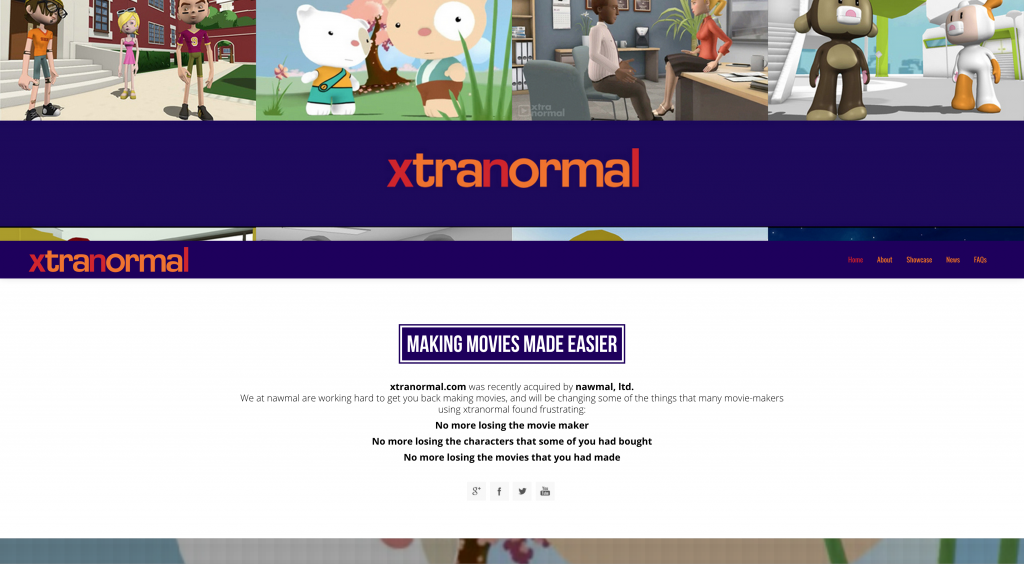
A typical example was one of my favourite online animation tools Xtranormal  I loved this app and used the free version along with thousands of other teachers, then started paying to buy more scenes and more characters and to have the option to download and save my videos!  Suddenly the company announced they were closing and loads and loads of teachers lost all their work.

This is what you can now read on their website, written by a team of people trying to resurrect the service: xtranormal

No more losing the movie maker

No more losing the characters that some of you had bought

No more losing the movies that you had made

So what are the going rates?

On the flipside of this, you have your average startup company which creates a great product or serivce and they offer a free plan for a limited range of presentations and one or two templates.

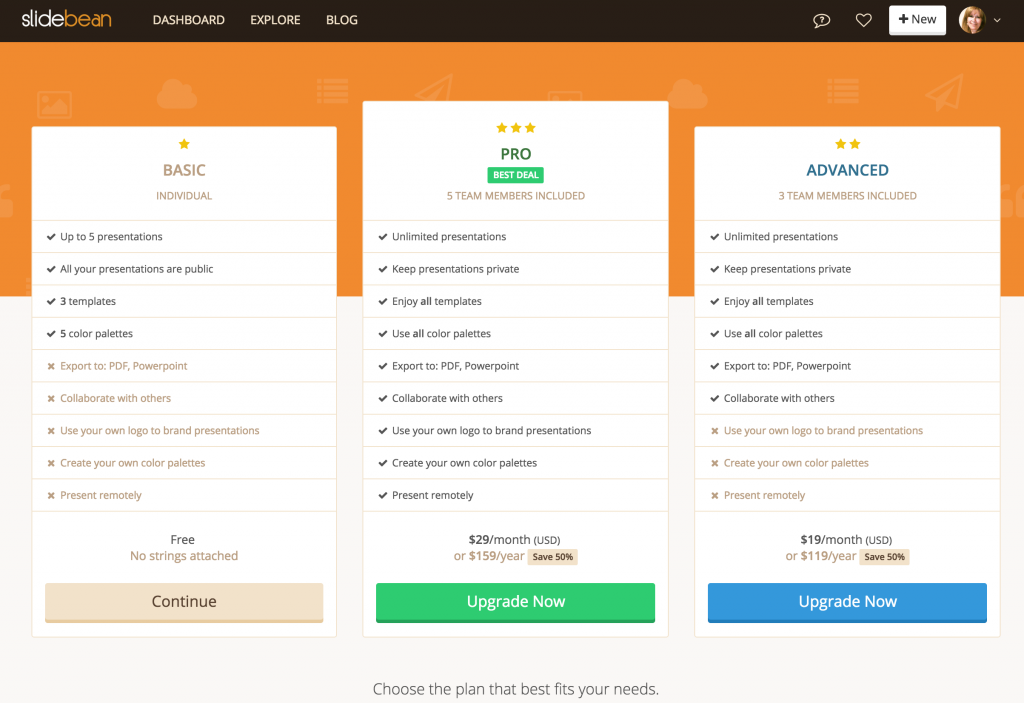
Pricing Slidebean

I believe most start ups think in terms of ‘Well, what’ 29 dollars a month? It’s not that much money!’  Or 19 dollars a month!!!

Well, I tell you that at the end of the day, if you pay for a few services like we do as a school, the bill at the end of each month is quite steep!!!!

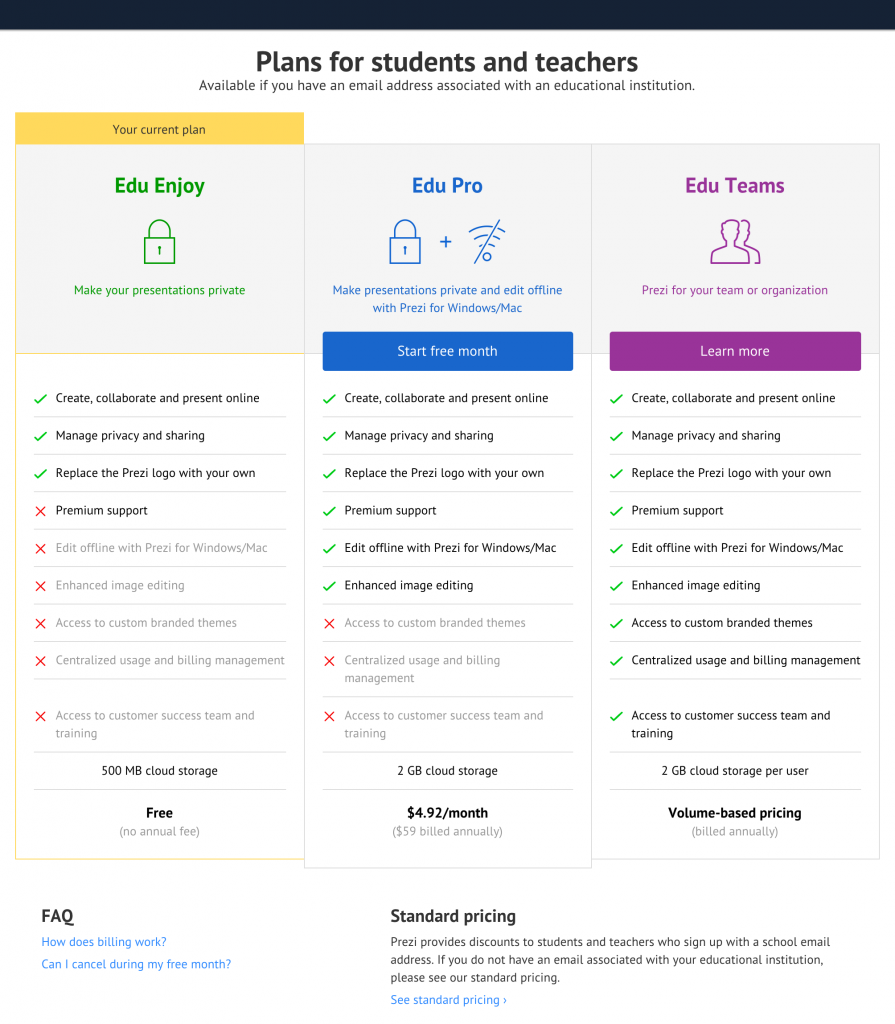
Compare this to the infinitely more versatile and original Prezi pricing plan and you will note the difference.

Of the two services, this is the one I would be more likely to pay for for this, and of course, other reasons, such as the versatility of the presentation templates, the desktop variation of a presentation which can be downloaded and played on one’s pc or laptop…

Pricing Prezi

Up to a couple of years ago, I used to pay a 29 euros per month subscription to Survey Monkey – when I calculated the cost of each survey I did using their services, it has cost me more than 300 or 400 euros!!!!

Google does it for free!!!!

One more example – my favourite screencast software – the famous Jing

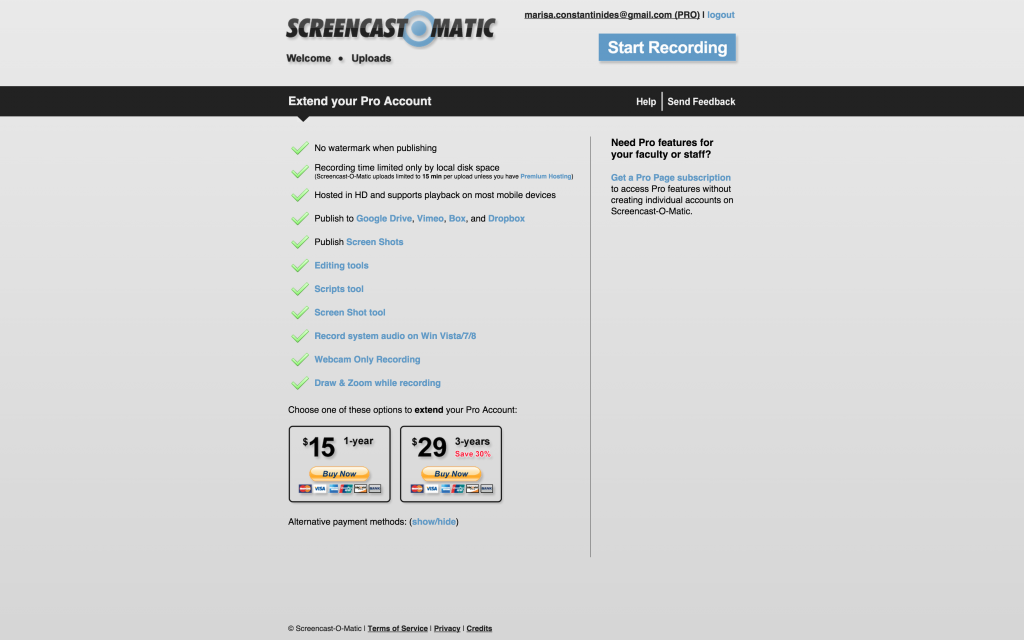
TechSmith Screencast.com online video sharing Plans and PricingCompare it with my OTHER favourite screencasting software, Screen-cast-0-matic

Go Pro Screencast O Matic Free online screen recorder for instant screen capture video sharing.

Compare two great screencast apps – Jing at about 100 dollars a year and Screen-cast-o-matic for 15 or under 10 if you go for the 3 year discount!

Apps

By contrast, most tablet  apps are much lower in price; for example, purchasing Microsoft Powerpoint for my iPad costs nothing, where you would have to pay almost 80 dollars US for the PC version. Keynote is now free but if you purchase an iPhone or iPad and even if you need to buy it is less than 20 dollars US – compare to powerpoint above!


Make the price right!

Make the price right, people! You can’t jump from nothing to 30 dollars a month – bring your prices down and you might get a lot more people paying!

You  let me have dropbox for free but if I want to pay, you ask me for 100 euros per month! 

Why would I pay that when Amazon asks for 70 a year for unlimited storage space!!!! Get real!!!! And OneDrive gives me 50 GB for free – Plus free online use of the latest versions of the Office Suite! 

This has happened to me time and again! I am willing to pay to keep my content safe but prices are too high – so I will keep going for the free versions for as long as I can.


P.S. Just like governments would make more money if they lowered their taxes – but greedy so and so’s that they are, they keep losing more and more money every year!!!!!

This post originally appeared on marisaconstantinides.edublogs.org, and was republished with permission.

____________________

Marisa Constantinides runs CELT Athens, a Teacher Development centre based in the capital of Greece, and is a Course Supervisor for all courses, including the DELTA Cambridge/RSA Diploma, the Institute of Linguists Diploma in Translation and off-site seminars and workshops on a variety of topics.

4 Ways to Improve Parent Involvement in K-12 Learning

By Matthew Lynch

Students benefit when there are parent-school partnerships surrounding their school work. However, it is not always easy to promote such a culture of shared responsibility, especially given the great time demands placed on parents and teachers today. Schools may face difficulty in attaining an efficient collaborative framework among stakeholders, which include teachers, parents, students, the community, and the administration.  Trust between schools and parents, in particular, is vital for creating a healthy learning environment.

So what can be done to foster stronger relationships between parents and teachers, administrators and whole schools?

1. Encourage collaboration. In general, parents who are supported by regular interactive meetings with teachers often show greater trust levels in teacher-parent relationships. Schools can create an environment favorable for the development of teacher-parent relationships by sharing the responsibility of improving learning processes and the academic performance of children. Many schools that claim to support collaborative decision-making patterns hold complete decision-making authority in their own hands, which can reduce the positive influence of collaborative decision-making pattern. Let parents feel empowered in the learning paths of their kids by allowing them certain input and choices.

2.  Work toward creating a friendly school environment. A healthy and congenial school environment, with an enabling and flexible structure, can help develop trust between school administrators and parents.  Generally, education and school leaders try to generate a social framework that will help teachers, administrators, and parents resolve differences in a peaceful and supportive manner. Overall improvement of student performance can be the outcome of improved relationships between teachers and parents.

3.  Reduce bureaucratic barriers.  Many times, barriers are created that prevent teachers from developing effective student-teacher relationships and discourage parents from taking part in helping students develop their learning skills. A parent who feels that his or her input is not wanted may give up on trying to be an influential part of his or her child’s life. The bureaucratic system of schools should allow plenty of room for parent and student input – and then take that feedback seriously. The centralized or hierarchical authority of schools can be used to implement these supportive regulations and policies to enhance parental involvement. Both can work together for a better outcome for the students.

4. Respect the deep-rooted importance of family.  Parental involvement in education and its effect on the academic performance of a child requires recognizing the fact that parents are children’s first teachers. Home is the first school, and as such, it is the place where children learn an abundance of skills, knowledge, and attitudes, some of which supports what is taught in schools. It’s true that some parents are more involved in the academic strides of their children than others – but with the right encouragement, teachers and schools can give parents the tools and encouragement needed to help their children succeed to the next level.

When parents get involved with their children’s educations, the children tend to succeed academically, and tend to perform better on exams (which, as we all know, is certainly helpful to teachers). They miss fewer school days and tend to be more conscientious about completing school-related work outside of school.

Conversely, children whose families are not as involved in their school experiences are often unable to compete academically with peers, their attendance is less regular, and they are less likely to graduate from high school.  Clearly, any movement toward building a stronger relationship between schools and parents will have a positive impact on student performance. Involved parents are the key to success when it comes to the improvement of K-12 students inside classrooms – and teachers, administrators and schools should encourage parents to play that pivotal role.


Jumpstarting Learning for Children Living in Poverty

Contrary to popular belief, DNA is not a child’s destiny. IQ is not fixed. Cognitive skills can change. This is critically important in K-12 schools because of the poverty gap — the difference between a child’s chronological age and developmental age.

In a healthy environment, a child’s developmental age will match his or her chronological age. In a high-risk environment, research shows that while a child’s chronological age is 5 years old, his or her developmental age is closer to 3 years old. This has a huge impact on school readiness and performance.

Today, 51 percent of all students in U.S. public schools are poor. Our public education system is designed to help students achieve a year of academic growth in a school year. For economically disadvantaged children, that’s a problem.

This problem, of course, is not new. In 1995, Betty Hart and Todd R. Risley published their groundbreaking research study that uncovered the widely cited 30-million word gap between children from low-income homes and their more economically advantaged peers. Not only does that gap still exist today, it’s becoming more prevalent as the poverty rate climbs.

Read the rest on this article on The Huffington Post.

Are liberal arts more valuable than STEM learning?

A liberal arts education that focuses on a broad range of topics, and is not vocationally-centric, is a bigger asset to today’s students than other trending tracks like STEM learning. That’s according to author Fareed Zakaria in his new book “In Defense of a Liberal Education.” Zakaria argues that the central focus of a liberal arts education is writing, and that “writing makes you think.”

In an interview with Forbes, Zakaria had this to say about his stance:

What a liberal education at its best does…is to allow people to range widely, to read widely, to explore their passions…I think that kind of breadth and the ability to feed your curiosity and indulge is incredibly important. It’s what, now in the corporate world, one would call synergy, or out of the box thinking, or the intersection of disciplines. This has always been a central part of what a liberal education has meant.

By having a liberal arts foundation, workers can then build on in other areas. Zakaria says that scientific thinking certainly has a place in American education but that there should be a “logical clarity and coherence to it.”

With all of the talk of Science, Technology, Engineering and Math learning as the wave of the future, Zakaria’s view and book are a refreshing reminder that writing and logic are still valuable. It goes back to the age-old concept that we must teach our students HOW to learn, and not just WHAT to learn. That’s the real way to ensure innovative and skilled future workers.

What do you think? Are liberal arts as important, less important or more important that STEM tactics?


Latest Posts