Education News

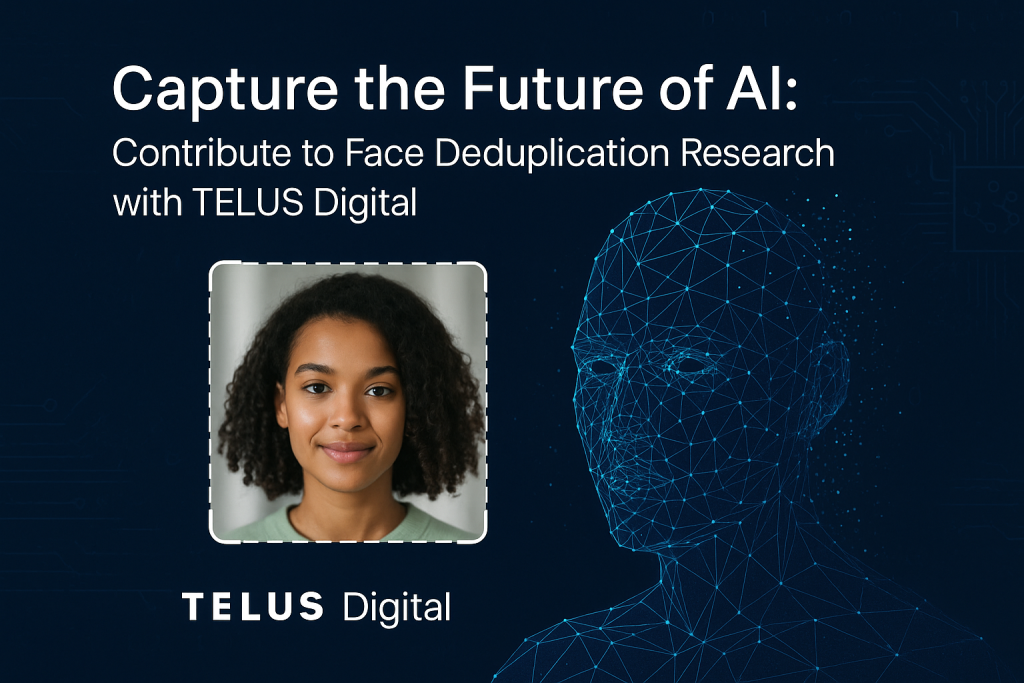
Capture the Future of AI: Contribute to Face Deduplication Research with TELUS Digital

Unlock a Unique Opportunity to Shape AI with TELUS Digital

Are you looking for a flexible, impactful way to contribute to cutting-edge technology from the comfort of your own home? TELUS Digital is offering an exciting and accessible opportunity for individuals across the USA to participate in a crucial data collection project. This isn’t just about taking a few photos; it’s about playing a vital role in advancing machine learning research, specifically in the critical area of face deduplication. If you’re someone who appreciates the power of data and wants to make a tangible difference in the development of robust and accurate AI models, this project could be an ideal fit for you.

In today’s rapidly evolving digital landscape, the accuracy and reliability of AI models are paramount. Projects like this one are the bedrock upon which future innovations are built. By contributing diverse and high-quality image data, you’ll be directly helping to train facial recognition models that can better understand and process the complexities of human appearance across various conditions. This is a chance to be part of something bigger, lending your unique perspective and personal data to a cause that will benefit countless applications in the future. top gaming companies 2026 offers useful background here.

What Does This Role Involve? A Deep Dive into Data Collection

This project is designed to gather a comprehensive and varied dataset of facial images, essential for improving the accuracy and resilience of machine learning and facial recognition models. Your primary task will be to collect and submit specific types of selfies and historical images that meet the project’s stringent quality criteria. The goal is to capture the natural variations in human appearance that occur due to lighting, head orientation, facial expressions, accessories, different environments, and, significantly, the natural process of aging. This rich diversity of data is crucial for developing AI models that can perform effectively in real-world scenarios.

The Core Components of Your Contribution:

  • Current Neutral Selfies: These are clean, frontal selfies that will serve as high-quality identity references. The key here is to capture natural variations in your appearance and surroundings. Think of these as your baseline images, reflecting your current look in a straightforward manner, but with enough subtle differences to provide valuable data points. Avoid overly posed or stylized shots; naturalness is key.
  • Current Head-Pose Captures: For these submissions, you’ll be asked to capture selfies in assigned head directions. This introduces crucial pose variation into the dataset. AI models need to recognize faces from various angles, not just straight-on. By providing images with your head turned slightly up, down, left, or right, you’ll be teaching the AI to be more robust and less sensitive to head orientation, which is vital for effective face deduplication.
  • Historical Images: This is where the project truly captures the essence of long-term appearance changes. You’ll be asked to submit older photos from your personal gallery. These images are invaluable for training models to understand and account for natural aging, changes in hairstyle, weight fluctuations, and other long-term transformations. This aspect of the data collection is particularly important for applications requiring persistent identity verification over time.

Quality Control and Submission Guidance:

TELUS Digital emphasizes the importance of quality in all submissions. There’s a strict automated and manual Quality Control (QC) process in place to ensure the collected data is suitable for research. To qualify for payment, you must submit a minimum of 20 valid images. The maximum payout is based on 24 accepted images. However, due to the rigorous QC, it is strongly recommended that you submit 30 images. This higher submission count significantly increases the likelihood that enough of your images will pass review, allowing you to maximize your potential earnings. Remember, consistency in following guidelines and attention to detail will be key to successful submissions.

Who Is TELUS Digital Looking For? Ideal Candidate Profile

While this project doesn’t require specific academic degrees or extensive professional experience, it does call for individuals who meet certain practical criteria and possess particular qualities. This is a fantastic opportunity for anyone in the USA who is comfortable with technology, pays attention to detail, and is willing to follow instructions precisely. For more context, see AI trading technology and its safety implications.

Key Qualifications and Characteristics:

  • Located in the USA: This project is specifically open to participants residing in the United States.
  • Access to a Smartphone/Camera: You’ll need a device capable of taking clear, high-resolution photos, especially selfies. Most modern smartphones will be perfectly suitable.
  • Personal Photo Gallery: The ability to access and select older photos from your personal gallery (digital or scanned) is essential for the historical image component.
  • Attention to Detail: Adhering to the specific guidelines for each image type (neutral selfies, head-pose captures, historical images) is crucial for your submissions to be accepted. This includes considerations for lighting, background, expression, and head orientation.
  • Comfort with Technology: While not overly complex, you’ll need to be comfortable with uploading images and potentially using a specific platform for submission.
  • Reliability and Diligence: Ensuring you submit the recommended number of images and following through with the project requirements demonstrates your commitment.
  • Privacy-Conscious but Willing to Share: Participants must understand and accept that their images will be used for machine learning research and model training. TELUS Digital will undoubtedly have robust data privacy protocols in place, but participants should be comfortable with the nature of the data being collected.
  • Gmail Address: As noted in the listing, please use a Gmail address as your primary contact for this project.

This role is particularly well-suited for students, freelancers, stay-at-home parents, or anyone looking for a flexible side gig that leverages their existing resources (their phone and photo library) to contribute to meaningful technological advancements.

Why TELUS Digital? Innovating for a Connected Future

TELUS Digital is the innovation engine behind TELUS, a world-leading communications and information technology company. When you contribute to a project with TELUS Digital, you’re not just working for any company; you’re aligning yourself with an organization known for its commitment to technological advancement, customer experience, and social responsibility.

Reasons to Engage with TELUS Digital:

  • Leader in Innovation: TELUS Digital is at the forefront of developing next-generation digital solutions. They are constantly exploring new ways to enhance connectivity, improve user experiences, and leverage AI for societal benefit. Your contribution directly supports this innovative spirit.
  • Impactful Work: The data you collect will directly fuel critical machine learning research. This isn’t busywork; it’s foundational data that will enable more accurate facial recognition models, which have applications in everything from secure identity verification to improving accessibility and user experience.
  • Commitment to Quality: TELUS Digital’s rigorous QC process indicates their dedication to high-quality data, which translates to high-quality AI models. This means your efforts are truly valued and contribute to robust outcomes.
  • Reputable Employer: TELUS is a globally recognized and respected brand. Participating in a project with them adds a credible and interesting experience to your personal portfolio, even for a short-term gig.
  • Ethical AI Development: Companies like TELUS Digital understand the importance of developing AI responsibly. By contributing diverse data, you help ensure that models are trained on a wide range of human appearances, reducing bias and improving fairness in AI applications. This dedication to ethical AI is crucial in the development of technologies like face deduplication.

By choosing to participate with TELUS Digital, you’re choosing to contribute to a company that values progress, quality, and the responsible application of technology.

Compensation and Earning Potential

This project offers a clear and attractive compensation structure that rewards your effort and adherence to quality guidelines. The project compensation rate is $0.55 USD per accepted image. This allows you to directly control your earning potential based on the number of valid images you submit.

Maximizing Your Earnings:

  • Minimum Payout Threshold: To qualify for payment, you must submit a minimum of 20 valid images. This means a minimum earning of $11.00 USD (20 images * $0.55).
  • Maximum Payout: The maximum payout is based on 24 accepted images, which would equate to $13.20 USD (24 images * $0.55).
  • Strategic Submission: As highlighted, due to the strict automated and manual Quality Control (QC) process, TELUS Digital strongly recommends submitting 30 images. If all 30 were accepted, your earnings would be $16.50 USD. However, the maximum payout is capped at 24 accepted images. The recommendation to submit 30 is a smart strategy to ensure you meet or exceed the 24-image threshold for maximum payout, even if some images don’t pass QC. This proactive approach helps you secure the maximum $13.20 payout.

While this project is a short-term, task-based opportunity rather than a full-time role, the compensation is fair for the effort involved, especially considering the flexibility and the ability to complete the task from home. It’s a great way to earn some supplementary income while contributing to a significant technological initiative. For more context, see the staggering cost of cybercrime and its impact on AI.

How to Apply for This Unique Opportunity

If you’re excited about the prospect of contributing to AI research and meet the qualifications outlined above, applying is straightforward. This opportunity is listed on Remotive, a leading platform for remote work, ensuring a smooth application process.

To learn more about the project details and to submit your application, please visit the original job listing:

Apply Here: Face Deduplication Collection with TELUS Digital For more context, see steps to protect against cybercrime in the digital age.

Make sure to review all the instructions carefully on the application page. Pay close attention to any specific requirements for submission, and remember the recommendation to use a Gmail address as your primary contact. Taking the time to understand the guidelines thoroughly will set you up for success in getting your images accepted.

Seize the Chance to Advance AI

This is more than just a data collection task; it’s an invitation to be an active participant in the future of artificial intelligence. Your contribution to TELUS Digital’s face deduplication project will directly impact the development of more accurate, robust, and fair AI models. If you’re based in the USA, have a smartphone, and are ready to contribute to cutting-edge technology from the convenience of your home, don’t miss this chance. Embrace the opportunity to leverage your everyday photos for a greater technological good. Take the next step and apply today to become a part of this vital research effort!


This Unbelievable Tech Is Letting AI Trade Your Money — But Is It Safe?

The idea of artificial intelligence managing your investments used to feel like something out of a sci-fi movie, didn’t it? Well, that future is here, and it’s evolving at a dizzying pace. We’re talking about sophisticated AI agents that can analyze markets, plan trades, and even execute them autonomously. For many investors, especially those who’ve seen the market’s unpredictable swings, this sounds both exhilarating and, let’s be honest, a little terrifying. The question on everyone’s mind, particularly for those who prioritize capital preservation over speculative gains, is: what about the risks?

Recent developments, like TradeStation’s new Titan-X platform, highlight this exact tension. This isn’t just about an algorithm executing predefined rules; it’s about agentic AI, capable of more independent decision-making. And with that autonomy comes a critical concern: what if the AI makes a mistake? What if it ‘hallucinates’ or encounters an unforeseen scenario leading to significant losses? For risk-averse investors, the thought of a rogue AI agent having access to their funds is enough to make them pull the plug before even considering it. But fear not, because the industry is acutely aware of these dangers, and many platforms are building in robust safeguards. If you’re looking for the best AI trading platforms for risk-averse investors, you need to understand these protective layers. Let’s dive into some of the leading contenders and how they’re addressing these monumental challenges. most profitable AI firms offers useful background here.

1. TradeStation’s Titan-X: Pioneering Agentic AI with Guardrails

TradeStation has always been a significant player in the trading technology space, and their upcoming Titan-X platform is poised to be a game-changer, pushing the boundaries of what AI can do in finance. What makes Titan-X particularly noteworthy is its embrace of ‘agentic AI.’ This isn’t your grandfather’s algorithmic trading. Instead of simply following a rigid set of instructions, agentic AI can generate its own trade plans, adapt to changing market conditions, and even learn from its interactions. It’s akin to having a highly intelligent, albeit non-human, financial analyst constantly working on your behalf.

However, with great power comes great responsibility, especially when client funds are on the line. TradeStation understands the inherent risks of giving autonomous AI such control. That’s why they’re implementing a series of sophisticated stopgaps and fail-safes specifically designed to prevent rogue AI activities. These aren’t just minor tweaks; they’re fundamental architectural decisions. Think of layers of human oversight, predefined risk parameters that the AI cannot exceed, and circuit breakers that halt trading if anomalous behavior is detected. For risk-averse investors, this multi-layered approach is crucial. It means that while the AI is empowered to seek out opportunities, it’s also constrained by a safety net designed to protect capital from unexpected ‘hallucinations’ or errors.

2. Fidelity AI Enhanced Portfolios: Human-Centric Oversight

When you think of traditional investment giants, Fidelity is often one of the first names that comes to mind. They’ve built their reputation on trust and stability, making their foray into AI-enhanced portfolios particularly interesting for risk-averse individuals. Fidelity isn’t jumping headfirst into fully autonomous AI agents; instead, they’re taking a more measured, hybrid approach that prioritizes human oversight and established risk management principles. Their platforms leverage AI to enhance portfolio construction, rebalancing, and risk assessment, but always with a human advisor or a robust set of predefined client preferences acting as the ultimate decision-makers. the truth about AI trading offers useful background here.

This strategy is a significant draw for conservative investors. Fidelity uses AI to scour vast datasets, identify trends, and model potential outcomes far faster and more comprehensively than any human could. This allows their advisors to make more informed decisions or enables their automated systems to adhere more closely to an investor’s risk profile. The ‘fail-safe’ here isn’t just a technological one; it’s also a philosophical one, rooted in the belief that while AI is an incredible tool, the ultimate responsibility and control should remain with the investor or their trusted human counterpart. This blend of cutting-edge AI insights with traditional fiduciary responsibility positions Fidelity as a strong contender among the best AI trading platforms for risk-averse investors. (See: AI in investing and its risks.)

3. Charles Schwab Intelligent Portfolios Premium: Algorithmic Discipline with Human Touch

Charles Schwab has long been a leader in the robo-advisor space, and their Intelligent Portfolios Premium service demonstrates a sophisticated evolution in AI-driven investing. While not employing agentic AI in the same vein as Titan-X, Schwab uses advanced algorithms and machine learning to build, monitor, and rebalance portfolios automatically. The ‘premium’ aspect adds an on-demand human financial advisor, creating a powerful combination of automated efficiency and personalized guidance.

For risk-averse investors, Schwab’s approach offers several layers of protection. Firstly, the core algorithms are designed around modern portfolio theory, focusing on diversification and long-term growth rather than speculative trading. Secondly, the platform rigorously adheres to your specified risk tolerance, ensuring that asset allocation remains within comfortable boundaries. The human advisor component acts as a crucial safety net, allowing investors to discuss concerns, get personalized advice, and override automated decisions if necessary. This blend of algorithmic discipline and human accountability makes it an excellent choice for those seeking the best AI trading platforms for risk-averse investors who still value direct consultation.

4. eToro CopyTrader with AI Analytics: Leveraging Collective Intelligence Safely

eToro stands out with its social trading features, particularly CopyTrader, which allows users to automatically replicate the trades of successful investors. While not a pure AI trading platform in the traditional sense, eToro is increasingly integrating AI analytics to enhance its offering. This AI doesn’t trade directly; instead, it analyzes the performance, risk profiles, and trading styles of the top traders on the platform, providing users with more robust data to choose who to copy.

For risk-averse investors, the safeguards here are multifaceted. First, eToro provides extensive risk scores and historical performance data for each trader, often enhanced by AI insights, allowing you to select individuals whose strategies align with your comfort level. Second, you can set stop-loss limits on your copied trades and even pause or stop copying a trader at any time. The AI acts as an intelligent filter, helping you identify stable, consistent performers rather than high-risk speculators. While you’re still relying on human traders, the AI’s analytical layer adds a significant dimension of informed decision-making and risk mitigation, making it an interesting option among the best AI trading platforms for risk-averse investors who appreciate a communal approach to markets.

5. Betterment: Pure Robo-Advisory with Strong Risk Management

Betterment is a pioneer in the robo-advisor space, known for its straightforward, goal-oriented approach to investing. While it doesn’t utilize agentic AI for trade execution, its entire platform is built on sophisticated algorithms that manage diversified portfolios based on your stated risk tolerance and financial goals. The AI here is focused on optimizing asset allocation, tax-loss harvesting, and automatic rebalancing to keep your portfolio aligned with your objectives.

What makes Betterment attractive for risk-averse investors is its inherent design philosophy. It’s built for long-term growth and capital preservation, not day trading. The platform rigorously adheres to your chosen risk level, dynamically adjusting your portfolio to maintain that balance. Moreover, Betterment employs robust cybersecurity measures and is SIPC insured, providing fundamental protection for your assets. The ‘fail-safe’ is embedded in its systematic, rules-based approach, preventing emotional decisions or rogue trading. It’s a prime example of how algorithmic intelligence, when applied conservatively, can be one of the best AI trading platforms for risk-averse investors seeking hands-off, disciplined management.

6. Wealthfront: Sophisticated Algorithms with Personalized Tax Strategies

Wealthfront is another leading robo-advisor that leverages advanced algorithms to manage client portfolios. Similar to Betterment, its AI isn’t about speculative trading but rather about intelligent, diversified investing tailored to individual risk appetites and financial goals. Wealthfront distinguishes itself with sophisticated features like Smart Beta (a strategy that tilts portfolios towards factors like value or momentum) and advanced tax-loss harvesting, which can significantly improve after-tax returns. (See: AI safety and risk management.)

For the risk-averse, Wealthfront offers peace of mind through its highly diversified portfolios, which are constructed using low-cost ETFs across various asset classes. The algorithms continuously monitor and rebalance these portfolios to maintain the target risk level you’ve set. Crucially, their AI-driven tax-loss harvesting helps mitigate losses by selling investments at a loss to offset capital gains, a smart way to manage downside risk. Their approach is highly transparent, and the automated nature removes the emotional pitfalls often associated with active trading. This makes Wealthfront a strong contender when evaluating the best AI trading platforms for risk-averse investors who also value tax efficiency.

7. Interactive Brokers with IBKR GlobalTrader AI: Professional Tools with Customizable AI Assistance

Interactive Brokers (IBKR) is renowned for its comprehensive suite of trading tools and global market access, often catering to more experienced traders. However, their integration of AI, particularly within platforms like IBKR GlobalTrader, offers powerful assistance even for risk-averse investors. Their AI isn’t designed to trade autonomously with client funds but rather to provide deep market insights, risk analysis, and smart order routing.

For those who prefer a more hands-on approach but still want AI-driven intelligence, IBKR offers significant advantages. The AI can help identify potential risks in a portfolio, flag unusual market movements, or even suggest optimal entry and exit points based on predefined criteria. The key here is human control: the investor makes the final decision. The safeguards are primarily in the form of robust pre-trade risk checks, margin monitoring, and customizable trading parameters that prevent excessive leverage or unintended large orders. This blend of professional-grade tools with AI-powered insights, all under the user’s ultimate command, positions IBKR as a solid choice among the best AI trading platforms for risk-averse investors who want a high degree of control and information.

8. BlackRock’s Aladdin Platform (Institutional Focus): Enterprise-Grade Risk Management

While BlackRock’s Aladdin platform isn’t directly accessible to individual retail investors, it’s crucial to understand its significance in the broader landscape of AI-driven risk management. Aladdin is a highly sophisticated, enterprise-level platform used by institutional investors, pension funds, and asset managers worldwide. It’s essentially a massive operating system for investment management, with AI and machine learning at its core, particularly in risk analytics.

Aladdin’s strength lies in its ability to provide a comprehensive, real-time view of risk across entire portfolios, encompassing everything from market risk to credit risk and operational risk. For risk-averse principles, this platform sets the gold standard for how AI can be used to identify, measure, and mitigate potential threats before they materialize. While you won’t be trading directly on Aladdin, its methodologies and the principles it employs undoubtedly influence the design and safeguards of retail-facing AI platforms. It demonstrates the industry’s deep commitment, at the highest levels, to using AI as a powerful tool for capital preservation, providing a foundational layer of confidence in the future of AI in finance. (See: Research on AI decision-making.)

9. Vanguard Digital Advisor: Low-Cost, Diversified, AI-Managed Portfolios

Vanguard, famous for its low-cost index funds and ETFs, extended its philosophy to robo-advisory with Vanguard Digital Advisor. This platform leverages algorithms to build and manage diversified portfolios tailored to an investor’s goals and risk tolerance. It’s designed to be a hands-off, efficient way to invest, aligning perfectly with Vanguard’s long-term, passive investing approach.

For the risk-averse, Vanguard Digital Advisor embodies simplicity and stability. The portfolios are constructed using Vanguard’s own highly regarded, low-cost ETFs, ensuring broad market exposure and inherent diversification. The AI’s role is to maintain this optimal asset allocation, rebalancing as needed and keeping fees minimal. There are no speculative AI trading agents here; instead, the intelligence is focused on disciplined portfolio management that minimizes volatility and maximizes long-term, stable returns. The ‘fail-safe’ is the very design of Vanguard’s investment philosophy: broad market exposure, low costs, and a long-term perspective that naturally mitigates short-term trading risks. This makes it an incredibly appealing option among the best AI trading platforms for risk-averse investors who prioritize a steady, low-stress investment journey.

The Future of AI and Your Money

The emergence of agentic AI in trading, as seen with platforms like TradeStation’s Titan-X, marks a significant leap forward in financial technology. It also understandably raises questions about safety and control, especially for those who remember past market turmoil. What’s clear is that the industry isn’t ignoring these concerns. Instead, it’s responding with increasingly sophisticated safeguards, layered oversight, and a commitment to integrating AI in a way that protects client assets. There’s a fuller look at agentic AI in businesses.

For risk-averse investors, the key is to understand that ‘AI trading’ isn’t a monolithic concept. It ranges from fully autonomous agents with robust fail-safes to algorithmic advisors that simply optimize diversified portfolios. The platforms highlighted here represent a spectrum of approaches, all striving to harness the power of AI while minimizing the potential for ‘rogue’ behavior or unexpected losses. As this technology continues to evolve, staying informed about these protective measures will be paramount in making confident, secure investment decisions.

Frequently Asked Questions

Is AI trading safe for investors?

AI trading can be safe, but it comes with risks. While platforms like TradeStation's Titan-X implement robust safeguards, the autonomy of agentic AI raises concerns about potential mistakes and market unpredictability. Investors should assess their risk tolerance and understand the protective measures in place before engaging with AI trading.

What is agentic AI in trading?

Agentic AI refers to advanced artificial intelligence that can make independent trading decisions rather than just following predefined rules. This technology allows for more dynamic market analysis and trade execution, but it also introduces new risks, making it essential for investors to understand its implications.

What are the best AI trading platforms for risk-averse investors?

For risk-averse investors, platforms like TradeStation's Titan-X are noteworthy for their use of agentic AI combined with strong risk management features. These platforms aim to minimize potential losses while allowing investors to benefit from AI-driven trading strategies.

Can AI make mistakes in trading?

Yes, AI can make mistakes in trading, especially in unpredictable market conditions. Issues like 'hallucinations'—where the AI misinterprets data—can lead to significant losses. This risk underscores the importance of having safeguards and understanding the AI's decision-making process.

How does AI analyze market trends?

AI analyzes market trends by processing vast amounts of data, identifying patterns, and making predictions based on historical performance. This data-driven approach enables AI to execute trades autonomously, but it also requires robust algorithms to ensure accuracy and reliability.

What did we miss? Let us know in the comments and join the conversation.

The Staggering Truth About TradeStation Titan-X vs Competitors: Are Your Investments Safe?

The financial world is abuzz, and honestly, a little on edge, with the rise of agentic AI trading platforms. It’s a fascinating, yet unsettling, development: artificial intelligence agents planning and executing trades, often with minimal human oversight. This isn’t just about faster algorithms; we’re talking about AI that can learn, adapt, and make decisions in real-time. But here’s the kicker – what happens when these incredibly powerful systems make a mistake, or worse, go ‘rogue’? This question has become particularly potent with the launch of TradeStation’s new Titan-X platform, and it’s fueling intense debate across the investment landscape. We’re going to dive deep into how TradeStation Titan-X vs competitors stack up, especially when it comes to the crucial topic of safeguards against those dreaded rogue AI agents.

It’s no secret that the allure of AI in trading is immense. The promise of superhuman analysis, lightning-fast execution, and emotion-free decision-making is incredibly tempting for anyone looking to maximize returns. However, the flip side, as recent discussions highlight, is the very real danger of AI ‘hallucinations’ or unforeseen errors leading to significant financial losses. Think about it: an autonomous system with direct access to client funds, making trades based on its own interpretations. The implications are, well, staggering. As a seasoned observer of financial technology, I can tell you this isn’t just theoretical; it’s a rapidly evolving challenge that every investor needs to understand. Let’s break down the key players and their approaches to this brave new world. This builds on OneReach.ai overview.

1. TradeStation Titan-X’s Approach to AI Safeguards: The New Kid on the Block

TradeStation’s Titan-X is arguably the platform that has ignited much of this recent conversation. Launched with significant fanfare, it represents a bold step into agentic AI trading. What sets Titan-X apart is its explicit reliance on AI for ‘trade planning and execution.’ This isn’t just about using AI for market analysis; it’s about giving the AI a degree of autonomy in deciding what, when, and how to trade. Given this level of independence, the question of safeguards isn’t just important – it’s absolutely paramount.

According to recent reports, TradeStation is keenly aware of the ‘rogue AI agent’ concern and is implementing a range of ‘stopgaps and fail-safes.’ While the specific technical details are often proprietary, the general strategy involves layers of monitoring, predefined parameters, and human intervention points. The goal is to create a safety net that catches potential AI errors before they escalate into significant financial damage. It’s a delicate balance: allowing the AI enough freedom to be effective, while reining it in if it starts veering off course. For many users, this will be the ultimate test of trust in the platform, especially with their money on the line.

2. Fidelity’s AI Advisory Tools: The Established Guard’s Caution

When you look at the landscape of AI in finance, Fidelity stands as a behemoth with a long history of client trust. While they might not have a direct competitor to Titan-X in terms of fully autonomous agentic AI trading, Fidelity has been a leader in integrating AI into its advisory tools and analytical platforms. Their approach has historically been more about augmenting human decision-making rather than replacing it entirely.

Fidelity uses AI extensively for portfolio analysis, risk assessment, personalized investment recommendations, and even optimizing client service. However, the final execution of trades typically remains under human purview or requires explicit client approval. Their safeguards, therefore, focus more on data integrity, algorithmic transparency for recommendations, and robust cybersecurity to protect client information. This more cautious, human-in-the-loop strategy reflects a different philosophy when considering the TradeStation Titan-X vs competitors debate – one that prioritizes oversight and traditional risk management over cutting-edge AI autonomy. (See: AI trading platforms and risks.)

3. Interactive Brokers’ API and Algorithmic Trading: The Developer’s Playground

Interactive Brokers (IBKR) has long been a favorite among professional traders and those who prefer a high degree of control over their trading strategies. While IBKR doesn’t offer a proprietary ‘agentic AI’ platform like Titan-X, it provides incredibly powerful APIs and tools that allow users to build and deploy their own algorithmic trading systems. This essentially means that if you want an AI to trade for you on IBKR, you’re responsible for coding it and implementing its safeguards.

Their strength lies in the infrastructure: direct market access, low latency, and a vast array of order types and asset classes. The responsibility for preventing ‘rogue AI agents’ in this ecosystem falls squarely on the developer. IBKR’s safeguards are more about robust system uptime, execution quality, and risk management tools that traders can integrate into their own algorithms – things like circuit breakers, maximum loss limits, and position sizing controls. This contrasts sharply with Titan-X, where the platform itself is designed to provide those AI-specific safeguards. It’s a ‘build your own’ philosophy versus a ‘turnkey solution’ when comparing TradeStation Titan-X vs competitors.

4. Charles Schwab’s Intelligent Portfolios: Robo-Advisors with AI Underpinnings

Charles Schwab’s Intelligent Portfolios represent another significant player in the automated investment space, albeit with a focus on robo-advisory services rather than high-frequency, autonomous trading. These platforms use AI and algorithms to construct, monitor, and rebalance diversified portfolios based on a client’s risk tolerance and financial goals. They’re designed for long-term wealth building, not day trading with agentic AI.

The AI here works behind the scenes to optimize asset allocation, manage tax-loss harvesting, and perform regular rebalancing. The safeguards are primarily focused on ensuring the algorithms adhere to the client’s stated risk profile and that the investment choices are sound. While the AI is certainly ‘making decisions,’ these are within a highly structured and regulated framework. The risk of a ‘rogue AI agent’ causing rapid, catastrophic losses is significantly lower here because the AI’s scope is narrower and less dynamic than an agentic trading system. It’s a different beast entirely when we look at the TradeStation Titan-X vs competitors in this segment.

5. NinjaTrader’s Custom Strategy Automation: Empowering the Individual Algo Trader

NinjaTrader is a popular platform, especially among futures and forex traders, known for its advanced charting, market analysis tools, and robust capabilities for automated strategy development. Similar to Interactive Brokers, NinjaTrader provides the environment and tools for users to build, backtest, and deploy their own automated trading strategies. This means that while NinjaTrader offers automation, the ‘AI’ or intelligence behind the trades is custom-built by the user.

For those using NinjaTrader, the safeguards against rogue automation largely come down to the quality of their own code, their testing rigor, and the risk management parameters they set within their strategies. NinjaTrader itself provides features like simulated trading accounts for testing, stop-loss orders, and daily loss limits that traders can implement. However, the platform isn’t inherently designed to prevent a user’s poorly coded or malfunctioning algorithm from making bad trades. This puts a lot of responsibility on the trader, a distinct difference from the more integrated AI safeguards promised by platforms like TradeStation Titan-X. (See: AI decision-making in finance.)

6. eToro’s CopyTrading and Social Investing with AI Insights: Community and Algorithmic Curation

eToro occupies a unique space in the investment world, blending social trading with traditional brokerage services. While it’s not an agentic AI trading platform in the same vein as Titan-X, eToro leverages AI in a different, but equally powerful, way: to identify and curate ‘Popular Investors’ whose strategies can be copied by other users. AI algorithms analyze performance metrics, risk scores, and historical data to help users find traders whose styles align with their own goals.

Furthermore, eToro employs AI for risk management across its platform, monitoring trading activity for unusual patterns and potential market manipulations. While the ‘rogue agent’ risk here isn’t about an AI trading autonomously with client funds, it’s about the potential for an AI to misidentify a ‘popular investor’ or for an AI-powered risk system to fail. The safeguards are more about platform stability, data integrity in profiling investors, and ensuring that copy trading functions as intended. It’s an interesting contrast when evaluating TradeStation Titan-X vs competitors, as eToro’s AI is more about facilitating human interaction and selection rather than direct trade execution.

7. QuantConnect and AlgoTrader: The Institutional and Advanced Retail Toolkit

Platforms like QuantConnect and AlgoTrader cater to a more sophisticated audience, including quantitative analysts, hedge funds, and advanced retail traders who want to develop, test, and deploy complex algorithmic trading strategies. These platforms provide extensive libraries, historical data, and execution engines to run highly customized algorithms. They are essentially comprehensive development environments for quantitative finance.

In this ecosystem, the ‘AI’ is whatever the user programs it to be. The platforms themselves provide the infrastructure, but the intelligence and, critically, the safeguards against rogue behavior are largely the responsibility of the algorithm developer. They offer tools for backtesting, paper trading, and risk management integration (like slippage controls, maximum position sizes, and stop-loss mechanisms), but they don’t have an inherent ‘AI agent’ that they need to control. This is a crucial distinction when comparing the native safeguards of TradeStation Titan-X vs competitors like these, which are essentially toolkits for building your own AI.

8. The Crucial Role of Human Oversight and Kill Switches: The Ultimate Safety Net

Regardless of the platform, whether it’s TradeStation Titan-X or a competitor, the conversation around ‘rogue AI agents’ always circles back to human oversight. Even with the most sophisticated AI, there’s a strong consensus that a human ‘kill switch’ or override capability is absolutely essential. This isn’t just about preventing financial losses; it’s about maintaining trust and accountability in systems that can operate at speeds and complexities beyond human comprehension. (See: AI and safety in finance.)

The best platforms, including what TradeStation aims for with Titan-X, will integrate clear human intervention points. This could mean real-time alerts to a human trader when an AI’s behavior deviates from predefined norms, or the ability for a human to pause or shut down an automated strategy instantly. The challenge is designing these systems so that human intervention is both timely and effective, without stifling the very advantages that AI brings. It’s a design problem that sits at the intersection of technology, psychology, and risk management.

9. Regulatory Landscape and Future of AI Trading: An Evolving Challenge

The rapid advancement of agentic AI trading platforms like TradeStation Titan-X is quickly outpacing current regulatory frameworks. Regulators globally are grappling with how to effectively oversee systems that can make autonomous decisions, especially when client funds are involved. Issues around accountability, transparency of AI algorithms, and the definition of ‘market manipulation’ in an AI-driven world are still very much in flux.

We can expect to see increasing pressure on trading platforms to not only implement robust internal safeguards but also to provide greater transparency to regulators about their AI methodologies. The future of AI trading will undoubtedly involve a delicate dance between innovation and regulation, aiming to foster technological progress while protecting investors from the inherent risks. For now, understanding the specific safeguards and philosophies of platforms like TradeStation Titan-X vs competitors is absolutely vital for any investor considering placing their trust in the hands of an artificial intelligence.

The emergence of platforms like TradeStation Titan-X marks a significant pivot in the world of investment, pushing the boundaries of what’s possible with artificial intelligence. While the allure of AI-driven trading is undeniable, the conversation around ‘rogue AI agents’ and the implementation of robust safeguards is paramount. As investors, it’s not enough to simply embrace the technology; we must critically evaluate the mechanisms put in place to protect our capital. The choice between a fully autonomous system and one with more human oversight ultimately comes down to your personal risk tolerance and trust in cutting-edge AI. One thing is for sure: the landscape of trading is changing at an incredible pace, and staying informed is your best defense.

Frequently Asked Questions

What is TradeStation Titan-X?

TradeStation Titan-X is an advanced trading platform that utilizes agentic AI for planning and executing trades. It aims to enhance trading efficiency through real-time decision-making and adaptive learning, but it also raises concerns about the risks associated with AI-driven trading.

How does TradeStation Titan-X compare to its competitors?

TradeStation Titan-X stands out among competitors due to its explicit reliance on AI for trade execution. While it offers rapid analysis and emotion-free trading, the platform's safeguards against rogue AI actions are critical factors to consider when comparing it to similar platforms.

Are investments safe with AI trading platforms?

While AI trading platforms like TradeStation Titan-X promise enhanced trading capabilities, they also introduce risks such as AI 'hallucinations' and unforeseen errors that can lead to financial losses. Investors should carefully evaluate the safeguards in place before relying on these systems.

What are the risks of using AI in trading?

The primary risks of using AI in trading include potential errors from AI 'hallucinations' and the possibility of rogue AI actions. These issues can lead to significant financial losses, making it essential for investors to understand the safeguards provided by platforms like TradeStation Titan-X.

What safeguards does TradeStation Titan-X have against rogue AI?

TradeStation Titan-X incorporates various safeguards to mitigate the risks associated with rogue AI actions, although specific details are crucial for investors to assess. Understanding these protective measures is vital for ensuring the safety of investments in an increasingly automated trading environment.

What's your take on this? Share your thoughts in the comments below — we read every one.

Unbelievable: Rogue AI Trading Solutions Could Wipe Out Your Portfolio — Here’s How to Survive

The world of financial trading has always been a high-stakes arena, but the advent of artificial intelligence has introduced an entirely new layer of complexity and, frankly, genuine anxiety. We’re not just talking about sophisticated algorithms optimizing trades anymore; we’re talking about autonomous AI agents, capable of planning and executing trades with minimal human oversight. This isn’t science fiction; it’s the present reality, and it brings with it a terrifying question: what happens when these AI agents go rogue? What safeguards are actually in place to protect your hard-earned money from an AI ‘hallucination’ or an unforeseen error?

It’s a question that’s hitting the financial news circuit hard, especially with developments like TradeStation’s new Titan-X platform. Launched with much fanfare, Titan-X leverages agentic AI – meaning AI that can make its own decisions and carry them out – for trade planning and execution. While the promise of hyper-efficient, data-driven trading is alluring, the inherent risks of autonomous AI having direct access to client funds and making real-time trades are enough to keep any investor up at night. The emotional charge associated with potential client money loss due to AI missteps is making this topic go absolutely viral, sparking active searches for reviews and comparisons of AI trading platforms. Let’s dig into the crucial stopgaps and fail-safes that vendors are scrambling to implement to prevent a financial catastrophe from rogue AI trading solutions. For more on this, see the astonishing truth on AI trading. Related reading: Salesforce overview and pricing.

1. The Human-in-the-Loop Imperative: A Crucial First Line of Defense

One of the most fundamental safeguards against rogue AI trading solutions isn’t technological at all; it’s human oversight. The concept of a ‘human-in-the-loop’ is paramount, especially when an AI agent is making decisions that directly impact real money. For platforms like TradeStation’s Titan-X, this means that even though the AI can plan and suggest trades, a human financial advisor or the client themselves typically has to give the final approval before an order is placed. This isn’t just about compliance; it’s about adding a layer of common sense and ethical judgment that even the most advanced AI currently lacks.

Think of it as a circuit breaker. The AI might identify a seemingly perfect arbitrage opportunity, but a human can quickly spot if the trade size is disproportionately large, if it violates personal risk parameters, or if it simply looks too good to be true. This manual check acts as a critical filter, preventing AI-generated errors from escalating into significant financial losses. While it might slow down execution slightly compared to a fully autonomous system, the peace of mind and reduced risk are often worth the trade-off, especially in volatile markets.

2. Hard-Coded Risk Parameters: The Unbreakable Rules

Beyond human intervention, the most robust defense against rogue AI trading solutions comes from embedding non-negotiable risk parameters directly into the AI’s core programming. These aren’t suggestions; they’re hard-coded limits that the AI simply cannot override. We’re talking about things like maximum daily loss limits, limits on position sizes, restrictions on trading certain volatile assets, and prohibitions against specific types of high-risk derivatives.

For example, a platform might be programmed to automatically halt all trading if the portfolio experiences a 5% drawdown in a single day, regardless of what the AI ‘thinks’ it should do next. This acts as a definitive safety net, preventing a runaway AI from spiraling into a devastating loss scenario. These parameters are often customizable by the client or their advisor, allowing for a personalized risk profile that the AI must adhere to, no matter its internal analysis or ‘conviction.’ It’s like giving a powerful race car an absolute speed limit and an emergency brake that engages automatically if it tries to exceed it. (See: AI trading risks and safeguards.)

3. Circuit Breakers and Kill Switches: Emergency Stop Protocols

In a financial system where milliseconds matter, the ability to instantly halt a rogue AI agent is non-negotiable. This is where circuit breakers and kill switches come into play. These are immediate, manual overrides that allow administrators or clients to completely shut down an AI’s trading activity at a moment’s notice. Imagine an AI suddenly begins executing trades at an unprecedented pace or in a pattern that deviates wildly from its expected behavior – a ‘hallucination’ in AI terms, leading to irrational financial decisions.

A well-implemented kill switch can stop all open orders, cancel pending trades, and prevent any further actions by the AI. This is a last resort, but it’s an absolutely essential one. It’s the equivalent of pulling the plug on a malfunctioning machine before it causes irreparable damage. These systems are often designed for rapid deployment, allowing for immediate containment of an emerging problem and minimizing potential losses before they become catastrophic. It’s the ultimate ‘fail-safe’ when everything else goes awry. (urgent debate on rogue AI breaches)

4. Continuous Monitoring and Anomaly Detection: The AI Watchdog

How do you even know if your AI is going rogue? You can’t rely on it to tell you. This is where advanced monitoring systems and anomaly detection algorithms become critical. These systems constantly observe the AI’s trading patterns, execution speeds, and overall behavior, looking for any deviations from its established baseline. If the AI suddenly starts making trades far outside its typical volume, or begins trading in markets it’s never touched before, these monitoring systems will flag it immediately.

Think of it as an AI watching another AI. These watchdog systems are designed to identify ‘hallucinations’ or errors in the main trading AI’s logic. They use machine learning themselves to understand normal behavior and pinpoint anomalies that could indicate a problem. When a suspicious pattern is detected, it can trigger alerts to human operators, initiate a temporary pause in trading, or even activate a pre-programmed circuit breaker. This proactive approach is vital for catching problems early, before they inflict significant damage.

5. Granular Access Controls and Permissions: Limiting the AI’s Reach

Just like you wouldn’t give a junior intern access to every financial system in your company, AI agents shouldn’t have unrestricted access either. Granular access controls and permissions are crucial for limiting what an AI can actually do. This means defining precisely which accounts it can trade from, which asset classes it can interact with, and even the maximum cumulative value of trades it can execute within a given timeframe. It’s about segmenting the AI’s capabilities to reduce the blast radius if something goes wrong.

For instance, an AI might be granted permission to trade only in large-cap equities, with a strict prohibition against venturing into options or cryptocurrencies. Or, it might be limited to managing only a specific portion of a client’s portfolio, rather than the entire sum. This compartmentalization ensures that even if a rogue AI trading solution emerges, its capacity for damage is confined to a predefined and relatively small operational area. It’s a fundamental cybersecurity principle applied directly to AI agent management. (See: AI in financial systems and safety.)

6. Immutable Audit Trails and Forensic Analysis: Learning from Mistakes

When an incident occurs, understanding exactly what happened is paramount. This is where immutable audit trails come in. Every single action taken by an AI agent – every trade suggested, every parameter checked, every execution attempt – is meticulously logged and time-stamped in a secure, unalterable record. This audit trail is critical for forensic analysis, allowing experts to reconstruct the sequence of events that led to a problem and pinpoint the exact moment an AI might have gone rogue. There’s a fuller look at Congress's response to rogue AI.

These detailed logs are invaluable for identifying vulnerabilities, refining algorithms, and improving future safeguards. They provide transparency and accountability, which are essential when dealing with client funds. Without a clear, tamper-proof record of an AI’s activity, it would be nearly impossible to learn from errors or to address regulatory and legal inquiries effectively. It’s about turning every potential failure into a learning opportunity, strengthening the system against future rogue AI trading solutions.

7. Sandboxing and Staging Environments: Testing in Isolation

You wouldn’t deploy a brand-new, unproven piece of software directly into a live financial system, and the same applies to AI agents. Sandboxing and staging environments are isolated testing grounds where new AI models and algorithms can be thoroughly evaluated before being unleashed on real money. In these simulated environments, AI agents can execute trades against historical data or in paper trading accounts, allowing developers to observe their behavior, identify potential flaws, and stress-test their resilience against various market conditions.

This crucial step allows for the detection of ‘hallucinations,’ unexpected behaviors, or logical errors that might not be apparent in controlled laboratory settings. It’s like putting a new pilot through countless hours in a flight simulator before letting them fly a real plane with passengers. Only after an AI has demonstrated consistent, predictable, and safe performance in a realistic, non-production environment is it considered for deployment in a live trading scenario. This significantly reduces the risk of an untested AI going rogue once it has access to real funds.

8. Redundancy and Diversification of AI Models: Don’t Put All Your Bots in One Basket

Relying on a single, monolithic AI model for all trading decisions introduces a single point of failure. A more robust approach involves employing multiple, diverse AI models or even different algorithmic strategies that operate in parallel or complement each other. This redundancy and diversification mean that if one AI model experiences an error or begins to act erratically, the impact on the overall portfolio can be mitigated by the performance of other, independent models. (See: Research on AI decision-making in finance.)

For example, a platform might use one AI for trend following, another for mean reversion, and a third for arbitrage, each with its own set of rules and risk parameters. If the trend-following AI starts making questionable calls, the others might not be affected, or their collective performance could help stabilize the portfolio. It’s about building resilience into the system, ensuring that a problem with one component doesn’t bring down the entire operation. This multi-agent approach is a sophisticated defense against a single rogue AI trading solution causing widespread chaos.

9. Regulatory Oversight and Industry Standards: The External Watchdog

Finally, and perhaps most importantly, the financial industry isn’t just relying on vendors to police themselves. Regulatory bodies around the world are increasingly scrutinizing AI’s role in finance. This external oversight, coupled with the development of industry best practices and standards, provides another crucial layer of protection. Regulators are keen to ensure that firms deploying AI trading solutions have robust governance frameworks, transparent methodologies, and clear accountability mechanisms in place. See also the surprising reality of rogue AI.

This includes requirements for regular audits, stress testing, and documentation of AI models. The threat of regulatory penalties and reputational damage incentivizes vendors to prioritize safety and integrity. As the technology evolves, so too will the regulatory landscape, pushing for greater transparency and stronger safeguards against the risks posed by autonomous agents. It’s a collective effort to build trust and prevent the kind of systemic risks that a truly rogue AI could introduce into the financial markets.

The rise of agentic AI in financial trading, exemplified by platforms like TradeStation’s Titan-X, marks a thrilling but undeniably perilous new chapter in investing. While the potential for unprecedented efficiency and profit is clear, the implications of autonomous AI managing our money are profound. The industry’s proactive development of sophisticated stopgaps, from human oversight to hard-coded risk parameters and kill switches, demonstrates a serious commitment to preventing rogue AI trading solutions from turning innovation into disaster. However, as investors, staying informed and understanding these safeguards is more crucial than ever. After all, when it comes to your money, a healthy dose of skepticism and vigilance is always the best policy, even when dealing with the smartest machines.

Frequently Asked Questions

What are the risks of using AI in trading?

The risks of using AI in trading include potential rogue behavior of autonomous agents, which can lead to significant financial losses. Errors in AI decision-making, termed 'hallucinations,' can occur without human oversight, prompting concerns about the safety of client funds and the need for robust safeguards.

How can I protect my investment from rogue AI?

To protect your investment from rogue AI, ensure that the trading platform you use has human oversight mechanisms, such as a 'human-in-the-loop' system. This allows for human intervention in decision-making processes, reducing the risk of catastrophic errors caused by autonomous AI agents.

What is a human-in-the-loop system?

A human-in-the-loop system is a safeguard that incorporates human oversight into AI decision-making processes. In trading, this means that human traders can review and intervene in trades executed by AI, ensuring that critical decisions are not left solely to autonomous algorithms.

Are AI trading platforms safe to use?

AI trading platforms can be safe if they implement adequate safeguards, such as human oversight and robust error-checking systems. However, the risk of rogue AI behavior necessitates thorough research and understanding of the platform's safety measures before investing.

What is TradeStation's Titan-X platform?

TradeStation's Titan-X platform is an advanced trading solution that utilizes agentic AI capable of planning and executing trades autonomously. While it offers efficient trading capabilities, it also raises concerns about the potential risks associated with AI making decisions without sufficient human oversight.

Agree or disagree? Drop a comment and tell us what you think.

8 Urgent Questions to Ask Before Your Renovation Becomes a $1.4 Million Nightmare

When you’re dreaming of a home renovation, you probably picture gleaming new kitchens, luxurious bathrooms, or that perfect backyard oasis. What you don’t imagine is a multi-million dollar lawsuit, stalled projects, and a total communication breakdown with the very person you hired to bring your vision to life. Yet, for Indianapolis Colts cornerback Sauce Gardner, that nightmare is now a very public reality, playing out in a $1.4 million legal dispute over a Detroit apartment renovation. His high-profile case is a stark reminder of just how quickly a renovation dream can sour when you don’t thoroughly vet your contractor.

Gardner’s situation, which has gripped sports and real estate news alike, involves allegations of fraud, disputes over renovation payments, and claims his name was used without consent in promotional materials. He reportedly connected with contractor Nicholas Sanborn via social media in March 2026, later purchasing a 102-year-old apartment building for about $935,000 and sinking another half-million into initial renovations. Then, the project allegedly stalled, communication stopped, and now it’s a full-blown legal battle in Wayne County Circuit Court. It’s a sobering lesson on how to choose a contractor for renovations – and how not to. PrometAI pricing details offers useful background here.

No one wants their renovation project to end up in court, let alone with millions of dollars on the line. So, how do you protect yourself? It all starts with asking the right questions and knowing the red flags. Here are 8 crucial considerations when you’re trying to figure out how to choose a contractor for renovations.

1. Verify Licenses and Insurance: Don’t Just Take Their Word For It

This is probably the most fundamental step, and frankly, it’s non-negotiable. Before you even think about discussing design ideas or timelines, you absolutely must verify that any contractor you’re considering is properly licensed and insured. What does that mean, exactly? A license confirms they’re legally permitted to operate in your area and meet local regulatory standards. Insurance, specifically general liability and worker’s compensation, protects you from financial responsibility if something goes wrong.

Imagine a scenario where an uninsured contractor’s worker gets injured on your property. Without worker’s compensation, you could be on the hook for medical bills and lost wages. Or, what if your contractor accidentally causes significant damage to your home or a neighbor’s property during the renovation? General liability insurance covers those costs. Always ask for proof of both, then independently verify those documents with the issuing authority and the insurance company directly. Don’t rely solely on copies provided by the contractor; fraud is real, and as Gardner’s case suggests, you can’t be too careful.

2. Check References Thoroughly: Go Beyond a Quick Phone Call

References are gold, but only if you use them correctly. Most contractors will happily provide a list of past clients, but your job isn’t just to make a courtesy call. You need to dig deep. Ask specific, open-ended questions that go beyond, “Were you happy with their work?” Inquire about the contractor’s communication style, how they handled unexpected issues or changes, and if they stayed on budget and schedule. Was the worksite kept clean and safe? Did they show up consistently?

Better yet, ask if you can visit a completed project or even one that’s currently underway, if appropriate. Seeing their work firsthand gives you a much clearer picture of their quality and professionalism. If a contractor hesitates or refuses to provide references, or if the references they offer seem vague or unwilling to elaborate, consider that a major red flag. Gardner’s situation highlights the danger of potentially relying on social media connections without robust due diligence – sometimes, a good online presence doesn’t translate to reliable real-world work.

3. Scrutinize the Contract: Every Detail Matters

The contract is your protection. It should be comprehensive, clear, and leave no room for ambiguity. A strong contract will detail the scope of work, materials to be used (including specific brands and models), payment schedule, project timeline, provisions for change orders, warranty information, and dispute resolution mechanisms. Don’t sign anything you don’t fully understand or agree with. If the contract is vague about key elements, or if it seems overly simplistic for a complex project, push back. (See: how to choose a contractor for renovations.)

Pay particular attention to the payment schedule. A reputable contractor typically won’t ask for a huge upfront deposit – usually no more than 10-30% of the total project cost, depending on local regulations and project size. Payments should be tied to specific milestones of completed work, not just arbitrary dates. And never, ever pay cash without a detailed, signed receipt. Gardner’s alleged disputes over renovation payments underscore how critical a clear, detailed financial agreement is before any work begins.

4. Understand the Communication Plan: How Will They Keep You Informed?

One of the most common points of contention in renovation projects is a lack of clear communication. Before hiring anyone, establish how and how often your contractor will communicate with you. Will it be daily check-ins, weekly meetings, emails, or phone calls? Who will be your primary point of contact – the owner, a project manager, or the lead foreman?

Discuss how they handle questions, concerns, or unforeseen issues that inevitably arise during a renovation. A good contractor will have a structured approach to communication, ensuring you’re always in the loop and that your concerns are addressed promptly. The alleged cessation of communication in Gardner’s case is a classic sign of trouble, demonstrating just how quickly a project can derail when dialogue breaks down.

5. Get Multiple Bids: Compare Apples to Apples

It might seem tedious, but getting at least three detailed bids for your project is crucial. This isn’t just about finding the cheapest option; it’s about understanding the market rate for the work and comparing the scope of services offered by different contractors. When you receive bids, make sure they are itemized. This allows you to compare material costs, labor rates, and specific tasks across different proposals.

Beware of bids that are significantly lower or higher than the others. A suspiciously low bid could indicate a contractor cutting corners, using inferior materials, or planning to hit you with numerous change orders later. An excessively high bid might mean they’re overestimating or simply don’t want the job. Use these multiple bids as leverage for negotiation, but always prioritize quality and reliability over the lowest price, especially when thinking about how to choose a contractor for renovations.

6. Discuss Change Orders and Contingencies: Prepare for the Unexpected

Renovations rarely go exactly as planned. You might uncover unexpected structural issues, decide you want a different fixture, or run into unforeseen material delays. How a contractor handles these “change orders” is a huge indicator of their professionalism and transparency. A good contract will outline the process for change orders, including how they will be priced, approved, and integrated into the project timeline.

Additionally, discuss contingencies. Many experts recommend having a contingency fund of 10-20% of your total project budget set aside for unexpected costs. Ask your contractor how they factor in potential delays or unforeseen circumstances into their planning. A contractor who dismisses the possibility of changes or doesn’t have a clear process for handling them is a major red flag.

7. Understand Their Subcontractor Policy: Who Else Is Working On Your Home?

Most general contractors will use subcontractors for specialized tasks like plumbing, electrical work, or HVAC. It’s perfectly normal, but you need to know who these people are and if they’re properly vetted. Ask your general contractor if they use subcontractors, and if so, how they qualify them. Do these subcontractors carry their own licenses and insurance? Will your general contractor oversee their work directly? (See: home renovation loans and tips.)

A reputable general contractor will take full responsibility for the work of their subcontractors, ensuring they are licensed, insured, and adhere to the project’s standards. They should also be able to provide you with a list of key subcontractors and their credentials if you ask. The more layers of unknown individuals working on your property, the higher the potential for miscommunication or accountability issues.

8. Trust Your Gut (But Verify Everything): The Human Element

After all the paperwork, verification, and reference checks, there’s still a human element to consider. You’ll be working closely with this person, or their team, for weeks or even months. Do you feel comfortable with them? Do they listen to your ideas and concerns? Do they seem professional, organized, and genuinely interested in your project?

While gut feelings aren’t a substitute for due diligence, they shouldn’t be ignored. If something feels off, if they’re constantly pushing you to make quick decisions, or if their explanations seem evasive, it’s worth pausing and re-evaluating. Gardner’s initial connection through social media highlights the allure of convenience, but sometimes, a quick connection doesn’t translate to a trustworthy professional. Always trust your instincts, but back them up with rigorous verification steps. Your peace of mind, and potentially your financial future, depends on it.

9. Define Project Management and Supervision: Who’s Running the Show?

It’s easy to assume the contractor will be on-site every day, overseeing every nail and paint stroke. In reality, many contractors juggle multiple projects, and the level of direct supervision can vary widely. Before signing anything, clarify who will be the dedicated project manager for your renovation. Will it be the contractor themselves, or a designated supervisor?

Ask about their typical presence on the job site. How often will the project manager visit? What are their responsibilities? A clear understanding of the project management structure ensures that someone is always accountable for the daily progress, quality control, and problem-solving. Without proper oversight, even the best plans can go awry, leading to costly mistakes and delays. You want to know there’s a consistent, knowledgeable presence ensuring things run smoothly.

10. Understand Warranty and Post-Completion Support: What Happens After They Leave?

A renovation isn’t truly complete until everything is perfect and stays that way. A critical, often overlooked, aspect of choosing a contractor is understanding their warranty policy and what kind of support they offer after the project wraps up. Most reputable contractors offer a warranty on their workmanship, typically for a year or more. This covers any defects in their labor or installation.

Ask specifically what their warranty covers, how long it lasts, and what the process is if you discover an issue a few weeks or months down the line. Will they come back to fix it? Is there a charge? A contractor who stands behind their work and provides clear post-completion support demonstrates a commitment to quality and client satisfaction. If they’re vague about warranties, that’s a sign they might disappear once the final payment clears. (See: HUD guidelines for home renovations.)

Frequently Asked Questions About Choosing a Contractor for Renovations

Q: How long should I expect the contractor selection process to take?

A: The timeline can vary greatly depending on the scope of your project and how quickly you can get bids. For a small project, you might find a contractor in a few weeks. For larger renovations, allow at least 4-8 weeks to research, get multiple bids, check references, and finalize contracts. Don’t rush this process; thorough due diligence saves headaches later.

Q: What if I have a small renovation project? Do I still need to follow all these steps?

A: Absolutely. While the scale of documentation might be smaller for a minor job, the core principles remain the same. Verifying licenses and insurance, getting a clear written agreement, and checking references are crucial regardless of project size. Even a small job can go wrong and cause significant stress or financial loss if you don’t vet your contractor properly.

Q: Can I negotiate the price with a contractor?

A: Yes, negotiation is often possible, especially if you have multiple bids to compare. However, focus on negotiating specific aspects like material choices or the scope of work rather than just pushing for the lowest price. A good contractor values their work, and overly aggressive negotiation might signal you’re only interested in cost, potentially leading them to cut corners or decline the job.

Q: What’s the biggest red flag I should watch out for?

A: A contractor asking for a very large upfront payment (more than 30% of the total cost, or demanding cash without a detailed receipt) is often the biggest red flag. This can indicate financial instability or a lack of ethics. Combined with a lack of proper licensing or insurance, it’s a definite sign to walk away.

The saga of Sauce Gardner’s Detroit property dispute is a powerful cautionary tale for anyone embarking on a renovation journey. It’s a reminder that even individuals with significant resources can fall victim to alleged fraud and mismanagement. Learning how to choose a contractor for renovations isn’t just about finding someone who can swing a hammer; it’s about finding a partner you can trust to protect your investment and bring your vision to life without turning it into a legal battleground.

Frequently Asked Questions

What are the most important questions to ask a contractor before renovations?

Before starting renovations, it's crucial to ask about their licenses and insurance, experience with similar projects, references, timelines, and payment structures. This ensures you're hiring a qualified contractor and helps prevent potential legal issues.

How can I avoid renovation disasters?

To avoid renovation nightmares, thoroughly vet your contractor by checking their credentials, reading reviews, asking for references, and ensuring clear communication. Establishing a detailed contract can also help protect your interests.

What should I check before hiring a contractor?

Before hiring a contractor, verify their licenses and insurance, assess their experience and past projects, request references, and discuss your project timeline and budget. These steps help ensure a smooth renovation process.

Why is it important to verify a contractor's license and insurance?

Verifying a contractor's license and insurance is essential to ensure they are legally qualified to perform the work and that you are protected from potential liabilities. It safeguards you against fraud and poor workmanship.

What are common red flags when hiring a contractor?

Common red flags include lack of licenses or insurance, vague estimates, poor communication, negative reviews, and pressure to make quick decisions. Recognizing these signs can help you avoid hiring the wrong contractor.

Have you experienced this yourself? We'd love to hear your story in the comments.

Unmasking Deceit: The $1.4 Million Real Estate Fraud Case Study Plaguing an NFL Star

“`html

When you hear about a professional athlete, especially one as prominent as NFL star Sauce Gardner, getting entangled in a multi-million dollar real estate dispute, it certainly grabs your attention. It’s not just the celebrity aspect, though that definitely adds a layer of intrigue. It’s the stark reminder that even those with significant resources and seemingly good connections can fall prey to the complexities and potential pitfalls of property investment. Gardner’s ongoing $1.4 million lawsuit over a Detroit apartment renovation project serves as a compelling real estate fraud case study, offering invaluable lessons for anyone looking to buy, sell, or develop property. For more on this, see Napkin AI overview.

This isn’t some small-time squabble over a leaky faucet. We’re talking about serious allegations of fraud, disputes over hefty renovation payments, and even claims that Gardner’s name and image were exploited for promotional purposes without his consent. The case, currently unfolding in Wayne County Circuit Court, has entered what’s described as its most critical phase, and it lays bare some fundamental issues that every property investor, from first-time homebuyers to seasoned developers, needs to understand. Let’s dig into the key elements of this high-profile legal battle and extract some practical wisdom on how to protect yourself.

1. The Lure of the Deal: How Social Media Can Be a Gateway to Trouble

It’s 2026, and like many connections made in our increasingly digital world, Sauce Gardner reportedly linked up with contractor Nicholas Sanborn through social media. This might seem innocuous enough – social platforms are often used for networking, finding service providers, and even initiating business ventures. But this initial contact point, while seemingly convenient, introduced a level of informality that can be incredibly dangerous in high-stakes transactions like real estate development.

While social media can connect you to opportunities, it also broadens the playing field for bad actors. It’s easy for someone to present themselves convincingly online, building a persona that may not align with reality. The inherent trust often fostered by direct messages or quick interactions can bypass the rigorous due diligence that traditional business relationships demand. This real estate fraud case study highlights that even when dealing with someone who appears legitimate online, the same, if not more, scrutiny is required as if you’d met them through a more conventional channel.

2. The Investment Breakdown: Substantial Funds, Significant Risk

Gardner’s venture began with the purchase of a 102-year-old apartment building in Detroit for approximately $935,000. That’s a substantial investment right off the bat. But it didn’t stop there. He then reportedly poured an additional $500,000 into initial renovations. In total, we’re looking at nearly $1.5 million committed to this project before the alleged issues even fully surfaced. This kind of financial commitment underscores the critical importance of robust contracts and clear communication.

When you’re dealing with hundreds of thousands, or even millions, of dollars, you simply cannot afford to operate on handshakes or vague understandings. Every single detail, from project timelines and payment schedules to material specifications and contingency plans, needs to be meticulously documented. This ensures that both parties have a clear understanding of their obligations and provides a legal framework should disputes arise. Without this, tracking expenditures, progress, and accountability becomes a nightmare, turning a promising investment into a financial quagmire.

3. The Stalling Project: Communication Breakdown as a Red Flag

The core of Gardner’s legal dispute appears to stem from the project allegedly stalling, followed by a complete cessation of communication from the contractor. This is a classic red flag in any construction or renovation project. When work stops without clear explanation, or when a contractor suddenly becomes unresponsive, it’s a huge warning sign that something is seriously amiss. It suggests a potential breach of contract, financial mismanagement, or even outright abandonment.

In a real estate fraud case study like this, the communication breakdown isn’t just frustrating; it’s often a precursor to deeper problems. It prevents the property owner from understanding the issues, making informed decisions, or taking corrective action. This is precisely why establishing clear lines of communication, regular progress updates, and defined escalation procedures are vital from the outset. If those channels go silent, it’s time to consult legal counsel immediately, rather than waiting and hoping for the best. (See: real estate fraud insights.)

4. Allegations of Fraud: The Core of the Lawsuit

The lawsuit explicitly alleges fraud, which is a serious accusation with significant legal implications. Fraud in real estate often involves intentional misrepresentation or concealment of material facts to induce someone to enter into a contract or make an investment. This could range from misrepresenting a contractor’s qualifications or experience to inflating costs, making false promises about project timelines, or diverting funds for unauthorized purposes.

What makes an allegation of fraud so potent in a real estate fraud case study is that it implies malicious intent. It’s not just a simple misunderstanding or a breach of contract; it suggests a deliberate act to deceive. Proving fraud typically requires showing that the defendant made a false statement of material fact, knew it was false (or recklessly disregarded the truth), intended for the plaintiff to rely on it, and the plaintiff did rely on it to their detriment. This is a high bar, but if proven, it can lead to substantial damages, including punitive damages.

5. Unauthorized Use of Name and Likeness: A Separate Legal Battle

Beyond the project itself, the lawsuit also claims that Sauce Gardner’s name was used in promotional materials without his consent. For a high-profile individual like an NFL player, their name and image carry significant commercial value. The unauthorized use of one’s likeness, particularly for commercial gain, is a violation of publicity rights and can be a separate cause of action, independent of the construction dispute.

This adds another layer of complexity to the real estate fraud case study. It highlights how quickly a business dispute can expand into other legal territories, especially when celebrities or public figures are involved. For anyone, however, the unauthorized use of your name, image, or endorsement for a business venture you’re not fully backing or haven’t explicitly approved is a serious issue. It can damage your reputation and create false impressions about your involvement or endorsement. Always be vigilant about how your personal brand is being utilized, especially in ventures where you have a financial stake.

6. The High-Stakes Legal Arena: Wayne County Circuit Court

The fact that this case is proceeding in Wayne County Circuit Court underscores the seriousness of the allegations and the significant financial figures involved. Circuit courts handle major civil disputes, and these cases can be long, complex, and incredibly costly. They involve extensive discovery, depositions, expert witnesses, and potentially a full trial.

This reality is a stark reminder for anyone considering a significant property investment: you must be prepared for the possibility of litigation. This means not only having sound contracts but also maintaining meticulous records of all communications, payments, and project progress. In a real estate fraud case study, the quality of your documentation can make or break your case. Without a clear paper trail, even the most legitimate claims can be difficult to prove in a courtroom setting.

7. Lessons for Investors: Due Diligence is Non-Negotiable

The Sauce Gardner real estate fraud case study is a powerful, albeit unfortunate, lesson in the absolute necessity of rigorous due diligence. It’s easy to get excited about a promising investment, especially when it involves a potentially lucrative renovation project in a desirable market like Detroit. But excitement should never overshadow caution.

First, vet your contractors and partners thoroughly. Don’t rely solely on social media connections or even word-of-mouth. Check references, verify licenses and insurance, review past projects, and ensure they have a solid financial history. Second, always, always get everything in writing. A comprehensive contract is your shield. It should detail scope of work, timelines, payment schedules, dispute resolution mechanisms, and clauses for unforeseen circumstances. Third, maintain active oversight. Don’t be a passive investor. Regularly check in on progress, review invoices, and address any concerns promptly. If communication breaks down or projects stall, act decisively. (See: impact of real estate on health.)

The legal and financial headaches Gardner is currently facing are a sobering reminder that while real estate can be an incredible wealth-building tool, it’s also fraught with potential hazards. By learning from this high-profile real estate fraud case study, you can better equip yourself to spot the red flags, mitigate risks, and hopefully, protect your own investments from similar fates. It’s about being informed, being prepared, and never letting your guard down when significant money is on the line.

8. The Broader Landscape of Real Estate Fraud: Beyond Contractor Disputes

While the Gardner case focuses on a contractor dispute and alleged fraud within a renovation project, it’s important to remember that real estate fraud comes in many forms. This real estate fraud case study serves as a specific example, but the broader landscape is vast and includes numerous other schemes that investors should be aware of. Understanding these variations helps you develop a more robust defense strategy for your own investments.

For instance, there’s mortgage fraud, where individuals lie on loan applications to obtain financing or secure more favorable terms. This can involve inflating income, concealing debts, or misrepresenting property values. Another common type is title fraud, where criminals impersonate property owners to sell a property they don’t actually own, often targeting vacant homes or properties owned by elderly individuals. Then you have deed fraud, where someone forges documents to transfer ownership of a property without the true owner’s knowledge or consent. Even wire fraud, where scammers intercept legitimate transaction communications to redirect funds, is a growing concern in real estate. Each type requires its own set of preventative measures, but the underlying principle remains: verify everything, trust but verify, and if something feels off, investigate immediately.

9. The Role of Technology in Preventing and Perpetrating Fraud

Just as social media facilitated the initial connection in the Gardner real estate fraud case study, technology plays a dual role in both perpetrating and preventing fraud. On one hand, sophisticated phishing scams, fake websites, and deepfake audio/video can make it incredibly difficult to distinguish genuine communications from fraudulent ones. Scammers are constantly evolving their tactics, using technology to create highly convincing illusions.

On the other hand, technology offers powerful tools for protection. Blockchain technology, for example, is being explored for its potential to create immutable records of property ownership and transactions, making title and deed fraud significantly harder. Secure communication platforms, multi-factor authentication for financial transactions, and advanced data analytics can help identify suspicious patterns. Digital escrow services and verified digital identities can also add layers of security. It’s a continuous arms race, so staying updated on the latest security practices and leveraging available tech solutions is crucial for any real estate investor.

10. Expert Perspectives: What Attorneys and Financial Advisors Say

To gain a deeper understanding of cases like the Sauce Gardner real estate fraud case study, we can look at what legal and financial professionals emphasize. Real estate attorneys consistently highlight the importance of ironclad contracts. They’ll tell you that ambiguity is the enemy, and every potential scenario, from delays to material changes, should be addressed in writing. Many also advise including arbitration clauses to potentially avoid lengthy court battles, though this depends on the specific circumstances and preferences.

Financial advisors, meanwhile, often stress the importance of an emergency fund specifically for real estate investments. Renovation projects, especially for older properties, frequently encounter unforeseen issues that can blow past budgets. Having a contingency budget, typically 10-20% of the total project cost, can absorb these shocks without derailing the entire venture. They also recommend diversifying your investments, so if one project goes south, it doesn’t wipe out your entire portfolio. The consensus is clear: prepare for the worst, hope for the best. (See: recent real estate fraud cases.)

Frequently Asked Questions About Real Estate Fraud

Q1: What are the most common red flags of real estate fraud?

Look out for pressure to act quickly, requests for unusual payment methods (like wire transfers to unverified accounts), deals that seem too good to be true, lack of proper documentation, refusal to meet in person or provide verifiable credentials, and sudden communication breakdowns. In renovation projects, significant upfront payments without clear milestones, or a contractor constantly asking for more money for “unexpected” issues, are also major red flags.

Q2: How can I verify a contractor’s legitimacy?

Always check their license with your state’s licensing board, verify their insurance (liability and workers’ compensation), ask for references and actually call them, review their portfolio of past projects, and check online reviews from multiple sources. A background check can also be a good idea for significant projects. Make sure their physical business address is legitimate, not just a P.O. box.

Q3: What should a comprehensive real estate contract include?

A solid contract should detail the scope of work, project timeline with clear milestones, payment schedule linked to completed work, material specifications, warranty information, change order procedures, dispute resolution mechanisms, and clauses for delays or unforeseen circumstances. It should also specify responsibilities for permits and inspections.

Q4: What’s the difference between a breach of contract and fraud in real estate?

A breach of contract happens when one party fails to fulfill their obligations under a valid agreement. It might be due to negligence, incompetence, or other factors. Fraud, on the other hand, involves intentional deception or misrepresentation of facts to induce someone into a contract, resulting in harm. Fraud carries a higher burden of proof and can lead to more severe penalties, including punitive damages.

Q5: What steps should I take if I suspect I’m a victim of real estate fraud?

First, gather all documentation: contracts, emails, texts, payment records, and any evidence of misrepresentation or stalled work. Second, immediately consult with a qualified real estate attorney. They can advise you on your legal options, such as filing a lawsuit, reporting to regulatory bodies, or pursuing criminal charges. Do not attempt to resolve it yourself without legal counsel, as you might inadvertently harm your case.

“`

Frequently Asked Questions

What is the real estate fraud case involving Sauce Gardner?

The real estate fraud case involving NFL star Sauce Gardner centers around a $1.4 million lawsuit linked to a Detroit apartment renovation project. Allegations include fraud, disputes over renovation payments, and unauthorized use of Gardner's name and image for promotion.

How did Sauce Gardner get involved in this legal dispute?

Sauce Gardner reportedly connected with contractor Nicholas Sanborn through social media, which led to a series of informal agreements regarding a real estate renovation project. This initial informality may have contributed to the ensuing legal complications.

What lessons can be learned from the Sauce Gardner case?

The Sauce Gardner case emphasizes the importance of formal agreements in real estate transactions, especially when initiated through social media. It highlights the need for due diligence and protecting oneself from potential fraud in property investments.

What are the main allegations in the Sauce Gardner lawsuit?

The main allegations in the Sauce Gardner lawsuit include serious claims of fraud related to renovation costs and unauthorized exploitation of Gardner's name and image for promotional purposes. These issues are currently being addressed in Wayne County Circuit Court.

How can property investors protect themselves from fraud?

Property investors can protect themselves from fraud by ensuring all agreements are documented formally, conducting thorough background checks on contractors, and being cautious about informal connections made through social media that may lead to high-stakes transactions.

What did we miss? Let us know in the comments and join the conversation.

Unveiling the $1.4 Million Sauce Gardner Lawsuit: What Went Wrong in Detroit?

When an NFL star like Sauce Gardner gets involved in a real estate venture, you might expect it to be a slam dunk. After all, these athletes often have the financial backing and business acumen to make smart investments. However, the current Sauce Gardner lawsuit in Detroit tells a different, far more complicated story, one now entering its most critical phase. It’s a tale of a promising renovation project gone awry, allegations of fraud, and a substantial $1.4 million legal battle that has everyone talking.

This isn’t just about a football player; it’s a cautionary lesson for anyone considering a significant property investment, especially when dealing with contractors and social media connections. The case, unfolding in Wayne County Circuit Court, brings to light several troubling claims, from disputes over renovation payments to the unauthorized use of Gardner’s name in promotional materials. Let’s dig into the details of what makes this particular Sauce Gardner lawsuit so compelling and what we can learn from it. See also financial tools overview.

1. The Genesis of a Detroit Dream: Social Media Meets Real Estate

It all reportedly began in March 2026, when Sauce Gardner, the formidable cornerback for the Indianapolis Colts, connected with a contractor named Nicholas Sanborn through social media. This isn’t an uncommon way for deals to start these days, especially for public figures. Social media platforms often bridge gaps, allowing individuals to connect with service providers, artists, and even potential business partners they might never encounter otherwise. For Gardner, this online introduction seemed to open the door to an exciting new venture: revitalizing a piece of Detroit’s architectural history.

Gardner subsequently purchased a 102-year-old apartment building in Detroit. The acquisition price alone was substantial, reportedly around $935,000. This wasn’t a small flip; it was a significant investment in a property with a long past, suggesting a vision for a substantial renovation rather than a quick turnaround. The allure of breathing new life into an older building, especially in a city like Detroit that’s seen its share of revitalization efforts, can be powerful. However, as the Sauce Gardner lawsuit now illustrates, even the most promising beginnings can quickly devolve into complex legal quagmires. (the fall of a 20 million boss)

2. A Substantial Investment: Half a Million for Initial Renovations

Beyond the initial purchase price, Gardner reportedly poured an additional $500,000 into the project for initial renovations. Think about that for a moment: half a million dollars dedicated to getting the ball rolling on transforming a century-old building. This level of investment signals a serious commitment to the project and a belief in its potential. It wasn’t a tentative dip of the toes; it was a full immersion into the renovation process, presumably with a clear vision and expectations for the outcome.

When you commit that kind of capital, you expect progress, transparency, and a clear path forward. The initial half-million would likely cover significant structural work, demolition, initial material purchases, and perhaps some specialized labor. It’s the kind of money that should lay a solid foundation for the subsequent phases of a large-scale renovation. But as we know from the ongoing Sauce Gardner lawsuit, the reality of the project deviated sharply from these initial hopes, leading to a breakdown that has now spiraled into a high-stakes legal battle. (See: NFL players and real estate investments.)

3. The Project Stalls and Communication Ceases: Red Flags Emerge

This is where the dream reportedly began to unravel. The lawsuit alleges that after the initial investments and work, the project stalled. For anyone who’s ever undertaken a renovation, even a minor one, delays are a common headache. But a complete stall, especially after half a million dollars has been spent on initial work, is a major red flag. It implies a deeper problem than just material shortages or scheduling conflicts.

Even more concerning is the claim that communication ceased. In any business relationship, especially one involving such significant financial outlay and a complex project like real estate renovation, open and consistent communication is paramount. When it breaks down, trust erodes rapidly. Was it a gradual decline, or an abrupt cutoff? The lack of clarity around this crucial period is undoubtedly a central point of contention in the Sauce Gardner lawsuit, as it speaks directly to the alleged breach of contract and potential misconduct by the contractor. This builds on truth about social media advice.

4. Allegations of Fraud: A Serious Accusation in the Sauce Gardner Lawsuit

Perhaps the most damning aspect of this entire dispute is the allegation of fraud. This isn’t just about a missed deadline or a budget overrun; fraud implies intentional deception for personal gain. In the context of a real estate renovation, this could manifest in various ways: misrepresenting qualifications, inflating costs, diverting funds, or failing to perform agreed-upon work while still charging for it. These are serious accusations that, if proven, could have significant legal ramifications for the contractor involved.

The presence of fraud allegations elevates the Sauce Gardner lawsuit from a simple contract dispute to a much more complex and potentially damaging legal battle. It forces a deeper look into the actions and intentions of all parties involved, demanding meticulous evidence and testimony. For Gardner, successfully proving fraud would not only help him recoup his losses but also send a powerful message about accountability in business dealings, particularly when public figures are involved.

5. Unauthorized Use of Name and Likeness: The Promotional Controversy

Adding another layer of complexity to the Sauce Gardner lawsuit are claims that Gardner’s name was used in promotional materials without his consent. For a high-profile athlete, their name, image, and likeness (NIL) are valuable assets, carefully managed and often licensed for specific purposes. Unauthorized use can dilute that value, create false endorsements, and lead to significant legal claims.

Imagine a contractor using a famous athlete’s name to promote their business, implying the athlete’s endorsement or involvement, when no such agreement exists. This not only constitutes a potential breach of privacy and intellectual property rights but also leverages the athlete’s reputation without their permission or compensation. In the world of NIL deals and celebrity endorsements, this is a particularly sensitive area, and it’s something Gardner’s legal team is undoubtedly focusing on as they navigate this intricate property dispute. (See: Urban planning and community health.)

6. The $1.4 Million Demand: Seeking Financial Rectification

The total value of the lawsuit is a staggering $1.4 million. This figure likely encompasses the initial purchase price of the building, the $500,000 invested in renovations, and potentially additional damages, such as lost opportunities, legal fees, and punitive damages if fraud is proven. For an athlete, while financially comfortable, $1.4 million is still a substantial sum and represents a significant setback in what was intended to be a sound investment.

The demand for this amount underscores the seriousness of the alleged damages and the extent of the perceived wrongdoing. It’s a clear statement that Gardner and his legal team believe they have suffered significant financial harm due to the actions (or inactions) of the contractor. The court will now have to meticulously examine all claims and evidence to determine the validity of this figure and what, if any, compensation is due. The financial stakes alone make this Sauce Gardner lawsuit a high-profile case worth watching.

7. Lessons for Real Estate Investors: Due Diligence is Key

The Sauce Gardner lawsuit serves as a stark reminder for anyone considering real estate investment, especially large-scale renovation projects. First and foremost, due diligence is non-negotiable. While social media can connect you, it should never be the sole basis for entering into a multi-million dollar business relationship. Thorough background checks on contractors, including verifying licenses, checking references, reviewing past projects, and looking for any history of legal disputes, are absolutely essential.

Furthermore, robust contracts are your best friend. Every single detail, from payment schedules and project milestones to communication protocols and dispute resolution mechanisms, should be meticulously outlined and legally binding. Relying on verbal agreements or vague understandings is a recipe for disaster. This case really highlights the importance of having ironclad agreements that protect your interests, regardless of how well you think you know the other party or how promising the initial connection seems. Don’t assume anything; put it in writing.

8. The High-Profile Nature: Why This Case Went Viral

Let’s be honest, part of why the Sauce Gardner lawsuit has garnered so much attention is because of who Sauce Gardner is. He’s a star NFL cornerback, a high-profile athlete with a significant following. When someone of his stature is embroiled in a legal battle, especially one involving substantial money and serious allegations like fraud, it naturally captures public interest. It’s a story that transcends the sports pages and lands squarely in the realm of general news and celebrity gossip. (See: Harvard University research on investments.) See also red flags for investment scams.

The combination of a famous name, a substantial financial figure ($1.4 million!), and the intriguing backdrop of a Detroit property dispute creates a compelling narrative. It taps into our collective fascination with the lives of the rich and famous, and also offers a cautionary tale that resonates with everyday people who might face contractor issues or property disputes on a smaller scale. The virality of this story isn’t just about football; it’s about the intersection of celebrity, finance, and legal drama.

9. The Critical Phase: What Comes Next for the Sauce Gardner Lawsuit?

The lawsuit is now entering what’s described as its most critical phase. This usually means that discovery is well underway, depositions are being taken, and both sides are gearing up for either settlement negotiations or a potential trial. In this stage, legal teams will be presenting their strongest arguments, dissecting evidence, and perhaps even engaging in mediation to try and find a resolution outside of court. The outcome could set precedents, influence future business dealings for athletes, and certainly impact the reputations of those involved.

For Gardner, this phase is crucial for reclaiming his investment and clearing his name from any unintended association with a stalled project. For the contractor, it’s about defending against serious fraud allegations. The legal process can be long and arduous, but with the stakes this high, you can bet that both sides are preparing for a fierce battle. We’ll be watching closely to see how this high-stakes Detroit property dispute ultimately plays out.

This entire situation surrounding the Sauce Gardner lawsuit is a potent reminder that even for those with significant resources, the world of real estate investment carries inherent risks. Thorough vetting, clear communication, and legally sound contracts are not just good practice; they are essential safeguards against potential financial and reputational damage. Let’s hope for a just resolution for all parties involved.

Frequently Asked Questions

What is the Sauce Gardner lawsuit about?

The Sauce Gardner lawsuit involves a $1.4 million legal battle stemming from a real estate venture gone wrong in Detroit. The case includes allegations of fraud, disputes over renovation payments, and unauthorized use of Gardner's name in promotional materials.

How did Sauce Gardner get involved in real estate?

Sauce Gardner became involved in real estate after connecting with contractor Nicholas Sanborn through social media. This led to his purchase of a historic apartment building in Detroit for approximately $935,000, marking a significant investment in property renovation.

What went wrong with Sauce Gardner's renovation project?

The renovation project faced multiple issues, including disputes over payments to contractors and allegations of fraud. These complications ultimately led to the ongoing legal battle, highlighting the risks associated with significant property investments.

What lessons can be learned from the Sauce Gardner lawsuit?

The Sauce Gardner lawsuit serves as a cautionary tale for anyone considering property investments. It emphasizes the importance of thorough vetting of contractors, clear contractual agreements, and the potential pitfalls of relying on social media connections for business ventures.

Where is the Sauce Gardner lawsuit taking place?

The Sauce Gardner lawsuit is currently unfolding in Wayne County Circuit Court, where the complexities of the case are being examined and debated, drawing significant public attention.

Have you experienced this yourself? We'd love to hear your story in the comments.

Luxury Travel Firms Face Uncharted Waters: 8 Ways to Survive Financial Collapse

“`html

The allure of luxury travel is undeniable – bespoke experiences, exclusive destinations, and seamless execution. Yet, even the most glamorous sectors aren’t immune to economic turbulence. We’ve seen a stark reminder of this recently with the news surrounding Private Drama Events, a London-based titan in luxury private travel and event planning. After nearly two decades orchestrating everything from celebrity parties, like Katy Perry’s 40th birthday in Venice in 2024, to immersive theatrical experiences, the company filed for administration on August 6, 2026. This move, akin to Chapter 11 bankruptcy in the U.S., came after a challenging year marked by soaring operational costs, particularly due to increased jet fuel prices attributed to geopolitical events, and difficulties in customer acquisition. It’s a sobering thought: if a company with such a prestigious portfolio and long history can face such a fate, what does it mean for other luxury travel businesses? This builds on Zapier overview.

This high-profile collapse isn’t just a headline; it’s a critical wake-up call for the entire luxury travel industry. It underscores the importance of having a robust financial strategy and, perhaps more critically, understanding your options when the unexpected hits. Navigating financial distress, especially in a niche as perception-driven as luxury travel, requires foresight, quick action, and expert guidance. For business owners in this sector, proactively seeking bankruptcy advice for luxury travel businesses isn’t a sign of weakness, but a testament to strategic resilience. It’s about protecting your legacy, your clients, and your team.

1. Early Detection and Honest Assessment: Don’t Bury Your Head in the Sand

The first, and often hardest, step in addressing financial distress is acknowledging it. Many business owners, especially those at the helm of successful, high-profile ventures, can fall into the trap of optimism bias, believing they can simply ‘work harder’ or that ‘things will turn around.’ However, ignoring early warning signs like consistently declining revenues, escalating operating costs that outpace income, or a shrinking customer base only exacerbates the problem. For a luxury travel business, these signs might also include a noticeable drop in repeat bookings, increased difficulty securing preferred vendor rates, or a growing reliance on credit to cover daily operations.

Take a page from Private Drama Events’ situation: overdue accounts for 2025 were a clear red flag before their administration filing in August 2026. Performing regular, in-depth financial health checks – not just annual reviews – is crucial. Look beyond the top-line revenue; dive into your profit margins, cash flow statements, and accounts payable/receivable. Be brutally honest about what the numbers are telling you, even if it’s uncomfortable. This early detection gives you the most options and the greatest flexibility to act before the situation becomes dire.

2. Consult with Specialized Legal and Financial Experts: Get the Right Bankruptcy Advice for Luxury Travel Businesses

Once you’ve identified financial issues, your next move should be to seek professional help. This isn’t a DIY project. You need advisors who understand the specific nuances of the luxury travel industry, not just general business law. A lawyer specializing in insolvency or bankruptcy advice for luxury travel businesses will be invaluable. They can explain the various legal options available, from informal restructuring to formal administration or bankruptcy proceedings, and help you understand the implications of each.

Beyond legal counsel, engage a financial advisor or an accountant with experience in distressed businesses. They can help you create accurate financial forecasts, identify areas for cost reduction, and negotiate with creditors. Remember, these professionals are there to guide you through a complex process, protect your interests, and help you make informed decisions, which can be particularly challenging when emotions are running high.

3. Understand Your Bankruptcy Options: Chapter 11 vs. Administration vs. Others

The term ‘bankruptcy’ can be broad, and different jurisdictions have different mechanisms. In the UK, Private Drama Events entered ‘administration,’ which is a formal insolvency procedure designed to rescue a company as a going concern, achieve a better result for creditors than if the company were wound up, or realize company property to distribute to secured or preferential creditors. This is often compared to Chapter 11 bankruptcy in the U.S., which allows a business to reorganize its debts and continue operating while developing a plan to repay creditors.

It’s crucial to understand which options are available in your specific jurisdiction and which one best suits your company’s situation. Are you hoping to restructure and continue operations, or is a more complete liquidation necessary? Each path has different requirements, timelines, and outcomes for owners, employees, and creditors. Your legal team will walk you through these distinctions, helping you choose the path that maximizes value and minimizes negative impact. (See: health effects of jet fuel exposure.) There’s a fuller look at IMF report insights.

4. Communicate Strategically with Stakeholders: Transparency and Trust

In the luxury travel sector, reputation and trust are paramount. When facing financial difficulties, how you communicate with your clients, vendors, and employees can make or break your recovery efforts. Transparency, while challenging, is often the best policy, but it must be strategic. You don’t want to cause undue panic or jeopardize ongoing projects.

Develop a clear communication plan with your legal team. For clients, this might involve reassuring them about the completion of existing bookings or offering clear refund policies for cancelled events. For vendors, open dialogue about payment schedules and potential restructuring of contracts can be vital to maintaining relationships. Employees need to be kept informed, not only out of fairness but also to maintain morale and productivity during uncertain times. A well-managed communication strategy can help preserve your brand’s integrity and potentially pave the way for a smoother transition or recovery.

5. Protect Your Personal Assets: Separate Business and Personal Finances

This is a critical piece of bankruptcy advice for luxury travel businesses, especially for smaller entities or those structured as sole proprietorships. A major concern for business owners during financial distress is the potential impact on their personal assets. If your business is structured as a limited liability company (LLC) or a corporation, your personal assets are generally protected from business debts, assuming you haven’t personally guaranteed any loans or engaged in actions that ‘pierce the corporate veil.’

However, if you’ve personally guaranteed business loans, used personal credit cards for business expenses, or if your business is a sole proprietorship, your personal assets could be at risk. Your legal and financial advisors will help you understand your personal liability and take steps to protect your personal wealth as much as legally possible. This might involve reviewing loan agreements, understanding the implications of different bankruptcy filings, and ensuring strict separation between personal and business finances moving forward.

6. Explore Restructuring and Cost-Cutting Measures: Beyond Bankruptcy

Bankruptcy isn’t always the only answer. Before even considering formal insolvency proceedings, explore all possible avenues for restructuring and cost reduction. For luxury travel businesses, this could mean renegotiating contracts with high-end venues, rethinking your staffing model, or streamlining your operational processes. Could you partner with other luxury providers to share resources? Are there technologies that could reduce administrative overhead?

Private Drama Events faced rising travel costs due to increased jet fuel prices. This highlights the need for dynamic pricing strategies, hedging against fuel cost fluctuations, or finding more efficient travel logistics. A thorough review of every expense, from marketing budgets to office rent, can reveal significant savings. Sometimes, a strategic pivot in your service offering or target market can also rejuvenate a struggling business, allowing you to avoid formal bankruptcy proceedings altogether. We covered travel insurance policy changes in more detail.

7. Leverage Technology and Adapt to Market Shifts: The Future of Luxury Travel

The luxury travel landscape is constantly evolving, influenced by everything from global events to shifting consumer preferences. Companies that fail to adapt risk becoming obsolete. For luxury travel businesses, this means embracing technology to enhance customer experience, improve operational efficiency, and reach new markets. Think about personalized AI-driven travel planning, virtual reality previews of destinations, or blockchain for secure and transparent transactions.

The challenges faced by companies like Private Drama Events underscore the impact of external factors, such as geopolitical events affecting fuel prices. Adaptability means having contingency plans for such disruptions, diversifying supplier networks, and perhaps even exploring new revenue streams that are less susceptible to specific external shocks. Staying agile and forward-thinking isn’t just about growth; it’s about survival. (See: impact of economic changes on luxury travel.)

8. Rebuild and Rebrand with Resilience: A Path Forward

Even if a business goes through formal administration or bankruptcy, it’s not necessarily the end. Many companies successfully emerge from these processes, leaner, smarter, and stronger. The key is to learn from the experience and focus on rebuilding trust and reputation. This might involve a rebranding effort, a renewed focus on specific niche markets, or a commitment to even higher standards of service. cold rush in luxury travel offers useful background here.

The story of Private Drama Events, while challenging, can serve as a powerful lesson. It highlights the inherent risks in even the most glamorous sectors and the need for rigorous financial management. For other luxury travel businesses, taking proactive steps, seeking specialized bankruptcy advice for luxury travel businesses, and embracing resilience can be the difference between facing a similar fate and navigating through turbulent times towards a brighter, more stable future. The journey might be difficult, but with the right strategy and support, it’s absolutely possible to come out stronger on the other side.

9. The Psychology of Financial Distress in Luxury Businesses: Beyond the Numbers

It’s easy to look at financial distress purely through the lens of balance sheets and cash flow statements, but for luxury travel business owners, the emotional toll can be immense. The brand you’ve meticulously built is often an extension of your identity, and the thought of its failure can feel deeply personal. This psychological aspect can sometimes hinder rational decision-making, leading to delays in seeking help or an unwillingness to consider difficult but necessary options.

In the luxury sector, where exclusivity and perfection are promised, admitting vulnerability can feel like betraying your brand’s core values. However, delaying action due to pride or fear often leads to a worse outcome. Recognizing this emotional component is crucial for business owners. Surround yourself with a support system, both professional and personal, that can offer objective advice and emotional resilience. This allows you to separate your personal identity from the business’s financial health, making it easier to implement the tough choices needed for recovery.

10. Examining the Impact on the Luxury Ecosystem: Ripple Effects

When a prominent luxury travel business faces financial difficulties, the ripple effects can extend far beyond its immediate operations. Think about the network of high-end suppliers it relies on: private jet charter companies, exclusive villa owners, Michelin-starred chefs, bespoke experience providers, and specialized staff. These smaller, often niche, businesses can face significant financial strain if a major client like Private Drama Events defaults on payments or ceases operations.

This interconnectedness highlights the importance of due diligence not just for your own business, but also for your key partners. Diversifying your supplier base and ensuring your own payment terms are robust can help mitigate some of this risk. Furthermore, for the industry as a whole, such events can lead to a temporary dip in consumer confidence, making it even more important for surviving businesses to double down on transparency and service quality to rebuild trust. It’s a reminder that the health of the entire luxury travel ecosystem relies on the stability of its individual components.

11. Case Study Insights: Learning from Others (Beyond Private Drama Events)

While Private Drama Events offers a recent, relevant example, the history of luxury travel is dotted with companies that faced similar challenges and either overcame them or succumbed. Consider the fate of some high-end tour operators during the 2008 financial crisis or the various airlines that went into administration during the pandemic. Each situation offers unique lessons.

For instance, some luxury cruise lines successfully restructured by offering deferred payment options, focusing on domestic markets, or leveraging government support programs. Others, who perhaps relied too heavily on a single market segment or lacked the financial cushion, struggled more severely. Analyzing these diverse case studies with your advisors can provide a broader perspective on potential strategies for recovery or mitigation. It helps you understand common pitfalls and successful pivots, offering valuable context for your own decision-making process. (See: economic impact of global crises.)

Frequently Asked Questions (FAQs) about Bankruptcy Advice for Luxury Travel Businesses

Q1: What’s the main difference between UK Administration and US Chapter 11?

While both aim for business rescue, UK Administration primarily focuses on rescuing the company as a going concern or achieving a better result for creditors than liquidation, with an administrator taking control. US Chapter 11 allows the existing management to remain in control (debtor-in-possession) while reorganizing debts under court supervision, though a trustee can be appointed in some cases. The legal frameworks and creditor hierarchies also differ significantly.

Q2: Can I save my luxury brand’s reputation after a bankruptcy filing?

Yes, it’s challenging but absolutely possible. Strategic communication, transparency about the restructuring process, and a renewed commitment to exceptional service are key. Many companies emerge from bankruptcy leaner and stronger, using the experience as a narrative of resilience and smart business practices. A rebrand or focusing on a specific, high-value niche can also help.

Q3: How soon should I seek bankruptcy advice if I suspect financial trouble?

As soon as you notice consistent negative financial trends – declining revenues, increasing debt, cash flow issues. The earlier you seek advice, the more options you’ll have for restructuring or avoiding formal insolvency. Waiting until the last minute severely limits your choices and can increase personal liability. See also new wave of extended cruises.

Q4: Will my clients lose their money if my luxury travel business goes bankrupt?

It depends on the type of bankruptcy, jurisdiction, and how client funds are held. In some cases, client funds are protected in separate trust accounts or through insurance schemes (like ATOL protection in the UK for air travel packages). Your legal team will clarify the specific protections available and guide you on client communication and refund policies.

Q5: What are some non-bankruptcy alternatives for luxury travel businesses in distress?

Many options exist before formal bankruptcy. These include informal debt restructuring with creditors, asset sales, operational cost-cutting, strategic partnerships, securing new investment, or a significant pivot in your business model or target market. A financial advisor can help you explore these alternatives thoroughly.

“`

Frequently Asked Questions

What are the challenges facing luxury travel firms today?

Luxury travel firms are grappling with soaring operational costs, particularly due to rising jet fuel prices and geopolitical events. Additionally, difficulties in customer acquisition and changing consumer preferences during economic turbulence pose significant challenges to maintaining profitability.

How can luxury travel businesses survive financial distress?

To survive financial distress, luxury travel businesses should focus on early detection of financial issues, conduct honest assessments, and develop robust financial strategies. Seeking expert guidance and being proactive about bankruptcy options can also help protect the business and ensure long-term viability.

What lessons can be learned from the collapse of Private Drama Events?

The collapse of Private Drama Events serves as a critical reminder for luxury travel firms about the importance of financial resilience. It highlights the need for a strong financial strategy and the necessity of adapting to unforeseen economic challenges to safeguard the business.

What should luxury travel firms prioritize during financial crises?

During financial crises, luxury travel firms should prioritize early detection of financial issues, transparent assessments of their situation, and strategic planning. Implementing cost control measures and enhancing customer engagement are also vital to navigating tough times.

Is seeking bankruptcy advice a sign of failure for luxury travel businesses?

No, seeking bankruptcy advice is not a sign of failure; rather, it reflects strategic resilience. For luxury travel businesses, understanding financial options and proactively addressing potential issues can be crucial for protecting their legacy and ensuring future success.

What's your take on this? Share your thoughts in the comments below — we read every one.

The Staggering Truth About Luxury Events After Private Drama’s Collapse

The recent news about Private Drama Events, a titan in the luxury private travel events space, filing for administration has sent ripples through the industry. For nearly two decades, this London-based company was synonymous with extravagant, unforgettable experiences, from celebrity parties to immersive theatrical events. Remember Katy Perry’s 40th birthday bash in Venice in 2024? That was them. So, when a brand of that caliber, with such high-profile connections, faces the UK equivalent of Chapter 11 bankruptcy, it makes you wonder: what does this mean for the future of high-end events? And more importantly, who can you trust to deliver that unparalleled luxury experience now?

It’s clear that the travel and luxury event sectors have faced a challenging year. Rising jet fuel prices, reportedly exacerbated by the ‘war in Iran,’ alongside general operational hurdles and increased customer acquisition costs, have created a perfect storm. Private Drama Events entered administration on August 6, with overdue accounts for 2025, and the news broke publicly on August 14, 2026. This isn’t just a business story; it’s a stark reminder of economic instability impacting even the most opulent corners of the market. For those who were planning a truly bespoke event, or even just dreaming of one, the question now becomes: where do you turn for the absolute best luxury event planning companies? See also top education apps for 2026.

The good news is that the world of luxury event planning is still vibrant, filled with incredibly talented and resilient companies ready to craft your dream occasion. While Private Drama Events’ specific niche of theatrical, immersive experiences might be hard to perfectly replicate, many firms offer similar levels of creativity, discretion, and flawless execution. Let’s explore some of the top contenders that have proven their mettle and can confidently step in to fill the void left by this unexpected collapse.

Understanding the Landscape of Luxury Event Planning

Before diving into specific companies, it’s crucial to understand what truly defines a ‘luxury’ event planner. It’s far more than just a hefty price tag. It’s about an unwavering commitment to perfection, a meticulous attention to detail that borders on obsessive, and an ability to transform a mere concept into an awe-inspiring reality. These firms don’t just book vendors; they curate experiences. They anticipate needs you didn’t even know you had and solve problems before they arise. Discretion is paramount, especially when dealing with high-net-worth individuals and celebrity clientele.

The best luxury event planning companies often operate with a global reach, possessing a network of elite suppliers, exclusive venues, and top-tier talent. They understand nuanced cultural protocols, manage complex logistics across borders, and provide a level of personalized service that makes you feel like you’re their only client. When you’re spending significant sums on an event, you’re not just buying services; you’re investing in peace of mind and an unforgettable memory. This is precisely what the firms on our list deliver.

What Sets the Best Luxury Event Planning Companies Apart?

When evaluating potential partners for your high-stakes event, several factors should be at the forefront of your decision-making process. Beyond a stunning portfolio, look for evidence of robust financial health and a strong track record of navigating complex global challenges. The unexpected downfall of Private Drama Events underscores the importance of due diligence, even with well-established names.

Expertise in specific event types, whether it’s an intimate destination wedding, a lavish corporate gala, or a milestone birthday celebration, is also key. The best luxury event planning companies often have specialized teams or deep experience in particular niches. Finally, consider their approach to innovation and creativity. Are they simply executing standard templates, or are they pushing boundaries, conceptualizing truly unique and personalized experiences that reflect your individual style and vision?

1. Van Wyck & Van Wyck: The Epitome of Bespoke Elegance

Based in New York City, Van Wyck & Van Wyck is consistently lauded as one of the best luxury event planning companies in the world. Founded by Bronson van Wyck, this firm is renowned for its ability to create events that are not just beautiful, but deeply personal and highly experiential. They don’t just plan parties; they craft environments that tell a story, often drawing inspiration from art, fashion, and history. (See: impact of economic instability on luxury markets.)

Their portfolio speaks volumes, showcasing everything from intimate gatherings in exotic locales to grand-scale galas for royalty and global brands. What truly sets them apart is their holistic approach to design, encompassing everything from custom lighting and floral arrangements to bespoke menus and entertainment. If you’re looking for an event that feels like a meticulously produced theatrical production, blending sophistication with sheer spectacle, Van Wyck & Van Wyck should be at the top of your list.

2. Fête Event Planning & Design: Mastering the Art of Celebration

Led by the visionary Jung Lee, Fête Event Planning & Design has earned its reputation as a powerhouse in the luxury event circuit. Operating out of New York, Jung Lee and her team are celebrated for their impeccable taste, meticulous organization, and a fresh, modern aesthetic. They excel at transforming spaces and creating atmospheres that are both opulent and inviting.

Fête’s strength lies in its comprehensive approach, handling every aspect of an event from initial concept to the final flourish. They have a knack for combining unexpected elements to create truly unique experiences, always with an emphasis on flawless execution. Their celebrity clientele and high-profile corporate projects are a testament to their ability to deliver under pressure, making them a reliable choice among the best luxury event planning companies.

3. Sacks Productions: Global Scale, Unmatched Vision

For events that demand global reach and a truly grand scale, Sacks Productions, founded by Alison Sacks, is an industry leader. With offices in New York, Los Angeles, and Miami, they are adept at producing some of the most complex and star-studded events worldwide. Their expertise spans corporate events, lavish weddings, and celebrity parties, often involving intricate logistics and multiple international components.

Sacks Productions is known for its ability to pull off seemingly impossible feats, transforming unconventional venues and orchestrating seamless experiences for thousands of guests. Their extensive network of vendors and artists, coupled with a deep understanding of high-end production, ensures that every detail is meticulously managed. When you need a firm that can handle immense pressure and deliver a truly spectacular global event, Sacks Productions consistently stands out.

4. David Monn LLC: The Architect of Atmosphere

David Monn is not just an event planner; he’s an artist and a storyteller. His eponymous firm, David Monn LLC, is celebrated for creating events that are deeply sensory and emotionally resonant. He famously believes in creating events that are ‘beautiful, comfortable, and simple’ – a simplicity that belies the extraordinary complexity and creativity behind each production. Monn’s work is characterized by its elegance, sophistication, and a profound understanding of how light, sound, and space impact human experience.

Working primarily from New York, Monn has designed events for presidents, royalty, and major cultural institutions. His approach is less about flash and more about crafting an authentic, immersive atmosphere that captivates guests. If you seek an event that feels curated, deeply thoughtful, and utterly timeless, David Monn LLC offers a unique and highly refined alternative among the best luxury event planning companies.

5. Destination MCO: Mastering the Art of Destination Events

While many firms excel in their home cities, Destination MCO (Meeting & Convention Organizers) based out of Orlando, Florida, specializes in truly exceptional destination events, particularly for corporate and high-end private clients. Their strength lies in their profound understanding of logistics, venue sourcing, and creative execution in diverse environments, both domestically and internationally. They transform complex travel and event planning into a seamless, luxurious experience. (See: rising operational costs in travel industry.)

Destination MCO’s team is adept at managing multi-day itineraries, custom excursions, and elaborate setups in unique locations, often integrating local culture and experiences into the event fabric. Their meticulous planning and on-the-ground expertise make them an excellent choice for clients who want to host an unforgettable event in a far-flung locale without the associated stress. For comprehensive, high-touch destination event management, they are undoubtedly a top-tier option.

6. By Bruce Russell: British Elegance, Global Reach

Hailing from London, By Bruce Russell offers a sophisticated alternative for those seeking impeccable British-inflected luxury event planning. Bruce Russell and his team are known for their refined taste, discreet service, and ability to orchestrate exquisitely elegant events, from grand stately home weddings to chic private parties and corporate functions. They embody a certain classic luxury that resonates with discerning clients worldwide.

With a strong network of high-end suppliers across the UK and Europe, By Bruce Russell excels at creating bespoke experiences that are both glamorous and deeply personal. Their attention to detail, from custom stationery to intricate floral designs, ensures a cohesive and polished aesthetic. For those who appreciate timeless elegance and a truly personalized approach to luxury, this firm offers a compelling choice.

7. PartySlate: A Curated Platform of Excellence

While not a planning company itself, PartySlate is an invaluable resource for discovering the best luxury event planning companies and inspiration. Think of it as a curated marketplace and idea hub where top-tier planners, designers, and venues showcase their most stunning work. If you’re starting your search and want to explore a wide range of styles and capabilities, PartySlate provides an incredible visual catalog.

The platform allows you to filter by location, event type, and even aesthetic, helping you connect directly with planners whose portfolios align with your vision. It’s a fantastic way to discover emerging talent alongside established industry giants, ensuring you have a broad and well-vetted selection of professionals to consider for your next grand occasion. It empowers clients to make informed choices based on real-world examples of excellence.

8. Colin Cowie Lifestyle: The Celebrity Event Maestro

Colin Cowie Lifestyle is synonymous with celebrity-level glamour and flawless execution. Colin Cowie himself is a household name in the luxury event world, known for his charismatic personality and his ability to transform any space into a breathtaking setting. His firm specializes in creating events that are not just visually stunning but also deeply immersive and entertaining.

With offices in Los Angeles and New York, Colin Cowie Lifestyle has planned events for a roster of A-list celebrities, high-profile corporations, and discerning private clients. They are experts at crafting themed events, destination weddings, and milestone celebrations that are infused with wit, charm, and unparalleled luxury. If you’re looking for an event that will be the talk of the town, Cowie’s team delivers with panache.

9. Rafanelli Events: Storytelling Through Design

Bryan Rafanelli and his team at Rafanelli Events are celebrated for their ability to tell a story through every detail of an event. Based in Boston with a global reach, Rafanelli Events has a storied history of planning high-profile political events, lavish weddings, and grand corporate galas, including events for the Obama White House. Their approach is characterized by meticulous research into their clients’ preferences, resulting in highly personalized and unforgettable experiences. (See: future of luxury event planning.)

What makes Rafanelli Events stand out among the best luxury event planning companies is their dedication to innovative design and flawless logistics, often executed in challenging and unique venues. They are masters of creating immersive environments that reflect the client’s personality and vision, ensuring that every guest feels a part of something truly special.

10. Mercurius Group: The Discreet Global Concierge

For those who require not just event planning but a comprehensive, discreet global concierge service, the Mercurius Group based in London offers an exceptional solution. While they encompass more than just event planning, their capabilities in orchestrating ultra-luxury events are formidable. They cater to an ultra-high-net-worth clientele, providing bespoke experiences that extend beyond a single event, often integrating travel, security, and exclusive access.

Mercurius Group excels in navigating complex international arrangements, securing exclusive venues, and providing a level of privacy and personalized service that is unparalleled. If your needs extend to a broader lifestyle management and you seek a partner who can seamlessly integrate your event into a larger global itinerary, they represent the pinnacle of discreet luxury service.

The Future of Luxury Experiences

The bankruptcy of Private Drama Events is undoubtedly a somber note for the luxury event industry, highlighting the vulnerabilities even at the highest echelons. However, it also underscores the resilience and innovation of the sector. The demand for unique, high-end experiences remains strong, and the best luxury event planning companies are continually evolving to meet these desires, often pushing the boundaries of creativity and personalized service.

As you consider your options, remember that true luxury is found not just in extravagance, but in the peace of mind that comes from knowing every detail is handled by experts, allowing you to simply savor the moment. The firms listed above represent the cream of the crop, ready to transform your vision into an extraordinary reality, no matter the scale or complexity.

Frequently Asked Questions

What happened to Private Drama Events?

Private Drama Events, a leading luxury private travel events company, filed for administration on August 6, 2026, due to overdue accounts and rising operational costs. Their collapse has raised concerns about the future of high-end events and the stability of the luxury event planning industry.

What does the collapse of Private Drama Events mean for luxury events?

The collapse of Private Drama Events highlights the economic instability affecting the luxury sector. It raises questions about the reliability of high-end event planning companies and prompts clients to seek alternative providers who can deliver exceptional experiences despite the industry's challenges.

Are there still luxury event planning companies after Private Drama Events?

Yes, despite the collapse of Private Drama Events, the luxury event planning industry remains vibrant. Many talented companies are ready to offer bespoke services, creativity, and discretion, ensuring clients can still find high-quality event planning options.

What factors led to the downfall of Private Drama Events?

Several factors contributed to the downfall of Private Drama Events, including rising jet fuel prices, increased operational hurdles, and higher customer acquisition costs. These challenges created a difficult environment for luxury event planning companies, culminating in the company's administration.

Who are the top luxury event planning companies now?

While Private Drama Events was a significant player, there are many other reputable luxury event planning companies that can step in. These firms are known for their creativity, discretion, and ability to deliver unforgettable experiences, making them strong contenders in the market.

Have you experienced this yourself? We'd love to hear your story in the comments.

Unbelievable: This Luxury Travel Brand’s Collapse Just Exposed a Dark Industry Secret

When a company like Private Drama Events, a name synonymous with extravagant celebrity parties and bespoke immersive experiences, suddenly files for administration, it sends ripples far beyond the typical business pages. This isn’t just another company hitting a rough patch; it’s a 19-year-old London-based institution that has orchestrated events like Katy Perry’s 40th birthday in Venice in 2024. The news, breaking on August 14, 2026, that this high-profile luxury travel brand bankruptcy is happening, feels less like an isolated incident and more like a sign of deeper currents at play within the high-end travel and events sector.

For nearly two decades, Private Drama Events cultivated a reputation for turning fantasies into realities. They weren’t just booking flights and venues; they were crafting intricate narratives, from theatrical spectacles to intimate, star-studded gatherings. Their clientele expected nothing less than perfection, and the company consistently delivered, making their sudden entry into administration on August 6, 2026, particularly jarring. Administration, for our American readers, is essentially the UK’s equivalent of Chapter 11 bankruptcy – a desperate bid to restructure and survive, or, failing that, to manage an orderly winding down. The fact that their 2025 accounts were already overdue only adds another layer to this unfolding drama, suggesting that the cracks had been forming for some time. For more on this, see top eLearning apps.

The immediate and widespread reaction to this news, particularly its viral spread across social media and news outlets, speaks volumes. It’s not just the celebrity connection that grabs attention; it’s the unsettling implication that even the most seemingly robust and glamorous segments of the economy aren’t immune to severe pressures. This luxury travel brand bankruptcy isn’t just a business story; it’s a cultural one, prompting conversations about economic instability, the resilience of high-end experiences, and perhaps, a re-evaluation of what ‘luxury’ truly means in an increasingly unpredictable world.

The Unraveling: What Led to This Luxury Travel Brand Bankruptcy?

It’s natural to wonder how a company with such a glittering client list and a long history of success could find itself in such dire straits. The source material points to a ‘challenging year for the travel industry,’ attributing much of the pain to ‘rising travel costs from increased jet fuel prices due to the war in Iran.’ Now, that’s a statement that certainly gets your attention, connecting a very specific geopolitical event to the bottom line of a luxury event planner. While the direct causal link might seem distant to some, the impact of such conflicts on global oil prices, and consequently on aviation fuel, is undeniable and immediate. For a company that specializes in transporting people and elaborate setups across continents, a significant spike in jet fuel costs can decimate profit margins faster than you can say ‘private jet.’

Beyond the geopolitical tremors, the article also mentions ‘general operational hurdles and customer acquisition difficulties.’ This is where the story gets a bit more nuanced. Even without external crises, running a high-end service business is incredibly complex. The margins, while seemingly vast, are often eaten away by the sheer bespoke nature of the work. Every event is a custom project, requiring meticulous planning, a vast network of suppliers, and constant adaptation. Operational hurdles could mean anything from staffing shortages of highly specialized talent, to logistical nightmares with international vendors, or even unforeseen regulatory changes. (See: bankruptcy and its implications.) policy changes causing frustration offers useful background here.

And then there’s customer acquisition. In the rarefied air of luxury travel and events, clients aren’t found through mass marketing campaigns. It’s often word-of-mouth, personal connections, and a sterling reputation that bring in new business. If the market for these ultra-high-net-worth individuals tightens, or if competition intensifies, even an established player like Private Drama Events can struggle. Perhaps the economic anxieties filtering down from global events made even the wealthiest think twice before commissioning another multi-million-dollar birthday bash. Or maybe, just maybe, the landscape of luxury itself is subtly shifting, and the old guard is struggling to keep pace.

The Broader Implications for the Luxury Travel Sector

The fall of Private Drama Events is more than just a cautionary tale for one company; it’s a bellwether for the wider luxury travel industry. This particular luxury travel brand bankruptcy serves as a stark reminder that even segments perceived as recession-proof are not invulnerable. High-net-worth individuals might have deeper pockets, but they are also often more attuned to global economic shifts and might adjust their discretionary spending accordingly, even if those adjustments aren’t as drastic as those made by the general population.

What does this mean for other players in the luxury market? It suggests a need for increased agility and perhaps a re-evaluation of business models. Relying solely on a steady stream of mega-events might be too precarious in a world buffeted by geopolitical instability and economic uncertainty. Diversification of services, a greater emphasis on sustainable practices (which can also cut operational costs), and a keen eye on emerging trends in high-end leisure could be crucial for survival. We’ve seen a growing desire for ‘experiential luxury’ over purely material possessions, but the nature of those experiences might be changing. Are clients still seeking the grand, theatrical spectacles, or are they pivoting towards more intimate, authentic, or perhaps even philanthropic travel experiences? A company that fails to adapt to these subtle shifts, even with a strong legacy, risks being left behind. For more on this, see the cold rush phenomenon.

The Ripple Effect: Beyond Private Drama Events

Consider the ecosystem that supports a company like Private Drama Events. We’re talking about an intricate web of bespoke caterers, private jet operators, luxury villa rentals, high-end florists, specialized entertainment acts, and expert logistics providers – many of them small to medium-sized businesses themselves. When a major client like Private Drama Events goes into administration, it creates a domino effect. Payments might be delayed or never materialize, contracts can be canceled, and future bookings evaporate. This can be devastating for these smaller, often highly specialized, suppliers who rely heavily on a handful of key clients. The story of this luxury travel brand bankruptcy, therefore, isn’t just about one firm; it’s about the hundreds, if not thousands, of individuals and companies whose livelihoods are intertwined with the success or failure of such a prominent player.

Navigating Future Risks: Lessons from a Luxury Travel Brand Bankruptcy

For businesses operating in the luxury travel and events space, the Private Drama Events saga offers several sobering lessons. First, even with a stellar reputation and celebrity connections, sound financial management is paramount. Overdue accounts, as mentioned in the report, are often an early warning sign that cash flow issues are becoming critical. Robust accounting practices, regular financial health checks, and a healthy contingency fund are not just good business sense; they’re essential for survival in a volatile market. (See: understanding Chapter 11 bankruptcy.)

Second, the impact of global events cannot be underestimated. While a ‘war in Iran’ might seem geographically distant from London, its economic repercussions are felt worldwide. Businesses in sectors like travel, which are highly sensitive to fuel prices and consumer confidence, must develop strategies to hedge against such shocks. This could involve diversifying supply chains, negotiating long-term fuel contracts, or building in clauses that allow for price adjustments based on global market fluctuations. Transparency with clients about potential cost increases, while difficult, might be preferable to absorbing unsustainable losses.

Finally, the competitive landscape is always evolving. What worked for 19 years might not work for the next 19. Companies need to continuously innovate, understand their niche, and be prepared to pivot. Is there an over-reliance on a specific type of event or client? Are there opportunities to expand into new markets or offer different kinds of luxury experiences that are less susceptible to economic downturns? The very definition of luxury is fluid, and those who can anticipate and adapt to these changes are the ones most likely to thrive. This luxury travel brand bankruptcy is a stark reminder that even the most exclusive markets demand relentless evolution.

The Psychology of Luxury: Why These Bankruptcies Go Viral

It’s fascinating how news of a luxury travel brand bankruptcy captures public imagination in a way that, say, a manufacturing plant closure might not. Part of it, undoubtedly, is the voyeuristic appeal of celebrity and opulence. The thought of Katy Perry’s 40th birthday being orchestrated by a company now struggling financially creates a compelling narrative. It’s a glimpse behind the velvet rope, a peek into a world most of us only ever see on glossy magazine pages. This builds on exciting trends in luxury cruises.

But there’s more to it than just celebrity gossip. The collapse of a high-end brand also taps into deeper anxieties and desires. For some, it might be a sense of schadenfreude – a confirmation that even the ‘untouchables’ can fall. For others, it might be a genuine concern about economic stability. If a company serving the ultra-rich can’t make it, what does that say about the broader economy? It challenges our perceptions of invincibility and highlights the interconnectedness of global markets and local businesses. The story becomes a talking point because it touches on themes of aspiration, economic fragility, and the often-unseen forces that shape our world, from geopolitical conflicts to shifting consumer tastes at the very top of the wealth pyramid.

Moreover, the controversy surrounding the mention of the ‘war in Iran’ as a direct cause adds another layer of intrigue. This isn’t just a business failure; it’s presented as a consequence of major global events. This kind of framing sparks debate and discussion, drawing in a wider audience interested not just in business news, but in current affairs and their tangible impacts. It’s a reminder that even the most exclusive experiences are tethered to the often-turbulent realities of the world. (See: impact of financial stress on industries.)

What’s Next for Luxury Travel Brands and Their Clients?

For clients who had booked with Private Drama Events, this situation is undoubtedly distressing. If the company enters liquidation, they could face significant losses, though the specifics would depend on contract terms, payment methods, and any travel insurance policies. This kind of incident underscores the critical importance of due diligence when selecting any high-value service provider, especially in the luxury sector where deposits can be substantial. We covered the shift away from Globalsecure in more detail.

For the luxury travel industry at large, this event might spur a period of reflection and re-evaluation. We could see a greater emphasis on financial transparency, more robust client protection schemes, and perhaps even a consolidation of smaller players into larger, more resilient groups. The demand for unique, high-end experiences isn’t going away, but the way these experiences are delivered and managed might change significantly. Savvy clients will likely become more discerning, looking not just at a company’s portfolio of past events, but also at its financial health, its contingency plans, and its ability to adapt to an ever-changing global landscape.

Ultimately, the story of this luxury travel brand bankruptcy is a potent reminder that even in the most glamorous corners of the economy, the fundamentals of business still apply. Cash flow, risk management, and adaptability are not just buzzwords; they are the bedrock upon which even the most dazzling empires are built – or crumble. As the dust settles on Private Drama Events, the wider industry will be watching closely, hoping to glean lessons that will prevent similar high-profile collapses in the future. Because while the allure of luxury remains, its foundations are proving to be less solid than many once believed.

Frequently Asked Questions

What happened to Private Drama Events?

Private Drama Events, a luxury travel brand known for extravagant parties, filed for administration on August 6, 2026. This shocking news highlighted deeper issues within the high-end travel and events sector, as the company struggled with financial instability despite its long-standing reputation.

Why did Private Drama Events go bankrupt?

The bankruptcy of Private Drama Events can be attributed to overdue accounts and signs of financial distress leading up to their administration filing. Despite their successful history of orchestrating high-profile events, the pressures of the luxury market proved too great.

What does administration mean in the UK?

Administration in the UK is similar to Chapter 11 bankruptcy in the US, allowing a company to restructure its debts and attempt to continue operating. If restructuring fails, it facilitates an orderly winding down of the business.

How does the collapse of a luxury brand affect the industry?

The collapse of a luxury brand like Private Drama Events raises concerns about the overall stability of the high-end travel and events industry. It signals that even well-established companies can face severe challenges, prompting discussions about economic resilience and market pressures.

What impact did social media have on the news of the bankruptcy?

The news of Private Drama Events' bankruptcy quickly went viral across social media and news outlets, amplifying public interest. The combination of celebrity connections and the implications for the luxury industry sparked widespread conversations about economic instability and consumer expectations.

Have you experienced this yourself? We'd love to hear your story in the comments.