As a parent, you are your child’s first teacher, and the education that you give them lays the foundation for the future. However, many parents take a hands-off approach once their child enters formal schooling. I suspect that many parents believe that their child is better off in the hands of experts, and they can take a backseat. Well, this is a myth that we need confront. When your child enters formal schooling, your role as your child’s first teacher does not end; it gets more intense. Why? Because as the years pass, your child will be exposed to an increasingly tougher curriculum.
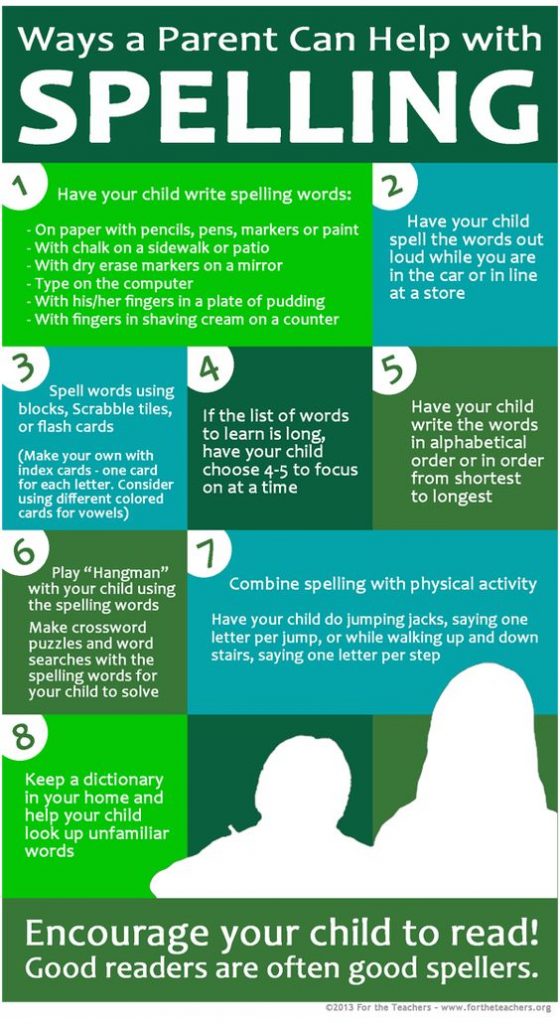
You may think to yourself, “I am not a trained educator.” That doesn’t matter. You have to become assertive and seek out resources that will make you the best parent-educator that you can be. Take spelling for instance. In the elementary grades, your child will be expected to learn how to spell a plethora of words. To assess how well they are doing, their teacher will usually have weekly spelling tests. Parents are expected to help their child prepare for these tests. You don’t have to be a trained educator for this, and there are plenty of resources that will help you choose the best strategies. For instance, we found this fantastic graphic that lists 8 ways parents can help their child with spelling. These tips and strategies will turn you into a world class spelling coach and may turn your child into a spelling bee champion.
As you can see, helping your child academically is not as hard as it seems. Remember, you don’t have to be perfect, you have to be committed.
If you want to market to the P-20 arena’s most influential audience, then The Edvocate is your publication of choice. The Edvocate is the fastest growing online destination for the P-20 market. Our readers are:
Highly educated and place a premium on quality education
Professionally upwardly mobile
Socially committed men and women engaged in their communities
Decision-makers in both the public and private sector
Passionate advocates for equality, access and opportunity for all
Because the editorial content is credible, relevant and unique to The Edvocate, our readers trust and rely on us. When great value is attached to a publication’s editorial, that value is also passed on to the advertising messages found within that publication. This makes The Edvocate the perfect medium to communicate in and reach a unique, target audience.
Readership
160,000 unique visitors per month, 340,000 visits per month, and 4,800,000 million page views per month.
Newsletter
135,000 opt-in subscribers and growing.
Online Display Ads, Advertorials, Sponsored Articles, etc.
Whether you want branding, lead generation, a call to action, thought leadership, or any combination of these results, we have programs that can meet all of your marketing needs. Click here to access our media kit. If you have any questions, contact an Ad Manager at 601-630-5238 or send an email to [email protected].
Product Reviews
Would you like The Edvocate to review your education related product? Contact us for more details. Because of the time consuming nature of the review process, we charge a fee to conduct product reviews. The fee depends on the complexity of the review. Email us for a quote.
Cause and effect aren’t always clearly and correctly paired in America’s classrooms.
Teachers don’t always have the time, energy, or awareness to properly attribute underperformance.
Is a disengaged student sleeping at his or her desk being lazy or suffering from lack of sleep?
Is disruptive behavior the reflection of student boredom or a cover for not understanding the material?
Is a sudden drop in academic performance really indicative of intelligence or simply a need for reading glasses?
Are poor test scores more a reflection on the teacher’s failings or a lack of support and encouragement for students at home?
Fundamental Attribution Error: School Edition
The gap of understanding in the classroom can be compared to how road rage incidents get escalated.
Suppose you fail to notice a light turning green at an intersection. You might explain your negligence in any number of ways — you were caught up in a song playing on the radio, you were monitoring the progress of a pedestrian nearby, you were investigating the car behind you via rearview mirror — all of which emphasize external factors, rather than individual failings.
Now suppose you were behind a car that wasn’t moving after the light turned green. Same situation, same outcome, but many people would instinctively blame that driver in more intrinsic ways — the driver was being stupid, careless, selfish, etc.
This is the essence of fundamental attribution error: we look outside ourselves to explain behavior, but focus on internal factors to explain the behavior of others.
We see a similarly challenged dynamic in dating and romantic relationships. In the absence of good communication, each member of a couple is prone to developing his or her own narrative to explain behaviors, perceived emotions, and even the successes and failures of a couple. When he comes home at night, is he being dismissive and distant because something is wrong with the relationship, or simply because he hasn’t stopped worrying about a bad day at work? Is she struggling to come up with a diner destination because she doesn’t know what she wants, or is she being purposefully passive-aggressive?
When applied to academic settings, the same fallacy is apparent. Both students and teachers are accused of not caring enough to try harder or perform better. A national preoccupation with educational outcomes — the effect we look for from our schools — has exacerbated a lack of understanding about the inputs, or causes.
Looking Upstream in Education
It is human nature to look for patterns; in the absence of clear, verifiable patterns, it is also human nature to invent patterns even in spite of evidence. In sports, for example, this can manifest as superstition:
don’t shave during Stanley Cup Playoffs
don’t wash your team jersey until the season is over
don’t curse a pitcher by saying he is on track to throw a perfect game, etc.
The outcome — surviving playoffs, having a good season, pitching a perfect game — clearly has no measurable or meaningful connection to the behaviors extolled, but the belief in their significance continues undeterred. In social contexts, a similar fallacy prevents us from correctly attributing effects to their causes. In education, it is possible we have focused on desired outcomes that fail to account for the power of confounding variables.
The variables of student life today are too many to count: from home life, social life, and social media, to the quality of instruction, the presence of role models, and even the medium of instruction and assessment, there are a lot of variables getting in the way of assigning cause and effect.
To move beyond fundamental attribution error, or falling into the old habit of superstition, it is important to spend more time and energy looking upstream for the real causes that need our attention. Going upstream is a principle of public health in which caregivers go beyond treating symptoms and instead look for opportunities to prevent sickness and injury. Businesses engaged in corporate social responsibility and other forms of social entrepreneurship take a similar approach: throwing money at a problem or social ill no longer impresses consumers or shareholders. Looking upstream for opportunities to meaningfully impact communities and benefit the world not only makes for a better story, it makes for more lasting forms of giving.
Both of these examples apply in education as well. By going upstream to understand what drives student performance, classroom behavior, and any other outcomes we care to monitor, we can better connect cause and effect and control for other variables. Going upstream in education isn’t just a matter of more spending or more resources, but of aiding teachers, administrators, and the general public to focus on what really drives outcomes.
When we stop focusing on outcomes to the exclusion of understanding inputs, we create a machine for using money and resources without generating improved results. When we go upstream to identify the real cause and effect relationship surrounding school, we can put our resources where they will have the greatest benefit.
As students get set to embark on their coveted winter break plans, parents should be prepping on how to combat the dreaded “winter slide” that can impact their very own kids. Days and even weeks out, students can begin to “coast” and quickly lose momentum in school.
Despite the fact that it’s not as long as the three-month break that kids typically refer to as the “summer slide,” the two to four weeks that students go without any educational activity can truly be detrimental to their long-term academic success, including core subjects such as math and science.
Parents have several opportunities to keep their children’s minds engaged and active, ready for the next semester or quarter. Here are some simple tips and best practices:
Have Them Help Plan a Long Drive or Vacation. Many families will embark on a vacation over the break, or drive far distances to visit relatives. If this is the case, make sure to include your child in the planning process. For example, have them figure out mileage between points A and B and the stops in between. Also prior to the trip, have them read up on your destination and put together a report of what to expect. It should include what the destination is best known for, wildlife that can be found there and a brief history of the area. Getting your child immersed in the culture and geography of your destination will help develop and strengthen their research skills and make them more aware of the world around them.
Involve Them in Meal Planning and Cooking. The kitchen is a great way for parents to reinforce the importance of following directions and managing time. For those opting to stay at home during the break, make it a point to involve your children in meal planning and cooking. These are crucial developmental skills and key elements to help improve your child’s organizational skills.
Work On a Project Together. The holidays are a great time to sit down with your child and work on a project together. Have them read aloud the instructions for assembling new equipment while you put it together. Or, if you are wanting to build something that requires cutting, have your child do the measuring before you start sawing or drilling. The skills your child will take away from this exercise is the importance of following steps and directions. It will also give them a good example of how you should work with others to achieve things that may be difficult for one person to perform.
Encourage Them to Be the Family’s News Reporter. Visit local zoos, botanical gardens or any place in your community where kids can see and learn about new things. If traveling, encourage them to bring a journal and record observations with drawings or brief written descriptions. Having your children share with you the highlights of their day will help with memory recollection and store noteworthy events.
It is perfectly alright to let your children enjoy holiday festivities. But, it is equally important to make sure they also spend time improving their brain function and keeping the information they spent months learning fresh in their heads as they head into the second half of the year. Relaxing is always a good thing, but too much can be detrimental and cause your kids and students to succumb to the dreaded “winter slide.”
Frank Milner is the president of Tutor Doctor, the top in-home tutoring franchise that offers students a personalized, one-to-one, in-home tutoring service to all ages. Milner has been at the helm of Tutor Doctor since 2007, after recognizing the company’s ability to help children across the world with its unique alternatives to the “one-to-many” teaching model that most extra-curricular learning centers offer. Milner’s daughter once struggled with what he calls “math meltdowns,” and understands that privacy and one-to-one learning allow for unlimited growth potential in a student. Milner is a firm believer that academic success can be achieve through two components – academic foundation buildings and academic discipline – and he carries that mindset into new cities and countries around the globe.
Globally, the U.S. is at risk of declining economic competitiveness due to its continuing lower levels of educational attainment in science, technology, engineering, and mathematics (STEM).
The U.S. currently ranks 44th according to the quality of its mathematics and science education.
A “leaky STEM pipeline” – in which factors such as lower expectations, discrimination, and a lack of interest make it less likely that racial or ethnic minorities, women or those from low-income families will pursue STEM careers – makes many adults less likely to be employed in these types of positions.
Yet STEM positions are often high-paying and provide greater economic well-being and employment stability, especially as the U.S. transitions to a knowledge-based economy.
Efforts that increase schoolchildren’s science achievement – particularly those from diverse, traditionally marginalized populations – could help provide children with greater future employment opportunities while ensuring that the U.S. remains economically competitive.
The question is, when should these efforts begin? That is, how early do leaks in the STEM pipeline begin to occur?
Science achievement gaps
My research seeks to understand why some groups of children are more likely to struggle academically in U.S. schools. To date, I have been reporting on factors that increase children’s risk for lower achievement in reading and mathematics.
Researchers have found that large science achievement gaps occur within the U.S. These gaps are very large by middle school, and they are disproportionately experienced by children who are racial or ethnic minorities, English Language Learners (ELLs), and those from lower-income families.
For example, 63 percent of U.S. eighth graders who are black display “below basic” (that is, less than partial mastery of knowledge and skills necessary for grade level work) levels of science achievement. The contrasting percentage for white children is 20 percent. While 52 percent of low-income children display below basic levels of science achievement, only 20 percent of higher-income children do so.
Yet why these science achievement gaps are occurring has been unclear.
Very few studies have examined children’s science achievement across time. Most studies have used samples of middle or high school students. As a result, when science achievement gaps begin to occur has not been well understood.
Here’s what our study shows
To better understand these science achievement gaps, we analyzed a nationally representative sample of U.S. schoolchildren as they entered kindergarten and then continued through elementary and middle school.
The data were collected by the U.S. Department of Education, and designed to be representative of the population of children who entered U.S. kindergarten classrooms in 1998-1999.
The data included children’s reading and mathematics achievement, their classroom behavior, and many characteristics of their families and schools. Such characteristics included the quality of the children’s parenting, their family’s income, and the racial segregation of their schools. From third grade to eighth grade, the surveys included a measure of children’s science achievement.
During kindergarten and first grade, the surveys assessed children’s general knowledge about their natural (e.g., the seasons, the lunar phases, erosion) and social worlds (e.g., what a fireman does, what planes and trains have in common).
Our analyses of these data yielded three surprising findings.
First, we found that very large gaps in general knowledge were already evident among children entering kindergarten classrooms in the U.S. For example, about 60 percent of black children scored in the bottom 25 percent on the general knowledge measure. The contrasting percentage for white children was 15 percent.
About 65 percent of low-income children entered kindergarten with low levels of general knowledge. Only 10 percent of high-income children did so. The general knowledge and science achievement gaps in kindergarten were even larger than the reading or mathematics achievement gaps.
In other words, leaks in the STEM pipeline were originating “close to the tap.”
The second surprising finding was that general knowledge gaps by kindergarten strongly predicted science achievement gaps by third grade. For example, of those whose general knowledge was in the lowest 25 percent during kindergarten, 62 percent, 60 percent and 54 percent had levels of science achievement in the lowest 25 percent at the end of third, fifth or eighth grade, respectively.
This suggests that children who are already struggling with low levels of general knowledge in kindergarten are likely to still be struggling in science throughout elementary and middle school.
Children’s general knowledge was a stronger predictor of third grade science achievement than race/ethnicity, reading or mathematics achievement, classroom behavior or family income.
Both the general knowledge and science achievement gaps were very stable over time.
Children who are racial or ethnic minorities, English Language Learners or from low-income households displayed lower levels of science achievement by third grade and typically continued to lag behind throughout elementary and middle school. Girls displayed relatively lower science achievement than boys in third grade.
Closing these gaps
Our third finding was more encouraging. We found that we could explain most of these general knowledge and science achievement gaps. And this could help inform efforts by parents, practitioners, and policymakers to close these gaps.
For example, we were able to explain 75 percent of the third grade science achievement gap between black and white children as well as 97 percent of the gap between low- and high-income children.
Factors that helped explain science achievement gaps included children’s reading and mathematics achievement, their behavior and, most importantly, their general knowledge.
Helping young children to be more knowledgeable about their physical and social surroundings, as well as to be better at reading and mathematics, may increase their science achievement as they grow older.
Asking children questions about their surroundings while encouraging and extending their initial explorations could help them improve their general knowledge and science achievement.
Encouraging policies that lead to high-quality childcare for children most at risk could reduce these gaps. Policies that counter the racial segregation of U.S. schools might also be helpful.
It is never too late to help children grow to be successful. But if we are really serious about their as well as our nation’s future opportunities, we will do more to help all children begin kindergarten already knowledgeable about their natural and social worlds.
Collective, coordinated, and sustained efforts by parents, practitioners, and policymakers during children’s early school careers could make all the difference.
**The Edvocate is pleased to publish guest posts as way to fuel important conversations surrounding P-20 education in America. The opinions contained within guest posts are those of the authors and do not necessarily reflect the official opinion of The Edvocate or Dr. Matthew Lynch.**
A guest post by Anica Oaks
While there is a current push toward private education in many circles in today’s society, the reality is that there are many happy, well-rounded, and well-educated children from both private and public institutions. It really does come down to choosing what’s best for your child. However, that choice isn’t an easy one. As you weigh the decision of private versus public, it’s important that you consider the advantages of each as well as your child’s actual needs. You should also ask some important questions before making the decision so that you are fully informed.
Benefits of Public Education
The news is often touting the shortfalls of the public school system; however, it actually offers a number of benefits that you might not otherwise recognize. If you’re considering private versus public education, be sure to include these benefits in your deliberation:
More qualified teachers: Teachers in the public sector are more likely to have master’s degrees and to have spent more hours pursuing continuing education courses.
More time on core subjects: A national report found that students in public schools actually spend an additional three hours every week studying the core subjects of English, math, social studies, and science compared to their private school counterparts.
More diversity: Public schools are available to students of any race and socioeconomic status, which creates more diverse student population.
Advantages of Private Education
That being said, the private school system also offers a number of advantages to its student population. While you are likely more aware of many of the benefits of private education, it is still important to keep these in mind:
Smaller schools and class sizes: Statistics indicate that private schools on average are half as large as public schools. Just as schools are smaller, so are the class sizes, offering an average student-teacher ratio of 9:1 compared to 17:1 in public school classrooms.
Less bureaucracy: Private schools aren’t mandated by all of the state regulations that public systems are, which results in less bureaucracy.
High parent involvement: Parents who invest in private education typically have a strong say in their children’s educations, so private schools lend themselves to high parent involvement.
Finding the Best Fit for Your Child
It’s tempting to rely on what everyone else is saying about a school when you are making your decision. But, you truly need to focus on what is best for your child. Consider the options, which range from your typical brick and mortar public schools to more contemporary charter schools, and be sure to visit and ask questions to find what works best for your child.
As you make your decision, ask about the curriculum, student-teacher ratio, and even the school’s expectations for parents. Having all of this information up front will help you make an informed decision for your child.
Selecting the right school for your child is important. Take the time to consider the advantages of public and private options and ask questions to find the right fit for your child.
___
Anica is a professional content and copywriter who graduated from the University of San Francisco. She loves dogs, the ocean, and anything outdoor-related. She was raised in a big family, so she’s used to putting things to a vote. Also, cartwheels are her specialty. You can connect with Anica here.
Students benefit when there are parent-school partnerships surrounding their school work. However, it is not always easy to promote such a culture of shared responsibility, especially given the great time demands placed on parents and teachers today. Schools may face difficulty in attaining an efficient collaborative framework among stakeholders, which include teachers, parents, students, the community, and the administration. Trust between schools and parents, in particular, is vital for creating a healthy learning environment.
So what can be done to foster stronger relationships between parents and teachers, administrators and whole schools?
1. Encourage collaboration. In general, parents who are supported by regular interactive meetings with teachers often show greater trust levels in teacher-parent relationships. Schools can create an environment favorable for the development of teacher-parent relationships by sharing the responsibility of improving learning processes and the academic performance of children. Many schools that claim to support collaborative decision-making patterns hold complete decision-making authority in their own hands, which can reduce the positive influence of collaborative decision-making pattern. Let parents feel empowered in the learning paths of their kids by allowing them certain input and choices.
2. Work toward creating a friendly school environment. A healthy and congenial school environment, with an enabling and flexible structure, can help develop trust between school administrators and parents. Generally, education and school leaders try to generate a social framework that will help teachers, administrators, and parents resolve differences in a peaceful and supportive manner. Overall improvement of student performance can be the outcome of improved relationships between teachers and parents.
3. Reduce bureaucratic barriers. Many times, barriers are created that prevent teachers from developing effective student-teacher relationships and discourage parents from taking part in helping students develop their learning skills. A parent who feels that his or her input is not wanted may give up on trying to be an influential part of his or her child’s life. The bureaucratic system of schools should allow plenty of room for parent and student input – and then take that feedback seriously. The centralized or hierarchical authority of schools can be used to implement these supportive regulations and policies to enhance parental involvement. Both can work together for a better outcome for the students.
4. Respect the deep-rooted importance of family. Parental involvement in education and its effect on the academic performance of a child requires recognizing the fact that parents are children’s first teachers. Home is the first school, and as such, it is the place where children learn an abundance of skills, knowledge, and attitudes, some of which supports what is taught in schools. It’s true that some parents are more involved in the academic strides of their children than others – but with the right encouragement, teachers and schools can give parents the tools and encouragement needed to help their children succeed to the next level.
When parents get involved with their children’s educations, the children tend to succeed academically, and tend to perform better on exams (which, as we all know, is certainly helpful to teachers). They miss fewer school days and tend to be more conscientious about completing school-related work outside of school.
Conversely, children whose families are not as involved in their school experiences are often unable to compete academically with peers, their attendance is less regular, and they are less likely to graduate from high school. Clearly, any movement toward building a stronger relationship between schools and parents will have a positive impact on student performance. Involved parents are the key to success when it comes to the improvement of K-12 students inside classrooms – and teachers, administrators and schools should encourage parents to play that pivotal role.
If you are a parent or a teacher, you most probably read stories to young children. Together, you laugh and point at the pictures. You engage them with a few simple questions. And they respond.
So what happens to children when they participate in shared reading? Does it make a difference to their learning? If so, what aspects of their learning are affected?
Shared reading for language development
British researcher Don Holdaway was the first to point out the benefits of shared reading. He noted that children found these moments to be some of their happiest. He also found that children developed positive and strong associations with spoken language and the physical book itself, during these moments.
Since then a number of studieshave been conducted showing the value of shared reading in children’s language development, especially in vocabulary and concept development.
Early childhood researcher Vivian Paley, for example, during her work in the University of Chicago Laboratory Schools, found that kindergarten children learned when a story was dramatized in shared reading. Not only did children develop oral language, they imaginatively learned the conventions of a story, such as character, plot and themes. In shared storytelling, children also learned how to use language in multiple ways.
As a language and literacy researcher, I work with teachers to develop reading strategies that develop children’s interest in reading and help them think critically. Kay Cowan, an early childhood researcher who studies the role of the arts in language learning, and I conducted two studies to understand children’s language development in grades one to five.
Grade 5 child generates vocabulary through shared reading. Kay Cowan, CC BY
We worked with approximately 75 children across grade levels. We began our language study by talking with the students about the power of words, and the role they play in and outside of school. Following this, we discussed the pleasures associated with words. We then read “Shadow,” an award-winning picture book by children’s author Marcia Brown, and poems by Shel Silverstein, another children’s author.
Children were then asked to think of an “absolutely wonderful” event that they had experienced, and associate an emotion with it. Children chose a personal event that elicited emotions. They then drew contrasting images of the word that showed opposite emotions, and studied synonyms and antonyms to understand the “shades of meaning.” They then wrote descriptive poetry to convey this emotion.
All children – even those who were at the risk of failing – used vivid language. Children described words like “ebullient” and “melancholy” in ways that related to their own emotion.
One child described her word “ebullient” as “bright,” and “merry,” and “never asking for anything.” “Ebullient” was also “warm,” and “gypsy-like,” and so on. Another described loneliness as “…making me feel cold/Like an icicle/wanting to melt away.”
Following this exercise, children noticed that their writing was much better. It showed us how wide and varied reading, repetition and varied encounters with words were extremely important for children to have a depth of understanding as well as verbal flexibility – being able to express the meaning of word in different ways.
Why home matters
The quality of exchanges between children and adults during shared reading is found to be critical to their language development. So, the role of home in shared reading is crucial.
Long-term studies by linguistic anthropologist Shirley Brice Heathand otherliteracy scholars have documented children’s ability to read as related to their families’ beliefs about reading, the quality of conversation at home and access to print materials prior to their entry into school.
For 10 years, Heath studied two communities a few miles a part, one black working-class and one white working-class. She documented how family practices (e.g., oral storytelling, reading books, talk) influenced children’s language development at home and in school. For example, children read and talked about stories, were asked questions about the stories or told stories about their lives, events and situations in which they were involved. Parents engaged their children in these experiences to prepare them to do well in school.
Similarly, researcher Victoria Purcell-Gatesworked with an Appalachian family, specifically mother Jenny and son Donny, to help them learn to read. With Jenny, they read and talked about picture books, listened to and read along with books on tape and wrote in a journal. With Donny, they shared reading, labeled pictures and wrote stories. Jenny was able to read picture books to her sons, while Donny learned to write letters to his dad in prison.
Other researchers have found that when parents, specifically mothers, knew how to interact with their children during shared reading using positive reinforcement and asking questions about the story, both children and mothers benefited.
Mothers learned how to ask open-ended questions, and prompted their children to respond to stories. Children were more engaged and enthusiastic about the shared reading experience. They also were able to talk more about the story’s content, and were able to talk about the relationship between pictures and story.
Children more readily learn math concepts like numbers, size (bigger, smaller) and estimation/approximation (lots, many) when parents engaged in “math talk” while reading picture books.
Shared reading in a digital world
While shared reading is often associated with print books, shared reading can be extended to digital texts such as blogs, podcasts, text messages, video and other complex combinations of print, image, sound, animation and so on.
Good video games, for example, incorporate many learning principles, such as interaction, problem-solving and risk-taking, among others. As in shared reading, children interact with their parents, teachers or peers as they engage in stories.
South African children share reading on computer. Amy Seely Flint, CC BY
Literacy researcher Jason Ranker’s case study of eight-year-old Adrian shows that young children can actually “redesign” how stories are read, discussed and told when they engage actively with video game narratives.
Adrian, who played a video game, Gauntlet Legends, created a story in Ranker’s class, to which he added many drawings to show the movement of characters.
In this case study, Ranker found that children like Adrian who play video games learn how to produce stories that do not follow the linear pattern found in print stories (exposition, climax, resolution). Rather, children experience stories at “levels” that allow characters and plots to move in many directions, eventually coming to resolution.
Similarly, children with access to certain apps are coordinating their storytelling on a touchscreen. They choose characters for their stories. They move them around with their fingers, and drag-and-drop them in and out of the story. If they want to create more complex stories, they work with others to coordinate characters’ movements. Sharing stories, then, becomes collaborative, imaginative and dynamic through these digital mediums.
Children, in essence, have redesigned how stories are told and experienced, demonstrating imagination, vision and problem-solving.
One thing that is clear across research is that rich complex language development does not happen merely by pointing at letters or pronouncing words out of context. It is engagement, and guided attention to language conventions, that matter in shared reading.
Ultimately, what is important is that shared reading must be a joyful experience for the child. Sharing stories must allow for a personal connection and allow for interaction and a shared learning.
Have you ever felt deserving of an apology and been upset when you didn’t get one? Have you ever found it hard to deliver the words, I’m sorry?
Such experiences show how much apologies matter. The importance placed on apologies is shared by many cultures. Diverse cultures even share a great deal in common when it comes to how apologies are communicated.
When adults feel wronged, apologies have been shown to help in a variety of ways:
Apologies can reduce retaliation; they can bring about forgiveness and empathy for wrongdoers; and they can aid in the repair of broken trust. Further, sincere apologies have the physiological effect of lowering blood pressure more quickly, especially among those who are prone to hold on to anger.
How do children view and experience apologies? And what do parents think about when to prompt their young ones to apologize?
Children as young as four understand the emotional meaning of an apology. Funkyah, CC BY-NC-ND
Recent studies have tested the actual impact of apologies on children. In one such study, a group of four- to seven-year-olds received an apology from a child who failed to share, while another group did not get an apology. The participants who received the apology felt better and viewed the offending child as nicer as well as more remorseful.
Another study exposed children to a more distressing event: A person knocked over a tower that six- to seven-year-olds were building. Some children got an apology, some did not. In this case, a spontaneous apology did not improve children’s upset feelings. However, the apology still had an impact. Children who got an apology were willing to share more of their attractive stickers with the person who knocked over the tower compared to those who did not get an apology.
This finding suggests that an apology led to forgiveness in children, even if sadness about the incident understandably lingered. Notably, children did feel better when the other person offered to help rebuild their toppled towers. In other words, for children, both remorseful words and restorative actions make a difference.
When does a child’s apology matter to parents?
Although apologies carry meaning for children, views on whether parents should ask their children to apologize vary. A recent caution against apology prompting was based on the mistaken notion that young children have limited social understanding. In fact, young children understand a great deal about others’ viewpoints.
When and why parents prompt their children to apologize has not been systematically studied. In order to gain better insight into this question, I recently conducted a study with my colleagues Jee Young Noh and Michael Rizzo at the University of Maryland and Paul Harris at Harvard University.
We surveyed 483 parents of three- to 10-year-old children. Most participants were mothers, but there was a sizable group of fathers as well. Parents were recruited via online parenting discussion groups and came from communities all around the U.S.. The discussion groups had a variety of orientations toward parenting.
In order to account for the possibility that parents might want to show themselves in the best light, we took a measure of “social desirability bias” from each parent. The results reported here emerged after we statistically corrected for the influence of this bias.
We asked parents to imagine their children committing what they would consider to be “transgressions.” We then asked them how likely they would be to prompt an apology in each scenario. We also asked parents to rate how important they felt it was for their children to learn to apologize in a variety of situations. Finally, we asked the parents about their general approaches to parenting.
The large majority of parents (96 percent) felt that it was important for their children to learn to apologize following an incident in which children upset another person on purpose. Further, 88 percent felt it was important for their children to learn to apologize in the aftermath of upsetting someone by mistake.
Fewer than five percent of the parents surveyed endorsed the view that apologies are empty words. However, parents were sensitive to context.
Parents reported being especially likely to prompt apologies following their children’s intentional and accidental “moral transgressions.” Moral transgressions involve issues of welfare, justice, and rights, such as stealing from or hurting another person.
Parents viewed apologies as relatively less important following their children’s transgressions of social convention (e.g., breaking a rule in a game, interrupting a conversation).
Apology as a way to mend rifts
It’s noteworthy that parents were very likely to anticipate prompting apologies following incidents in which their children upset others on purpose and by mistake.
This suggests that a focus for many parents, when prompting apologies, is addressing the outcomes of their children’s social missteps. Our data suggest that parents use apology prompts to teach their children how to manage difficult social situations, regardless of underlying intentions.
For example, 88 percent of parents indicated that they would typically prompt an apology if their child broke a peer’s toy by mistake (in the event that the child did not apologize spontaneously).
Indeed, parents especially anticipated prompting apologies following accidental mishaps that involved their children’s peers (and not parents themselves as the wronged parties). When a child’s peer is a victim, parents likely recognize that apologies can quickly mend potential interpersonal rifts that may otherwise linger.
We also asked parents why they viewed apology prompts as important for their children. In the case of moral transgressions, parents saw these prompts as tools for helping children take responsibility. In addition, they used apology prompts for promoting empathy, teaching about harm, helping others feel better and clearing up confusing situations.
However, not all parents viewed the importance of apology prompting in the same way. There was a subset of parents who were relatively permissive: warm and caring but not overly inclined to provide discipline or expect mature behavior from their children.
Most of these parents were not wholly dismissive of the importance of apologies, but they consistently indicated being less likely to provide prompting to their children, compared to the other parents in the study.
When to prompt an apology
Overall, most parents in our study viewed apologies as important in the lives of children. And the child development research described above indicates that many children share this view.
But are there more and less effective ways to prompt a child to apologize? I argue that parents should consider whether a child will offer a prompted apology willingly and sincerely. A recently completed study sheds some light on why.
In this study – currently under review – we asked four- to nine-year-old children to evaluate two types of apologies that were prompted by an adult. One apology was willingly given to the victim after the apology prompt; the other apology was given only after additional adult coercion (“You need to say you’re sorry!”).
We found that 90 percent of the children viewed the recipient of the prompted, “willingly given” apology as feeling better. However, only 22 percent of the children connected a coerced apology to improved feelings in the victim.
So, as parents ponder the merits of prompting apologies from children, it seems important to refrain from pushing one’s child to apologize when he or she is not ready, or is simply not remorseful. Most young children don’t view coerced apologies as effective.
In such cases, interventions aimed at calming down, increasing empathy and making amends may be more constructive than pushing a resistant child to deliver an apology. And, of course, components like making amends can accompany willingly given apologies as well.
Finally, to arguments that apologies are merely empty words that young children parrot, it’s worth noting that we have many rituals that involve rather scripted verbal exchanges, such as when two people in love say “I do” at a wedding or commitment ceremony.
Just as these scripted words carry deep cultural and personal meaning, so too can other culturally valued verbal scripts, such the words in an apology. Thoughtfully teaching young children about apologizing is one aspect of teaching them how to be caring and well-regarded members of their communities.
Now that the first month of school is over, parents can get ready for the next milestone of the school year – they will soon get reports of the state tests their children took last year.
My estimates show that approximately 26 million students in public schools took statewide tests in reading and math last year. Many of them also took statewide tests in science. These tests provide important information to parents about how well their children are doing in school.
However, my research also shows that when parents receive their child’s test score report, they may have a tough time separating the important information from the statistical gibberish.
What’s more, the results might not even give them accurate information about their child’s academic growth.
Is your child ‘proficient’?
The No Child Left Behind law, enacted in 2002, required all states to set “achievement level standards” in reading and math for grades three through eight, and for one grade in high school, typically 10th or 11th grade. States were also required to develop tests to measure students’ level of “proficiency” on each test.
As a result, the test reports parents receive classify children into achievement levels such as “basic” or “proficient.” Each state decides what these classifications are called, but at least one category must signify “proficient.”
These achievement level categories are described on the test score reports, and so this information is easily understood by parents. For example, I find it helpful each year to see if my sons reach proficiency in each subject area.
But children’s test scores in a given year, and their achievement level, are not the only information reported in some states. A new statistical index, called a “student growth percentile,” is finding its way into the reports sent home to parents in 11 states. Twenty-seven states use this index for evaluating teachers as well.
Although a measure of students’ “growth” or progress sounds like a good idea, student growth percentiles have yet to be supported by research. In fact several studies suggest they do not provide accurate descriptions of student progress and teacher effectiveness.
What does it mean?
What exactly are “student growth percentiles”?
They are indexes proposed in 2008 by Damian W. Betebenner, a statistician who suggested they be used as a descriptive measure of students’ “academic growth” from one school year to the next. The idea was to describe students’ progress in comparison to their peers.
Like the growth charts pediatricians use to describe children’s height and weight, student growth percentiles range from a low of one to a high of 99. However, their calculation involves a lot more error than physical measurement such as height and weight. Our research at the University of Massachusetts Amherst indicates substantial error in their calculation.
Student growth percentiles are derived from test scores, which are not perfectly accurate descriptions of students’ academic proficiency: Test scores are influenced by many factors, such as the questions asked on a particular day, students’ temperament, their level of engagement when taking the test or just the methods used to score their answers.
Each student’s growth percentile is calculated using at least two different test scores, typically a year or more apart. The most recent test scores of a student are then compared to the most recent test scores of students who had similar scores in previous years. This is to see which of those students had higher or lower scores this year.
The problem, however, is that each of the calculations carries some measurement error. Further calculations only compound that error. So much so that the results end up with twice as much error. No statistical sophistication can erase this error.
The question is, why are so many states using such an unreliable measure?
Using it for accountability
The use of student growth percentiles is due in part to a desire to see how much students learn in a particular year, and to link that progress to accountability systems such as teacher evaluation.
In 2010, the Race-to-the-Top grant competition invited states to come up with innovative ways of using test scores to evaluate teachers, which paved the way for this new measure of “growth” to be quickly applied across many states.
However, the use of student growth percentiles began before research was conducted on their accuracy. Only now is there a sufficient body of research to evaluate them, and all studies point to the same conclusion – they contain a lot of error.
In addition to our research at the University of Massachusetts Amherst, research on the accuracy of student growth percentiles has been conducted by education nonprofits such as WestEd, Educational Testing Serviceand other research institutions. Researchers J.R. Lockwood and Katherine E. Castellanorecently concluded that “A substantial research base already notes that student growth percentile estimates for individual students have large errors.”
However, many states seem to be unaware of these research findings. Massachusetts even goes so far as to classify children with growth percentiles less than 40 as “lower growth” and children with growth percentiles greater than 60 as “higher growth.”
Measuring teacher performance
As I mentioned earlier, 27 states are using student growth percentiles to classify teachers as “effective” or “ineffective.” Research on the use of growth percentiles for this purpose indicates they could underestimate the performance of the most effective teachers, and overestimate the performance of the least effective teachers – the exact opposite of what these states are trying to do with their teacher evaluation systems.
A recent report by WestEd evaluated the use of student growth percentiles for evaluating teachers and concluded they “did not meet a level of stability” that would be needed for such high-stakes decisions.
Let’s go back to traditional measures
I believe student growth percentiles have taken us a step backwards in the use of educational tests to improve student learning.
Traditional measures of children’s performance on educational tests, such as whether they are “proficient” in a given year and their actual test scores, give a good idea of how well they performed in math or reading in a particular year.
These traditional percentile ranks are still reported on many educational tests, just like they were when we as parents were in school. Traditional percentile ranks compared us to a national or state group in a given year, rather than comparing us to how other kids in the nation or state were “growing” across different tests they took in different years, as student growth percentiles attempt to do.
Given what we now know about student growth percentiles, my advice to parents is not only to ignore them on their children’s test score reports, but also to contact their state department of education and ask why they are reporting such an unreliable statistic.
Developing measures of how much students have learned over the course of a year is a good goal. Unfortunately, student growth percentiles do not do a good job of measuring that.