Teaching Strategies, Tactics, and Methods

Teaching Students About Hexagons

Hexagons are 2D geometric polygons known for being in honeycombs and pencils. A hexagon has six sides and six interior angles.

What is a regular hexagon shape?

A regular hexagon is a 2D geometric polygon with six sides equal in length and six angles that are equal in size. It has no curved sides, and all the lines are closed. The sum of the interior angles of a hexagon is 720 degrees. These shapes also have six rotational symmetries and six reflectional symmetries.

The picture below shows a regular hexagon.

There are three properties that a regular hexagon must have:

  • All sides of the hexagon have to be equal in length.
  • The interior angles must measure 120 degrees each.
  • If you add all the interior angles together, they must equal 720 degrees.

Here’s an interesting fact:

You can split a hexagon up into six equilateral triangles. These will all be the same size and can fit back together like a honeycomb. When we do this with lots of hexagons, it’s known as tessellation.

What is an irregular hexagon shape?

An irregular hexagon has six sides and six angles that vary in length and size. This can lead to strange shapes you may not instantly recognize as hexagons. However, there are an infinite number of ways that you can align six sides to create a hexagon.

Here are a few different irregular-looking hexagons. Why don’t you try drawing a few more with your students?


How many sides does a hexagon have?

All hexagons have six sides, regardless of the type of hexagon. This means all have six sides: regular hexagons, concave hexagons, and convex hexagons.

How many angles does a hexagon have?

A hexagon has six angles because it has six vertices. Therefore, the interior angles of a regular hexagon add up to 720º, and each interior angle of a regular hexagon is 120º.

If your hexagon is irregular, all the angles could be different sizes. However, even if this is the case, they’ll still add up to720º.

Did you know that there are not just interior angles but exterior ones too?

Whereas the interior angles add up to720º, the exterior angles add up to 360º. You might be thinking that you’ve heard that number somewhere else. That’s because you have!

A circle is a 360º round. If you draw it correctly, you can fit a regular hexagon inside a circle. The corners of the hexagon should touch the circle six times round.

You might wonder who found out how many angles are in a hexagon. Well, it dates back to the Romans. In 36 BC, Roman philosophers were pondering the honeycomb hexagon shape. It turns out that it’s one of the most mathematically perfect forms. It’s also the most efficient packing method.

How many corners does a hexagon have?

Wondering how many corners a hexagon have? Well, since all hexagons have six sides, six vertices, and six angles, all hexagons have six corners too. This is always the case, and it does not matter what type of hexagon it is. So that means that regular hexagons, irregular hexagons, concave hexagons, and convex hexagons have six sides, six vertices, six angles, and six corners each.

Hexagon lines of symmetry

A regular hexagon has rotational symmetry. This means that when it is rotated on its axis, the shape of a regular hexagon looks the same. The rotation angle is 60°, and the order of the rotational symmetry is 6.

How symmetry lines does a hexagon have?

Regular hexagons have six lines of symmetry. You’ll find three along the lines that join the midpoints of its opposite sides and three more along the diagonals. This means that a regular hexagon has ‘reflection symmetry.’

To find a hexagon’s, or any shape’s, line(s) of symmetry, you must fold it. If the folded parts sit identically on top of each other, will all the edges match, then the fold line the line of symmetry? Some shapes have multiple lines of symmetry, like a regular hexagon, so fold the shape differently to see how many lines of symmetry it has.

Types of Hexagons

There are four main types of hexagons: regular, irregular, concave, and convex. We’ve already looked into the first two, so let’s investigate the latter.

What’s a concave hexagon?

A concave hexagon has an angle or angles that point inwards. If you measure this angle’s total, it will be more significant than 180 degrees.

This is the defining characteristic of a concave hexagon, and if your hexagon doesn’t have an inward pointing angle, it doesn’t count as a concave hexagon.

A concave hexagon has one line of symmetry across its middle. To check where the line of symmetry is on a concave hexagon, you must fold the shape in half horizontally, ensuring that all the corners are perfectly matched.

What is a convex hexagon?

A convex hexagon has no angles that point inwards, similar to a regular hexagon. Although both these types may look similar, make sure not to confuse them with each other, as a convex hexagon may not have sides of the same length or angle.

Plus, there are no lines of symmetry on a convex hexagon.

Where can I see hexagons in everyday life?

Do you think a specific shape, such as a hexagon, can appear in the world? If you look closely, you can see most shapes in everyday life. Here are a few examples of where you might find hexagons.

If you look closely, you can see most shapes in everyday life, but here are a few examples of where you might find hexagons:

  • Beehives: The most common hexagons you’re probably thinking of are honeycombs in beehives. Bees are serious about being efficient; that’s why they make their honeycomb hexagon shaped. It’s a strong shape and doesn’t leave gaps between the holes like circles. You might think triangles also have those same qualities, but triangles don’t have enough space to store things and baby bees inside.
  • Nuts: No, not the ones you eat! We’re talking about the nuts you use to fasten things. These are shaped like a hexagon with circular holes in the middle. They’re made like this because it makes them easier to turn with some tools. If they were a circle, lots of devices wouldn’t be able to grip onto them.
  • Pencils: You might not have noticed, but your everyday pencils are hexagon-shaped. This is because it can save space when storing them, they’re easier to grip, and it makes gluing two halves together easier when manufactured.
  • Saturn: You might be thinking, what does a planet have to do with hexagons? Isn’t a planet round? You’re right, but if you look at the top of Saturn, there’s a massive hexagon shape. It’s even bigger than Earth! Scientists think that this is an enormous storm with lots of different points of pressure. These points make the gasses form a hexagon shape.
  • Footballs: Footballs include pentagons and hexagons stitched together into a sphere to make a round ball great for kicking. Take a look at your football the next time you have a PE lesson or a kickabout with your friends.

Don’t take our word for it; the next time you’re out there, see if you can spot some for yourself. You might be surprised by how many you find!

Properties of hexagons at a glance.

Here are a few properties and facts about hexagons:

  • Every angle inside a regular hexagon is 120 degrees.
  • Hexagon lines of symmetry: a regular hexagon has six axes of symmetry. Half of these pass through the diagonals that are opposite of the vertices. The others pass through the middle of the opposite edges.
  • If you want to divide a hexagon up into equal parts, it’s easy. Just draw a line from the center to each of its vertices. This makes the hexagon look like a pizza with six perfect slices.
  • If you divide a hexagon into six equal slices, each of the angles in the center would equal 60 degrees. These all add up to 360 degrees, forming a circle in the center of the regular hexagon.
  • Fun fact: the New York supreme court in the USA is hexagon-shaped. It is the highest court in that state and has ultimate jurisdiction over criminal and civil cases.

Teaching Students About Mean, Median, Mode, and Range

What are the mean, median, mode, midrange, and range?

The mean, mode, median, and range are averages used in statistics to give information about data and help the user to conclusions.

The mean, mode, median, midrange, and range are defined as:

  • Mean: the average can be calculated by adding all the values in a data set and dividing it by the overall number of values you added together.
  • Median: the middle number in the set of values. You find it by putting the numbers in order from the smallest to largest and covering up one number on each end until you reach the middle.
  • Mode: the number or value that appears most often in the set. To find the mode, you must count how many times each value appears.
  • Range: the difference between the lowest and the highest value. Subtract the lowest possible value from the highest to work it out.
  • Midrange: the number exactly halfway between the minimum and maximum numbers in a data set. To work out the midrange, you must find the sum of the smallest and largest and divide it by 2.

Children will learn about these averages in maths lessons on statistics, which will provide them with essential skills, such as analyzing data, understanding trends, and more.

How do I calculate the mode, median, mean, midrange, and range?

How to calculate mean:

We can work out how to calculate mean numbers using the set of data below:

2, 2, 5, 6, 7, 8

To work out the mean, you should:

  • Add all the numbers to the data set to find the total.
  • Divide the total by the number of individual values in the data set.

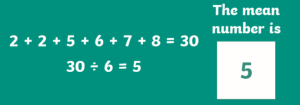
In the example (see below), adding these values results in 30, divided by 6 (the number of values) equals 5. This means that we’ve found the mean to be 5.

How to calculate the median:

We can work out how to calculate the median using the set of data below:

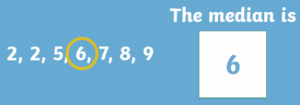
2, 5, 7, 2, 6, 8, 9

To calculate the median, you need to:

  • Arrange the numbers in order, starting from the smallest and ending with the largest.
  • Start covering up one number on each end until you get to the middle one.

In the example below, you’ll see that the median is six, as this is the number that appears in the middle of the data set.

Below are a few challenging questions for your children to practice calculating the median:

  • A shoe shop has recently had an end-of-season sale. They’ve sold trainers in sizes 6, 7, 4, 7, 7, 6, 4, 6, and 5. What was the middle shoe size?
  • What is the median of these numbers: 4.1, 4.5, 2.0, 4.6, and 4.2?
  • The cost of 5 different fruit juices is 75p, 99p, 89p, 79p, and 85p. What’s the median price?

How to calculate the mode:

The mode helps to find the most frequent number.

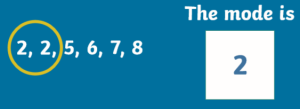
Let’s take 2, 2, 5, 6, 7, and 8 as the set of values to see how the mode can be worked out.

If you count how many times each number is present in the set, you’ll notice that 2 appears the most. This means that 2 is the mode — it’s as easy as that!

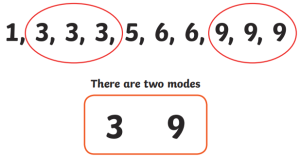
It’s important to remember that you can have more than one mode, so don’t worry if there are two or more sets of numbers, which appear equal times and are the highest values.

Why not encourage children to solve the problems below to track children’s knowledge?

  • What is the mode of these numbers: 54, 67, 32, 54, 72, 98, 32, 33, 21, 32, 67?
  • Julieta had 6 maths tests, the scores of which were: 82, 75, 78, 82, 71, and 82. What was her mode score?
  • Throughout the week, Annie went to the shop 7 times. On her visits, she spent: £5, £7, £9, £5, £2, £5, and £6. What was the most common amount of money Annie spent?

How to calculate the midrange:

The midrange is used to identify a measure of the center.

There are a few simple steps to carry out to calculate the midrange of a set of numbers:

  • Step 1: Sort out your numbers (either in ascending or descending order)

For example, if this is your set of data:

100, 30, 17, 620, 77, 900, 12, 470, 4

This will be the same set of data in ascending order:

4, 12, 17, 30, 77, 100, 470, 620, 900

This will be the same set of data in descending order:

900, 620, 470, 100, 77, 30, 17, 12, 4

  • Step 2: Find the maximum and minimum numbers

This bit will be easy if you follow step 1. But first, you must look at either end of your data set and find the largest and smallest numbers.

For example, if this is your set of data in ascending order:

4, 12, 17, 30, 77, 100, 470, 620, 900

The maximum number is 900, and the minimum number is 4.

  • Step 3: Use the midrange formula

There is a straightforward formula to follow when calculating the midrange. The midrange formula is:

M = (max + min) / 2

Let’s break down what this formula means:

  • M = midrange
  • Max = maximum value in a set of numbers
  • Min = minimum value in a set of numbers
  • Now, let’s apply this formula to our example:

M = (900+ 4) / 2

M = 904 / 2

M = 452


Difference Between Midrange and Range

A lot of people get confused between the midrange and the range. While they sound similar, they are different. The range is the difference between a data set’s highest and lowest numbers. However, the midrange is the average between 2 numbers in a data set.

Children will learn about these averages as part of their maths education and as part of lessons on statistics in particular.

In year 6, they’ll practice solving problems, which include finding the mean, mode, and median, while also learning about the range. Pupils will practice calculating and interpreting these averages while understanding how they’re applied in everyday life.

That’s why real-life examples play a crucial role in learning. The aim is to develop children’s mastery, but an in-depth understanding of calculating mean, mode, median, midrange, and range is needed.

What is a Pyramid (Square-Based)?

What is a square-based pyramid?

A pyramid is a 3D shape that has a base and triangular sides. For example, a square-based pyramid also has a square base which it rests upon.

The Egyptian pyramids are an excellent example of square-based pyramids.

What are the properties of a square-based pyramid?


  • 3D shape
  • Four triangular sides that are all the same shape and size
  • Square base
  • Five sides in total
  • Five vertices
  • Eight edges

Types of square-based pyramids

Square-based pyramids can be divided into three categories: right-square pyramids, oblique-square pyramids, and equilateral-square pyramids. We can distinguish the square-based pyramids based on the lengths of their edges, the position of the apex, and so on. Let’s explore the three types of square-based pyramids below.

Right-square pyramid

If the apex of the square-based pyramid sits directly above the center of the base, in other words, it is perpendicular to the base; we can classify it as a right-square pyramid.

Oblique-square pyramid

If the apex of the square-based pyramid is not aligned directly above the center of the base, we can classify it as an oblique-square pyramid.

Equilateral-square pyramid

If all of the triangular faces of the square-based pyramid have equal edges, then we can classify it as an equilateral-square pyramid.

What do you call a pyramid with a square base?

A square-based pyramid is a polyhedron, a 3D shape with flat polygons as its sides.

It can also be called a pentahedron because it has five sides – “Penta” is Latin for 5.

If all of the triangular sides of the pyramid are equilateral, with equal sides and angles, the square-based pyramid is known as a Johnson solid. It is because all of its edges are equal in length.

Vocabulary

Apex – the highest point of a shape.

Base – the bottom of a shape.

3D (three-dimensional) shape – a solid shape that occupies space and has three dimensions: length, depth, and width.

Edge – an edge is where two faces meet.

Face – a flat or curved surface on a shape.

Net – what a shape looks like if it is opened out flat.

Vertex – a corner where edges meet.

What is Perimeter?

The perimeter of a shape is the measurement of the length of the shape’s outline. If you are wondering how to measure the perimeter, add the length of all its edges.

Children might be given the perimeter of a shape and asked to work out the length of unlabelled edges.

An analogy about walking around a shape or building a fence around a field may help children to visualize this new term and understand the perimeters of shapes and how to measure perimeter.

Children can often be asked to work out the perimeter of a shape during primary school by finding the lengths of edges that haven’t been labeled using the information given.

Read on to find out:

  • a step-by-step guide on how to find the perimeter of different shapes;
  • the national curriculum aims regarding the perimeters of shapes, which pupils must meet;
  • handy resources to support teaching about perimeter for teachers as well as parents.

Why would we measure the perimeters of shapes?

As in the example above, we teach how to measure the perimeter of 2D shapes in school. It is an essential skill taught in the maths topic of shapes and measuring areas.

Perimeter is also often used when measuring the area of a space, such as a garden or a room in your home. For example, if you want a new carpet or garden fence, you’d know the distance around your living room or garden.

So, calculating the distance around a shape or space is a useful life skill. Moreover, it is an excellent example of how maths is applied to real-life situations!

How to measure the Perimeter of Shapes?

Calculating the perimeter would depend on the shape you’ve got. However, if you have a shape with straight sides, you can follow two simple steps:

  1. First, find the length of each edge of the shape or space.
  2. Once you’ve found the lengths, you add the lengths of all the sides together to find the perimeter.

Now, let’s look at some examples of how to measure the perimeter for common 2D shapes.

How to work out the perimeter of a square?

A square is probably the most exact shape to work out the perimeter. Made up of 4 sides of equal length, a square’s perimeter can be calculated using the formula P = 4a. If it’s too early in the morning for equations, the perimeter equals 4 x the length of one side of the square.

Still not sure how to work out the perimeter of a square? Let’s look at some examples to make it a bit clearer.

Take a square with sides of 3cm; the perimeter of that shape would be the distance all around the outside of the shape. We can work this out by adding each 3 cm side (3 cm + 3 cm + 3 cm + 3 cm = 12 cm). As all the sides are the same length, we could simplify this by doing multiplication instead of repeated addition. It would look like 3 cm x 4 = 12 cm.

For a square with sides of 10 m each, the perimeter would be 40 m (10 m × 4 = 40 m).

For a square with sides of 2.5 km, the perimeter would be 10 km (2.5 km x 4 = 10 km).

Calculating the Perimeter of a Triangle

In the example below, the length of each three sides of the triangle equals 5 cm. To calculate the distance around it, you add the lengths together, resulting in a perimeter of 15 cm.

For an equilateral triangle (where all sides are the same length), you could multiply the length of one side by 3. It does not work for scalene or isosceles triangles, so watch out!


How to Find the Perimeter of a Trapezium

A trapezium is a quadrilateral shape with one pair of parallel sides. The formula for finding the perimeter of a trapezium is:

Perimeter = sum of parallel sides + sum of oblique sides

So, to find the perimeter of a trapezium, we must first find the measurement of all its parallel and oblique sides. Another way to put the formula for finding the perimeter of a trapezium is:

Perimeter = a + b + c + d

A, b, c, and d are all sides in the formula above.

Let’s go through an example:

Find the perimeter of this trapezium, where the measurements of the sides are:

  • Side a: 10 cm
  • Side b: 15 cm
  • Side c: 8 cm
  • Side d: 17 cm

So, let’s put these values into our formula.

Perimeter = a + b + c + d

Perimeter = 10 + 15 + 8 + 17

Perimeter = 50 cm

Finding the perimeter for a trapezium is pretty simple, as it is just a process of addition. However, practice makes perfect, so let’s go through another example.

Find the perimeter of this trapezium, where the measurements of the sides are:

  • Side a: 30 cm
  • Side b: 55 cm
  • Side c: 29 cm
  • Side d: 37 cm

So, let’s put these values into our formula.

Perimeter = a + b + c + d

Perimeter = 30 + 55 + 29 + 37

Perimeter = 151 cm

Find the Perimeter of a Parallelogram

When asking ‘How to find the perimeter of a parallelogram, we must find the sum of all the edges of the shape. However, we can make our calculations easier because rectangles and parallelograms have two pairs of equal parallel sides.


Children will be introduced to two methods for how to find the perimeter of a parallelogram. We will use both ways so that you can work out the perimeter in this case. But first, let’s have a look at the example below.

  1. The first method is to add all the lengths of the sides, which would show that the perimeter of the rectangle above is 28 cm.

10 cm + 10 cm + 4 cm + 4 cm = 28 cm

  1. The second method considers that rectangles have two pairs of equal, parallel sides. So, you can multiply 10 cm by 2 and 4 cm by 2 and add the totals together.

10 × 2 + 4 × 2 = 20 + 8 = 28 cm

Children will reach the same answer using either of the two methods above. So this is an excellent way of showing them how to find the perimeter of a parallelogram and how interconnected geometry and maths calculations are.

Finding the Perimeter of a Rectilinear Shape

Even though rectilinear shapes might seem confusing initially, children must follow the same two steps to calculate the distance around these shapes.

In the example below, the lengths of all sides are given, so all you must do is add them up.


Sometimes, however, pupils must calculate the length of any sides not given – see the rectilinear shape below.


In this case, you can work out the length of side a by adding the ones opposite it: 3 and 6.

a = 3 cm + 6 cm = 9 cm

You’ll notice that side b can be found by subtracting 7 from 10.

b = 10 cm – 7 cm = 3 cm

So, now that you know the lengths of all sides, you can calculate the perimeter by adding them together.

10 cm + 3 cm + 3 cm + 6 cm + 7 cm + 9 cm = 38 cm

Finding the Perimeter of a Circle

Circles are different, as they don’t have straight sides. But of course, we can still find the distance around them.

Children will learn that the perimeter of a circle is also called ‘the circumference.’ Because measuring the distance around this shape is difficult, a formula is followed to calculate the circumference.

Here’s the formula with an explanation of what each symbol stands for:

C = 2πr

C = circumference, π (pi) = a constant, which is approximately 3.14, r = radius

See the image below for an example of how it’s calculated.


How to find the perimeter of an irregular shape?

If a shape is irregular, the sides are not all the same length. To find the perimeter, you must add up all the lengths of its outer sides. Ensure to include the correct unit in your answer.

How To Work out Perimeter: Quick Fire Formulas

When teaching kids how to work out the perimeter of shapes, it can be handy to have a list of the different formulas on hand. Depending on what level they are working at, many of these formulas will not apply to kids as they are too advanced. However, they are still good to keep a note of for later learning.

The formula for a parallelogram is:

2(Base + Height)

The formula for a triangle is:

a + b + c

In this formula, a, b and c represent the side lengths of the shape.

The formula for a rectangle is:

2(Length + Width)

The formula for a square is:

4a

In this formula, a represents the length of a side.

The formula for a trapezoid is:

a + b + c + d

In this formula, a, b, c, and d represent the four sides of the trapezoid.

The formula for a kite is:

2a + 2b

In this formula, a represents the length of the first pair, and b represents the length of the second pair.

The formula for a rhombus is:

4 x a

In this formula, a represents the length of a side.

The formula for a hexagon is:

6 x a

In this formula, a represents the length of a side.

What’s the difference between perimeter and area?

Pupils will learn about area and perimeter usually around the same time, so it’s essential to know the difference between them.

As mentioned above, a perimeter is a distance around the outside of a shape. On the other hand, the area is the amount of space inside a shape. See the visual aid below, which shows the difference between the two.

Finding the perimeter in real life

You can find the perimeter of almost any object in real life. The same principles as what you’ve done on paper apply similarly. Here’s a step-by-step guide on how to measure something’s perimeter. Just remember, you might not be able to measure everything.

  1. The first step is to decide what to measure the perimeter of. Usually, 3D objects don’t have a perimeter, but we’re not going to measure all of the objects.
  2. Let’s say you want to measure a fridge. That’s an excellent way to practice your perimeter skills. So, pick a side you want to measure the perimeter of.
  3. So, you’ve picked the front? Excellent! That’s even better if your fridge has two doors; it’s double the practice.
  4. First, you must measure all sides of the fridge’s front. If it has two doors, measure them separately so you can do twice the practice.
  5. After you’ve got the measurements, you can do the calculation to work out the perimeter. Remember, add all the numbers up and ensure they’re the same unit!

What Are 18 preposition Examples?

There are many prepositions, but the most commonly encountered at the primary level are:

Place

Time

Direction

In

Before

To

On

After

Toward

At

During

Into

Under

In

Along

Behind

On

Across

Between

At

Through

What are five examples of prepositions in sentences?

  • The essentials are on the table.
  • You will find the café across from the butchers.
  • We keep extra blankets under the bed.
  • The film starts in an hour.
  • Sophie sat at her dinner table.

How to identify prepositions in a sentence

A preposition shows a relationship between a noun or pronoun and another word in the sentence. Therefore, you can learn to identify the preposition in a sentence by spotting the nouns and pronouns. A noun or pronoun must always follow a sentence’s preposition. It can also never be followed by a verb.

While learning to identify and create sentences with prepositions, you should also learn to spot the five types of prepositions. These include simple, double, compound, participle, and phrase prepositions.

Simple prepositions are some of the easiest and first prepositions your students will get to grips with. These common prepositions can describe a location, time, or place with prepositions such as at, for, in, off, on, over, and under. Take a look at these sentences with simple prepositions.

  • There is some milk in the fridge.
  • She was hiding under the table.
  • The cat jumped off the counter.
  • He drove over the bridge.

What is the Mean?

The mean is average. It is the total sum of all the numbers in a data set divided by the number of values in the group. It may sound a tad robotic, but it’s pretty simple.

There must be at least two numbers in the set for you to be able to find the mean. They should be connected or have some relationship for the mean to be essential. For example, the mean is helpful if you compare the average temperatures of each day across a month or the different marks students get in a class. However, it’s not so beneficial if you use data on a dog’s weight and the speed of an injured pigeon.

Other types of averages are the mode, median, and mean.

How to find the mean in maths

If you’re wondering how to calculate the mean, then we’re here to help. What we mean when we’re working out the mean is finding the average of a group of values. To do this, we find the total of all those values before dividing by the number of values we have.

Let’s work through an example together:

Here, we’ll work out how to find the mean of 2, 2, 5, 6, 7, and 8.


  1. What we must do first is add all of these numbers together. So, as you can see, the answer to this is 30.
  2. Now, we have six numbers in total. So, our next step is working out 30÷6.
  3. We’ve now worked out that 30÷6=5.
  4. Our final answer, and the mean of these numbers, is 5.


However, it is essential to remember that the mean is not always a whole number. Sometimes, it is a decimal, and that’s OK. We don’t discriminate against decimals in maths.

If we were looking for the mean of a less friendly set of numbers, we might get a decimal answer. Usually, a question will tell you how they want the answer to be given, to one, two, or three decimal places or the nearest whole number.

How to work out the mean with negative numbers

If you think knowing how to find the mean in maths is different when negative numbers are involved, don’t worry! We work it out the same way we would if all the numbers were positive. So let’s try an example with negative numbers:

  1. We will find the mean of 2, 6, 6, 9, -1, and -4.
  2. First, we must add them together. To make this easier, add the positive numbers together before treating the negative numbers as a subtraction problem. By doing this, we get 23-5=18.
  3. Next, we must divide by the number of values we have. That gives us 18÷6=3.
  4. Our final answer, and the mean of these numbers, is 3.

What is the mean in maths? Types of mean

The most common type of mean we learn and are taught in schools is technically called the ‘arithmetic mean.’

It appears most in statistics when we have a set of data. This data set can be from several sources. For example, it could be the results of an experiment or observational study.

Other notable types of mean include:

  • Pythagorean mean
  • Geometric mean
  • Harmonic mean

When would we use the mean?

One of the primary instances where we could calculate the mean would be when we want to figure out an average or norm of a set of values.

25 Terrific Team Building Activities for Kids

Team building activities for kids that require no equipment

These nifty team-building activities for kids require no equipment – only the things you’ll already have in your classroom. From trusted classics to new favorites, we highly recommend you take a shot at these with your class.

  1. Hot Seat

This super-neat game will get your students working collaboratively. Divided into two teams, your students will play a guessing game, where one player will sit in the “hot seat.” Then, their teammates will be secretly given the word by you. Then, without mentioning the word or spelling it out, the teammates have to describe the word to their “hot seat” team member. Finally, the two opposing teams will rotate, with the fastest team to guess their word, winning a point in each round.

  1. Rock, Paper, Scissors – Ultimate Edition

We’re sure you already know what rock, paper, and scissors are, so we won’t bore you with those details. But this game version turns the volume up, making it an ultimate edition. First, each pair will play a classic game of rock, paper, scissors – however, the loser of each game has to become the winner’s “cheerleader.” Then, the winner would take on another winner in the class. Slowly, this pattern will repeat until you have eliminated the class down to two final players, with many “cheerleaders” cheering them on to a victory. With a bit of encouragement behind them, you’d be surprised how much fun your students will have!

  1. Articulate Artist

This game is one of the tremendous team-building activities for kids that emphasizes the importance of communication. One chosen teammate will be sat with their back to the other teammates, so they can’t see what’s going on. Then, the other teammates will be given a picture by you, the teacher. The teammates must accurately describe that picture so the chosen teammate can draw it. The results of this activity depend on collaboration, with clear and concise communication being a valuable skill here.

  1. Number’s up!

Have all of your students walk around the school gymnasium slowly. Next, you will shout a number on your call – for instance, “four.” On hearing this, your students must huddle into groups of four quickly. Then, repeat the activity with different numbers, encouraging your students to walk around the room so that different combinations of students are made rather than the same friend groups. Not only is this awesome for advancing processing skills, but it’s also a handy numeracy activity.

  1. Lean on Me, Pal!

This one can be tricky, so we recommend you play it where there’s a soft landing, just in case! In small teams of 6-8, two teammates will lean on each other, letting their weight rest on their partner’s bicep and shoulder. Then, they must walk together slowly, crossing the finish line. The following two players in the team will then take their turn. The first team to complete the fastest activity without falling over wins!

  1. Don’t wake the sleeping troll

It is one of the simplest team-building activities for kids that takes almost no preparation and requires little space. First, there is a “sleeping troll,” and for this activity, that’s you, teachers (sorry!) Then, without speaking, your students must line up in order of height, tallest to shortest. Once they think they’ve managed this, they must shout “boo!” at the sleeping troll (which is, again, still you, we’re afraid…) and scare you enough to “pass the bridge” successfully. This activity teaches the importance of non-verbal communication, which is essential for building team bonds.

  1. What am I?

In small teams of 4-5 students, one chosen teammate will have a sticky note on their forehead. The sticky note could have a primary color, a shape, or a number written on it. The other teammates must answer questions about what’s on the sticky note to the chosen teammate without giving the game away until the selected teammate can correctly guess the answer or the time runs up. It is an ideal exercise not only for team building but also to benefit logical thinking and processing skills.

  1. Human words

This team-building activity is the definition of “physical literacy,” if ever there was one! After assembling your students in small groups, you’ll start by shouting a letter. Once you’ve done so, your students must make their bodies into this letter. For example, they would outstretch their arms for the letter “T.” Once they’re accustomed to the directions, throw a short word at the team and see if they can work together to spell it out using their bodies.

  1. We’re going on a picnic!

This team-building activity requires keen focus and listening skills. In a large circle, all of your students will sit together. You will lead by saying we’re going on a picnic, and name something you’d take starting with the letter “A.” The following person must think of something with the letter “B.” But the tricky part of the game is that each student must remember what everyone else before them chose before they can give their answer. Repeat the game until you’ve completed the entire alphabet without any mistakes.

Team Building Activities for kids that require equipment

The following games require a little extra gear but guarantee a ton of fun. Luckily, we’re sure you’ll be able to source everything listed here quickly. You should have almost everything to hand in your school gymnasium.

  1. Pass the Ball

This game is a super fun team-building activity for kids, as it takes a collaborative effort to have a chance at winning. With a large floor mat (or other such equipment that’s wide and flat), you will assemble a small team of 4 children. They will each hold a side of the mat. Then, a tennis ball will be placed in the middle of the carpet. The children must collaborate to guide the ball into the waiting bucket gently. If the ball falls off the mat, it must start again. The first team in your class to complete the task wins!

  1. Trust Walk

This Trust Walk is an ideal activity for small groups. One of the team members will be blindfolded, and the other team members must guide their friend through an obstacle course using only their verbal instructions. It is an excellent team-building activity for kids, relying on teamwork, good direction, and trust.

  1. Lifeboat!

Lifeboat is a nifty game requiring your students to think tactfully about the activity. First, a long rope will be looped. Then, you’ll cry, “lifeboat!” Next, your students will jump into the hole the string creates. Easy enough, right? But each time the game is played, the string will become tighter, making the hole smaller and smaller. Your students must get creative to ensure the entire team can get into the lifeboat in time.

  1. Spider Web

This game of Spider Web is an engaging way to learn new information about each other. Have your students stand in a circle, with you starting by holding a ball of yarn. Ask one of your student’s questions, such as, “What is your favorite color?” Then, holding onto the loose end of the rope, throw the ball to the student to answer the question. The process will repeat until everyone is holding a piece of string and has responded to a question, with a spider’s web being created in the center of the circle. Good luck untangling!

  1. Hula-Hoop-la

This activity is not only ideal for building teamwork, but it’s also excellent for enhancing fine motor skills! Have your students stand in small groups, holding up a hula-hoop using only their fingertips. Then, taking excellent care, your students must crouch down slowly and place the hula-hoop on the ground without dropping it. This game takes honest communication and hand-eye coordination, making it one of our favorite team-building activities for kids.

  1. This or That

This game is tons of fun for learning each other’s preferences. Have your learners in one long line, all facing one way, with two long ropes on either side of the line. Then, the teacher must shout out a ‘this or that?’ question, such as “blue or red?” or “pizza or fries?”. Students will jump to the left if they prefer the first answer or to the right if they choose the second. This game is not only fun for learning more about each other, but it’s also strengthening gross motor skills and logical processing at the same time. Win-win!

  1. Pass the object along

This activity requires your class to be split into four teams. In each group, one person will be the “finder,” although you can repeat this game to let everyone have a chance at playing that role. Each team will have a signature color (we recommend the primary colors of blue, red, and yellow, or you could choose something different, like green). From there, tons of differently-colored objects will be laid on the playing floor. On the teacher’s signal, the team blue “finder” must find as many blue objects as possible, then race them back to the team, who will pass them down their line and into the bucket. The team with the most correctly-colored objects in their bucket at the end of the time – we recommend a minute – wins!

  1. Hula-Hoop Pass

This game is super fun and one of the team-building activities for kids we wouldn’t mind trying ourselves! In a long line, your students must hold hands – and not let go! A hula-hoop will be placed on the end player’s arm, and the game’s object is to get the hula-hoop passed across the entire line of people without letting go of each other’s hands. It is a fun activity that works on many coordination skills and enhances gross motor techniques. After all, it will take some creative maneuvering to clear the hula-hoop!

  1. Don’t drop that ball!

In this activity, you’ll assemble groups of students. They will each be sitting on the ground, one in front of the other. The first person in each team will be given a soccer ball, and they must pass it to the person behind them so it makes it down the line. But there’s one essential rule – nobody can turn around! So the players must work collaboratively to ensure they don’t drop the ball by carefully leaning backward to pass it to the next player. The first team to successfully get their ball to their last player without dropping it will win.

  1. Cups and Saucers

It is a super-fun game that the entire class can play. Have one side of the course as “cups” and the other as “saucers.” There will be dozens of saucer-shaped marker cones on the playing field. The object of the activity is for team “cups” to ensure their cones are facing up, whereas the “saucers” team must ensure the cones are flat on their usual side. After a minute or so, stop the play, and count which team has the most cones. The team with the most cones their way will win! It is fantastic for building team dynamics and healthy competition, and the exercise is a bonus.

Team building activities for kids that can be played outdoors

The best way to team-build for maximum fun is to get into the excellent outdoors. Not only is fresh air ideal for the mind, body, and soul, but by using this selection of super fun team-building activities for kids, your students will bond in no time!

  1. Relay race

Perhaps the ultimate team-building activity for kids is a relay race. Once you’ve picked a suitable racetrack, assemble your students in small teams. For example, if you want to enhance fine motor skills and gross motor activity, you could have the team hand off a baton or ball in their relay race. But tagging their teammate’s hand works just as well. The first team to get everyone around the track and assemble back together win!

  1. Wheelbarrow, anyone?

For a collaborative team-building exercise, we recommend a wheelbarrow race. Now, don’t worry. You don’t must go and buy actual wheelbarrows. The wheelbarrow in question, in this game, is for one teammate to hold the other teammate’s feet. Then, they will work together, with the standing teammate running and the held-up teammate using their hands to crawl to emulate a wheelbarrow. The first team to cross the finish line successfully will win!

  1. Four-way tug of war

This tug-of-war game turns the volume up on the classic, where four ropes are tied together instead of two. Four teams will pull the ropes, with a large demarcated circle in the middle of the activity. The first team to remove the center of the tangled cords over the edge of the circle, closest to them will win. This one is maximum fun and strengthens muscle groups from head to toe at the same time.

  1. Two-legged race

Another collaborative team-building activity for kids is this two-legged race. In pairs, your students will stand together and have their feet tied to each other at the ankles. They must use coordination and verbal communication to work as one unit, running the two-legged race. The first team to cross the finish line wins!

  1. Water Well

This one is super-messy, which guarantees excellent fun but must be played outdoors. There will be a significant “well” of water, perhaps in a paddling pool, in the center of the playing area. In teams, your students must fill their own team’s bucket with as much water as possible. The first teammate will use a cup to scoop water out of the well, then run back to their team, who will be lined up. Each teammate will have a cup and cup-to-cup; they must pass the water down the line, spilling as little as possible. This process will repeat until the time is up. The team with the most water in their bucket will win!

  1. Dodgeball

On a warm day, head outdoors with your class. Separate them into two sides opposite each other. With very light bouncy balls on the floor, your team will (lightly, please!) throw the balls at the opposite team. Once a teammate has been hit by a member of the opposing team, they leave the game. The team with the most players left standing will win the game.

What is Volume?

Volume is the amount of physical space a 3D object takes up. It is the 3D equivalent of area for a 2D shape. It is measured in cubic measurements, like cm³. It can be found by multiplying its length × height × width.

Measuring volume in this way is a basic equation and one of the first equations children learn about in school. Therefore, volume in Maths is essential, as it helps lay the foundations for further equations study.

What unit is volume measured in?

A cubic meter is the official volume unit recognized by The International System of Units. However, this unit is impractical because it designates a large volume, and smaller sizes are often needed. As such, it’s not used very often, especially in schools. Instead, people tend to measure volume in the:

  • Cubic centimeters
  • Cubic inches
  • Milliliters
  • Liters
  • Gallons

All measurements for volume are cubic measurements. The cubic size is shown by a small 3. The volume is the product of three different heights multiplied together.

Formulas for the volume of common shapes

The formula for volume in Maths varies depending on which shape you are working with. Here are the formulas for finding the volume units of common 3D shapes:

  • Cube volume = side³
  • Cuboid (rectangular box) volume = length × width × height
  • Sphere volume = (4/3) × π × radius³
  • Cylinder volume = π × radius​​² × height
  • Cone volume = (1/3) × π × radius² × height
  • Pyramid volume = (1/3) × base area × height

Finding the volume of objects with different states of matter

Calculating volume in Maths can often depend on what shape you’re dealing with and what state you’re working with. Most often, children get taught about calculating the volume of a solid, but it’s also helpful to explore how best to calculate the volume of liquids and gases.

How to calculate the volume of a solid

When finding the volume units of standard, solid 3D shapes, you need the correct equation, and you’re set. However, things get a little trickier when you want to find the volume of irregular shapes.

There is no set equation to follow to find the volume of an irregular shape. However, all hope is not lost, as there are slightly unorthodox ways to work out the volume. For instance, you can try Archimedes’ Gold Crown method. This method was born when the famous mathematician, Archimedes, was tasked with determining whether the King’s (Hiero) crown was made from pure gold or just gold-plated. The trick was that Archimedes could not destroy the crown in the process. So Archimedes got to work. One day, the idea came to him when he was having a bath. Archimedes stepped into the bathtub and noticed that the water level rose as he entered it. From this observation, Archimedes concluded that the volume of water displaced must be equal to the volume of the part of his body he had submerged. Knowing the King’s crown’s volume and weight, he could work out the density and then compare it with the density of pure gold. In doing so, Archimedes was able to work out whether the King’s crown was made of pure gold or not.

While working with very different objects and circumstances, you can use Archimedes’ Gold Crown method to find the volume of any irregular shapes you encounter.

Here are the steps you must take to follow Archimedes’ Gold Crown method:

  • Get a larger container than the object you want to measure the volume of. It can be anything that holds water, such as a basin, a bucket, a measuring cup, or a beaker. Ensure the container has a scale.
  • Pour water into the container that you have chosen and use the scale to read the volume measurement.
  • Place your object inside the container of water. Ensure the thing is completely submerged so that you can measure its whole volume
  • Use the scale to read the volume.
  • Compare the two volumes; the difference between the measurements is the volume of your object.

How to calculate the volume of a liquid

It is pretty simple to measure the volume of a liquid; all you need is a container with a scale of measurement on it. Some of the containers that scientists use to measure the volume of liquids are:

  • Beakers
  • Flasks
  • Burettes
  • Pipettes
  • Graduated cylinders

You can then pour the liquid into the container, ensuring that it’s placed on a flat surface and that the liquid is the only thing filling the container. Then, take a reading off the side, where the liquid stops against the measurements. It will be the volume of the liquid.

How to calculate the volume of a gas

Things are a little more complicated when measuring the volume of gas. There are many reasons why this is the case, one of which is that the volume of gas is heavily influenced by temperature and pressure. Moreover, gases expand to fill any container that they are in

There are some methods you can use to try and measure the volume of gas, however. For example, you can use the balloon method. This method involves inflating a balloon with the gas that you are trying to measure the volume of. Then, you can use Archimedes’ Gold Crown method, which is detailed above. Place the balloon into a container of water, and check the difference in volume before and after the balloon is placed.

In chemistry, a syringe is used to measure the volume of gas. This gas syringe is used to insert or withdraw a volume of gas from a closed system.

There is also an equation for calculating the volume of gas. All you must use in the equation is the density and mass of the gas whose volume you are trying to measure. The equation is:

Volume = mass/density

What is a Schema?

A schema is a pattern of repeated actions, which will later develop into learned concepts.

Schemas use the ‘trial-and-error method of learning and are adopted by children as an effort to make sense of the world around them. They won’t necessarily manifest the same way with each child and will be primarily based on their interests and natural curiosity.

Children will use a schema pattern of behavior to keep trying out their ideas and testing their existing knowledge. They will modify these schemas based on their newfound knowledge and skills.

Why are schemas essential?

These repeated actions are strongly linked to early cognitive development and embedded in our early years’ practice. The ability to explore schemas will improve children’s cognitive brain structures and help them develop new neurological pathways.

Schemas are a fundamental part of child development; through practitioners having an awareness of schema development, they will be able to:

  • Successfully observe schemas, and be able to use this knowledge to inform curriculum planning.
  • Practitioners reviewing observations will use this knowledge to track development and provide informed learning assessments.
  • Be effective in scaffolding learning.

It’s essential that they can skilfully identify these schemas and scaffold them successfully, providing children with the necessary adult reinforcement. Furthermore, once practitioners identify various schemas, they should ensure that the setting provides an ‘enabling environment’ that gives children ample opportunities to explore and refine them.

Levels of Schemas

There are four distinct ‘levels’ that are associated with each schema; these consist of the following:

  • Level 1- Sensorimotor Stage: This stage is mostly explored by every young child in infancy. They will explore the world through their senses, understanding what is happening around them through taste, touch, smell, hearing, and sight.
  • Level 2- Symbolic Representation: This will start at around 16-26 months; children will begin to use one object to symbolize another, particularly if these objects have common characteristics.
  • Level 3- Functional Dependency: This will happen at the latter stages of the EYFS; children will use the information and knowledge they have gained throughout the Early Years Foundation Stage to secure their cognitive structures. Each of the Early Learning Goals (ELGs) summarises the essential skills children have learned within that specific development area and describes how they will blend all of this knowledge.
  • Level 4- Abstract Thought: Children reaching the 40-60 months stage of the EYFS Development Matters framework will take their life experiences and the information and knowledge they have gained to adapt and assimilate their ideas. They use this to form their ideas and concepts, sharing them with others.

The Main Types of Schemas

Many types of schemas can be explored in several ways; here is a breakdown of the most common schemas developed in early childhood.

Trajectory

This schema involves children exploring the movement of objects or their bodies through the air. Children are excited and curious to see how their actions can impact an object or themselves. They want to test out different ways of using the trajectory schema; much like a science experiment, they will observe the various outcomes and use this information to refine the schema. Trajectory exploration will later lead to more refined physical movements within both gross and fine motor development.

Example: Have you noticed that babies will throw their food at meal/snack times? It can sometimes be frustrating, but rest assured that they are learning from this experience, which is their way of exploring the trajectory schema.

Scaffolding the trajectory schema: Preparing activities that allow children to explore the schema in a supportive environment is an excellent way to encourage children to engage in the trajectory schema positively; this might include:

  • Rolling cars on different surfaces and observing their landing and speed.
  • Playing with other balls, exploring the different ways they bounce.
  • Playing with paper planes and watching how far they can fly.
  • Inputting target practice to start to refine the trajectory skills.

Connecting

It can be the connecting of toys and provisions such as blocks or sticking craft materials together, or children might explore connecting their bodies with their peers through hand holding or linking arms.

You will notice that children enjoy connecting objects such as Lego and are just as fascinated with disconnecting them or sometimes the creations their peers have made! They are testing out what will happen when things come together and fall.

Creating a safe environment where this type of play is encouraged will support future understanding of more complex connecting concepts, such as magnets and the correlation between a slippery surface and the speed at which an object will move.

Example: Children may spend an extended time making a Lego model, and just as you take a picture to track the many EYFS developmental outcomes they have achieved, they knock it down. Watching in awe and excitement as the many block fall to the floor.

Scaffolding the Connecting Schema: Some children will want to explore the schema using smaller equipment like threading resources and collage activities, while others want to connect on a larger scale. You should provide activities for both, ensuring that these are safe and that adult supervision is given where necessary.

If children are exploring the schema with objects that aren’t safe, outline why this is dangerous and provide them with things that allow them to develop the connecting schema, such as:

  • Lego
  • Blocks
  • Duplo
  • Threading Beads
  • Tracks
  • Large foam bricks
  • Collage materials

Transporting

Children use the transporting schema regularly; they enjoy seeing the physical payoff that comes with moving an item from one place to the other; they might also enjoy mixing these items to see what will happen.

Example: Have you noticed that children are fascinated with transporting sand to water and vice versa? Which usually ends with a very watery sand tray and a very murky-looking water tray. It is their way of exploring transportation and observing how the two materials mix.

Scaffolding the Transporting Schema: Be aware of the importance of transport, and although it may not fit with your set areas within the setting, understand that it is essential children are given a chance to move items from one place to the next. You can implement a range of simple activities and provisions:

  • Provide practical transport tools like pushchairs and trolleys so that children can transport items safely.
  • Have children explore the schema by being helpful. For example, can children transport toys from the floor back to the box?
  • Have areas where children are encouraged to mix materials; why not provide buckets in your outdoor water tray, and encourage children to transport the water to plants/flowers or a mud kitchen?

Enclosing/Enveloping

At first glance, these schemas seem very similar, and initially, they have common characteristics, but the end goals are different.

  • Enclosing is the ‘closing in’ of objects; these will still be visible but will have a bordering enclosure; this could be in the form of placing the small world farm animals inside the chamber, wrapping the doll in a blanket, or placing circles around marks which are already on a page.
  • Enveloping: Envelopes will ‘wrap’ on an object, sometimes from sight. For example, they will ‘hide’ the doll beneath the blankets, and might create a beautiful picture, only to cover it entirely in paint so that it is no longer visible.

You will provide opportunities to enclose and envelop all your areas of provision; children will use the items and activities in the setting to explore these theories. You will quickly identify which one of these schemas the child is using and be able to explore these more in-depth through adult scaffolding.

Example: In the small farmyard world, one child may spend extended periods making fences and placing each animal in the enclosed spaces they have made- Enclosing.

Example: Another child later accesses the small farmyard world; they take each animal and hide them in the barnyard and cottage, moving them ultimately from sight-Enveloping.

Positioning

You might notice how some children don’t use the provisions quite as you intended; rather than drawing with the crayons, they line them up. They might be territorial over the cars in your small world area, using them to make neatly formed lines of various vehicles.

Example: You may have set out a beautiful sea life small world area and notice the child taking a limited interest in the imaginative concept of the activity. Instead, they are more concerned with lining the shells up and placing them in size or color order.

Scaffolding the Transporting Schema: Give children opportunities to explore positioning; this can be done using a range of natural materials. For example, why not collect stones and pebbles, then use these to make lines and shapes on hessian?

Rotation

Children might explore these through circular items such as car wheels or by rotating themselves, twirling, and spinning. This schema will help children understand rotation, which will help lay the foundation for mathematics skills and physical development.

Scaffolding the Rotation Schema: There are many ways to explore rotation, from providing ‘busy boards’ that use all rotating devices such as locks, wheels, and nuts and bolts. To explore spinning outside or rolling down the grass. If children are particularly interested in the spinning nature of your resources, create a space where they can sit peacefully and explore the concept.

Orientation

Have you ever wondered why children enjoy being upside down? Rather than sit on the settee, they want to hang from the couch upside down. Because they are exploring the orientation schema, they wish to view the world from a different angle and explore this contrasting concept.

Example: Children want to climb up on surfaces and walls, interested in how the world looks from higher up.

Scaffolding the Orientation Schema: You can provide these opportunities through your larger outdoor equipment; rather than take away risks, work hard to minimize these risks to give children opportunities to hang upside down or be elevated in comparison to their usual stature.

It can be as simple as undertaking a daily task lying down, so why not provide pens and paper at ground level, encouraging children to lay on their tummies?

Each schema is interlinked and won’t necessarily follow rigid ‘rules’ or appear in a set sequence. It is the role of the practitioner to identify these schemas as they happen, understand their importance, and provide ample support and opportunities for children to explore them safely.

What is a Dominant Hand?

Your dominant hand is the hand you’re more likely to use when doing delicate motor tasks like writing, brushing your teeth, or catching a ball.

When people say they are right-handed, they say their right hand is dominant. However, you can be right-handed, left-handed, or ambidextrous – which means you don’t favor either hand.

What is your non-dominant hand?

Your non-dominant hand is your ‘less preferred’ hand. It’s the one that isn’t your dominant hand.

If you’re right-handed, then your left hand is your non-dominant hand.

If you’re left-handed, then your right hand is your non-dominant hand.

Often, when we use our non-dominant hand for tasks like writing, our movements are clumsier and harder to control. Try writing with your non-dominant hand – your handwriting will become much messier than your dominant hand!

Are there benefits to using your non-dominant hand?

Now that we know the answer to ‘what is your non-dominant hand?’, let’s look at some of its benefits.

When you use your non-dominant hand for writing or tying your shoelaces, it might feel like you tried using your dominant hand for the first time because you’re teaching that hand and your brain a new skill.

We rely on our dominant hand for many activities, which often means our non-dominant hand gets left behind. However, practicing those activities using the non-dominant hand can build strength and skills.

Some creative writers like to use their non-dominant hand when writing so that they can focus on getting their ideas out rather than making sure that their handwriting is neat. So, sometimes using your non-dominant hand can help you be more creative!

It can also be beneficial to use your non-dominant hand in everyday tasks to help build fine motor skills in that hand. So why not try doing some of these daily activities with your non-dominant hand?

  • Brushing your teeth;
  • opening a jar;
  • pouring drinks;
  • cleaning dishes;
  • using cutlery;
  • washing your body;
  • using your computer mouse.

At first, using your non-dominant hand for these activities will feel awkward. But, in the long run, it helps to strengthen your muscles and fine motor skills.

What is the difference between a dominant and a non-dominant hand?

Your dominant hand has faster and more precise movements and better control over fine activities. The non-dominant hand might be less comfortable and harder to do controlled movements with.

The muscles in the dominant hand are more potent and easier to use, whereas they’re less developed in the less dominant hand.

A dominant hand is about 10% stronger when gripping things than a non-dominant hand. It might be genetic or might come from years of preferred use.

How do you know which hand is dominant?

Most people can tell which hand of theirs is dominant simply by feel.

Using your dominant hand is more comfortable, and it’ll likely feel easy to do specific tasks.

It’s also more likely that you’ll use your dominant hand for instinctual or fast-paced reactions. For instance, if someone threw a ball at you when you weren’t expecting it, you would probably react with your dominant hand to try and catch it.

However, it’ll depend on the task you’re doing. For example, you might prefer to use your right hand with some functions but favor your left with others.

If you’re trying to work out a child’s dominant hand, pay attention to which hand they instinctually use when using a spoon to eat or draw with or even which foot they kick a ball with.

At what age should a child have a dominant hand?

Following the updated Development Matters Guidance and Early Years Outcomes for EYFS children, children are expected to prefer a dominant hand between the ages of three and four.

This non-statutory guide gives practitioners an overview of how children’s development is expected to progress from birth until Reception. Children are likely to start showing this between 22-36 months, and from 40 months onward, a preference is expected to be more pronounced.

A dominant hand should naturally emerge as young children grow and start doing more gross and fine motor activities like writing, coloring, and playing.

It may take until age six for one to become more apparent, and younger children may still be experimenting as their bodies grow and develop. Like all the skills they are learning, children will pick them up at their own pace, and one child may be very different from another.

What makes a person left-handed or right-handed?

Only 10% of the population are left-handed, and under 1% are ambidextrous! So what makes people favor their left hand over their right?

Scientists currently believe that left-handedness comes from your genes.

The combination of genes you inherit from your parents determines how your body and brain develop.

The right side of the brain controls the left hand, and the left side of the brain controls the right hand.

With just the right combination of genes, the brain develops to favor either side, and for lefties, the right side develops more to make their left-hand dominant.

It’s rarer to be left-handed because the gene for right-handedness is more common in the population, so more people are right-handed.

How can I support left-handed children?

As left-handedness is less common, daily objects may be harder to use for left-handed people.

Objects like scissors, can openers, and even notebooks favor right-handedness. So in a classroom, it’s essential to try and make worksheets and objects accessible for people who aren’t right-handed.