With more than 4,000 public and private two- and four-year colleges in this country, finding the right one is not just a challenge—for many it can be overwhelming. Without a clear college search roadmap, many students fail to explore the full range of schools available to them.
But luckily for high school students, there’s a new, innovative, free website to simplify the college search process: CollegeFindMe.com.
Unlike other college search engines, CollegeFindMe makes it easy for colleges and universities to find you! When you log onto the site, you’ll be asked to fill out an academic and personal profile. This assessment will allow you to share a full picture of your talents, interests, and achievements so that admissions offices will get to know you as more than just an SAT or ACT score.
Then use the site’s three different search engines to look for colleges by filling in different criteria. Once you have a list of options, you can easily check off boxes and add them to your “My College” list.
Simultaneously, college admissions officers will be able to review students’ confidential profiles to search for students or demographics that best fit their admission criteria. With CollegeFindMe, colleges will have a direct channel to send applications, fee waivers, invitations to visit their campus, or scholarship offers to attractive candidates that they otherwise might never have reached.
Today’s high school guidance departments are stretched to the breaking point. The national ratio of students to counselors is nearly 500 to 1, and research from the Education Department’s Office for Civil Rights shows that one in five U.S. high schools has no school counselor on staff, a deficit that impacts most those families in greatest need of help.
“A U.S. Department of Education survey found that guidance counselors provide an average of 38 minutes of college search/application advice per high school student—and that’s over a four-year time frame,” says CollegeFindMe CEO Christina Bai. “While some families are able to spend thousands of dollars on supplemental college guidance, that option is out of reach for most families.”
“This is truly an equalizer,” explains company spokesperson Josef Blumenfeld from EdTech180. “All students deserve the chance to attend the college of their dreams. Sadly, non-affluent families often can’t fill the gap left by over-burdened high school guidance departments, and they don’t know where to turn. By using CollegeFindMe as the first step in their college search and application process, all students can start down the right path to the right college.”
CollegeFindMe hopes to level the playing field by giving all students the chance to find the perfect place. Or, better yet, sit back and let the right college find you.
As a parent, when was the last time you were invited to your child’s school to share something personal and important to you? Maybe something interesting about your cultural background or your unique skills?
The answer, most often, is never.
As an educator, don’t you wish you could figure out how to get the support you want from the parents in your school? Wouldn’t it be great to understand what parents have to and want to offer to support your curriculum? To bring the broader world into the classroom and serve as role models?
A longtime educator and nonprofit leader shares his blueprint for turning contentious topics into teachable moments that help turn students into global citizens.
By Dr. Ian Jamison
More than any other generation in human history, the students who are in school today will live alongside, work with, and relate to peers with the widest possible range of cultural backgrounds, beliefs, values, and perspectives. To help them thrive in this complex world, it is imperative that we give them the tools they need to build societies that welcome diversity rather than fearing it, that encourage open-mindedness rather cultivating prejudice, and that include rather than exclude.
The alternatives are too terrible to contemplate. Every day we see news reports that indicate what happens as a direct result of people rejecting diversity, celebrating intolerance, and wishing to impose their monolithic vision of reality upon others. With the rapid growth of social media and other forms of online communication, our students are almost certainly already participating in global discussions. At best, young people are being subjected to poor examples of how to interact online, and at worst, we know that a great deal of radicalization into violent extremism takes place online.
The Sept. 11, 2001 (9/11) terrorist attacks were the worst acts of terrorism on American soil to date. Designed to instill panic and fear, the attacks were unprecedented in terms of their scope, magnitude and impact on the American psyche.
As we reflect on the 15th anniversary of this tragic event, a question to consider is: How has this event impacted those individuals who are too young to remember a world before 9/11?
As an applied social psychologist, I study responses to natural and human-caused adversities that impact large segments of the population – also called “collective trauma.” My research group at the University of California, Irvine (UCI) has found that such exposures have compounding effects over the course of one’s lifespan. This is particularly relevant for children who have grown up in a post-9/11 society.
PTSD and Ground Zero
Many of the outcomes on which my team and I focus involve mental health, such as post-traumatic stress symptoms (PTS) and post-traumatic stress disorder (PTSD).
Post-traumatic stress symptoms include feeling the event is happening again (e.g., flashbacks, nightmares), avoiding situations that remind individuals of the event (e.g., public places, movies about an event), negative feelings and beliefs (e.g., the world is dangerous) or feeling “keyed up” (e.g., difficulty sleeping or concentrating).
Collective trauma is experienced by those who might not be near at the time of the event. Jim Young/Reuters
In order to meet diagnostic criteria for PTSD, an individual must have been directly exposed to a “traumatic event” (e.g., assault, violence, accidental injury). Direct exposure means that an individual (or their loved one) was at or very near the site of the event. It might be somewhat obvious that people directly exposed to a collective trauma like 9/11 might suffer from associated physical and mental health problems. What is less obvious is how people geographically distant from the epicenter or “Ground Zero” might have been impacted.
This is particularly relevant when considering the impact of 9/11 on children and youth across America: Many reside far from the location of the actual attacks and were too young to have experienced or seen the attacks as they occurred. The point is people can experience collective trauma solely through the media and report symptoms that resemble those typically associated with direct trauma exposure.
Impact on physical and mental health
The events of 9/11 ushered in a new era of media coverage of collective trauma, where terrorism and other forms of large-scale violence are transmitted into the daily lives of children and Americans families.
I have been exploring these issues with my collaborators Roxane Cohen Silver and E. Alison Holman. My colleagues surveyed a nationally representative sample of over 3,400 Americans shortly after 9/11 and then followed them for three years after the attacks.
In the weeks and months following the 9/11 attacks, media-based exposure was associated with psychological distress. This included acute stress (which is similar to PTS but must be experienced in the first month of exposure), post-traumatic stress and ongoing fears and worries about future acts of terrorism (in the months following the attacks).
These harmful effects persisted in the years following 9/11. For example, the team found measurable impact on the mental and physical health (such as increased risk of heart diseases) of the sample three years after the attacks. Importantly, those who responded with distress in the immediate aftermath were more likely to report subsequent problems as well.
These findings bear close resemblance to research led by psychologist William Schlenger, whose team found that Americans who reported watching more hours of 9/11 television in the immediate aftermath of 9/11 were more likely to report symptoms resembling PTSD. For example, those who reported watching four to seven hours were almost four times as likely to report such symptoms compared to those who watched less.
However, it is also the case that studies have found the number of children who reported longer-term distress symptoms to be relatively low. Among other factors, children whose parents had low coping abilities or themselves had learning disabilities tended to report higher distress.
For example, my collaborator Virginia Gil-Rivas, who studied American adolescents exposed to 9/11 only through the media, found that symptoms of post-traumatic distress decreased in most adolescents at the one-year mark. An important finding of her study was how parental coping abilities and parental availability to discuss the attacks made a difference.
What’s been the impact on children? Gary Hershorn/Reuters
Despite the number of studies that have followed children over the course of several years, no studies have comprehensively examined the long-term impact of 9/11 on children’s development and adjustment. That is because it is difficult to compare American children who lived through 9/11 with those who did not, since almost every American child was exposed to images of 9/11 at some point in time.
This limits the ability of researchers to examine how children’s lives might have changed over time.
However, some researchers believe that even media-based exposure to collective trauma could likely have a longer-term impact on the attitudes and beliefs of those who grew up in a post-9/11 world. It is possible, for example, that exposure to 9/11 and other acts of terrorism has led to fears of perceived threats, political intolerance, prejudice and xenophobia in some American children.
How 9/11 trauma impacts people today
Fifteen years later, a bigger question is: How does the collective trauma of 9/11 affect people today?
Over the past several years, my team and I have sought to address many of the issues that remained unanswered in the scientific literature after 9/11. We sought to replicate and extend the findings initially produced after 9/11 through an examination of responses to the 2013 Boston Marathon bombing, the worst act of terrorism in America since 9/11.
To this end, we surveyed 4,675 Americans. Our sample was demographically representative, meaning that our sample proportionally matched the U.S. Census data on key indicators such as ethnicity, income, gender and marital status.
This allowed us to make stronger inferences about how “Americans” responded. Within the first two to four weeks of the Boston Marathon bombings, we surveyed our sample about their direct and media-based exposure to the 2013 Boston Marathon bombing and their subsequent psychological responses.
Our study found that as media exposure (a sum of daily hours of Boston Marathon bombing-related television, radio, print, online news and social media coverage) increased, so did respondents’ acute stress symptoms. This was even after statistically accounting for other variables typically associated with distress responses (such as mental health).
People who reported more than three hours of media exposure had higher probability of reporting high acute stress symptoms than were people who were directly exposed to the bombing.
Then, last year, we sought to explore whether the accumulation of exposure to events like 9/11 and other collective trauma might influence responses to subsequent events like the Boston Marathon bombing.
A runner approaches the finish line during the 120th running of the Boston Marathon. Gretchen Ertl/Reuters
Once again, we used data from demographically representative samples of people who lived in the New York and Boston metropolitan areas. We assessed people who lived in the New York and Boston areas to facilitate a stronger comparison of direct and media-based exposure to 9/11 and the Boston Marathon bombing: people who lived in New York or Boston were more likely to meet criteria for “trauma exposure.”
This study had two primary, congruent findings. First, people who experienced greater numbers of direct exposure to prior collective trauma (e.g., 9/11, the Sandy Hook Elementary School shooting, Superstorm Sandy) reported higher acute stress symptoms after the Boston Marathon bombings.
Second, greater amounts of media-based live exposure (i.e., people watched or listened to the event as it occurred on live television, radio, or online streaming) to prior collective trauma were also associated with higher acute stress symptoms after the Boston Marathon bombing.
So greater direct and media-based exposure to prior collective trauma was linked with greater acute stress responses (e.g., anxiety, nightmares, trouble concentrating) after a subsequent event.
Stay informed, but limit exposure
Overall, our research indicates that the impact on children growing up post-9/11 likely extends well beyond the physical and mental health effects of exposure – be it direct or media-based. Each tragic incident that individuals witness, even if only through the media, likely has a cumulative effect.
People are resilient, but they need to be aware of the potential for distress. DVIDSHUB, CC BY
Nevertheless, the positive finding is that most people are resilient in the face of tragedy. In the early years following 9/11, several studies examined how 9/11 impacted children nationally. Like adults, children exposed both directly and through the media tended to be resilient in the early years following the attacks and symptoms generally decreased over time.
Even so, being aware of the potential for distress through media exposure is important. Even small percentages can have large implications for our nation’s physical and mental health. For example, in the case of 9/11, 10 percent of a nationally-representative sample reporting post-traumatic stress represents 32,443,375 Americans with similar symptoms.
So, people should stay informed, but limit repeated exposure to disturbing images, which can elicit post-traumatic stress and lead to negative psychological and physical health outcomes.
Kids Discover Online users of the science and social studies curriculum can now design their own homework and assessments within the platform.
Just in time for back to school, Kids Discover, a leading provider of science and social studies curriculum, has added custom Assessments to its Kids Discover Online learning environment.
With the new tool, educators have full control to mix and match science and social studies materials to create, distribute, and assess custom quizzes, tests, and homework assignments directly within the platform.
Teachers can choose from 5,000 pre-built questions covering more than 1,200 science and social studies topics. Question types include discussion prompts, short answer, multiple choice, and true/false, allowing educators to choose how they want to assess what they’ve taught.
Using the pre-built questions as a starting point, teachers can customize each question and group different types of questions together to create a variety of assessments ranging from short multiple-choice quizzes to longer mixed-question assessments.
To help differentiate homework assignments from assessments, teachers can lock and unlock content to restrict what the student can view while the assessment is in progress.
The Kids Discover Online platform automatically grades all true/false and multiple-choice questions using customized answer keys. The Gradebook feature keeps all student scores in one place so teachers can track students’ progress through the year, analyze their strengths and weaknesses, and provide intervention when necessary.
According to Ted Levine, the president and CEO of Kids Discover, the Assessments feature was inspired by Kids Discover users. “It is so important that our users know we listen to their feedback and requests,” he said. “They are our best source of information on how to continue making our solution the absolute best for them and their students.”
The collaborative SaaS tool works on any device to engage students through interactive activities, games, and lesson-building
(Montreal, Canada) August 23, 2016 — EXO U Inc. (“EXO U” or the “Corporation”) (TSXV: EXO), a software development company, today announced the launch of Ormiboard, a first-of-its-kind digital learning environment that redefines whole-classroom teaching by transforming any device with any operating system into an easy-to-use whiteboarding and collaboration tool.
“Created using teacher feedback to build a hassle-free whiteboarding experience linked with collaboration and sharing features to engage students, Ormiboard realizes the potential of today’s BYOD, 1:1, and mixed-device classrooms,” said Jim Kirchner, the CEO of EXO U. “We say ‘the world is your whiteboard’ because Ormiboard’s web-hosted environment effectively puts interactive whiteboards in the hands of every student, whether they’re at school or home—creating an omnipresent 21st century canvas focused on student collaboration and creation.”
Teachers can migrate existing whiteboard content from software such as Smart Notebook and ActivInspire to capitalize on the work they’ve already done. They can also choose from Ormiboard’s ready-made lessons or create their own activities, games, and lessons with students on any device within Ormiboard’s easy-to-use interface.
Ormiboard’s expanding library of templates and searchable content covers all subject areas and includes quick quizzes, click-and-drag assignments, games, and exams. Users can also create and customize lessons using a floating toolset to insert more than 500 vector clip art images, pictures, shapes, text, tiles, sounds, actions, and more.
“In class, Ormiboard incorporates all devices into a single immersive learning environment and empowers teachers to instantly push content and activities to student devices, jump to external content, simultaneously view multiple student sessions on one screen, and select any students’ activity to appear on the front-of-class display,” further explained Kirchner.
Ormiboard allows teachers to create multiple forms of questions and push them to student devices, and results are available on an educator’s device immediately. This capability allows teachers to assess as often as they like and use students’ responses as part of the lesson. Teachers can then save sessions in order to track students’ performance individually or in groups.
“Ormiboard can even help your students grow into coding and support STEM skills development if teachers add simple Javascript into lessons so students can animate activities themselves,” added Kirchner.
In seconds, teachers can fully integrate Ormiboard with Google Classroom, Google Drive, Dropbox, Evernote, and other popular third-party platforms.
Ormiboard is available directly to teachers worldwide. To sign up for a free trial or for more information please visit Ormiboard.com. For a limited time, early adopters of Ormiboard Go will receive a dramatically discounted price.
About EXO U
At EXO U, we believe that people learn best with instructional technologies that support and don’t interrupt the momentum of teaching, learning, and collaboration—whether they are learning in person, remotely, or across an evolving device landscape. That’s why our web-based whiteboarding and classroom management solutions for educational institutions and corporations work on any device with any OS, anytime and anywhere, solving important mobility issues such as security, privacy, real-time collaboration, and management of application and content. EXO U’s shares trade on the TSX Venture Exchange under the ticker symbol EXO.V. For more information about Ormiboard, visit Ormiboard.com and follow us on Twitter @ormiboard.
Internal communication may be more important than many think. 42% of communication is delivered through other people. Whether it is information needing to be communicated to teachers, students or administration a student success is highly dependent on the frequency and quality of communication. Successful communication between teachers and parents is most common in schools with well-informed, effective educators.
Schools, realizing this, have implemented practices to communicate valuable information within their school systems. What are some of these strategies and what benefits do they provide to these school districts?
Developing New Policies
School systems can often be dispersed, making meetings and collaboration difficult. With advancements in technology, however, sharing thoughts and ideas is becoming increasingly easier. In the past, in order to make policy changes, the school board would have to coordinate meetings between all interested parties to develop new policies. Now, with the use of wikis, administrators can access information regarding changes in the school district and make adjustments accordingly.
Not only has technology made it possible for people to access this information from anywhere at any time, but it has also expanded the reach of this data. Before the use of wikis, many parents and faculty were left out of the policymaking process altogether. Whether the problem was logistical or time related, some would argue that there was not an accurate representation of all interested parties.
By using technology to streamline an antiquated process, school districts have afforded many people the opportunity to provide insights and opinions on some of their most important educational concerns.
With all of the responsibilities involved with being an educator, it is easy to get caught up in day today activities and lose sight of larger issues within the school district. Schools are realizing that a disconnect exists in the communication process and are becoming more active in increasing engagement with employees.
To assist teachers in becoming more involved with internal communication, some districts are employing Internal Communications Managers. These managers act as facilitators of information throughout the school district. Their primary responsibilities are to keep employees informed on major initiatives, events, and news affecting the school district.
Although this method is slightly different than wikis, the idea is essentially the same. The Internal Communications Managers help teachers stay involved by gathering the information and releasing it to interested parties, thus reducing teachers’ time devoted to the discovery of this information.
Developing Employee Portals
There are many facets and resources on school districts’ websites that provide valuable information to visitors. But, often, what lies within these sites are valuable portals tailored for specific audiences.
At this point, it is commonplace for both students and teachers to have portals in the school district website. Portals are valuable resources for educators to find information that pertains strictly to the data that is important to them. With the obvious value that these portals provide, think of the value that may be added if every school made these resources available to their employees.
Being Recognized by Leadership
Few things at the workplace are more satisfactory than hearing how much your boss appreciates you. So, when we talk about internal communication in schools, it is important that we address the interaction between the school board and the educators. It is vital that the school board keeps acknowledge educators that are making an extraordinary effort to enhance students’ education. When board members recognize these educators, they need to implement positive reinforcement practices to encourage future innovation.
On the other hand, if the school board notices teaching practices that are less than expected, they can communicate this to educators and push for corrective action.
Using Digital Signage
The challenges of communicating with staff in a public school system are apparent. Whether checking and responding to emails or logging into portals, communication can require a great deal of effort.
Because of this challenge, we are now seeing schools take the “billboard” approach throughout their buildings. These digital signs are easily recognizable and don’t require additional effort to absorb the information. Schools are using these billboards to display both general and emergency information.
If these signs are placed throughout the school, educators will also see them as they pass by. This eliminates the need to have a phone conversation or to send out a memo
to all interested parties. The digital signage creates a platform to simultaneously provide all of the necessary information to the entire staff.
Remembering that Communication is Key
If we want educators to be as effective as possible, we need to keep them informed. Parentteacher communication is crucial to student success, and in order to maximize the effectiveness of teachers we need to master the internal communication process.
With these 6 best practices for better internal communication in public schools you are sure to see an improvement in overall employee communication. A school that is engaged together will have students that succeed together. To kick off your communication this school year sign up for your FREE trial of Ving here. It is time to start using a tool that allows you to be in control of your communication and start knowing what is and isn’t working at your school.
Ving is a powerful web-based content management tool for teachers who want to create interactive lessons with multimedia and assessment tools. Suffice it to say, Ving is not your typical content management system due to its ability to track student progress and integrate with Google Drive and Classroom. Ving and Google Classroom work perfectly together to create a powerful content and learning management system. Ving also solves an age-old problem educators have faced when utilizing a LMS (Learning Management System) or CMS (Content Management System) . . . the inability to track the time a student spent watching a video, reading a document or completing a quiz. Ving is unique because it tracks student progress as they work through your lesson content and provides useful analytics. Essentially, Ving is the perfect tool for blended or flipped learning for any learning environment. I recently utilized Ving in an actual classroom situation and here I share my impressions on the usefulness and usability of this tool.
How Ving Works
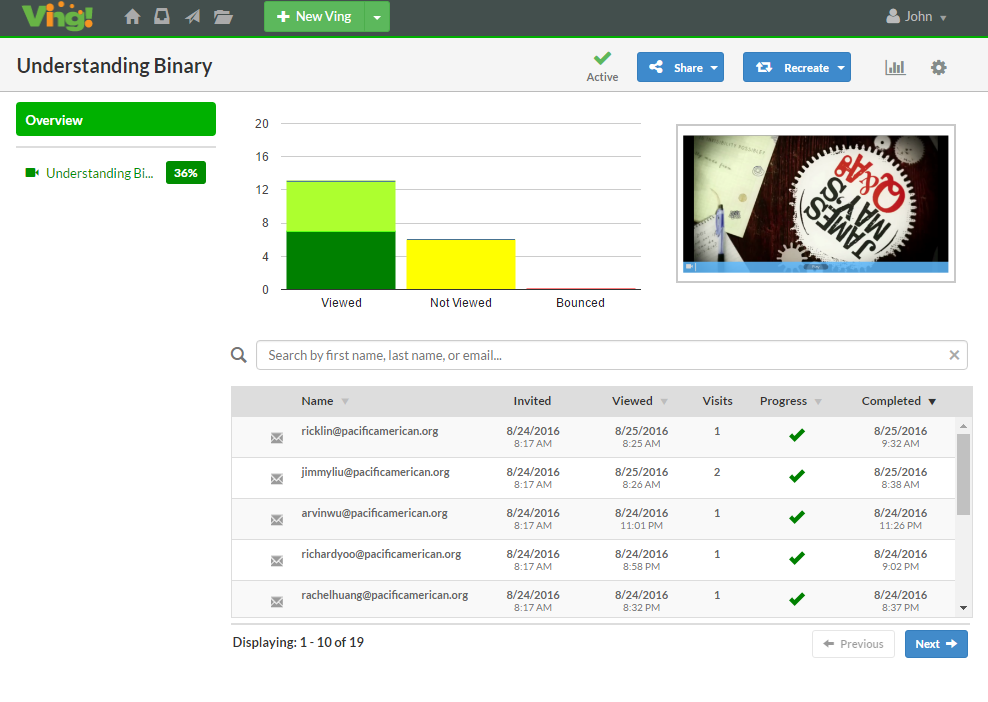
Ving allows educators to upload their own resources into a content management system and then track students in real-time as they work through videos, quizzes, articles and audio clips. From the moment a student starts interacting with an assignment an educator can track a student’s progress real-time.
Ving works on any device and teachers have the ability to email or post assignments from “Google Classroom, student portals, and social media pages”. Ving features a user interface where teachers can upload any combination of videos, audios, documents, images directly from their computer or Google Drive. Equally impressive is the ability to create quizzes and surveys for assessment.
Other useful features are the ability to save your Ving as a template in Google Drive to be used in future assessments or by another educator. The template feature allows for collaboration and sharing between teachers, school districts and beyond. Also, the ability to sync Google contacts with Ving is a huge time-saver when inviting students to your Ving. Finally, student analytics can be easily exported in Excel or CSV format for recording keeping.
Getting Started with Ving
Sign up was almost effortless as I was able to link Ving directly to Google Apps for Education account with a few clicks. I immediately appreciated Ving’s clean interface as It provided easy access to the Home, Inbox, Shared and Draft Icons. A quick look around and I was ready to jump in! With a click on the “+New Ving” button I was directed to the highly intuitive content interface and then dived right into creating my first assignment.
Content Management Interface
Ving’s simple interface had me uploading lesson files in no time. As Ving integrates with Google Drive I was able to upload photos, videos and audio clips from the cloud effortlessly. Several documents essential to my lesson were on my Windows PC, no problem, Ving provides the capability to upload content directly from my computer. I was preparing a lesson on the use of binary in computing for my high school computer science course and uploaded several videos, a PDF document and images. Additionally, I recorded a voice file for instructions on how to complete the module. Finally, I created a quiz to assess their knowledge on my newly minted lesson materials. With a simple click on a “+” button I was able to choose from 6 question types include True/False, Yes/ No, Multiple Choice, Multiple Response, Likert Scale and Short Answer.
I post all my teaching materials on Google Classroom however it often becomes cluttered with videos, documents and other course related information. Ving to the rescue! I simply create a self-contained module with all my learning resources and post the link in Google Classroom thus avoiding clutter and streamlining a student’s viewing experience. Shortly after implementing Ving in my teaching practice students commented on how they enjoyed having all the learning content available in one Ving. It made sorting through Google Classroom a less daunting task.
Creatively, Ving has several useful options as well including the ability to customize the resource layout via a selection of different grid types and color schemes. I was able to reorder my resources with easy drag-and-drop functionality. It was time to click on “Create” and bring my Ving to life,
Using the Analytics Interface
After creating my Ving I clicked “Share” and was ready to invite students via my Google contacts. Previously, I had created a contact list for my Computer Science course in Gmail and was able to send a Ving invite with one simple group email. Additionally, I found that I needed to make some edits after my Ving was published. In this particular case I was able to take advantage of Ving’s “revise” feature which allowed me to add a PDF document and edit my active, shared Ving without my students being the wiser!
Student Experience and Real-Time Analytics
As my Computer Science students worked through the lesson content they received a green check mark as they completed viewing videos, documents, audio and quizzes. I received an email that my students were working on the Ving and could track real time as they worked through the modules. Most importantly I was able to see how much time they dedicated to each module. Finally, I was able export student results via Excel or CSV format.
A Powerful, Flexible Solution to Content Management
Ving is a much needed tool for blended or flipped learning environments due to its ability to track student analytics as they progress through teacher provided multimedia, documents and quizzes. It only takes moments for an educator to gain insight into which students’ lack engagement and motivation. As this academic year progresses I’m looking forward to creating and organizing my future teaching units with Ving. I recently demonstrated Ving to other teachers and they are extremely excited to use the platform in their own teaching practice due to its ease of use and its ability to enhance Google Classroom.
There are several features that I hope the developers will upgrade in the near future. For instance, when creating a quiz, I couldn’t select the correct answer and later realized that I would need to self-grade quizzes. An automatic grading feature will enhance Ving greatly. In terms of summative assessments integrating Google Forms into their platform would be incredibly powerful as well. Additionally, there is a small-learning curve when using Ving, therefore the existence of a help button located directly in the interface would be helpful rather than burying it in the menu section. That being said, the Ving team enlists the use of email to provide its users with timely hints and suggestions.
In closing, Ving is truly innovative and a must-have tool for any educator and has the capability to vastly improve one’s teaching practice. It has greatly improved the Google Classroom experience for my students. The web-based tool greatly enhances the ability to flip your teaching practice with its ability to track student progress and time spent watching a video, reading a document, listening to audio or taking a quiz. I will enthusiastically be recommending Ving to my fellow educators.
To kick off your communication this school year sign up for your FREE trial of Ving here. It is time to start using a tool that allows you to be in control of your communication and start knowing what is and isn’t working at your school.
The new Moments app allows teachers to chat with parents and share assignments, announcements and awards
(ATLANTA, GA) September 1, 2016 – ClassFlow Moments, a new free app for teacher-parent communication, is the latest addition to Promethean’s award-winning collaborative learning software ClassFlow. With the ClassFlow Moments app, teachers can easily share classroom assignments, announcements, and awards with parents so they can proactively engage with their students’ learning. ClassFlow Moments is free for parents.
“Most parents can identify with asking their children about school and receiving a one-word answer,” said Vincent Young, the Chief Marketing Officer at Promethean. “ClassFlow Moments offers a new way for teachers to connect parents to their students’ classroom activities. As teachers assign homework or reward students with award badges in ClassFlow, they can easily alert parents at the same time. The parent-student conversation after school then shifts to ‘Tell me how you earned a badge for excellent class participation today,’ or ‘What ideas interest you for your science project?’ With the ClassFlow Moments app, students receive additional support from their family to reinforce their education.”
According to a report from the Southwest Educational Development Laboratory (SEDL), “Programs and interventions that engage families in supporting their children’s learning at home are linked to higher student achievement.” Using the ClassFlow Moments app, teachers can bring parents and guardians into the learning process by sharing classroom content directly from ClassFlow – the hub where they direct classroom activities, deliver lessons, launch quizzes and interactive polls, and send out homework assignments.
Using their ClassFlow account and the free ClassFlow Moments app, teachers can send parents:
Class assignments: Communicate assignments and their due dates so parents can work with their student to encourage timely and quality completion.
Class activities and announcements: Remind parents to send in permission slips for a field trip, of a school celebration taking place this week, and that students have a test on Friday – all from the same place where teachers manage lessons and class content.
Student success and awards: Notify parents of any badges given to students during class for showing initiative, being a team player, solving problems, and more.
Messages: Chat with parents securely from the app. Teachers can chat one-on-one with an individual parent, or start a group chat to reach all parents.
“It’s so important to invite parents and guardians into the learning process, but it can be challenging when I’m already pressed for time as a special rotations teacher focused on STEAM learning and technology,” said Jaime Vandergrift, Instructional Technology Specialist and ClassFlow Ambassador. “ClassFlow Moments makes it easy to keep parents informed about what’s happening in my classroom and our school. There are quick and simple instructions for parents on how to get and use the app. It’s also intuitive for me as a teacher, since the ClassFlow lesson software I’m already using can directly share information with parents through the app. An open line of communication between the teacher and the parent is essential in shaping a student’s learning journey.”
ClassFlow simplifies the way teachers discover, create and deliver interactive learning. ClassFlow is trusted by over 50,000 schools and institutions in 154 countries worldwide.
To learn more about ClassFlow and sign up for a free account, visit ClassFlow.com.
About Promethean
Promethean is a global education company that improves learning productivity by developing, integrating, and implementing innovative 21st-century learning environments that help make everyone more engaged, empowered, and successful. Promethean’s main corporate offices are located in Blackburn, UK, and Atlanta, USA. Promethean is a member of the Net Dragon Websoft Holdings Limited (HKSE: 0777) group of companies. For more information, please visit PrometheanWorld.com.
That depends partly on how they compete. In the world of higher education, universities compete for enrollment: more students, and more funding. They compete for prestige: better students, and more acclaimed faculty. They compete for funding: more research, more graduate students. Do they ever compete to solve real world problems.
It is easy, amid all the competition for these benchmarks, to forget that the mission of any school–university or otherwise–should be to solve problems, and to teach students to do the same.
Solving Problems, or Hogging the Spotlight?
You can see the difference when it comes to the hype cycle that is so prevalent in today’s technology-obsessed reporting. Catching wind of the Next Big Thing in education–from the augmented reality classroom to the gamified lesson plan, the personalized learning system to the responsive test–may make headlines, but it may also drive us to lose sight of what all these new tools and old practices are really all about.
Online learning has been guilty of both in the past. MOOCs were heralded as the end of formal college education as we knew it, only to then be decried as non-starters that students were more likely to drop out of than use as a ladder to success. For-profit colleges, in the interest of maximizing enrollment (and profits), became synonymous with “online degrees,” even as major universities tried to bring their own curriculum and faculty into the internet age. Both are still struggling to win the credibility game.
All this, despite the fact that more and more students say they prefer online learning to traditional classrooms. It all can start to look like higher education is just a pie, and schools are just looking to get their slice, rather than ensure everyone is fed.
But between the breaking stories, there is some innovation quietly targeting not general acclaim or government-backed student loans, but the real world problems and challenges an educated populace is supposed to solve. When a program begins its life as a solution, rather than as a novelty or an obligatory offering, it makes an important difference–and not just to the students.
The UNProject
Several years ago, the state’s Department of Children and Family Services cut funding to travel training for agents working in the rural areas of Nevada. No longer could these welfare agents be compensated for pursuing professional training and continuing education by traveling.
Considering the geography of Nevada, as well as the socioeconomics of such a large, dispersed, and often underserved population, this put both the social workers and the families they served at a meaningful disadvantage.
Today it is easy to suggest that the circumstances clearly called for a distance education system to bridge the gap and keep rural social workers equipped with the best knowledge and practices available. That is the model used to deploy telehealth services like primary care to the nation’s rural and remote communities, after all.
But when the University of Nevada in Reno (UNR)’s social work department took on the challenge, they recognized that they had to do more than just digitize a curriculum–they had to make it practical, and accessible to people who would put their education directly into action.
This is what led to their UnProject: UNR’s attempt to broadcast training and learning opportunities using a new, online, education system that ran on the same Blackboard-based platform the university already used.
Blending Innovation with Accountability
Students, parents, professors, employers, and politicians all recognize the historical void of accountability in higher education. Graduates with exceptional records are still routinely seen as unprepared to do real work, and the growing burden of student debt is often cited as an example of waste and reckless spending when it doesn’t produce a growing economy or cutting-edge workforce.
Simply giving students material and holding them accountable for digesting it wasn’t a viable model. UNR was a stakeholder in the success of everyone who used their online classroom to serve real clients and their families around the state; outcomes were practical, not just grades and test scores. The faculty behind the curriculum of these programs were collaborating with the Nevada DCFS to determine areas of need, both on behalf of the clients, and of the social workers serving these families. They couldn’t drop the ball when it came to delivery.
The UnProject at UNR took questions of accountability head-on, because the very nature of the program was to solve a problem. Solving that problem required innovation, which meant the instructors were creatively designing course materials and accommodating their delivery platform in the interest of finding what worked best–not just adding bells and whistles for the sake of modernity or bragging rights.
Feedback was instant and continuous. The instructors learned what worked, what didn’t, and what had the biggest impact on the social workers in the field. They also helped these workers bridge the mental gap to see the new platform as a tool for them–not a novelty, and not a half-measure, but an evolving response to a felt need.
The best part was, their most effective tools weren’t something they had to purchase, or build from scratch: they were the basics already built-in to their Blackboard platform. They were free to focus on disseminating best practices and responding to their students, rather than troubleshooting with an unwieldy, untested new system.
Where You Start Informs Where You Go
This foundation in practice, in problem-solving, and in going from state bureaucrats to rural families and workers, underscores what is now the online social work degree at UNR.
Yes, it is still just another online degree–but the faculty and resources that power the program are as much a tool of the state government as they are a product delivered to paying students. The program grew from something solving a problem, to a pathway to certification. This is the broad sort of model that makes education meaningful and resilient–not just incorporating the latest gimmicks.
A focus on problem-solving answers more questions than simply format and packaging: rural child welfare workers are not looking to put feathers in their caps by taking online classes; these are professionals on the fringes of society (literally: Nevada is a huge state with many rural, impoverished, and marginalized communities and families). That means the curriculum, the materials, and the medium are all, by necessity, whittled down to what works.
It wasn’t a PR stunt. The people who benefited from the new system were in no position to publicize the success story. It was a case of educators doing what they do best, and the domino effect that results from effective instruction.
What is Valued
Online education can solve similar problems even for those who aren’t out in the field or limited by the realities of rural life. Non-traditional students–adults, working professionals, drop-outs, parents–have long lived and worked on the margins of higher education, unable to gain the credentials to validate and certify their skills, knowledge, and experience, to fully participate or reintegrate into the professional workforce.
When schools look at these potential students not just as enrollment figures and dollar signs, but real people with real needs and a capacity to solve problems themselves, the value of a degree and a school are maximized.