Uncategorized

The Key to STEM Achievement: Answering the Question

‘When Am I Going to Use This?’

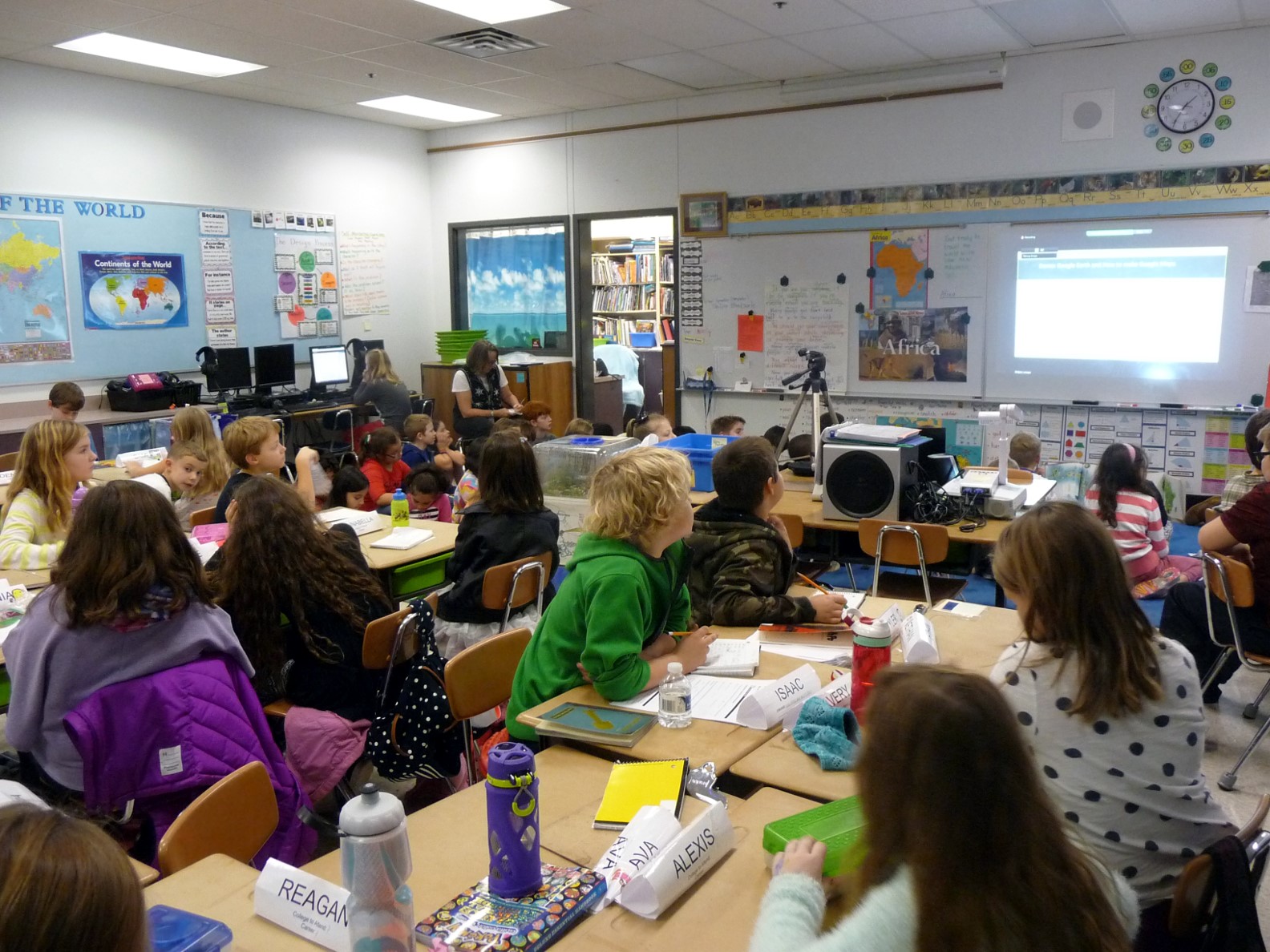
In Maureen Foelkl’s classroom at Chapman Hill Elementary School in Salem, Oregon, second and third grade students designed solutions to seasonal flooding and erosion in their community with the help of actual engineers in the field.

The project won Foelkl the Presidential Award of Excellence in Math and Science Teaching. While working on it her students learned about complicated concepts such as how a flood plain works, how structures can keep water out, and what kinds of materials can hold water in.

Foelkl invited civil engineers to talk with her students about these topics either in person or through interactive conversations that took place online. Her students then designed and tested their own prototype structures for mitigating the effects of or for withstanding a flood.

Foelkl, who is now an independent contractor writing science, technology, engineering, and math (STEM) curriculum for multiple organizations, says her students were highly engaged throughout the project. Having outside experts speak with them “brought authenticity to the lesson,” she says. “My students asked questions that I could not begin to answer.”

She adds: “No textbook I know can come close to interacting with students in that fashion.”

Making It Real

Research suggests the No. 1 reason students avoid STEM-related courses or careers is because they don’t see the relevance of what they are learning. In other words, there is a huge gap between what is happening in the classroom and in the real world.

Clearly, it’s time for a new approach—and Foelkl and many others have found that connecting students with actual STEM professionals helps make these subjects come alive in ways that a textbook just can’t replicate.

In Oregon, the state has created nearly a dozen STEM Partnerships, or regional hubs in which leaders from the education, business, and nonprofit communities come together to design community-based solutions to their STEM workforce challenges.

The South Metro-Salem STEM Partnership is one such hub, which serves districts in the Salem and Portland areas—accounting for about 25 percent of the state’s students. A key element of their effort is Oregon Connections, which is connecting students (and teachers) with industry experts. These STEM-related professionals come into the classroom either in-person or virtually to make science and math more meaningful for students.

“To me, the most important thing is making it real,” says Melissa Dubois, director of the South Metro Salem STEM Partnership. “We don’t get the innovations we get by magic. You don’t get an iPhone because it just materialized from nowhere; there are people with skills and expertise who have a really great time trying to dream up and build these kinds of products.”

Through Oregon Connections, teachers can request scientists, engineers, and other STEM-related experts to visit their classrooms in person or through an online conversation to talk about the work they do and why it’s important. The online conversations are powered by Nepris, which matches teachers with STEM experts from anywhere in the country and also hosts the video conferences.

Teacher, Maureen Foelkl, guides her third graders from Chapman Hill Elementary School in Salem, Oregon through a STEM lesson and brings in industry experts to her class virtually using Nepris or for in-class visits using Oregon Connections.

“I have been using Oregon Connections extensively over the past three years,” says Dylan McCann, a sixth grade math and science teacher at Twality Middle School in Tigard, Oregon. “We’ve met virtually with programmers, military defense engineers, naval architects, and pilots. My students have had the opportunity to see actual professionals using concepts we have been learning in the classroom—and that gives them an answer to the age-old question: ‘When am I ever going to use this?’”

Opening Students’ Eyes to New Possibilities

Besides making STEM topics more engaging and relevant for students, bringing industry experts into the classroom also opens students’ eyes to new career choices they might never have considered before. And, having the entire world of professionals at their fingertips through Nepris means there are virtually no limits on whom they can talk to.

Dubois says it’s important for students to know that the things they love to do could lead directly to a career: “If you’re an outdoor kind of kid, there’s a role for you. Do you love exploring the woods after school? There are people who do this for a living, and it’s a really important job, because it helps us manage our resources and be good stewards of the environment.”

That personal connection, now fulfilled by Oregon Connections, seems to be missing in many classrooms, she adds. And even though it might only be 30 minutes with somebody on a giant screen through the Nepris connection or a short in-person visit arranged by the partnership, “it’s far more impactful than the teacher saying, ‘You could be an engineer when you grow up.’” When students are exposed to actual professionals who are doing this work on a daily basis, those are the things they remember. They remember the people, not the words.”

The Oregon Connections program has “opened doors to occupations that hone in on students’ interests,” Foelkl says. “I have my students tell me at the beginning of the year what they might want to do after high school. The most frequent answers used to be a veterinarian, a zookeeper, a teacher, or someone in the military. These are all grand occupations, but somewhat limiting.” After hearing from STEM professionals, she says, “I had students tell me they want to work on plane engines, become a chemical engineer, become an inventor and open their own business, teach others about how to stay safe, lead environmental causes, write their own code—and still care for animals.”

Students in Maureen Foelkl’s third-grade class at Chapman Hill Elementary School in Salem, Oregon designed solutions to flooding and erosion with help from professionals linked to their class through Oregon Connections.

Seeing STEM professionals who look like them also helps address a lack of equity in these fields.

“I purposely try to bring in professionals who can personally connect with my young girls and students of color,” McCann says. “I think it is extremely important to give students in the underrepresented demographics (role models) they can look up to and have conversations with. For instance, last year my students were learning about thermal energy transference, and I had a young African American woman talk to my students about what it’s like to design, build, and test rockets—and what it’s like to get to blow things up for a living. She spoke about her journey as an African American woman (in a STEM-related field), and she showed my students that with perseverance and a great attitude, they can achieve anything they ever want.”

He concludes: “Giving my students the opportunity to connect with real people using what we are learning in class every day is invaluable. Without this real-world exposure, there is no context to what we are doing in the classroom. I have seen my students remember concepts and maintain excitement for careers they never thought possible, years after a visit with a professional. Bringing professionals into my classroom will continue to be a part of my teaching strategy for years to come.”


What Parents Really Think about Parent-Teacher Communication Apps

Three parents­ share how a mobile app helps them stay connected to their children’s education.

By Tracy Everard, Kim Valley, and Shannon LeFevre

In this digital, mobile age, almost 90% of parents own a smartphone. When it comes to parent-teacher communication, though, many schools still rely on paper notes (which may not make it home) and periodic parent-teacher conferences (which happen so seldom that they may give a minor issue the time to develop into a major problem). Plus, when events happen at school, parents often hear about them last minute and may miss opportunities to participate or even provide some needed help.

With the help of apps created to help them stay in touch at the speed of texting, teachers and parents are adapting to new ways of communicating. Here, three parents at Southern Door Elementary School in Wisconsin reveal how connecting in real time with 1st-grade teacher Jessica Meacham has improved their peace of mind—and their kids’ education.

Tracy Everard

At the beginning of the year, Mrs. Meacham asked the parents what was the best way to communicate with them. Most of us said email or texting. This is why, when Mrs. Meacham announced she was implementing the parent-teacher communication app, Bloomz, I was thrilled. My first thoughts were “This is going to be great! I shouldn’t miss anything now. We are finally going to use the technology that is available.”

With the app, you have everything in one spot. I’ve used it to sign up for parent-teacher conferences and to communicate directly with Mrs. Meacham; and whenever she needs volunteers or classroom supplies, she just posts it on the app and all the parents get a notification.

I remember if we got in trouble when I was in school, we were sent to the office or a note was sent home. I think Bloomz is a low-stress way for teachers to address any issues as they come up so that they do not build up. Whenever there is an issue, or even a positive experience with a child, it only takes a second to send an individual message.

Kim Valley

Bloomz is similar to Facebook in some ways, so most parents were pretty comfortable with it. I use it every day to check my son’s schedule. He likes to know what specials are scheduled for the day. It’s so fast and easy. I wish all teachers would use it.

I love getting updates during the day. For example, one day a butterfly emerged in the classroom terrarium, and Mrs. Meacham took pictures of all the students with the butterfly and share them with us. I feel like I know exactly what my son is doing at school. I love watching his short videos. It also helps to open up communication between me and my son at home. I can ask him specific questions instead of the vague, “What did you do at school today?”

Communication between parents and teachers is so easy with the app. Another example: My son turned in his book order but forgot the check in his folder. A quick message from Mrs. Meacham, and we quickly tracked the check down and turned it in. In the same way, I know that if I have any questions they will be answered just as easily.

My parents talked to my teacher once a year, during a face-to-face meeting. Bloomz has really opened up communication between parents and teachers.

Shannon LeFevre

I welcomed the idea of a parent-teacher communication app because I was familiar with a past teacher who blogged, and I liked to be able to peek at what my child was doing in school and what I need to prepare for. For example, Mrs. Meacham sent parents a message the week of homecoming so that we could remember to encourage the children to dress up for the theme days.

The app means less paper floating around in backpacks, possibly getting crumpled or lost. With the app, I know that if Mrs. Meacham has something important to communicate to me (or vice versa) the message will get through.

The app was a big help when my son was stung by a bee on a Sunday afternoon, resulting in him having to carry an Epi-pen. I was able to contact Mrs. Meacham that night and get going on his medication plan. It made me feel a lot better knowing she knew what was going on and was prepared to get his plan in place.

Better Communication Means Better Education

Parent-teacher communication apps like Bloomz take the guess work out of helping kids progress at school. Parents know what their kids are working on and what areas they need to improve in, so they can help teachers guide students towards specific academic and behavioral goals. Teachers also know if parents have any thoughts or concerns about their kids’ education, and don’t need to wait for conference time to hear about it. This sort of open, real-time communication creates a team environment where everyone’s goal is to ensure that each student has the best learning experience possible.

Tracy Everard, Kim Valley, and Shannon LeFevre are parents of students in Jessica Meacham’s 1st-grade class at Southern Door Elementary School in Brussels, WI.

To see more go to https://www.bloomz.net.

Want to follow Bloomz on Twitter? Follow them @BloomzApp

Are wealthy donors influencing the public school agenda?

This article was written by Rebecca Jacobsen,  Jeffrey Henig, and Sarah Reckhow

School boards have often been portrayed as old-fashioned and dysfunctional, so much so that some school reform leaders have advocated for eliminating school boards altogether.

It is no surprise then that school board elections have mostly been known as being sleepy affairs. Most candidates in the past have been known to spend less than US$1,000 toward campaign expenses such as campaign literature and name recognition efforts. In 2010, for example, less than 3 percent of candidates reported spending more than $25,000.

However, this reality, as we have known it, is changing. Of late, out-of-state donors are writing very large checks to support candidates and political action committees (PACs) in local school board elections. Yes, there are PACs now involved in local school board elections.

Recent school board elections in places such as Denver, Indianapolis, Los Angeles, Minneapolis and New Orleans have seen candidates routinely raising at least 50 times as much money as the 2010 national average.

Why is this happening? And how might the involvement of these large wealthy donors change our local schools?

We are scholars of politics and education. Our research shows that such large donations have the potential to change who is elected to govern and, as a result, how our schools are reformed.

Why do school boards matter?

First, let’s look at the unique arrangement of power in the U.S. education system to understanding why this new infusion of funding is significant.

The U.S. education system is highly decentralized, with control of schools spread across over 13,000 independent, local school districts. Most boards, comprising five to eight members, enjoy considerable power over many areas, including whom to hire, what to teach, when to hold school and how to allocate budgets.

State of Maryland school board meeting. Maryland GovPics, CC BY

It is true that of late, the decision-making power of school boards has been curtailed by recent national (e.g., No Child Left Behind and Every Student Succeeds Act) and state (e.g., state takeover laws) policies. For example, when NCLB came up with its own guidelines for “highly qualified teachers,” school boards had to ensure that their definition for teachers’ qualifications aligned with federal standards and not only with local priorities and standards. Ignoring these federal guidelines was accompanied by the potential loss of federal funding.

Even with these recent limitations, however, school boards nonetheless remain important. They can modify, regulate, innovate and resist state and federal policy demands.

This ability to resist or modify policy guidelines was evident recently after the Obama administration released its “Letter on Transgender Students,” which advised school districts to treat transgender students based on their expressed gender identity rather than their sex assignment at birth.

School boards across the country were called upon by local citizens to resist this policy. In some cases, local school boards voted to not comply with the Obama administrations guidelines.

Thus despite their relatively low profile, school boards have the power to dramatically shape local educational experiences by modifying, or even at times ignoring, state and federal rules and regulations.

How widespread is outside money?

This ability to alter or resist state and national policy may be the motivating force behind the recent investment by wealthy, national donors.

To examine this rise in donations to local school board candidates, we investigated over 18,000 campaign contributions in local education elections between 2008 and 2013 in five cities (Bridgeport, Denver, Indianapolis, Los Angeles and New Orleans). We selected these five sites for examination because they were geographically and politically diverse and yet all five had school board elections where national donors became involved.

We found that donations from outside donors were widespread and significant. In the 2012-2013 elections, for example, we found that large outside donors gave over $2.8 million to school board candidates and committees, comprising 44 percent of all funds contributed by individuals. This represents a significant increase from 2009-2010, when large outside donors comprised only 4 percent of donations in the cities we examined.

The figure below shows the growth of out-of-state donations by individuals in each city.

In-state vs. out-of-state individual donations by city and by year. Data Source: Authors’ Data, CC BY

Who’s making the contributions?

By examining publicly available campaign finance disclosure reports, which are filed by all candidates, including school board candidates, and list each donor and the amount donated, we were able to track a list of wealthy donors who contributed at least $1,000 in one election cycle (see here for an example of how to access these data). In total, we found 96 large national donors involved in education philanthropy and education reform. These donors included, for example:

Reed Hastings, CEO of Netflix, who donated in Los Angeles in 2011 ($150,000) and 2013 ($100,000) and in New Orleans in 2013 ($2,500). The high-tech billionaire is active in supporting the development of new charter schools and founded educational organizations such as NewSchools.org and Aspire Public Schools.

Reed Hastings. re:publica, CC BY

Alan and Jennifer Fournier, who donated in Indianapolis in 2012 ($4,000), Los Angeles in 2013 ($2,000) and New Orleans in 2012 ($2,200). Alan Fournier is founder of Pennant Capital Management, which manages $6 billion in assets. Alan Fournier cofounded (with David Tepper, a hedge funds manager), Better Education for Kids, which advocates for tenure reform and greater teacher accountability.

Katherine Bradley, the president of CityBridge Foundation, which “finds, incubates and invests in the most promising practices in public education,” who donated in Denver in 2009 ($500) and 2013 ($6,500), New Orleans in 2012 ($2,500) and Los Angeles in 2013 ($2,000).

Laurene Powell Jobs, wife to the late Steve Jobs and founder of Emerson Collective, who donated to Los Angeles in 2009 ($1,000) and 2013 ($103,000), New Orleans in 2012 ($2,500) and Denver in 2009 ($2,525). She is active in school reform and is a board member for several education nonprofits including Teach for America, the New Schools Venture Fund, and Stand for Children.

Could the top 0.01 percent change local schools?

Outside money may not be a bad thing if the values and interests of donors align with residents in the communities. It might even be a good thing if outside donations raise the visibility of school board elections, so often plagued by disengagement.

Perhaps bigger campaign war chests and close election battles will fuel engagement in school board elections, increase voter turnout and increase awareness of education issues. But these presumed benefits rest on the assumption that these elite donors share the same values and interests of the local community.

Research suggests that this assumption is unlikely to hold because policy preferences among the very wealthy differ from most Americans. Research by prominent academics working on economic inequality, Benjamin I. Page, Larry M. Bartels and Jason Seawright, captures these differences. These scholars found that,

“[o]n many important issues, the preferences of the wealthy appear to differ markedly from those of the general public.”

These different preferences are borne out in our data as well. We found that national donors favored “reform” candidates, or, put simply, those who supported policies such as school choice, performance-based accountability and adoption of the Common Core of State Standards.

School choice offers parents the ability to choose a their child’s public school rather than being assigned one based on one’s home location. Performance-based accountability plans generally require that school or teacher performance evaluations be based upon student standardized test scores. Schools or teachers may face sanctions if these targets are not met. The Common Core of State Standards (CCSS), adopted voluntarily by states, outline what students should know and be able to do at the end of each grade.

We found that candidates who received union support received almost no support from large, national donors. This targeted funding ultimately shaped, at least in some cases, the focus of the election debate.

Here is why it matters

The concentration of funds on candidates with particular policy agendas can squeeze out other policy issues. For example, a candidate we interviewed who was very interested in restoring adult education programs for immigrant parents noted,

“It [money] changes the discourse…their [the reform candidates] message is the only message. Not just the dominant message anymore. It’s the only message that people are hearing.”

While this candidates wanted to focus on the importance of providing adult education programs for immigrant parents, he felt his message about the importance of this issue was unable to compete with the messages being put forth by the reform candidates because he lacked funding to promote his policy agenda.

What changes in public schools when wealthy donors get involved? woodleywonderworks, CC BY

In our interviews, candidates who received outside funds noted that additional funding enabled them to reach voters more often and through multiple strategies. One candidate supported by large, national donors explained that in addition to mailings and yard signs, more traditional forms of reaching voters, the additional funds enabled him to hire a professional videographer who filmed and edited three vignettes that were shown on TV: one at his home with his family, one in a local library in the community and one in a classroom.

Even traditional forms of contact were given an upgrade. For example, a candidate noted that her materials were “more polished” with “nice photos,” something other candidates were unable to do because of a lack of funds.

Some candidates we interviewed felt voters benefited from this, whereas others worried that voters were “inundated” with information from just a few candidates. One candidate described how a friend received seven mailers from a candidate supported by outside funding in a single day. Candidates without this level of funding repeatedly noted that their message couldn’t compete.

Increasing polarization

As with state and national elections, we heard from several candidates that outside donations were also leading to increased conflict during campaigns and less willingness to compromise once elected.

One candidate described the polarization of the local board as being “very much like our federal government” where board members were either “a charter school candidate or a union backed candidate” and when on the board, “nobody can cross the line.”

As a result, some expressed concern that voters were becoming more cynical and less confident in their local public schools.

One candidate shared that she heard from voters on several occasions to “please stop calling” because “I’ve already gotten 10 calls this week about the election.” This candidate was concerned that disengagement in the form of low voter turnout was a direct result of citizens being turned off by the election.

What does this mean for public schools?

We certainly support greater attention to improving our public education system. But reform takes time. It takes compromise. It takes understanding of the day-to-day realities of local schools.

The old fashioned school boards, with all of their faults, were often slow and pragmatic, a force that could shield school leaders, teachers and students from broader political forces that whip the local agenda back and forth.

It remains to be seen whether school boards are strengthened by the nationalization of local school board elections or whether the injection of national funds will hinder the ability of schools to improve.

The Conversation

Rebecca Jacobsen, Associate Professor of Teacher Education, Michigan State University; Jeffrey Henig, Professor of Political Science and Education, Teachers College, Columbia University, and Sarah Reckhow, Assistant Professor of Political Science , Michigan State University

This article was originally published on The Conversation. Read the original article.

It’s time to reduce the number of PhD students, or rethink how doctoral programs work

This article was written by Gwilym Croucher

There are not enough academic jobs vacant in Australia each year to employ all our PhD graduates.

This imbalance risks training an increasing numbers of doctoral students on a promise that cannot be fulfilled: that is future academic employment.

We need to accept a hard truth that Australia needs to rethink the design of the PhD and the expectations around it, or radically reduce intake to doctoral programs.

In 2015, Australia graduated over 10,000 postgraduate research students – the vast majority of these were doctoral students. There were over 65,000 research higher degree students enrolled at Australian universities last year with most full or part time PhD students.

The number of PhDs in Australia will continue to grow. Enrolments in higher degrees have increased by almost half since 2001, and although much of this has been through more international doctoral students, domestic student numbers continue to grow year on year.

Most of these PhD graduates do not end up in a career of teaching or research at a university, or even teaching or research somewhere else.

There are currently over 50,000 staff employed in full-time or fixed-term academic roles in Australian universities. The number of positions vacant each year is nowhere near enough to accommodate even a small proportion of new Australia PhD graduates, let alone those who completed in prior years.

If the majority of PhD students, then, do not end up in ongoing academic employment, are designs for doctoral program right? Are student expectations realistic if they enter the degree with aspirations for a teaching and research career as many, perhaps most, do?

The Australian government recently accepted the excellent report from ACOLA on doctoral training. This looks at many of these challenges. There are broad issues related to research training and the academic workforce that the sector must now face.

Rethinking the PhD

There is a real need to think about the prospect of academic employment for PhD graduates. Much of the teaching in Australian higher education is delivered by sessional staff at universities.

Australian universities now depend on sessional teachers, short-contract researchers and other casualised and fixed-term staff to operate.

Many universities wouldn’t be viable without these staff. But for most academics, sessional employment is not a replacement for an ongoing position, offering little in the way of development of career progression.

Sessional work itself is not a problem unless it shows that many doctoral graduates find this as their only option. Or if it shows that students are being set up with unrealistic expectations of their future prospects for permanent academic employment.

We risk an unsustainable academic Ponzi scheme. This is not just an Australian trend, the US faces a similar challenge for large numbers of sessional staff.

But thinking through doctoral programs is more than just about managing PhD candidate expectations.

It is about doctoral training in a mode which combines the apprenticeship model, learning how to research, with more formal components of the other areas of learning that work in non-academic environments.

They need to be able to leverage the broad range of skills acquired through doctoral training, such as project management and strong writing skills.

Many students contribute as junior researchers to projects. This is critical to student research training and the overall research effort. However, to ensure they finish their degree with the right skills set will likely require a more diverse set of experiences and training. We need to avoid at worst viewing PhD students as a cheap research workforce.

Redesigning the PhD in Australia is a big task. It requires an ongoing discussion about enrolling such a large cohort of doctoral students who will not work in academia.

In an age of the innovation economy and government focus on thinking past the mining boom, there is much to be said for doctoral trained workers.

They are a great national resource to be celebrated, where time spent in PhD research is recognised for the skills developed beyond an area of deep expertise.

But the decisions we make now about how we train PhDs will be with Australia for a long time. If we don’t change, we need to consider training fewer of them.

The Conversation

Gwilym Croucher, Senior Lecturer, Melbourne Centre for the Study of Higher Education, University of Melbourne

This article was originally published on The Conversation. Read the original article.

Early childhood educators rely on families to prop up low income, research finds

This article was written by Paula McDonald, Karen Thorpe, and Susan Irvine

Early childhood educators struggling in low-paid jobs often have to prop up their income through family members and/or partners, new research shows.

Wages for qualified early childhood teachers have improved over time. However, incomes of those with vocational qualifications, including diplomas and certificates, remain low and do not reflect the responsibilities that characterise the role.

Certificate III-qualified educators, who assist in the design and delivery of educational programs, are paid A$753 per week before tax. This is considerably below the average weekly earnings of $1,137 across all occupations.

The difference between the pay rates of certificate-qualified early childhood educators and the Australian national minimum wage of $17.29 per hour before tax is minimal.

Dissatisfied with pay and conditions

Many early years educators believe their pay is too low. This is a view shared by politicians, including Tanya Plibersek and Sarah Hanson-Young, unions and an increasing number of peak bodies and employers.

The 2013 National Early Childhood Education and Care Census reported that 87% of educator respondents indicated satisfaction with their job, but half were dissatisfied with pay and conditions.

Another survey of educators who had left the sector found that low pay had influenced the decision to leave.

In any one day, early childhood educators may undertake a range of tasks requiring different skills. These include observing and interacting with children, planning and implementing the curriculum, engaging with parents, including referring them to other services, and other care activities such as preparing meals, changing nappies and cleaning.

Educators said that their daily work exposed them to health risks such as acquiring illnesses when children were unwell.

Significant physical demands were also reported. These included lifting children, as well as furniture and equipment. Receiving a decent day’s pay was considered a reasonable expectation for these physical requirements and risks.

They also compared their pay to the hours they worked. Although weekend work and work after 6.30pm should be paid at 150-200%, we found many examples of educators who worked unpaid hours.

Typically, this involved preparing learning materials at home in the evenings for the next day, attending professional development after hours, or community liaison work on the weekends. This kind of unpaid work is also common for other educators, such as schoolteachers.

Why retention is still high

Although pay is low, early years educators often rationalise their decision to stay in the sector as essentially a vocational choice.

Many argued that their desire to assist children to develop and learn trumped the pursuit of money in occupational decisions. But this happened only when educators had access to alternative sources of household incomes to cover basic necessities such as rent or mortgage payments, food and child-rearing expenses.

To cover these expenses, additional household income is often needed. For some, this is derived from partners who earn higher incomes in other occupations and hence offset their low wages. Others describe the importance of financial support from parents, ex-partners and other extended family members.

While increased demand has led to improvement in wages for early childhood teachers, this is not the case for all educators in long day care.

Shallow pay structures, the costs of study for educators earning near minimum wage, as well as inflexible training programs, constrain the process of professionalisation of this workforce.

Yet this remains an important goal for the sector, because staff qualifications strongly impact the quality of care and education provided to young children.

Policy needs to redress low pay

Developing effective policy in the early childhood education and care sector needs to address more than just issues of access and costs to parents and the government.

A critical, but often invisible, part of delivering effective early years education and care is about ensuring fairness for the workforce itself.

The idea of fairness and equality is especially important when we consider that the sector is staffed almost exclusively by women.

The very low proportion of men working in the sector, reported at around 3%, is likely to be a consequence of low pay.

It may also be part of the cause. Highly feminised sectors of the labour market are often low-paid. Examples include librarians, community service workers and retail service assistants. This situation needs to change.

In economic terms, the broader conversation about financing early years education and care should acknowledge that the sector is financed not only by governments and parents, but also propped up financially by members of educators’ households.

Where additional household income is not available, such as when educators do not have partners or families to partially support them, the educators themselves bear the cost of early years education.

The Conversation

Paula McDonald, Professor of Work and Organisation, ARC Future Fellow, Queensland University of Technology; Karen Thorpe, Professor, Psychology, Queensland University of Technology, and Susan Irvine, Associate Professor, School of Early Childhood, QUT Caboolture, Queensland University of Technology

This article was originally published on The Conversation. Read the original article.

Making university admissions process more transparent is important, but won’t help improve equity

This article was written by Shane Duggan

Universities are being urged to make their admission process more transparent following the release of a report by the Higher Education Standards Panel, which was set up by the government to help with reforming areas of higher education.

The rapid expansion of the university sector has led to a disparity of admissions practices, with equivalent courses at different institutions potentially having wildly different admissions requirements.

Earlier this year, a Fairfax media investigation revealed up to 63.5% of students at some universities were being admitted to courses of study below the advertised Australian Tertiary Admission Rank (ATAR) “cut off” scores.

However, subsequent disclosure by a number of prestigious universities has illustrated that this practice tends to be isolated to particular institutions, and courses of study.

The review was careful to point out that offers to students with an ATAR of “50 or less” made up slightly over 2% of all offers in 2016 – and more than half of these students rejected their offer.

Across the sector, universities have been accused of being non-transparent about how they deploy “bonus point” schemes. The review found that almost all providers offer bonus points of some kind. These points are commonly allocated for:

  • high academic achievement in particular subjects;
  • participation in elite sport or arts;
  • students facing social, geographic, or economic disadvantage.

The review suggests that the opacity is at least in part the result of successive waves of expansion and diversification of the sector that have gone relatively unchecked since the 2008 Review of Australian Higher Education (the Bradley Review).

Report recommendations

The review highlights five key issues around the use of ATARs for admissions that it sought to address:

  • a lack of common language used between universities
  • unable to compare course admissions criteria between states and territories
  • availability of information from admissions centres
  • overemphasis on the ATAR as an admission requirement
  • potential inflation of “cut-offs”.

In response, the panel makes fourteen recommendations focusing on four priorities: transparency, accessibility, comparability, and accountability.

Combined, the recommendations seek to improve clarity of information for young people and their families in the selection of courses of study, as well as for providers in assessing prospective student applications.

As was anticipated, a number of recommendations concern the publication of accurate minimum ATARs and clearer articulation of non-ATAR requirements.

The review calls also for the adoption of a common language around admissions processes across all higher education providers.

In a diverse system of relatively autonomous providers and discrete state and territory admissions centres (TACs), this will be difficult.

Third, the review calls for the development of a national higher education admissions information platform.

This aligns broadly with the Turnbull government’s advocacy of the Quality Indicators for Learning and Teaching (QILT) website and was a key feature of the terms of reference for the panel to consider.

However, substantial research has shown that simply making information available does not necessarily address the challenges many young people face in completing secondary education and choosing higher education courses.

Too often, students from disadvantaged backgrounds are unaware of the options available to them. Commonly, they come from backgrounds with no history of higher education.

These students tend to have lower completion rates and report a poorer experience of higher education. Many do not feel that higher education is for “people like them”.

Is the ATAR still useful?

Four in ten students admitted to a course with an ATAR lower than 60 do not complete. from www.shutterstock.com

For many senior leaders, the ATAR remains an efficient and convenient tool for allocating Commonwealth supported higher education places.

However, researchers have suggested that the current policies contribute to “gaming” practices at some of the country’s most elite schools.

Research has shown how academic success concentrates in elite public and independent schools through subject and curriculum selection, intensive test preparation, and academic tutoring.

While debate continues regarding the effectiveness of the ATAR for predicting success for young people once they enter university, data does support the predictive power of the ATAR at a group level.

Data shows that four in ten students admitted to a course with an ATAR lower than 60 do not complete it.

Scholars have been at pains to point out, however, that ATAR performance and retention rates both correlate strongly with factors of disadvantage such as Indigenous, remote, part-time, and socio-economic status.

Transparency won’t necessarily help to improve equity

Equity of access to higher education remains an area of broad agreement between political parties.

Diversity schemes such as the Higher Education Participation and Partnerships Program (HEPPP) are currently being reviewed in line with the government’s intended shake up of the higher education sector.

Over the next three years, HEPPP is marked for a A$152 million cut. Along with the shift to a demand-driven system, targeted HEPPP programs are thought to be partly responsible for the over 50% growth in low-SES participation in higher education since 2010.

More information needed for school leavers

The panel’s recommendations represent an opportunity to ensure young people have accurate information for making decisions about their intended courses of study.

They will not, however, address continued concerns about Year 12 completion rates. It is too late to begin the careers counselling process at the point of applying for courses, no matter how clear and accurate the information provided.

Helping students make an informed choice about higher education is critical. However, information about the admissions process itself is not enough.

Greater attention must also be given to ensuring that students are provided with the skills to navigate higher education.

It is increasingly likely that for the majority of young people, this engagement will be a lifelong activity.

Beyond this, helping students to develop a sense of belonging is key for boosting engagement and retention.

A successful reform must also include a more comprehensive approach to working with young people to identify a diversity of pathways and opportunities.

It must actively challenge and seek to redress the prioritising of university over technical and trade options.

It must be inclusive of broader questions of the benefits of having young people engage in education beyond school without reducing that discussion to one of “budget constraints”.

Despite recent concerns about the economic value of degrees, post-school qualifications are more important than ever.

These reforms must enshrine principles of student equity both in how young people are supported to access higher education, and in their experiences in those institutions once they arrive.


Shane Duggan, Lecturer in Youth Studies and Education Policy, University of Melbourne

This article was originally published on The Conversation. Read the original article.

Schools will teach ‘soft skills’ from 2017, but assessing them presents a challenge

This article was written by Bill Lucas

When students go back to school in January 2017 there will be some significant changes to their timetables. As well as learning areas like English, maths and science, there will be some new things to grapple with called “capabilities”.

The Australian curriculum will be focusing not just on the 3Rs – reading, writing and arithmetic – but also on the kinds of “soft” skills young people will need if they are to be successful throughout their lives.

The new capabilities are:

  • Information and communication technology – using technology to access information, create products and solve problems
  • Critical and creative thinking – learning how to think and find ways to approach problems
  • Personal and social – recognising others’ emotions, supporting diversity and working together
  • Ethical – understanding values and concepts that underpin views
  • Intercultural – learning about your own and others’ cultures and beliefs.

From 2017 teachers will be expected to teach and assess these capabilities, although state and territory education authorities can determine whether the capabilities will be assessed.

In Victoria schools will be required to assess progress in the development of students’ capabilities, and there will be a specific focus on improving critical and creative thinking.

Why “soft” skills are important

To call these skills “soft” is actually unhelpful. It implies they are not as important or demanding as the so-called hard stuff like the 3Rs. They are. They include attributes such as collaboration, perseverance, problem solving, empathy and self reflection. The rationale for their inclusion in any curriculum is sound.

Economists like James Heckman have made the case in terms of improved life outcomes such as higher employment rates and lower rates of crime.

Psychologists such as Angela Duckworth and Martin Seligman have shown how capabilities predict success in education more powerfully than conventional measures such as IQ. For example, students with greater self discipline apply themselves more to their schoolwork and are less likely to be distracted.

Employers the world over acknowledge that they are vital to the future prosperity. In a global world, people need to understand different cultures to collaborate across borders.

And the globally regarded Programme for International Student Assessment (PISA) tests selected collaborative problem-solving in 2015 to sit alongside English, maths and science – a sure indication that this capability is both important and assessable.

But how do you assess these skills?

At the school level, just how do you assess these more generic capabilities? And when you get beneath the surface, what exactly is being assessed?

Work on assessing capabilities is underway in Asia and North America. A major study by the Organisation for Economic Development (OECD) into the assessment of creative and critical thinking is taking place in fourteen countries including Wales, France and Brazil.

From work like this, we know that we need to think about teaching methods (how useful assessment is for learners); practicalities (how doable it is for teachers in busy classrooms); and various technical issues of assessments (being sure results are reliable, valid and fair).

Most of all, we cannot helpfully assess any capability unless we can precisely define it for students, teachers, parents and employers.

The Victorian Curriculum and Assessment Authority (VCAA) has helped by selecting four key capabilities and mapping out in detail likely progression from Foundation through to Year 10.

Elsewhere in the state there is a trial being supported by the Mitchell Institute involving eleven schools.

Early learning from these schools suggests teachers need to change the way they teach to encourage more rigorous group work, better project planning, more effective feedback and the use of well-framed questions to drive authentic enquiries into real-world problems.

Assessing capabilities is harder than assessing subjects – and the evidence base is much less well-formed.

Knowing that a student achieved a level 8b in critical and creative thinking is not particularly useful.

But from the trial we are finding that students need to become more critically reflective and develop digital portfolios of evidence.

Digital portfolios are collections of student work that demonstrate their achievements either to the school or also, as in the case of open badges, publicly.

More nuanced assessment needed

Teachers have to use progress criteria more reliably. Experts from outside school can provide expert, authentic feedback.

Online tests developed by VCAA are now available for some aspects of capabilities.

In our own work for the OECD we have discovered how assessment needs to be more nuanced than the production of simple grades producing feedback specifically designed to improve learners’ progress.

Across the world there are initiatives which demonstrate that capabilities can be both developed and assessed.

These include Building Learning Power, the Partnership for 21st Century Learning, AC21S, and New Pedagogies for Deeper Learning which is now being tried in more than 70 Victorian schools.

For more than a hundred years we have focused on teaching and assessing disciplinary knowledge in schools. Now we need to focus on capabilities as well. While it will not necessarily come naturally to all teachers, it is vital work.

Bill Lucas, International adviser, Mitchell Institute, Victoria University

This article was originally published on The Conversation. Read the original article.

Barack Obama’s Top Ten P-20 Education Accomplishments

As President Obama’s time as Commander in Chief of the Unites States of America comes to an end, many people are wondering how he’ll be remembered throughout history. What accomplishments did he make? How did he impact our country? When Obama was first sworn into office in 2009, education was one of his top priorities. As such, here are the top 10 accomplishments that he made in the field of education.

1. Race to the Top

Race to the Top is an initiative that the Obama Administration created to promote education reform at the state level. It had states compete for grants by working to raise standards, facilitate student progress reporting, provide greater teacher support, and utilize more effective teaching strategies. Over $4 billion was given to 19 states within the first year alone.

2. Elementary and Secondary Education Act Revisions

To improve K-12 student performance tests, the Obama Administration set aside $330 million for revisions to the Elementary and Secondary Education Act (ESEA), which was originally passed in 1965 by President Lyndon B. Johnson. The changes to the tests were based on the latest psychometric research. ESEA also looked for ways to help ESL students, increase students’ college and career readiness, and improve the effectiveness of teachers.

3. Healthy Hunger-Free Kids Act

As First Lady, Michelle Obama focused on children’s nutrition. She encouraged schools to serve healthier lunches. In conjunction with her, the Obama Administration passed the Healthy Hunger-Free Kids Act. This legislation allocated about $4.5 billion to help schools serve nutritious and healthy lunches. It also doubled the number of fruits and vegetables served and ensured that only whole grains are offered to students.

4. Every Student Succeeds Act

When Obama took office, he recognized that No Child Left Behind (NCLB) had merit, but its execution was flawed. So, he worked with a group of Democratic and Republican Congressmen to create the Every Student Succeeds Act (ESSA). ESSA aims to increase accountability in schools and provide the necessary interventions to improve schools throughout the nation.

The legislation transfers some of the power regarding education from the federal government to state and local governments. And although it kept standardized testing for students in kindergarten through 8th grade, it only made it mandatory for high school students to take the test once.

5. College Scorecard

With the increasing number of college graduates bogged down by student loans, Obama wanted to find a way to help students and parents find schools that would give them the most for their money. To do this, he created College Scorecard with the input from college students and their families.

College Scorecard factors in several things that are important to students and their parents, such as the average amount of debt that students have after college and the average amount that they earn after graduating. The website allows people to search for colleges based on the program, degree, college size, location, and other factors. Then, they can compare several colleges to determine which one will give them the best value for their money.

6. Educate to Innovate Initiative

When Obama first took office, he wanted to push for more science, technology, engineering, and math (STEM) opportunities for students. He hoped that through the Educate to Innovate initiative there would be more college graduates in these fields. By investing in the Innovation Fund and working with the Department of Education and National Science Foundation (NSF), he anticipated an increase of 100,000 more STEM teachers each year.

7. Preschool for All Initiative

The Preschool for All initiative works in conjunction with the Head Start program to prepare young children for elementary school. With $75 billion allocated to it, this initiative provides learning opportunities for students before they even reach preschool through home visits from nurses, social workers, and other professionals who can provide educational support. The Preschool for All initiative also provides preschool for children from low-income and middle-income families.

8. Maternal, Infant, and Early Childhood Home Visiting Program

The Maternal, Infant, and Early Childhood Home Visiting Program was created under the Affordable Care Act. It allocated about $1.5 billion for home visits to families in need of health care and early education interventions. One of the main goals of these home visits is to prepare students for school by getting them the professional assistance that they need.

9. College Degree Attainment

As president, Barack Obama hoped to ensure that college students received the education they desired without accruing large amounts of debt. To do this, he enlarged the amount of federal support that students can receive by increasing the number of Pell Grants awarded, offering the Education Tax Credit, and decreasing student loan interest rates.

10. Summit on Community Colleges

In 2010, Obama also held the White House Summit on Community Colleges. He aimed to improve community colleges and provide grants for people seeking technical training or job-driven training opportunities. By doing this, he hoped to enable more people to get the training needed to attain better employment.

When Obama first took office in January 2009, education was a top priority. Through these accomplishments and others, he was able to impact education throughout the United States of America and bring about positive change for students.


The Cost of College: What happens when college costs spin out of control?

The rising cost of college is causing long-term problems for this generation of graduates. Now that Americans are beginning to recognize the damage student loans are doing, will the government focus on making college more affordable? Or is this just the way things are?

According to a new Gallup-Lumina Foundation poll, many Americans feel that college is no longer affordable. Just 17 percent of white Americans polled believe that “education beyond high school is affordable to anyone in this country who needs it” and only 19 percent of black people polled believe the same.

Hispanics are far more optimistic in their view of college affordability. By way of the Gallup poll, more than 50 percent of Hispanics polled responded that college is affordable to those who live in America.

Separated into three categories of white, black, and Hispanic, the gulf between how Hispanics feel about the cost of higher education compared to whites and blacks is staggering. That may mesh with how some view the outlook and direction of the country.

But this study also mentions the rising cost of tuition and the copious amount of debt that students are saddled with upon exiting college. According to Gallup, tuition at a “public four-year college has increased by more than 250% over the past three decades.”

That’s likely why many students carry an average of $30,000 in student loan debt and why some in the federal government want to extinguish student loan debt when filing for bankruptcy.

This new study is another in a long line of studies that show just how un-affordable higher education has become for some. With the rising cost of tuition and student fees, many students are being priced out of the ability to attain a college degree.

Even Senator Elizabeth Warren called out the federal government for its student loan problem. She said that outstanding student loan debt needs to be refinanced and that “college affordability and student debt” are issues that need to be included in the re-authorization of the Higher Education Act.

The cost is turning off some students as they are afraid of amassing thousands of dollars in debt and ruining their financial future. If anything, this shows just how dire the situation has become and why the federal government needs to act on fixing the problem.

Just how bad is this college debt problem, anyway?

Consider this. In the fall of 2012, 66 percent of high school graduates from that year were enrolled in college, and that number does not include students that waited longer to enroll or non-traditional adult students.

Currently, there is a call for a more affordable college education, which makes sense. It comes on the heels of a recession that undercut the value of a college education. Even those with a college degree were not immune to the financial hit that the economy took and those still paying off their student loans were often left without the very job they had always assumed would pay off their educational debts.

A study by the Urban Institute found that almost 300,000 Americans with master’s degrees were on public relief, along with 30,000 with doctorates. The average debt of a college graduate is $35,200 and that can take decades to pay off.

For black students, this issue can be even worse. A Gallup poll found that in the last 14 years, around half of black college students graduated with student loan debt exceeding $25,000. This is compared to 35 percent of white students had loan debt that high.

Often the only way for black students to afford a college education is by taking on these loans. Four out of five black students take student loans to attend college and typically have nearly $4,000 more student loan debt compared to white students, according to a 2013 report by The Center for American Progress.

There is deep inequality here in the U.S. In 2013, the median income for black households was $34,600, and the poverty rate is 27%, nearly three times that of white Americans.

Furthermore, college students with high debt tend to suffer long-term health issues

According to a new study via Gallup.com, college graduates “who took on the highest amounts of student debt, $50,000 or more, are less likely than their fellow graduates who did not borrow for college to be thriving in four of five elements of well-being: purpose, financial, community, and physical.”

The survey has an area of 25-years as Gallup only polled individuals who graduated college between 1990-2014. What the study found is that graduates who are burdened with $50,000 or more in student loan debt may struggle to repay their loans, which in turn has causes them to delay making large purchases, e.g. buying a new home.

Those saddled with debt are unable to save as much as their counterparts who do not have as much debt or none at all, and Gallup’s “thriving gap,” percentages between those with $50,000 in debt less the percentage of student’s without it, shows an 11 point percentage spread between the two parties.

The study also found that more recent college graduates seem to be performing worse than those who graduated before 2000. Those who obtained a college degree between the years of 1990-1999 are doing better socially, physically, and in purpose.

Student loan debt now outweighs credit card debt and has surpassed $1 trillion. With wage growth still stagnant and many individuals going without full employment, this will mean more health issues and many former graduates with void savings accounts as well.

Even the coveted private school does not pay off right away

Ivy League schools are prestigious, with many students vying for acceptance and few earning a spot as an attendee. However, for people seeking the cushiest early-career salaries, the Ivy Leagues aren’t paying off instantly.

Princeton, Harvard, Yale and Columbia don’t make it into the top 30 universities for starting salaries. The University of Chicago, a tie for fourth, doesn’t make the top 200.

The PayScale survey tells us that Princeton, the highest performing Ivy League school offers its graduates a median starting salary of $60,000 – earning is the 34th highest in the country.

And spending a year’s worth of salary for one year of higher education at Harvard does not always lead to great career results.

According to U.S. News and World Report, a recent Brookings Study shows that “other schools may either not cost as much and yield a similar salary and success of loan repayment, or they may cost about the same but generate higher earnings potential.”

On the other hand, going to an elite military or tech school might just be your best bet. For example, graduates of the United States Naval Academy at Annapolis earn a median annual salary of over $80,000 over their first five years post-graduation, earning the school the top number of surveyed schools.

Now granted, the nation’s traditionally elite schools distinguish themselves with a salary growth near graduates’ mid-career. Graduates from Ivy League and like schools see their pay jump significantly when they are more than ten years past graduation. But the quick payoff that many students expect after graduating from Harvard or Yale may not happen.

On the flip side, there are options today, especially with online courses. With less red tape than the traditional college format, online students can earn credits while still working full time, maintaining families and dealing with illnesses. Whether students take just one course remotely or obtain an entire degree, they can take on the demands of college life more readily.

Each year online learning initiatives becomes less of a fringe movement and more of an incorporated and accepted, form of education. More than 6.7 million people took at least one online class in the fall of 2011, and 32 percent of college students now take at least one online course during their matriculation. It is even becoming commonplace for high schools to require all students to take an online class before graduation as a way to prep them for the “real world” of secondary education.

The flexibility and convenience of online learning are well known but what is not as readily talked about is the way distance education promotes diversity of the college population. With less red tape than the traditional college format, online students can earn credits while still working full time, maintaining families and dealing with illnesses. Whether students take just one course remotely or obtain an entire degree, they can take on the demands of college life more readily – leading to a student population with more variety.

The Babson Survey Research Group recently revealed that while online college student enrollment is on the rise, traditional colleges and universities saw their first drop in enrollment in the ten years the survey has been conducted. This drop is small – less than a tenth of one percent – but its significance is big. A trend toward the educational equality of online curriculum is being realized by students, institutions, and employers across the board. The benefits of a college education through quality online initiatives are now becoming more accessible to students that simply cannot commit to the constraints of a traditional campus setting.

A controversial experiment that could lead the way to even more college credit accessibility is MOOCs or massive open online courses. As the name implies, these classes are offered to the general public at a low cost, or no cost, in the hopes of earning their students college credit. California-based online course provider Coursera recently had five of its offerings evaluated by the American Council on Education for college credit validity. Four of the courses were recommended for college credit by ACE, and one was endorsed for vocational credit, providing student work verification through a strict proctoring process.

These credits are not earned through community colleges or online-institutions; Duke University, the University of California at Irvine and the University of Pennsylvania are on Coursera’s list of places the courses will earn credit for students that pay a nominal fee. Students that obtain these credits through Coursera can approach any higher education institution and seek their inclusion in a degree program, but the final discretion is up to the particular school.

MOCCs are certainly in an infancy stage and do not provide a “sure thing” yet for students that participate. In the Babson survey mentioned earlier, only 2.6 percent of schools offer a MOOC, but an additional 9.4 percent are building a MOCC plan. The potential for further diversity and equality in education through MOCCs is certainly on the horizon. This form of online learning means that students do not have to commit to an entire course of study to obtain credits or even commit to a particular institution upfront.

MOOCs will further eliminate the socio-economic barriers that keep promising students from seeking out college credits. Students are given more flexibility in scheduling at an affordable price. Though the MOOC trend has its dissenters, I believe it will win over even the most skeptical and increase accessibility for all people that seek higher education. After all, at one time the mention of online courses raised a few eyebrows in the educational community and look how far the concept has come.

Plus, not everyone is paying full price for a college education. In fact, a vast majority are paying below the advertised price.

By way of NPR.org, the National Association of College and University Business Officers conducted a study “of tuition discounts at private, nonprofit, four-year colleges and universities.”

The information released in the survey suggests that all colleges that were surveyed offered some sort of discounts to its students.

“They estimate 89 percent of first-time, full-year freshmen received some discount in 2014-2015. Of those students, the average grant they received is estimated to cover 54.3 percent of tuition and fees.”

That’s at least half off of student fees and maybe tuition

Still–even with the steep discounts, it’s not enough to curb the rising rate of students who carry too much debt. At least this survey doesn’t go into detail as to how these discounts may offset the full cost of college or how it impacts the load of debt that students carry post-graduation.

While the study is a brief overture into how some schools attend to the full cost of college, it also shows just how expensive some schools are if nearly 90 percent of freshmen can utilize discounts. Wouldn’t it be nice to have a college system that was just plain affordable for all students, without the trappings of all these discounts and needing to spend so much time tracking down the money to attend?

Who wants to make college affordable again?

As it stands, things may not be looking good

According to a study, there is a correlation between the rising cost of Medicaid and declined spending on higher education. Created by Moody’s Analytics for The National Commission on Financing 21st Century Higher Education, the study suggests that state budgets will constrict spending on higher education because of the high cost of Medicaid.

Because money from the Affordable Care Act will start to slow by 2020, many states will have to allocate more funds for Medicaid, which in turn will cause a decrease in discretionary spending.

So, many states that are struggling with budget deficits or have deeply cut funding for higher education will likely face more financial issues.

The study portends that Medicaid will outrun state revenues. If that potential trend holds, then higher education truly is in trouble.

To further foreshadow the problem, higher education spending is only expected to grow by as little as four percent each year. Any growth may look good on the surface, but that type of spending will likely cause many colleges and universities to reshuffle their spending priorities.

Louisiana’s budget crisis led Governor Bobby Jindal to look at cutting a record $600 million from higher education. Because of the loss of funding, Louisiana State University (LSU) planned to file for academic bankruptcy. That will mean that LSU will be forced to raise tuition and student fees, likely pricing some students out of attending the university.

Likely more states that face this crisis of funding will attempt to raise revenues and cut higher ed funding. Unfortunately, education funding is usually the first to get cut when state funding gets tight. Because this issue isn’t supposed to shock state budgets for at least another five years, hopefully, states will take precautions now to prepare for the issues down the road.

Here’s who’s talking about solutions

U.S. Senator Marco Rubio spoke about his efforts in his home state of Florida, and perhaps on a federal level, to make college attendance a shared cost. Rubio is no stranger to college debt. When he arrived at the U.S. Senate, he still had $100,000 in outstanding student loans. Rubio has been upfront about his modest upbringing and also the power his education gave him but he has acknowledged that the cost is too high. The basics of his college plan would allow private investors to pay for the tuition of college students in exchange for a portion of their earnings later on. This would mean the students acquired no traditional debt and would not start out their careers in the hole – at least not in a typical way.

While I like the out-of-the-box thinking of this plan, it raises more questions than answers. At least when a student takes out a federally-backed loan or even a private one that meets federal regulations, there is some protection for the student. I worry that allowing too many private investors in on the college lending game could mean more financial pressure on the borrowers. And what happens if a student finds him or herself unemployed for a long period of time? Or unable to work due to injury? These are all issues that would certainly be addressed before legislation was drafted and approved but there are already some red flags that pop up in this hands-off government approach to college debt reform.

Another college payment idea that is arising across the country is a state-run repayment program that is similar to Rubio’s private investor one. Already in Oregon the Pay It Forward program has been approved (though not yet enacted) that will give students their public college education upfront, free of cost, in exchange for paying the state a portion of their earnings post-college. Supporters bill it as a “debt free” alternative to a college education, but like Rubio’s plan there is still money owed at the end of the college term that does impact actual earnings. It will be interesting to keep an eye on Oregon in the coming years to see how the program impacts the first groups of students who take advantage of it.

What if a public college education was completely free, though? That’s the approach Tennessee Governor Bill Haslam wants to take when it comes to the state’s community colleges. At his State of the State address, he called for free tuition at Tennessee’s community colleges to improve the state’s reputation as one of the least educated. Haslam proposed that the money to pay for it come from the state’s lottery earnings that would be placed in a $300 million endowment fund. While a short-term solution, I’m not sure that this is a sustainable payment plan. But if even one class of students in the state can take advantage of it, that may make a huge positive impact on Tennessee’s long-term economic outlook.

And of course, President Obama has some of his solutions as well. For example, during his 2015 State of the Union address, he laid out proposals to revamp the tax code by raising taxes and fees on the wealthiest Americans and largest financial institutes. The additional money from these taxes would be used to pay for free tuition for two years of community college.

Obama’s plan would give many people in America the opportunity to receive an education– something that many people in our country have always wanted, but could never afford.  The President points out that more people will have the ability to obtain a degree, and we will also see a more competitive nation with a stronger middle-class economy.

In his proposal for free tuition, Obama highlights that students would need to maintain a 2.5 GPA, attend at least half time and be on track to graduate on time. The proposal would not be exclusive to recent high school graduates.

The President estimates the cost of the free tuition program at $6 billion a year

I think community colleges are the key to an affordable education, especially when paired with 4-year college initiatives. If community college becomes more affordable, I think that some students may not have to work full-time as they take classes so that they could quicken the pace of their attendance.

Here are some other ways that the President has increased access to college education:

Enforcement of the DREAM Act. The Development, Relief and Education for Alien Minors, or DREAM, Act will an estimated 2.1 million young people in the U.S. with access to an education and amnesty from deportation. While Obama’s administration has stressed the ethical points of this act, rightfully so, it offers may economic benefits for America as well.

The Center for American Progress estimates that the DREAM Act will create 1.4 million new jobs by the year 2030 and that it will infuse some $329 billion into the U.S. economy.

Pell Grant Increases. The President has also pledged to double the amount of funding available in the form of Pell Grants over the next three years. Unlike student loans, Pell Grants do not need to be repaid. For the 2011–2012 school year, the maximum award amount was $5,550.
While a Pell Grant cannot cover all of the college costs, it goes a long way towards covering in-state tuition or community college courses. All students can apply for the program, too, and students receive aid awards based on financial need and cost of attendance.

By 2017, the maximum amount awarded to students is expected to rise to $5,975. By 2021, the Congressional Budget Office estimates that 820,000 more Pell Grant awards will also be available. The money will come, in part, from restructuring to the distribution of federal student loans. By implementing a direct student loan program, instead of a bank-subsidized one, $68 billion will also be saved by the year 2020.

Higher College Tax Credits. The Obama-Biden administration plans to triple the current tax credits available to students and parents of students paying college expenses, too. The American Opportunity Tax Credit gives a $2,500 tax credit maximum per student and students can claim it for four years.

According to the IRS, up to 40 percent of the credit is refundable, up to $1,000, to people that file even if no taxes are owed. In addition to courses and fees, the new tax credit also covers related costs like books, supplies, and required class materials.

Income-Based Loan Repayment. President Obama has often said that he believes that paying for college should not overwhelm graduates. As a reflection of this, he has pledged to expand income-based repayment options to keep the bills from college from becoming unmanageable. Around two-thirds of college students have a debt of over $23,000 upon graduation. This can be especially difficult for students that want to enter public service jobs and those who face unexpected financial hardships like unemployment or serious illness.

Beginning in 2014, students can limit payments to 10 percent of income – a reduction from 15 percent in the previous law – which means a reduction of $110 per month for unmarried borrowers that owe $20,000 and make $30,000 per year. An estimated 1 million borrowers will be positively impacted by this change in repayment options. Also, borrowers that make monthly payments will be allowed debt forgiveness after 20 years. Public service workers like nurses, teachers, and military employees will receive debt forgiveness after just ten years.

Many Americans wish they could pursue their dream of a college education, but they just do not have the means to follow through with their plans. I appreciate Obama’s focus on the future of America’s children, inclusion and equality, and college affordability.

But as much as the President has done to make college affordable, here’s another big idea to transform the state of college affordability today: a free college education.

Free college: the ultimate solution?

Yes, free college

This is something that presidential hopeful Bernie Sanders hopes to accomplish, in addition to easing the student loan burden that many college graduates carry now.

Currently, student loans are thought of as the cost of doing business. But costs are rising in an out of control manner, and each class that finishes college graduates deeper and deeper in the hole. According to the Boston Globe by way of commondreams.org, the class of 2015 will carry a student loan debt of $56 billion and is “the most indebted class in history.”

What if there was no cost to obtain a college education and it was viewed as a basic right, much like the K-12 public school system? It seems that the knee-jerk response is to claim that the nation can’t afford it. The trillion-dollar college education industry, coupled with the lending companies that “help” finance these endeavors, would feasibly go under if students did not have to find, earn or borrow the tens of thousands necessary to prove they care about their career.

Perhaps that’s true. But how would the economy as a whole look if college student debt disappeared? Instead of taking the first, low-paying job that came along to desperately find the cash to start repaying loans, maybe students would hold out for the perfect job where their talents and education could be best utilized. Instead of the nearly 22 million young adults living at home with their parents, maybe those kids would invest in their housing and start contributing to that industry faster. Parents who save every penny to pay for college would feasibly have more cash to put back into other aspects of the economy, strengthening whatever industries they touched.

When the facts are examined, it seems that the only ones truly benefitting from the current higher education model are the institutions themselves and the companies that support lending. In the second quarter of this year, private lender Sallie Mae reported $543 million in net income. In 2013 alone, Sallie Mae has spent over $1.2 million lobbying against legislation meant to relieve some of the college debt strain. Much like the skyrocketing healthcare industry costs over the past two decades, colleges and lenders have been left to their own devices with improper regulations.

The result is the “soaring college costs” we hear so much about today. According to the College Board in 1992 one year of college at a public four-year institution cost around $7,500 in today’s dollars. Now that cost is $10,000 higher. Private nonprofits cost around $17,000 in 1992; today the cost is nearly $24,000.  The cost of college is a runaway train at this point. College costs have risen faster than the inflation rate for decades.

While an economy hindrance, the high price tag of a college education has very little resistance when observing the nation’s population as a whole. Colleges and lending companies have, for the most part, gotten “a pass” because the pursuit of knowledge is deemed a worthy one where the price should never be considered an issue. Under the guise of a better-educated workforce, colleges and lenders have been able to get away with more than any other industry providing a basic, American service. What would the reaction be if utility costs rose that quickly, or the price of a gallon of milk?

For a college education to have the intended impact on the individual and society as a whole, it needs to be affordable – or completely free. It is a basic American right.

The HBCU Advantage, Part I: A Lesson in Thriving While in Dire Financial Straits

Today, most Historically Black Colleges and Universities fight financial ruin as they struggle to find their new position in today’s integrated world. Getting the funds to not only survive, but blossom, is an exercise in creativity—and HBCUs are up to the challenge. Want to know how? This chapter covers some of their latest undertakings.

Why HBCUs love donations (hint: it’s not the money)

Stephen A. Smith, best known for his work on the ESPN show “First Take,” plans to give $250,000 to his alma mater, Winston-Salem University. According to Journalnow.com, Smith is dedicated to aiding the school he loves.

Smith made the announcement during a fundraiser for Winston-Salem where he pledged to give $50,000 per year for the next five years to the school.

While speaking, Smith said that HBCUs need assistance and that he and other alumni should step up to the plate to help the schools thrive.

“A lot of HBCUs are hurting financially, but I’m here to tell you they are needed in a big way.”

Smith was a big hit at breakfast, and his announcement regarding his generous donation came as a shock to the university. Smith did not mention it ahead of his speech, apparently, and so the sounds of shock in the room were genuine. Elwood Robinson, the school’s chancellor, was left speechless because he was unaware that Smith planned to give so much back to the school at one time.

“But to do what he did and back it up like that and it’s just tremendous. It just speaks of the commitment he has to this university, and it goes back to what Big House Gaines taught so many of his players and students, and that’s to give back,” said Robinson.

Big House Gaines was Smith’s basketball coach when he attended Winston-Salem, and because of Smith’s generosity towards his former school, he was inducted into the Big House Gaines Hall of Fame.

I think what Smith did is admirable and will hopefully set the stage for other HBCU alumni to donate to the schools that helped them reach success. With so much competition for education available, it’s important that HBCUs are supported both in spirit and in tangible funds by the people they have graduated.

It’s not just alumni donations that are welcome. Donations from outside organizations seem to be popular as well.

One church was certainly generous with its gifts

Many students headed to Historically Black Colleges and Universities this fall received fantastic going away presents from Alfred Street Baptist Church in Alexandria, Virginia. It gave away more than $2 million in scholarships to high school students on their way to HBCUs later this year.

The event held at T.C. Williams High School, the school made famous by the movie Remember the Titans starring Denzel Washington, hosted the 14th annual HBCU College Festival where more than 3,000 students, parents, and volunteers attended.

More than 60 HBCUs were represented at the festival, and many students attained full ride scholarships to an HBCU.

Over $40,000 in application fees were waived, and in addition to the full scholarships given, close to 170 students received merit scholarships on site.

With over 5,000 students registered to attend, the event was the largest in the festival’s history. While students from Virginia were there, others came from areas such as Florida, New York, Illinois, and other places.

It was, to say the least, a resounding success. The event showed why HBCUs are so important and how the community may come together for a great cause.

Some students who received scholarships and money for college at the event may have received a once in a lifetime opportunity as the cost of college tuition, and fees continue to rise.

State legislators have cut into budgets for higher education, and Congress has attempted to curtail the available dollars for Pell Grants.

But the great news for students who may see a bleak future due to current events is that we still have organizations and churches that are willing to provide support for students who need it, and for those who deserve it.

Next year’s festival is likely to be just as successful, and with more than $2 million given out in scholarship money this year, hopefully, more is handed out in 2017.

Let’s look at another donation given to support HBCU excellence

Duke Energy is putting its financial support behind Historically Black Colleges and Universities.

By way of Prnewswire.com, the energy giant gave a grant of $35,000 to the North Carolina organization The Institute to supports its new HBCU Leadership Exchange.

A non-profit that supports business diversity, The Institute will soon launch the HBCU Leadership Exchange to help support and forge relationships between corporations and students enrolled at HBCUs in North Carolina.

In short, The Institute’s new program will look to connect students at HBCUs with jobs in corporate America. It’s not a bad program to build as diversity within the corporate field–specifically technology–is always a hot button topic.

The Institute has a track record of aiding minority business development as the group offers services to assist the growth of small businesses. As The Institute has been around for more than three decades, the HBCU Leadership Exchange is starting off with strong backing.

Also–Duke Energy gives close to $30 million in grants each year in areas such as education, economic development, the environment, and much more.

But this new program has potential to serve a grand number of black students. While the grant from Duke Energy isn’t substantial, it at least gives The Institute a portion of the starting funds needed to help launch the program.

With no reason to believe that the exchange will not have success, Duke Energy will likely to continue to provide financial support that will only grow in the future.

As mentioned previously, the goal of this new exchange is to foster relationships between corporations and HBCU students.

Students who are looking for jobs in a specific area will likely be paired with mentors or given the opportunity to meet and greet leaders from certain industries.

With growth and limitless potential on the horizon, students at HBCUs in North Carolina should be excited about this new venture.

Here’s something interesting about the nature of these donations: they’re not just about helping the schools stay afloat. A lot of money goes to help students go to school, preparing the next generation of students for the workforce. Notice also the donation to The Institute, where the eventual goal is better-represented leadership in corporate America. The money that is being used to further HBCU causes is an investment in tomorrow, rather than a means to survive today. There’s something admirable about this.

Is the government finally on board? Government support increases

In recent years, it seems like HBCUs have been dwindling into obscurity. They have been fighting potential obsolescence as more black students choose to attend predominantly white universities. To stick around, they have needed to rebrand themselves or establish the kind of reputation that keeps students dying to attend.  Unfortunately, many schools have been unable to do this and have faced de-funding and closing.

But it seems as if recently, the government is realizing just how important these institutions are.

For example, to advance the goals of HBCUs, North Carolina Congresswoman Alma Adams has introduced the HBCU Innovation Fund Act. The bill would create a fund that would make the availability of $250 million in grants open to Historically Black Colleges and Universities.

To improve viability, student achievement, rates of graduation, enrollment figures, and more, the accessibility of grant money to HBCUs would help to push them towards modernization.

As HBCUs continue to receive press regarding how some schools are doing financially, and if segregation regarding offered programs occurs, it is refreshing to see that all HBCUs may receive a boost if this bill passes.

The legislation, H.R. 4857, was lauded by the United Negro College Fund as innovative and has over 15 co-sponsors in Congress.

If the bill passes, it will open HBCUs up to more than just money and opportunity. Grant money would be used to help remodel certain courses and create new programs. As with the new Queer and Cultural Studies program being offered at Bowie State University, more programs of this nature may be cultivated through HBCUs if H.R. 4857 is passed.

There will be more opportunities for inclusion and recruitment, and retention efforts will certainly increase.

Some HBCUs struggle to maintain strong enrollment numbers, particularly in a culture where online learning often replace on-campus initiatives. This bill would hopefully help many HBCUs create stronger programs to go after more students.

But more than anything, this legislation would make HBCUs more competitive in an educational environment that has changed. Some schools have failed to keep up, through no fault of its own, and some are beginning to fall behind.

Stemming that tide and keeping HBCUs around so that more students of color are served, and the cultural importance of each school is maintained, an HBCU fund for innovation and is needed and welcomed.

It may be a while before the HBCU Innovation Fund Act makes its way into law. Fortunately, there will also be more immediate funds available for HBCUs over the next fiscal year.

According to Salisburypost.com, funding for the federal program that provides financial assistance for HBCUs will increase nearly $400 million. That’s good news for some of the country’s oldest universities and trailblazers for providing a college education for everyone.

“The omnibus spending bill provides a $22 million increase for the Title III Strengthening Historically Black Colleges and Universities program administered by the U.S. Department of Education, providing the largest funding boost for the program in six years. As a result, total program funding will increase to $387 million in Fiscal Year 2016.”

The new money included in the spending bill will continue to help some of these schools recruit new students, replenish endowments, and perhaps most important, buy cutting-edge technology.

United Negro College Fund CEO Dr. Michael Lomax believes that this funding will work towards making HBCUs more attractive to new students and said as much in the Salisburypost.com article. I share Dr. Lomax’s belief that HBCUs need to be protected as part of the important college landscape in America.

For the past couple of years, the HBCU category of schools has been under increased scrutiny due to financial reasons and because some schools have been forced to close. There has also been some criticism that the very roles HBCUs were created to take on are not as relevant in today’s diverse college population. I’d argue that the first problem can see potential improvement with federal funding and a bigger cash influx from alumni, private donors, and business partnerships. I’d also argue that though the primary role of HBCUs has evolved, they are more relevant than ever and we should continue to support them.

While increased funding will not cure each and every problem that HBCUs have, it will alleviate some of the financial pressure that some schools face – so I think this funding is a step in the right direction.

Creative ways HBCUs are generating revenue

Many institutions of higher education are looking to carve new avenues to create revenue.

Howard University is no exception—except that it has stumbled across something old to inject new money into the university.

Jair Lynch Real Estate has entered into a deal with Howard University to develop Meridian Hill dormitory into luxury rentals available to the general public.

The move will ease some of the financial pain the school has felt over the years. An idea first pitched by Howard President Wayne Frederick a couple of years ago; the school finally pulled the trigger on the deal this month.

According to Washingtonpost.com, Howard will still own the property and required Jair Lynch to pay an upfront fee of $22 million for the rights to redevelop the property.

Over the past few years, Howard’s financial health has come into question as the school’s credit has been downgraded twice and the school’s staff has been reorganized or cut.

To contend with those issues, Frederick identified the school’s real estate as a way to drive new income. Valued at over $1.5 billion, Howard has a lot to review regarding what it may sell or lease.

But Frederick and school officials aren’t ready to sell off everything. Taking their time to evaluate what’s in the school’s best interest, they don’t seem to be in a rush.

Every move hasn’t been met with open arms. The school has decided to enter into an FCC auction for its airwaves that may bring in upwards of $461 million. That would mean that Howard would rid itself of WHUT-TV; a sale that is sure to upset alumni and students.

The decision to enter into the auction isn’t final as the school has until March to decide if it still wants to participate. Howard may decide to opt-out as there is no guarantee that it will receive a value of $461 million for its airwaves.

I applaud Howard’s decision to tap the resources it already has to stabilize revenue, and it will be fascinating to see what sort of interest is sparked for the luxury apartments.

Conclusion

Overall, it’s great to see how much support HBCUs are getting, and how much effort the colleges themselves are putting into being their best yet. While it’s true that we are in challenging times for HBCUs, the moves HBCUs and their supporters are making will ensure that these challenges are merely growing pains, rather than the end of the road.