Uncategorized

What Educators Need to Know About Higher Education Today

As an educator and advocate for better education in the United States, you need to know what’s going on in higher education today. Why? Because—and it’s not an exaggeration to say this—much of what happens on college campuses both reflects and affects the climate of the rest of the country. Read on to find out which big issues are on the mind of college students…and why you should care about these issues.

How to make college worth the investment

  1. Prepare students for the real world.

I’ve covered this extensively on my website: more and more, students do not feel like they are getting their money’s worth from college.

Consider this: almost 90 percent of students in America go to school for better job opportunities.

In a startling new survey conducted by the Higher Education Authority, a significant amount of international college students “feel they are not learning job skills” — which clearly is the point of spending tens of thousands on earning a college degree.

Nearly 28,000 students from Ireland participated in the survey where they were asked about questions geared towards their college experience as well as future career outlook.

While many of students who participated DO feel unprepared, the vast majority state that they “felt they were gaining knowledge and skills that boosted their chances of getting a job.”

The study also reveals how students who major in certain disciplines feel about their job prospects post-graduation.

“In general, scores for “work integrated learning” were lowest among students studying courses in the arts and humanities, which tend to be broader and may not include work placements.”

The study also found that students majoring in business administration and law, services, and “comm. techs” indexed higher scores when it came to career readiness. Each area seemingly has higher job placement than arts and humanities because the positions in those fields are far more static.

The Irish Times reports that “he survey was developed in response to a key aim of the national strategy for higher education to 2030” which may be to incorporate more of what students want into learning the curriculum.

Compared to students in the United States, the findings are the same. Back in 2010, a study prepared by the York College in Pennsylvania found the same evidence: students in America “seem to be ill prepared for the demands of the workplace.”

Same goes for managers hiring students fresh out of college in America. According to Forbes.com, Harris Interactive found that “fewer than two in five managers believed college graduates were well-equipped for a job in their field of study.”

The study went on to find that many managers feel that new college graduates lack clear writing skills, can’t conduct a meeting, and cannot manage a project.

If anything, this collection of studies abroad and domestically show that a college degree may be tangible and lead to a job post-graduation, but skills learned in college may not help former students keep them.

  1. Think about whether standardized testing is the way to go.

The idea of standardized testing at the college level can be tempting. After all, it can help measure how effective that expensive education is for that student.

However, it gets messy quickly. Think about it. Standardized testing in K-12 education is already a perennial hot button issue. Proponents feel that measuring knowledge in these rigid ways helps lift the entire educational system. Critics say the measurements do nothing but encourage “teach to the test” methods and narrow the scope of what instructors can teach if they want to have acceptable test results. These arguments are nothing new, but they are now seeing a new audience.

What if the same principles of K-12 standardized testing were applied to colleges and universities? Americans spend over $460 billion on higher educational pursuits every year, yet there is no official worldwide system in place to determine whether students are learning what they should, compared to other schools. In June, the Organization for Economic Cooperation and Development unveiled research on whether a global testing system for college students is possible. The group will continue to review its findings and decide if it wants to push for implementation of the Assessment of Higher Education Learning Outcomes test, abbreviated as AHELO.

Right now the comparison system for colleges and universities lies in the many rankings that are released each year by sources like U.S. News & World Report and hundreds of bloggers who weigh in on the topic. The AHELO would be a “direct evaluation of student performance at the global level…across diverse cultures, languages and different types of institutions.” It would provide institutions feedback meant to help them “foster improvement in student learning outcomes.” In a nutshell, the test would not measure student achievements as much as shine the light on instructors that need some improvement.

To K-12 students, this sounds familiar. To college faculty, the idea is fraught with landmines. How can one test take into account so many variables in higher education across the globe? Would instructors be punished by the institution, or even worse held to some misguided accountability scale by peers, if students did not rank highly enough on an AHELO or some other test? If college is a time for fostering critical thinking skills, would a standardized test take away some of that freedom?

College instructors and administrators are right to have doubts, and particularly before any testing mandates go into effect. Take the classic college entrance exams – the SAT and the ACT. Though research has found little correlation between results on these tests and actual knowledge or intelligence, they are a standard part of college admissions. It is more difficult to reverse a testing mandate than to fight it off at the outset.

It is easy to see why colleges and universities are leery of standardized testing, but K-12 instructors should be too. Presently, K-12 instructors guide students through the formative education years, dealing with standardized tests and other demands of contemporary teaching. Success with those students is ultimately determined by two other numbers: graduation rate and college placement. At that point, a K-12 teacher’s job is done, at least in theory. Adding another layer of teacher testing (cleverly disguised as core knowledge testing) at the college level could have an impact on K-12 instructors too.

If the AHELO is designed to “foster improvement” in the higher education schools that are tested, who is to say that those ideals of improvement will not then be extended to the K-12 schools that came beforehand? A student who demonstrates below-college-level proficiency in language or math would in theory not be the product of college that failed him or her – that student’s incompetency would be a result of a previous school, or schools. Could a global test for college negatively impact the K-12 schools that preceded it?

As with any measurement of teaching and learning, the AHELO and other similar initiatives need scrutiny before becoming global law. I am not sure of the necessity of such a system, and it will take some hard arguing by the other side to convince me otherwise.

  1. Consider unconventional ways to strive for a more—and better educated—population.

Many states are struggling with creating a more educated and prosperous workforce.

Some of them have solutions.

According to the Times Free Press, Tennessee Governor Bill Haslam has a plan that would create independent boards “for the University of Memphis and other four-year universities in the Tennessee Board of Regents system.”

The plan falls under Haslam’s “Drive to 55” goal that would increase the number of adults in Tennessee with “some form of post-high school credential” by 23 percent, to a total of 55 percent.

Just under a third of the state’s adults currently possess a college degree or vocational program certificate.

This move may not impact the University of Tennessee as the governor has yet to state if his new plan will include the University of Tennessee system.

Other portions of Haslam’s plan include the creation of a task force to come up with the best ways to work out the plan details.

Because the governor doesn’t have political or legislative autonomy, his plan will have to be approved by the state legislature when they return for a session in January.

So far, there has been no indication as to how the legislature will vote, but judging by the reaction from some Republican lawmakers, Gov. Haslam’s plan has been met with glee by those on the right side.

This plan is ambitious on the surface but may lack details of what’s needed to push more adults to obtain a post-secondary education. Giving some of the state’s universities its boards and governing power is great and allows for singularity, but it doesn’t show how doing so would push more adults towards a college education.

How to help students feel safe on campus

Just like in the real world, where diverse populations coexist, tensions sometimes arise between different groups. And sometimes, this does not turn out well for students in marginalized groups.

Think about rape and sexual assault, for example. Last year, comedian Bill Cosby made headlines when some decades-old allegations resurfaced. While these allegations are receiving the lion’s share of attention, there is some equally disturbing information from the campus of the University of Virginia about consistent cover-ups regarding allegations of rape from the young women on its campus.

You can read all about these cases in their corresponding news stories from a variety of outlets — but what I don’t see being discussed in depth is the role of colleges in preventing and reporting these incidents. The safety of students is certainly of utmost importance to colleges but to what extent? Where does the responsibility for student safety end — or is it all-encompassing?

And if the answer to that question is that colleges really should shoulder a lot of the responsibility for student safety, especially when it comes to issues of sexual assault, what else can be done to solve this problem? Should there be national standards that colleges and universities pledge to uphold — and then who will reinforce them? President Obama has already called on the young men of the nation to speak up when they see sexual crimes taking place on college campuses. Is that where we should shift our focus?

It’s clear that at least some of the crimes committed against our young adults on campuses where they feel a veil of safety are falling through the cracks. It will take a concerted effort to turn that tide, but so far the solution does not seem obvious.

Speaking of sexual safety, LGBTQ students deal with problems in this arena to an alarming extent.

According to AmericanProgress.org, over 70 percent of LGBTQ students “reported experiencing sexual harassment, compared with 61 percent of non-LGBT students.”

To compound the issue, many college campuses are still in the slow process of growing to become more inclusive regarding the needs of students who identify as LGBTQ.

The report featured on AmericanProgress.org also suggests that some college campuses “may not include certain sexual acts in their definitions of rape” because “the perpetrator is of the same gender as the survivor.”

What an awful feeling knowing that the college that one attends is insensitive to the needs of its students, specifically those within the LGBTQ community.

It’s vital that students have a sense of safety while on campus. It’s supposed to be a place of freedom, a space for creativity, and an educational asylum. When those protections are removed or never placed at all, students are left vulnerable.

LGBTQ students looking for colleges to attend that make safety paramount should look to AffordableCollegesOnline.org‘s new guide, “LGBTQ Resource for College Students.”

The guide features an array of resources for students to utilize, but also offers a way for students to find supportive campuses that are “more welcoming and supportive.”

There are two diversity experts featured in the guide, and both are interviewed on the subject of student safety, recommendations for LGBTQ students, and much more.

In essence, it is a total resource of comfort for LGBTQ students to utilize when looking for the school that closely fits their wants and needs.

Let’s address another way in which students can feel unsafe on campus: unaddressed racial incidents.

A collection of black University of Missouri football players is refusing to practice or play in games until the school’s president Tim Wolfe resigns.

The move comes after Wolfe has been criticized for his handling of several race incidents across campus.

According to uppermichiganssource.com, Wolfe’s decision not to act to correct the racial tension encompassing the campus has forced one student to forge a hunger strike.

“The latest controversy kicked off with Missouri graduate student Jonathan Butler going on a hunger strike Monday. Butler says he’s not happy with Wolfe’s handling of several racial incidents on campus, and will not eat until Wolfe steps down or is fired.”

Some of those incidents include claims of a swastika drawn in human feces “on a college dorm’s brand new white wall” and many black students, including the school’s student association, were “racially abused.”

The school was slow to react, and it has taken the bravery of one graduate student to create a power vacuum.

For the students, head coach Gary Pinkel has tweeted his support of their decision and so has the school’s athletic department.

State lawmakers called for Wolfe to step down and the Missouri Board of Curators.  He ended up doing so in November 2015.

If students feel unsafe on campus due to threats from other students and the school’s leadership have aided in cultivating an unsafe environment, then the first domino of many to fall should likely be the school’s president.

How to Deal With Racial Stereotyping on College Campuses

The past few years have brought the deep-seeded ugliness of racial profiling to the surface. From the shooting death of the unarmed Trayvon Martin in Ferguson, Mo., to the … Whether it is brute force from the very people who commit to protecting citizens or discrimination in everyday life, racial profiling holds back all Americans because it prioritizes fear over the truth.

Racial profiling is even evident in the private sector, with the most recent evidence of this found in a study that found that just before the housing crash in 2008, black families with a combined income of $230,000 annually were just as likely to receive sub-prime loans as white families making just $32,000 annually. It seems that racial profiling trumps actual statistics and documentation of financial stability in minorities.

Racial profiling happens, and it’s dangerous – even on college campuses, which are often advertised as some of the most progressive places in the country. The latest example of this in action took place on one of the largest campuses based on population in the nation: The University of Central Florida. In late April, UCF students received an emergency text notification that there was a “POSSIBLE MIDDLE EASTERN MAN/WOMAN” with a gun in the UCF main campus library. The alert was prompted by a later-unsubstantiated report of a young woman in a headscarf praying and wielding a gun in a common area of the library. Once the relief of no actual threat sunk in, students and faculty started to speak out against the anti-Islamic rhetoric that surrounded the entire scenario.

In a piece for UCF’s daily newspaper The Central Florida Future, Tahoora Ateeq, Pakistani Student Association President, wrote:

“It would have been more beneficial if the UCF alert was sent out with a description of the person’s manner of dress, the person’s shoes, the person’s height or the person’s gender. In the future, I hope that UCF acts more wisely and does not utilize such a vague description that feeds into people’s stereotypes and prejudices.“

UCF’s story isn’t isolated, though. In a 2013 paper in the Association for the Study of Higher Education, Black students reported being treated differently by their professors than their white peers. A particularly disturbing portion of the paper accents an experience by a black female computer science student who said her professor associated her with stereotypical interests and called her “one of you.”

Minorities often feel unfairly profiled and stereotyped outside the classroom as well. In the fall of 2015, a black student at Hinds Community College in Mississippi reported being arrested after a police officer felt his baggy pants violated the college dress code. How can our minority college students be expected to focus on the academics at hand if they are constantly on the defensive against racial profiling and discriminatory policies?

There is a mental toll that goes along with racial profiling on college campuses, too. Black students and other minorities, even white women, often report feeling like they have to “prove themselves” beyond typical college work to somehow show that they deserve their spot – especially at schools with known diversity recruitment programs. This need to always fight back against negative stereotypes hurts students academically, which is understandable considering the energy that should be geared toward actual learning is channeled to being on the defensive. Instead of just being free to focus on their studies, too many students feel the weight of racial and other stereotyping.

So what can college and university campuses do to fight back against racial profiling?

It starts at the top. Administrators need to listen when students report incidents of racial injustice and not look the other way, as a faculty member at Yale suggested when black students were outraged by white peers donning blackface for Halloween. Campus police and security officers must be trained in the best policies for keeping the peace without unjustly profiling the very students they are meant to protect. Faculty members should not only support diversity awareness, but they should BE diverse themselves. Universities must recruit a variety of employees that are from diverse backgrounds at all levels of the organization. The more blended the student and faculty population is on a college campus, the better the chance that racial profiling and other stereotyping will simply not exist. It starts with an awareness, though, and actual policies that boost diversity and speak out against discrimination.

How to stay aware of drug use on college campuses

One thing that you might want to be aware of is drug use on college campuses.

While it is nothing new, the drug of choice seems to vary by generation.

A new survey released by the University of Michigan shows that marijuana use with college students is on the rise.

For the first time since 1980, more college students are getting high on a daily basis.

“Daily or near-daily marijuana use was reported by 5.9 percent of college students in 2014 — the highest rate since 1980, the first year that complete data was available in the study. This rate of use is up from 3.5 percent in 2007.”

Even for students who only use it socially or just occasionally, there has been an uptick in the numbers.

“The percent of students using marijuana once or more in the prior 30 days rose from 17 percent in 2006 to 21 percent in 2014.”

Without the study saying it, I’d guess this rise in use is an indicator that marijuana is no longer viewed so negatively and as a dangerous drug.

But if one views this is as bad news, there is a silver lining attached. College students no longer smoke as many cigarettes as they used to. Just 13 percent of college students said that they smoked a cigarette in the last thirty days.

While this information is certainly good to know, it is not necessarily an indicator of bad behavior with college students, if you put the use aside.

If cities continue to decriminalize the use of marijuana, use of the drug is likely to continue to increase on college campuses. How we view and measure the drug’s impact on academia would certainly serve as a fascinating follow-up study down the road.

How to pay faculty what they deserve

A gap of three percent separates the California State faculty and California State officials. At least that’s the number that may end up causing a strike.

According to PE.com, professors and lecturers are asking for a bump in pay, but CSU officials aren’t budging.

It is the fourth time in eight years that Cal State faculty so riled up about salaries that it is threatening an all-out strike. Today the school administrators will vote whether to listen to the demands or risk the faculty refusing to work for wages they feel are too low.

The percentage that’s causing the squabble amounts to $2,900 for a full professor and $1,800 for a lecturer working full-time.

That’s not a lot of money on the front end, but with the size of the school’s faculty, the total comes to around $61 million.

The school is not completely against a raise for faculty members and has offered 2 percent. This is the same raise that other university employees were granted earlier this year.

The vote on whether to strike will take place today. Classes won’t immediately be canceled though. If the faculty union does decide to strike, it won’t take place until the beginning of 2016.

I hope the school and faculty can come to some sort of agreement that means students won’t be impacted negatively. The top-notch professors are the reason Cal State is so sought after so the school should consider that heavily when looking over these salary demands. Talent and expertise should be compensated when possible for the benefit for student retention and success following graduation.

How to Use Income Diversity to Replace Affirmative Action

It’s no secret to anyone who works in higher education that affirmative action programs are in danger. Most recently, the Supreme Court upheld the affirmative action program at the University of Texas after a case filed by Abigail Fisher waffled in lower courts for years. Fisher, a white woman, believes that she was denied admission to the school based on her race and claimed reverse discrimination. While the Supreme Court decided against Fisher’s claims, the issue brought contemporary affirmative action programs to the forefront and got people talking.  Critics of the programs wonder if they are outdated and if they lead to reverse discrimination, as Fisher claimed, in some cases.

It’s important to note however that when affirmative action was outlawed in California in 1998, the number of minority students fell 36 percent at UCLA and 61 percent at UC Berkeley. Furthermore, affirmative action programs are credited with tripling minority applicants to universities in some cases, according to the National Conference of State Legislatures. It’s tough to argue with its effectiveness when you see those statistics. California isn’t alone. Other states with affirmative action bans include Florida, Nebraska, Arizona, Washington, Oklahoma, and New Hampshire.

Despite its success, it seems that affirmative action’s positive impact on the college landscape is narrowing. So what can colleges do to still recruit, educate, and graduate a diverse student population if affirmative action programs are fading?

The Case for Income Diversity

Harold O. Levy, executive director of the Jack Kent Cooke Foundation, writes for The Hill that the best way to keep diverse populations on campuses is to put income diversity programs in place. Minority groups are still at an income disadvantage when compared to white peers, so admission policies that take income into account and attempt to distribute those student openings among varying income levels. Levy cites the national poverty rates as proof that these programs would work: for white Americans, the poverty rate was 10 percent in 2013, compared to 26 percent for African-Americans and 24 percent of Hispanic Americans. Simply putting wording in place that reserves space for students based on their income levels has the potential to keep minority students in place.

I think the income diversity programs make a lot of sense. The whole point of affirmative action in the first place is to give traditionally disadvantaged students a shot at a college education. If that’s truly the goal, then students who come from low socioeconomic backgrounds, including white students, have a better shot at college placement under an income diversity program. A College Board/National Journal Next America Poll tells us that students who have parents who went to college are more likely to go themselves than their peers. We also know via U.S. Census Data that those parents make nearly $1 million more than their non-college peers. So the students who come from lower socioeconomic situations are not just at a cost disadvantage. From a mental perspective, it is more of a stretch that these students will go to college in the first place.

Which leads me to the next immediate thought I had after reading Levy’s piece: how can we make income diversity programs work? It’s one thing to put the wheels in motion with policy; it’s a totally different thing to make it successful. Along with important policy, colleges that are truly serious about income diversity must recruit those students smartly and have support programs in place that help them get to graduation. Recruitment should start early, even at middle school, before students have a chance at envisioning their lives without college. Get them excited as preteens about their futures with a college degree and let them know about income diversity initiatives.

My second point is equally important. As I mentioned above, first-generation college students face different challenges than their counterparts, and it’s important to guide them a little more closely to their degrees. If you’re going to actively recruit students who are economically disadvantaged, and may even be working their way through school, you have to implement programs that support them in those unchartered waters. It’s not enough to admit students from disadvantaged homes – colleges also have the responsibility to graduate them.

Income diversity initiatives have the potential to further diversify college campuses and give more students the opportunity at higher education. With the right implementation, they could finally close the achievement gap at the college level – but first universities have to get on board with the movement.

Why we need to pay attention to what’s happening on college campuses

College campuses often represent our larger society—in distinct, striking, and unusual ways. We know that today, racism, homophobia, and marijuana are hot-button issues in the national news.  As educators, it’s often useful to know how to navigate how college students and faculty tend to handle these issues. As you know, their reactions often influence higher education policy and the state of education in the US.

Will the Costs of College Cause an Economic Disaster?

Higher education is potentially one of the best tools for social mobility in America. However, as it is set up now, it may only help the rich get richer. Why? Well, college is a great way for lower-income people to improve their economic situation—but they need to be able to afford it first.

Is college worth it for students who already start out at a disadvantage?  Let’s look at what students, especially from low-income areas, are up against when they choose post-secondary education today.

Is the future of higher education doomed?

In April 2014, education, corporate and philanthropic leaders from around the world who met in Essex, NY at a two-day Summit believed that many colleges will be unrecognizable in another decade and that unless millions more low-income students attain college degrees we face a global economic crisis.

Participating in the Summit were 60 individuals from China, Ireland, Great Britain, Canada, Germany, France and the United States representing a dozen colleges and universities, eight foundations, six corporations and 15 secondary schools, including executives from Google, The Bill & Melinda Gates Foundation, GE Foundation, Ernst & Young, University of Michigan, Harvard, Trinity College Dublin, Beijing Normal University, among others.

“Our outstanding participants included five lead speakers who framed the key issues surrounding college 2025. These speakers are futurists, experts in teaching and learning, recognized globally. We even had a 10-time Oscar winner,” said Rick Dalton, president and CEO of College For Every Student, the organization that sponsored the Summit with Trinity College Dublin.

Emerging Technology Trends

Dr. Nicholas Haan, a futurist from Singularity University in California, said, “We must leverage the exponential technology trends and the disruption that’s upon us to solve today’s inequalities and inefficiencies in education.”

Haan provided examples of the technology trends that will affect education in the near future, including Artificial Intelligence (AI) and robotics as well as Digital Manufacturing. He urged attendees to view challenges as problems that can be solved. “We need to throw out our old thinking and prepare ourselves for a world that is collaborative, ongoing and personalized.”

Lord David Puttnam of Queensgate, film producer, educationalist and Labour peer (UK), told summit participants, “Today’s students are embarking on a journey with no map. Today’s teachers are working in a scenario that has never been seen before – they are doing a job no one has ever been asked to do. They are becoming digital learners, interested in creating, sharing and delivering content with their students.”

Revolutionizing the Engine of Education

Paul Reville, former Massachusetts Secretary of Education and current professor at Harvard Graduate School of Education, said the “engine of education” should be re-configured, “We need to tackle the problem of differentiation, extend the entitlement of education and create a braided system that addresses – and includes – the challenges of social, physical and mental health services. A solution that focuses on instruction alone, simply will not work.”

Cliona Hannon, Director of Trinity Access Programmes (TAP) at Trinity College Dublin, said, “We are talking about developing innovative opportunities for low-income students. We need the talent of all young people engaged in civic society.”

The Recruiting Revolution

Dr. William Fitzsimmons, Harvard College’s Dean of Admissions, discussing the range of strategies and programs Harvard is undertaking to recruit low-income students and to support them once they’re enrolled, emphasizing “this is a human rights issue – it’s an outrage to waste the talent of these young people.”

From Harvard’s continued work on strengthening their financial aid structure, to actively recruiting low-income students in cities across the country, to creating and implementing student support programs, Fitzsimmons concluded “we can’t just bring students in and hope it works – it’s imperative we provide substantial support throughout.”

Professor Les Ebdon, Director of the Office of Fair Access in the UK, shared insights on his country’s approach to making fair access and participation a reality through its development of comprehensive access agreements.

Solutions to the Challenges

Leaders of the Summit will produce a white paper that delivers strategies to increase access and support for low-income students for College 2025.

“We know the devastating price of inequality, and we gathered to do something about it. There’s a better world out there for our children. A college degree is still the best path to a world of opportunity,” said Dalton of CFES.

Is college only for the elite?

Ironically, those who need to enter this “world of opportunity” most are least able to.

According to a report via the Times Higher Education, affluent children have a nearly 60 percent chance of “entering a highly selective university, compared with 27 percent for the less privileged group. The prospects of not entering any university were 8 percent and 27 percent, respectively.”

While this news isn’t necessarily new or surprising, it does continue to reaffirm a theory that higher education in the United States is not the model of equality that it really should be.

Student loan debt is a hot button issue now because it recently passed credit card and auto loan debt as the second-largest type of debt that Americans hold. Couple that news regarding debt to this report that suggests how tough it may be for less affluent children to enter America’s top colleges and it reveals flaws in our higher education systems.

The report also shows that no matter how higher education is structured in America and other countries, “affluent families will do whatever it takes to seek out qualitative advantages within the system that they face.”

In essence, rich kids still have a leg up. While this is not surprising, it is disheartening in a country that claims to be a land of equal opportunities.

As I have written about on my site, reorganizing how higher education impacts children who come from lesser backgrounds is paramount. Tuition growth will have to be restricted, the government will have to completely restructure Pell Grants and student loans, and America’s economy will have to continue to improve for these kids to have a chance to succeed.

Why the poor might not have access to a college education

It’s well-known how expensive post-secondary education is today. What is not as well-known is why.

Part of this is a lack of state investment in colleges and universities in recent years.

Only two states in the country are spending as much per student on higher ed funding as they did pre-recession, according to a report released by Young Invincibles. The nonprofit millennial advocacy group is pushing for debt-free higher ed funding and increased state involvement in helping young people obtain college degrees.

Between 2008-2014, North Dakota and Alaska were the only states to increase higher education spending, by 38 percent and 6 percent respectively. During this period every other state cut higher education funding, on average by 21 percent per student.

Why hasn’t higher education funding bounced back?

As the economy recovers, funding at the state level for colleges and universities has not bounced back. The reasons for these cutbacks vary based on state revenues, budget restrictions, and other factors. It seems that the decrease in investment is easier for policymakers to pass, as constituents are more likely to accept these types of cuts, versus more contentious moves like tax increases.

Though individuals may not overwhelmingly object to higher education budget cuts, they should. A direct impact can be seen in a family’s budget when these types of cuts are made. As states were decreasing their higher education funding, tuition and fees rose by 28 percent on average for two-year and four-year public universities, between 2008-2014. Tom Allison, Young Invincibles’ deputy director and author of the report tells MarketWatch, “The skyrocketing student debt we see is a symptom of a disease, and the disease we see is state disinvestment from higher education.”

The report clearly is not the first to draw a connection between states’ decreased investment in higher education and increasing tuition and growing student debt. However, Allison tells MarketWatch that arming residents with this type of information and how it directly affects their pocketbooks may encourage students, parents, and lawmakers to fight for better funding for higher education institutions.

Do students benefit from a “stable” higher education industry?

You might think that higher education is in trouble with everything that is going on within the industry. But surprisingly, the higher education industry is doing just fine.

According to Washingtonpost.com, Moody’s has officially upgraded the higher education industry to stable from negative.

“[T]he firm predicted that higher education will stabilize, for the first time post-recession, allowing more predictability in operating budgets. They upgraded the whole sector to “stable.””

The article lightly details why the rating was elevated and if it is sustainable.

Due to rising revenue because of growth in tuition and federal research funding, the industry has experienced stability, which is something higher education hasn’t been accustomed to since the start of Obama’s second term.

But that news isn’t necessarily grand for students. Tuition growth may be great for the industry as a whole because it decreases volatility, but rising college costs due to tuition increases have priced many students out of higher education.

Hopefully, the stability of the industry will lead to a reduction in how often colleges and universities are forced to raise tuition due to budget cuts and low funding from state legislatures.

But overall, this is good news. When higher education had a negative outlook, it was bad for all involved. An uptick in that outlook will surely help this arena in remaining stable and improving its standing in the coming years.

Answering the hard question: is college worth it anymore?

With all these factors that may benefit higher education, the government, the student loan industry, and everyone who is not a college student, it’s worth asking whether college is even worth going to anymore.

Many Americans definitely do not think so, and there is a lot of merit to that line of thought.

But the Obama Administration’s College Scorecard has a clearer, if counter-intuitive, insight.

The Obama Administration’s College Scorecard is kind of the gift that continues to give. It gives prospective students, and their parents, the ability to compare schools without having to fully visit too many colleges.

Another fantastic win from the scorecard is that we are provided with an idea of how well students do financially after they’ve graduated.

According to an article via Hamptonroads.com, the scorecard “tracks salaries ten years after the freshman year.” The good news? Student salaries used for the purpose of the article range from $34,000 to $56,000. The bad news? Salaries all depend on a student’s major.

But that’s not bad news as someone with a degree in finance is likely to make more than a student who chooses a career path in journalism.

The economy also plays a major role in determining one’s salary. Some companies constrict employment, increase employee production, and fail to produce salary increases because of how tight its bottom line becomes due to the state of the economy.

Even with those deciding factors, college graduates still make more than that of those with just high school diplomas. Most companies still prefer a college graduate compared to someone who just has a G.E.D. or high school diploma. A college degree won’t guarantee that you are wealthy, but it should help you live a more comfortable life than if you didn’t have it at all. That statistic isn’t likely to change anytime soon, and students should still strive for a college education to maximize their lifetime earning potential.

Now if we could just get the pursuit of those college degrees to be a little more affordable in the first place, we’d have something.

There are many ways to get there. Here are just a few suggestions.

Free college: a basic right or a privilege we can’t afford?

Earning a college education is something that is a double-edged sword for the nation’s youngest adults and some of their parents too. Society dictates that some form of secondary education is an absolute must for lifetime success but the cost associated with earning those credentials is debilitating. The Washington Post reports that the average college student will graduate with $25,000 in debt. With over $1 trillion in outstanding loans, student debt outweighs credit card debt and is exempt from bankruptcy protection.

Some may say this is just the cost of doing business and that a few years (or decades) of repaying student loans is worth the cost in the long run. If a person truly values his future, repaying loans and interest rates are just part of proving his dedication. To each his own, and other related monikers.

But what if that mentality were flipped? What if there was no cost to obtain a college education and it was viewed as a basic right, much like the K-12 public school system? With proponents such as 2016 Presidential hopeful Bernie Sanders, the conversation about free college is finally opening up in a major way.

It seems that the knee-jerk response is to claim that the nation can’t afford it. The trillion-dollar college education industry, coupled with the lending companies that “help” finance these endeavors, would feasibly go under if students did not have to find, earn or borrow the tens of thousands necessary to prove they care about their career.

Perhaps that’s true. But how would the economy as a whole look if college student debt disappeared? Instead of taking the first, low-paying job that came along to desperately find the cash to start repaying loans, maybe students would hold out for the perfect job where their talents and education could be best utilized. Instead of the nearly 22 million young adults living at home with their parents, maybe those kids would invest in their housing and start contributing to that industry faster. Parents who save every penny to pay for college would feasibly have more cash to put back into other aspects of the economy, strengthening whatever industries they touched.

When the facts are examined, it seems that the only ones truly benefitting from the current higher education model are the institutions themselves and the companies that support lending. In the second quarter of this year, private lender Sallie Mae reported $543 million in net income. In 2013 alone, Sallie Mae has spent over $1.2 million lobbying against legislation meant to relieve some of the college debt strain. Much like the skyrocketing healthcare industry costs over the past two decades, colleges and lenders have been left to their own devices with improper regulations.

The result is the “soaring college costs” we hear so much about today. According to the College Board in 1992 one year of college at a public four-year institution cost around $7,500 in today’s dollars. Now that cost is $10,000 higher. Private nonprofits cost around $17,000 in 1992; today the cost is nearly $24,000.  The cost of college is a runaway train at this point. College costs have risen faster than the inflation rate for decades.

While an economy hindrance, the high price tag of a college education has very little resistance when observing the nation’s population as a whole. Colleges and lending companies have, for the most part, gotten “a pass” because the pursuit of knowledge is deemed a worthy one where the price should never be considered an issue. Under the guise of a better-educated workforce, colleges and lenders have been able to get away with more than any other industry providing a basic, American service. What would the reaction be if utility costs rose that quickly, or the price of a gallon of milk?

For a college education to have the intended impact on the individual and society as a whole, it needs to be affordable – or completely free. It is a basic American right.

What if college can’t be free?

Perhaps a free college education is out of reach for America right now. However, an affordable one certainly shouldn’t be. At least, this is the hope of Presidential candidate Hillary Clinton.

Last year, she announced a plan that will tackle issues related to higher education.

“New College Compact” aims to tame the cost associated with attaining a college degree. She’s also looking to put a leash on student loan debt.

According to Brookings.edu, Clinton’s plan would make community colleges free.

“It vows to make enrollment at community colleges free and affordable without loans at four-year public institutions if students contribute the equivalent of wages from a 10-hour per-week job and families make the contribution prescribed by the aid eligibility formulas.”

Clinton is facing stiff competition from Bernie Sanders and will likely have to hold off a strong charge from Martin O’Malley. So releasing a progressive higher education plan surely works in her favor until it doesn’t.

While the plan sounds good on the surface, Clinton will have to tighten a few corners. HBCUs have serious concern over how free community college will impact their enrollment and financial aid.

She wants to reduce interest rates on student loans, but a Brookings study found that many students who reside in higher tax brackets hold a lot of the debt associated with student loans.

“Our prior analysis indicates that higher-income households hold a disproportionate share of student loan debt. The richest 25 percent of families hold 40 percent of the student loans, and would, therefore, receive roughly 40 percent of the benefits of a proposal that allowed all loan debt to be refinanced at lower rates.”

Still–even with that nugget of information, many low-income students who face high repayments or garnishment due to default would likely benefit from the proposal.

What would happen if schools stopped charging tuition?

Political activist Ralph Nader decided to run for president on the premise of being a consumer advocate and one who fights against keeping America from turning into an exclusive meritocracy.

It’s also why he wants his former school to do away with tuition

Nader graduated from the Harvard Law School in 1958 with a bachelor of law and thinks that the school isn’t doing enough to keep costs for student low.

Along with other activists, Nader is calling for Harvard University to use its endowment to eradicate tuition fees.

Boasting the largest endowment in the nation, Harvard has a fund of $36 billion and raised over $1 billion in 2015.

Simply put, Harvard isn’t hurting for dollars

Tapping into that income will not harm Harvard’s ability to fund other projects, like new buildings and paying for other fees, but it may set a precedent that other schools will be forced to follow.

Because Harvard’s endowment is so big–again, largest in the nation–it has the privilege that other schools may not harness.

Some in Congress are at least exploring the idea of potentially forcing some schools to use money from endowments towards tuition fees. The issue this presents is that many who decide to give to a school’s endowment usually do so for a certain cause or matter.

Former Harvard Business School student John Paulson gave the Harvard University School of Engineering and Applied Science a gift of $400 million in 2015. That money may be designated strictly for use at that school.

It’s also worth noting that these endowments are tax exempt and the policy may allow for schools like Harvard to run up the score.

Removing that exemption may not hurt Harvard, but it would damage other schools. For example, Grambling State University’s (GSU) endowment is only $4.5 million, and the school would be severely hurt if that money was taxed. GSU also has an alumni base that isn’t as financially strong as Harvard.

For the sake of rich and powerful schools, doing away with tuition fees would certainly help its students. But that rule should likely only apply to schools that can afford it, which means that no law or policy may be created to force schools to do so.

Are Income Share Agreements another option for college affordability?

What are Income Share Agreements (ISA)?

These will help students who take out loans to attain a degree that may be deemed worthless in the workplace. Often, they are saddled with massive amounts of debt that they are unable to pay back.

This causes many to default on their loans and fall down an income hole that detaches them from the ability to obtain credit to purchase a home, vehicle, etc…

Because it’s tough to section these students off–those who may be in danger of gaining a degree that’s economically barren–some may be eligible to take out an ISA loan.

These loans allow the student to pay back the cost of their degree regarding its value. So if one student has a degree that has little to no worth, he or she will have a small amount, if any, to repay.

Inversely, if a student’s degree turns out to be of much value, then that student will pay back more.

Ostensibly this seems like a good deal for students. It’s affordable, colleges and universities seem open to it, and Congress is exploring ways to create a regulatory environment for ISAs.

Hopefully, once properly researched and vetted, the application of these loans are a win for students as the cost of tuition and school fees continue to rise.

How to prevent an economic crisis by making college affordable again

Let’s be clear—there are many ways to peel a banana. Since there are many reasons higher education costs have skyrocketed over the past few decades, there are many solutions we can engage to manage these costs and lessen the burden on students.  We can make college totally free, or we can look for various ways to make college less expensive.

One thing seems to clear, though: students who are lower-income need to be able to find their way up…and it is becoming more and more difficult to do so. These days, a college degree is more necessary than ever. We need to make college cheaper and more accessible to lower-income students if we want a vibrant future for our economy.

America’s Nobel success is the story of immigrants

This article was written by Adil Najam

If it were not for Bob Dylan – the singer, songwriter and now Nobel laureate – 2016 would have become the first year since 1999 without a Nobel winner born in the United States.

Since World War II, the U.S. has dominated the four research Nobels (in medicine, chemistry, physics and economics). It did so this year too. But there was a difference: None of the nine scholars who shared the four research Nobel Prizes in 2016 was born in the United States. However, as many as six of the winners work at U.S. universities and now call the United States as their home.

In other words, this year, as in so many others, America’s Nobel success was a story of immigrants. At a time when immigration has become a hot-button issue, this fact did not go unnoticed, including by the White House.

So why does this matter?

I have been associated with U.S. academia for a quarter-century – first as a student from Pakistan and then as a researcher, a teacher and more recently a university administrator. I have experienced the magical embrace of U.S. higher education firsthand.

I believe the diversity of the Nobel winners is a testimony to the spectacular exceptionalism of U.S. higher education: U.S. academic institutions attract, welcome, embrace and ultimately benefit from the best intellectual talent from all corners of the world.

Race to the top

There are many things that make American higher education truly exceptional. Immigration, and the ease and openness of U.S. academia to scholars from across the world, is certainly not the only one.

But, it is an important one.

In fact, many other countries are trying hard, though less successfully, to replicate the U.S. experience. For example, countries such as Singapore, South Korea, even Saudi Arabia, which are investing heavily in building their own research universities, begin by trying to attract top researchers from across the world. They offer them incentives such as outstanding facilities and lucrative salaries.

Nobel Academy in Stockholm. William Marnoch, CC BY

Such incentives help. But they are not enough. U.S. universities are quite unique in the way they welcome and embrace talent, which helps attract the best in the world.

The journey of Nobel laureate Ahmed H. Zewail (who received the Nobel for chemistry in 1999) is illustrative of the exceptionalism of U.S. higher education and the culture of openness. Writing about his journey from his native Egypt to U.S. academia, Zewail describes how he was embraced by all the universities he was part of – whether as a student at University of Pennsylvania, as a postdoc at University of California, Berkeley or as a professor at California Institute of Technology.

“My science family came from all over the world and members were of varied backgrounds, cultures, and abilities. The diversity in this ‘small world’ I worked in daily provided the most stimulating environment, with many challenges and much optimism.”

America’s research excellence

The history of the Nobel awards is, in fact, a rather neat lens through which we can see this play out.

The very first American to win a Nobel in the sciences was Albert A. Michelson. He was awarded the prize in 1907 for his research on the measurement of the speed of light. Michelson’s parents had immigrated to the United States from Strzelno in then Prussia, now Poland, when he was only two years old.

Since its inception in 1901, the Nobel Prizes and the Prize in Economic Sciences have been awarded 579 times to 911 people and organizations. The U.S. alone has had more than 350 Nobel winners. More than 100 of these have been immigrants and individuals born outside of the United States.

No other country comes close. The two countries apart from the U.S. that can claim more than 100 laureates are the United Kingdom and Germany. What is noteworthy is that a number of winners of both these countries were living and working in the U.S. when they were awarded their Nobel.

In fact, if it were to be a category of its own, immigrants to the U.S. who won the Nobel, would would come second only to the U.S.-born laureates group. Their number exceeds that of laureates born in any single country.

The point is the global movement of intellect and ideas is often necessary and perhaps central to the creation of knowledge and production of great research. The United States has both immensely contributed to and benefited from the excellence of such research.

With increasing globalization, this trend will not slow down. If anything, this trend is on the rise and is likely to continue. Consider, for example, the research Nobels awarded to those in the United States in the last two years. Of the ten laureates who live, teach and work in the United States, all but one were born outside the U.S, and six studied in U.S. universities.

Attacks on openness are misguided

Great research is a truly global enterprise. In context of current conversations on immigration – and the notion that somehow immigrants might be thwarting America’s “greatness” – it is instructive to note just how much of America’s great success in Nobel Prizes has come because of immigrants.

Attacks on American openness are not just misguided, they are self-defeating.

Trump supporters in the United States – much like Brexit supporters across the Atlantic – seem worried that this embrace of the outsider is making America less great.

As America’s Nobel success testifies, they could not be more wrong.

The Conversation

Adil Najam, Dean, Frederick S. Pardee School of Global Studies, Boston University

This article was originally published on The Conversation. Read the original article.

What causes mind blanks during exams?

This article was written by  Jared Cooney Horvath and Jason M Lodge

In our five-part series, Making Sense of Exams, we’ll discuss the purpose of exams, whether they can be done online, overcoming exam anxiety, and effective revision techniques.


It’s a pattern many of us have likely experienced in the past.

You prep for an exam and all the information seems coherent and simple. Then you sit for an exam and suddenly all the information you learned is gone. You struggle to pull something up – anything – but the harder you fight, the further away the information feels. The dreaded mind blank.

So what is going on?

To understand what’s happening during a mind blank, there are three brain regions we have to become familiar with.

The first is the hypothalamus. For all intents and purposes, we can conceive of the hypothalamus as the bridge between your emotions and your physical sensations. In short, this part of the brain has strong connections to the endocrine system, which, in turn, is responsible for the type and amount of hormones flowing throughout your body.

The second is the hippocampus. A subcortical structure, the hippocampus plays an incredibly important role in both the learning and retrieval of facts and concepts. We can conceive of the hippocampus as a sort of memory door through which all information must pass in order to enter and exit the brain.

The third is the prefrontal cortex (PFC). Located behind your eyes, this is the calm, cool, rational part of your brain. All the things that suggest you, as a human being, are in control are largely mediated here: things like working memory (the ability to hold and manipulate information in your mind), impulse control (the ability to dampen unwanted behavioural responses), decision making (the ability to select a proper response between competing possibilities), etc.

How a mind blank happens

When you are preparing for an exam in a setting that is predictable and relatively low-stakes, you are able to engage in cold cognition. This is the term given to logical and rational thinking processes.

In our particular instance, when you are studying at home, seated in your comfortable bed, listening to your favourite music, the hypothalamus slows down the production and release of key stress hormones (outlined below) while the PFC and hippocampus are confidently chugging along unimpeded.

However, when you enter a somewhat unpredictable and high-stakes exam situation, you enter the realm of hot cognition. This is the term given to non-logical and emotionally driven thinking processes. Hot cognition is typically triggered in response to a clear threat or otherwise highly stressful situation.

So an exam can serve to trigger a cascade of unique thoughts – for instance,

If I fail this exam I may not get into a good university or graduate program. Then I may not get a good job. Then I may perish alone and penniless.

With this type of loaded thinking, it’s no wonder that those taking tests sometimes perceive an exam as a threat.

When a threat is detected, the hypothalamus stimulates the generation of several key stress hormones, including norepinephrine and cortisol.

Large levels of norepinephrine enter the PFC and serve to dampen neuronal firing and impair effective communication. This impairment essentially clears out your working memory (whatever you were thinking about is now gone) and stops the rational, logical PFC from influencing other brain regions.

At the same time, large levels of cortisol enter the hippocampus and not only disrupt activation patterns there, but also (with prolonged exposure) kill hippocampal neurons. This serves to impede the ability to access old memories and skews the perception and storage of new memories.

In short, when an exam is interpreted as a threat and a stress response is triggered, working memory is wiped clean, recall mechanisms are disrupted, and emotionally laden hot cognition driven by the hypothalamus (and other subcortical regions) overrides the normally rational cold cognition driven by the PFC.

Taken together, this process leads to a mind blank, making logical cognitive activity difficult to undertake.

Is there any way to avoid this?

The good news – there are some things you can do to stave off mind blanks.

The first concerns de-stressing. Through concerted practice and application of cognitive-behavioural and/or relaxation techniques aimed at reframing any perceived threat during an exam situation, those taking tests can potentially abate the stress response and re-enter a more rational thinking process.

Another concerns preparation. The reason the armed forces train new recruits in stressful situations that simulate active combat scenarios is to ensure cold cognition during future engagements.

The more a person experiences a particular situation, the less likely he or she is to perceive such a situation as threatening.

So when preparing for an exam, try not to do so in a highly relaxed soothing environment – rather, try to push yourself in ways that will mimic the final testing scenario you are preparing for.

• Read more from the series.

The Conversation

Jared Cooney Horvath, Postdoctoral fellow, University of Melbourne and Jason M Lodge, Senior Lecturer, Melbourne Centre for the Study of Higher Education & ARC-SRI Science of Learning Research Centre, University of Melbourne

This article was originally published on The Conversation. Read the original article.

Listening Is the Start of Everything

A student shares how moving away from the competitive speech of debate and towards Generation Global’s philosophy of dialogue has helped him in the classroom and in life.

By Scott Lee Chua

When I was still in middle school, I was involved in debate. Debate was all about winning, about saying something so others are unable to respond. Then in my freshman year, I found Generation Global, an online community that supports dialogue among students all over the world. As I went through the training modules and learned more about the power of dialogue, I decided that this was not something I wanted to do as an extracurricular activity—this was a guiding principle that I wanted to incorporate into my whole educational journey.

I stuck with Generation Global for all four years of high school at Xavier School in the Philippines. In my senior year, I became president of the club that participated in Generation Global. I went from the competitive speech of debate to an approach based more on learning. What I discovered was that listening is the start of everything. When you truly listen to someone else, you open yourself up to different ideas and learn from them. It’s about respect: listening doesn’t compel you to agree on a political stance or like what the person is saying, it only asks that you be empathetic.

By listening to people who have different ideas than I do and integrating their experiences with mine, I learned that even the most contentious topics can be approached from different perspectives. You both still “win” when you share and respect each other.

In connecting with other students the world over, I learned to navigate differences not just in the classroom but in my personal life. The listening and speaking skills I learned helped me get over some tough times with friends. I was so sold on dialogue that I made it a point to bring the experience to other people who had never participated in Generation Global.

As one step in that direction, my friends and I organized “Sounds of September: Poetry for Peace,” an event where we invited around 200 students from different schools and a wide variety of economic brackets to share their poetry—and to listen to each other.

Adjusting to Differences

After I graduated, I moved to Singapore to continue my studies at Yale-NUS. There’s so much diversity here: 40 nationalities living in the same square mile. So many of my assumptions have been uprooted—even things as basic as what food is considered tasty and what food is not. I have a Filipino palate that craves salt, but I quickly learned that not everyone shares my tastes. The definition of “yummy” is different for everyone!

I live with four other roommates, and we constantly have to negotiate things like how loud someone’s music should be, who sweeps the floor, what time to wake each other up. The trick is that you can never open a dialogue aggressively. You have to give other people the benefit of the doubt and start from the assumption that everyone has good intentions. With that mindset, you can listen, and you can learn. When someone else says something that doesn’t sit well, the worst thing you can do is think that they’re out to get you and immediately take offense.

Creating Opportunities for Dialogue

I don’t just practice my dialogue skills with my roommates. I have also become a moderator for Generation Global. I have gone from participating in dialogue to creating opportunities for other to take part in it. My difficult but worthwhile goal is to create an environment where open dialogue is accepted, where people can learn to speak with sensitivity and listen with sincerity.

So far in my work as a moderator, I’ve seen that some people tend to clam up when they know someone like myself is watching. Others are quite adept at relating their social experiences or religious beliefs, but still shy away from reflecting on why they act and think that way. Because I don’t want to “police” them but rather push them to learn more, I ask them to share what aspects of their culture or identity makes them unique, and go from there. The aim is to foster genuine personal conversations, not debates.

I believe this is important work because, in a world where so many students live much of their life online, the opportunities for dialogue are rare. On social networks like Facebook and Twitter, students can “dialogue” with others, but thanks to overly intelligent algorithms, the Internet often shows you what you want to see. Digital life can be an echo chamber unless you try to break out of it. Real dialogue gives everyone who embraces it an opportunity to break out of the shell and truly connect with another human being. All you have to do is listen.

Scott Lee Chua is a freshman at Yale-NUS College, Singapore, and an alumnus of Xavier School Philippines. He is a Generation Global moderator, magazine columnist, and escape room designer, but still does not know how to open those plastic bags for fruits and vegetables at the supermarket. Email him at [email protected].

On Wednesday, November 16, at 3 p.m. ET, you can hear more about Scott’s experiences with Generation Global on the webinar Effective Student Dialogue: Critical Thinking and Active Listening, presented by Dr. Ian Jamison, the Head of Education at Generation Global.

NEO Learning Management System: The World’s First Comprehensive LMS

By John Cork

When it comes to Learning Management Systems (LMS) educators and learning institutions, have many choices available to them. With many years as both an Educational Technology Coordinator and educator, I’ve worked with learning management systems like Moodle, Blackboard, Canvas and Google Classroom.  I’ve found that it’s extremely difficult to find and implement an LMS that excels and satisfies the diverse needs of educators, students, and information technology staff.  NEO from CYPHER LEARNING is the answer as it excels on all levels.

When I evaluate a Learning Management Systems, I look carefully at design, usability options, assessment capabilities, I.T. infrastructure requirements and price. NEO LMS goes beyond as it successfully integrates gamification, proficiencies and third party systems better than any LMS currently available. Additionally, it features one of the most attractive user interfaces I’ve encountered! Below I highlight the many features of NEO LMS and where the cloud-based platform excels.

Graphical User Interface/Navigation

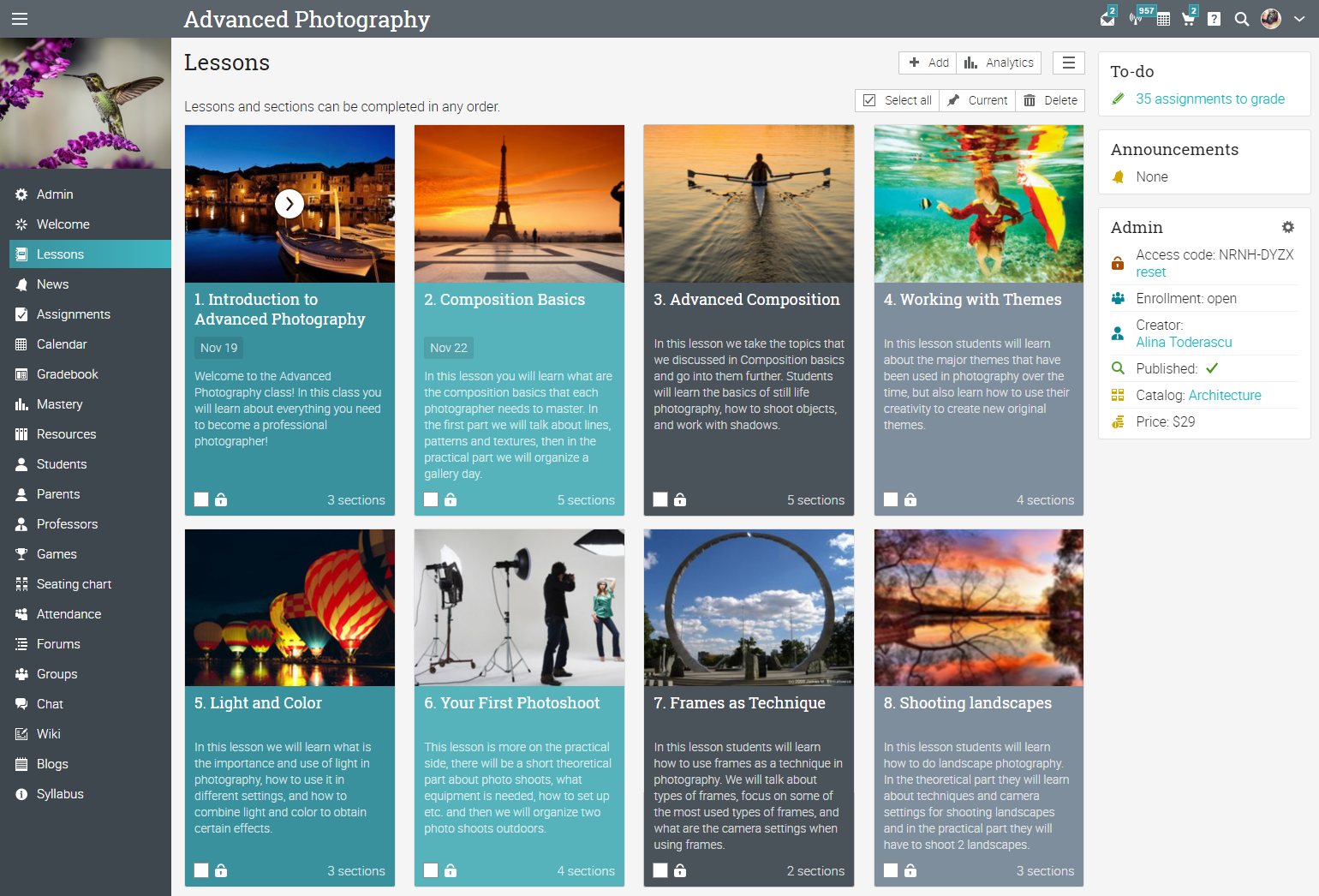
At first glance, I was immediately impressed with NEO’s attractive and modern user interface. The UI meets modern web-design standards and doesn’t need significant customization like many other learning management systems. Also, NEO looks great on any operating system or mobile device.

screencapture-adp-neolms-teacher_lessons-list-374982-1479223465628

Navigating NEO takes some getting used too, however, this is mainly due to the impressive number of features and options available.  Not too worry, after spending 30 minutes exploring under the hood, I found NEO’s menu to be logically organized and easy to use.

Schools and teachers will love NEO’s highly customizable features which allow you to personalize the LMS with logos, images, color schemes, fonts, and links.  Additionally, you can easily create a custom portal with news, a class catalog and a calendar.

Usability and Key Features

As both a teacher and an Educational Technology Coordinator NEO LMS has all the features I require and then some more. Lessons, undoubtedly an essential part of any LMS, are nicely laid out with links to resources represented by colorful icons that make navigating easy.

neo-3

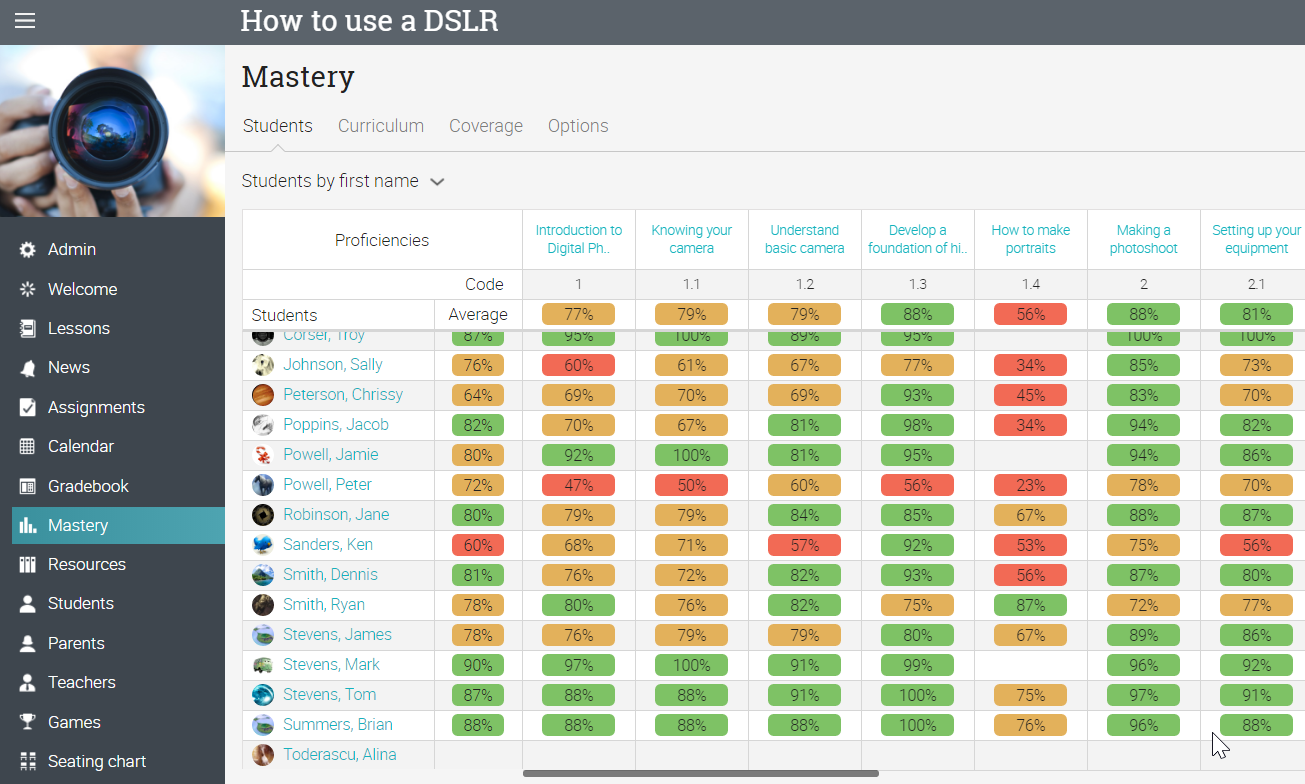
You’ll also find features that go beyond like “mastery” and “gamification” which make NEO LMS truly impressive.  Today, learning isn’t just about earning grades but rather demonstrating “mastery” of different skills.  NEO features a “mastery” section that allows an educator to add proficiencies and track students’ progress. For example, a teacher can easily integrate U.S. Common Core standards into their course and track progress as students complete assignments.

The game engine allows an educator to include points, leaderboards, and badges which can be easily aligned with assignments and lessons.  As students progress down a learning path, they gain points and badges while unlocking further lessons.

Assessment and Grading

neo-5

Any good LMS must contain a robust grade book that can handle different grading weighting schemes and have the ability to import/export grades with ease.  NEO LMS meets these requirements with search features, analytics and configuration options.

NEO LMS supports over 12 different assignment types, which includes quizzes, essays, discussions and even debates. Quizzes support a wide range of configuration options with seven different question types, instant feedback, and analytics.  Also supported are timed quizzes, question banks, and rubrics!

The grade book is equally impressive as it allows generous customization options and “pop-up” analytics to make grading less of a task. Attendance allows teachers to track students with five categories including On Time, Arrived late, Left Early, Absent, and Excused.

NEO also features a “rubric builder” that allows teachers to create “custom criteria and ratings.”  Teachers can then use the rubric to easily grade an assignment with a simple point-and-click of the mouse!

Integrations

14352076_1420693737946066_4394314099827130518_o


Also impressive is NEO’s ability to integrate a wide range of third-party apps and systems allowing the user to extend the default LMS functionality.  There are too many to list here, but they include G Suite (Google Apps), Office 365, web conferencing, SCORM, Turnitin.  Additionally, the NEO team is very proactive when it comes to teacher feedback and regularly adds new integrations!  NEO even allows developers to access their API to create their custom integrations.

Other Mentions

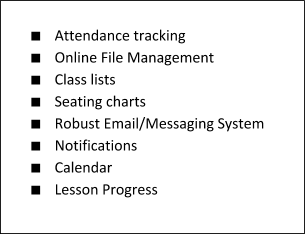
NEO includes many other key tools that allows a teacher to create beautiful classes without any technical knowledge. Some of the many other key features include the following:

neo-7

I’m constantly discovering new features and ways to effectively integrate this robust learning management system into my teaching practice.  If I am in need of assistance a quick visit to the help section of the LMS results in a quick response from the NEO team!

Information Technology Requirements and Cost

Adequately predicting IT infrastructure is one area that many schools and districts overlook. Many educational institutions immediately gravitate toward a low-cost or open source option like Moodle and soon discover large overhead costs due to investment in hardware requirements to get up and running.  In recent years, for instance, I found myself requiring expensive servers and equipment with complex database and server configurations to accommodate more than a few dozen Moodle users. NEO is highly scalable as it runs in the cloud and won’t require time from your information technology support staff.

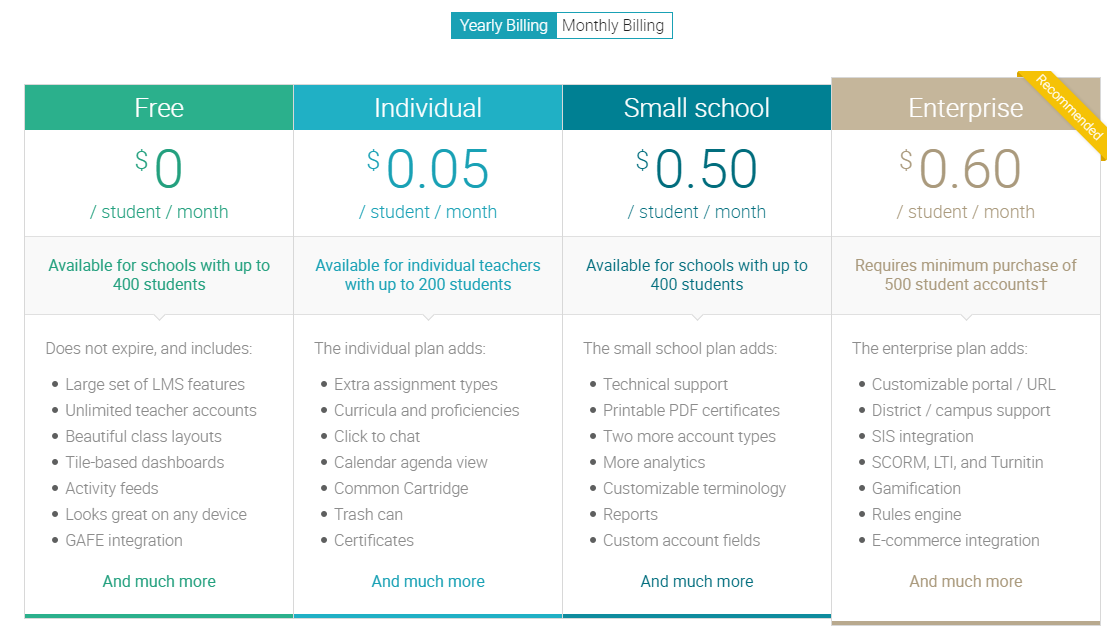
Most importantly NEO LMS is a great value when considering the robustness and features of the platform.  Here is their pricing structure:

neo-9

  • Free – for schools with up to 400 students
  • Individual – for individual teachers with up to 200 students: .60 per student per year
  • Small school – for schools with up to 400 students: $6,00 per student per year
  • Enterprise – 500 or more students: $7.20 per student per year

I have experience with many different learning management systems and while some excel in certain areas they fail to impress in other areas.  For example, Moodle is a free, open source solution, however, if you have more than a few users you’ll find yourself spending a small fortune on servers and hiring system admins.  Blackboard hits the sweet spot however it is cost prohibitive for many schools and districts.  Also, Google Classroom is not a viable solution due to its lack of features normally found in a modern LMS.

In summary, if you’re considering an LMS for your school NEO deserves serious consideration as it more than satisfies on all levels at an affordable cost per user.  I encourage you to head over to NEO’s informative website at https://www.neolms.com and find out more about their LMS.


How to Market to College Students with Smart Data

I tried ReachBright – and here’s what I learned. 

Today’s college students have more options for higher education than ever. Vying for the attention of potential students in such a crowded marketplace can seem nearly impossible and the same is true for when they graduate. When the right combination of informed data and marketing blend, though, it’s possible to cut through the noise to reach the right potential, current and former students with customized messaging.

rb-logo

I recently had the chance to demo ReachBright, a data and automated marketing platform tailored to colleges and universities. ReachBright has three separate systems based on which college marketing task is at hand. Those three are:

Enrollment management – It tracks website visitors and their specific areas of interest. From there, targeted emails based on interests are sent with the intent to start an admissions conversation. The platform works in conjunction with any major enrollment management software.

Campus engagement – This system designates campus “cheerleaders” who can up the motivation of disengaged students. It also asks students for feedback on a variety of topics that inform and improve their college experience. Social media is leveraged to boost the image of the college or university through student-generated social content.

Alumni development – Colleges can connect to alumni on the places they are already using – like Facebook. Alumni can then be matched to specific interests to increase the chances of giving. The platform is also great for targeted alumni communications with no donation ask that keep them engaged with their alma mater.

Where Data and Marketing Combine

ReachBright users can see the data related to their campaigns sliced and diced in many different ways. The email function works much in the way other popular email systems like Constant Contact and MailChimp work – by showing who is opening, clicking and otherwise engaging. This better informs future messaging to the individual recipients.

reachbright-screenshot-daily-summary


ReachBright users also have the opportunity to see the browsing history of website visitors to know how to best target them with messaging. This is especially effective for prospective students because knowing where they are spending time on the site can inform specific messaging from the college. There is even a “missed opportunities” option where the college can see what communication weaknesses exist and how they can be strengthened. ReachBright keeps all employees in different departments in the know on what communications have happened with which potential, current or past students so the marketing game plan can be unified.


reachbright-screenshot-report


The data itself is also impressive. ReachBright is built on the Google backbone, tapping the extremely powerful and effective data mastered by the search engine giant. Equipped with Google expertise, the data retrieval process is already tried and tested. The insights that ReachBright provides make marketing targeting plans more accurate and customized.


reachbright-screenshot-monthly-insight


ReachBright: Specializing in Higher Ed

The thing I really found unique about ReachBright is that it is built solely for higher education institutions. Since the college and university landscape is so nuanced when it comes to what types of marketing work for specific goals, other generic data/marketing platforms aren’t a perfect fit. Instead of trying to make those broader systems work for a college settings, ReachBright is already tailored to the task. ReachBright works specifically in the higher education industry and can therefore bring more detailed and accurate offerings to clients.

This is just a small sampling of all the features of ReachBright. Request your free demo now by visiting the ReachBright site.

The Diversity Responsibility Colleges Face Following the 2016 Election

The Presidential race between Hillary Clinton and Donald Trump will go down as one of the most unpredictable, and contentious, of American history. The candidates’ personalities, paired with the 24-7 news cycle and social media, made an already inundated time for political messaging completely saturated. It pushed people to their breaking points, revealing the worst in some and the true colors in many.

The end result is a country that will truly never be the same. Whether it’s neighbors with opposing yard signs who can no longer see eye to eye, or family members disinvited to Thanksgiving celebrations, the very real impact of this election season will linger for long after the votes were cast.

Things have changed for colleges and universities too. It’s too soon to know exactly what to expect in the way of legislation, funding and federal support for the higher education landscape over the next four years, but there are some intangible effects that are already evident. The most basic of these lessons is this: We aren’t as far along as a diverse nation as we thought.

And it isn’t just set-in-their-ways adults either. The night of Trump’s victory, a black baby doll with a noose around its neck was found in an elevator at predominantly white Canisius College in Buffalo, New York. This is just one example that proves that the nation’s youngest adults are not all enlightened when it comes to diversity and equality; there is still a lot of work to be done and much of it should happen on college campuses. Yet, on the higher education scene students are still being marginalized – whether that discrimination is direct or a result of policy.

So where do we go from here? As a collective college and university system, how do we piece together our latest revelations about our nation and apply it to building a more diverse ecosystem?

Colleges must recognize the new normal.

It starts by colleges acknowledging that we truly aren’t as progressive (as a nation) as we thought. Of course, those of us who have made diversity our life’s work have long been aware of the holes in the equality spectrum. But now we have an entire nation who is seeing it, some for the first time, too. Whether they choose to acknowledge it or not, a deeper awareness of the plight of many marginalized Americans was revealed during election season. It will impact the way we treat each other and it will impact the atmosphere of college campuses. People just know more. That knowledge ups the responsibility of what colleges teach and how they interact with student bodies.

Colleges must acknowledge everyday injustices.

Discrimination isn’t always outright. It doesn’t always manifest in hate crimes or racial slurs. Many times it is subtly ingrained in our societal fabric – penetrating our psyche to the point that we don’t even notice it anymore. This is especially true for the traditionally privileged of society – the white, middle-class males (if we are going for a stereotype). The unfair things these Americans have faced pale in comparison to minority groups, and even women. When you’ve never been exposed to the type of establishment racism and division that are common to disadvantaged populations, it feels like that type of existence is far-fetched – maybe even made up. It takes movements like Black Lives Matter, or …., or even the obvious xenophobia and racism that arose during the election season to really wake a person up.

Colleges must step up when it comes to eliminating inequality across the board with a more proactive approach. Instead of having a crisis team on call, universities must work consistently to give all students the opportunities they deserve. They must also call on the workforce beyond the college years to do the same. Where there is a student at a disadvantage, questions must be asked as to what led to that point – and how it can be fixed.

There is no easy fix for where we are as a nation when it comes to diversity. Colleges and universities have the responsibility to spearhead positive change, though. The next generation of adults deserves better opportunity and higher education is the starting place.

How Colleges Can Maintain Diversity in a Trump-Led America

The shock of the Presidential election results is still sinking in across America, for both Trump supporters and anti-Trump voters. The thing that seemed outlandish and completely impossible just a year ago has now become the reality for Americans. The truth remains, however, that come January 20 the nation’s highest office will be helmed by Republican Donald Trump.

Based on his campaign rhetoric there is a lot of understandable fear regarding the state of diversity in the nation and what it all means for marginalized groups like minorities, LGBTQ+ individuals, and even women. What happens in the next four years remains to be seen but colleges, our nation’s hotbeds for diversity progress, can take some actions to ensure that they are just as inclusive and progressive in four years as they are today.

Here’s how to keep college and university campuses moving forward for diversity in a Trump-led America:

Talk about the issues.

Trump’s platform rose to popularity on issues like illegal immigration, tax-funded health insurance, and abortion rights. Facilitate conversations at the college-wide level about these issues, looking at the best outcomes for a more diverse America while truly examining the opposing views. This can take place in classrooms but should also happen at a college-wide level at forums or other university-hosted events. Don’t just dismiss xenophobia or white privilege as “bad” – talk about why people put their faith in those things and how to turn the tide from fear to understanding. Allow students to learn from each other in an organic way that doesn’t hand down a black-or-white decree on the issues. Colleges must lead the discussions on these issues so the next generation of educated graduates has a broader world view and deeper awareness.

Prepare for less student aid.

Under the Obama administration, plans for two years of free community college for all students who maintained the right course load and grade-point average were under way. It’s reasonable to assume that Secretary Clinton would have furthered that plan and also reasonable to assume that Mr. Trump will not. Things like Pell grants and federally-funded aid are likely to tank or at the very least, remain stagnant. Colleges and universities that want to keep increasing the diversity on their campuses must put actionable plans in place to make that happen. This includes more private scholarships, along with more reasonable costs for students and spending plans for attendance. Early high school recruiting will becomes more important than ever so colleges and universities can target a diverse population and get those students prepped for college costs and financial aid programs.

Prepare for funding cuts.

One of Vice President-elect Mike Pence’s claimed successes in his home state of Indiana was a fiscally stronger state (at least on paper). The reality of that was cuts to education, specifically public education, and the juvenile criminal justice system (among other areas). Public colleges and universities should expect to see less funding across the board in an attempt to “repair” national spending. Private colleges could feel the sting too when it comes to federal funds for student aid and other eligible campus spending. Every college campus has different needs but thinking ahead, right now, about ways to salvage diversity programs and support programs for disadvantaged students is vital to keeping those services afloat and thriving. How can your school continue to support the students that need diversity programs the most?

Tap alumni giving.

Most colleges and universities already have a robust alumni giving program in place but the urgency now for outside funds is greater than it was before this election. If there are programs that will see funding cuts, let alumni know the specifics. Share information about what funding is going down and how they can help boost it back up. If graduates know about the specific need they are more likely to give. Alumni who appreciate what a diverse campus and student support services did in their own lives will be more likely to give if they know a program is going to be cut or eliminated completely. Alumni are usually passionate about the place they earned their higher education, and will help to keep it successful if they can.

Fear is understandable – but preparation is smart. Trying to control what we can right now when it comes to protecting diversity on college campuses can make the difference in what we see regarding it when these four years are up.

What Professor Esolen Gets Right about Diversity, Faith

History professor Anthony Esolen recently came under fire when he penned an article for Crisis magazine that questioned the push for diversity at his workplace, Catholic institution Providence College. The piece “Ideology is the Enemy of True Faith” criticizes Providence College and the entire Catholic community when it comes to enthusiasm for the rights of the LGBTQ+ community and more.

Among other accusations, Esolen said that the college is on the diversity bandwagon (to paraphrase) and that the popular views its taking run directly against Catholic doctrine. Specifically, Esolen mentions the need to uphold traditional heterosexual marriage because that is truly what moves diversity forward through reproduction.

Needless to say, Esolen’s words have triggered a firestorm of criticism, launched a petition against him from the Black Studies department at Providence, and even incited a public rebuke from the college president. In interviews with other news sources, Esolen has defended his position, saying that those who disagree aren’t really Catholics anyway (another paraphrase).

Esolen’s position certainly rings of prejudice when first read and of course, he won’t be leading any diversity workshops anywhere any time soon. His bold statements though may do more to advance diversity on college settings than harm it. Here’s what his stance, and the response against it, can teach us about our own campus diversity programs:

Diversity IS a buzz word.

Without action, diversity is just a pointless word that is slapped on college promotional materials for appearances. A college or university that uses diversity for shallow reasons or out of obligation is not one that is doing its part to really further the opportunities for all students. Esolen says that promotion of diversity of certain groups of students run afoul to Catholic ideology and he’s right. Can Catholic colleges, then, truly claim that they provide diverse options for all students if certain ones – like those in the LGBTQ+ community – are marginalized in the basic doctrine of the church that sponsors the school? Schools cannot gloss over the facts when it comes to diversity. If you foster a spirit of acceptance and believe in opportunities for all, spell it out specifically in your mission statement. If those college beliefs don’t match the sponsoring institution (a church for example) then clearly outline how you are separate from that set of convictions.

Professors should hold opposing views.

At least some of them. Higher education institutions are the premiere spots for advanced thought in our nation. It’s why so much innovation comes from these campuses and why students who enter as young, naïve adults leave as educated and aware ones. A professor who doesn’t agree with campus policy has the right to dispute it. Does Esolen deserve the criticism coming his way from his colleagues and students at the college? Absolutely and he likely expected it. Does he deserve to lose his job over it? I’d argue no, he does not.

If we start taking away peoples’ livelihoods because they question things, then what sort of precedent are we setting? I think a university can denounce the words of a professor like Esolen but still keep him employed. As long as he is teaching the subject at hand (Western Civilization and Renaissance English Literature, in his case) and following the benchmarks of his job then he’s fulfilling those duties. We cannot silence or punish every person who says things we don’t like. Learning to dig in more deeply with our own beliefs, however, is a valuable lesson that lasts well beyond college years.

Religion can fuel discrimination.

While the church community, particularly in America, does much to benefit the lives of citizens worldwide, it’s important to acknowledge the parts of different doctrines that do not align with diversity. The role that religion (of all kinds) plays in world view of its members matters on college settings. Even public institutions must face the ramifications of this learning that is embedded over nearly two decades before students strike out on their own as adults. Religion plays a role in how students view their peers – and how professors view their students. Colleges must be aware of that fact and work to unite students, faculty and the greater community beyond religious lines.

Sometimes something unexpected brings out the best in people – which I think will be the case ultimately with Esolen’s article. His views have already called to action people who disagree and brought about an important conversation about diversity at Providence College and throughout the nation. What we do with that conversation determines its positive impact, despite the negativity associated with the original words.