
Uncategorized

Does it pay to get a double major in college?

Christos Makridis, Stanford University

Students are bombarded with an array of competing opportunities during college, all with the promise that each will lead to a better job or higher earnings upon entering the “real world.”

One such option is the double major, in which a student earns two bachelor degrees at once, sometimes in entirely different disciplines. But will doing so lead to a higher-paying job? Is it worth the “lost” time that could have been spent in other activities such as internships or student government?

In college, I earned several degrees, which led to a broader education that I believe enriched the quality and creativity of my thinking and improved my career prospects. As an economist-in-training, however, I wanted hard data to back up my anecdotal experience.

To do this, I crunched some numbers from the Census Bureau on over two million full-time workers and analyzed them to see if there’s a connection between earning multiple degrees and financial gain in the years following graduation.

Double-majoring on the decline?

While double majors have been a popular way to balance a deep study of the humanities with traditional degrees in the sciences, basic tabulations suggest that the percent of workers with a double major has been roughly constant, or even decreasing, over the past six years depending on how one restricts the sample.

For example, looking at all individuals between ages 20 and 29, only 12.5 percent of the population had a double major in 2015, which is down from 14.2 percent in 2009, according to my calculations from the American Community Survey (ACS) Census data. At the same time, the percent of workers within the same age range with any kind of college degree grew from roughly 23 to 36 percent.

On the one hand, double-majoring can help students avoid becoming overly specialized, exposing them to new ways of thinking and communicating with others outside their primary area. On the other, it creates a trade-off with other educational opportunities.

In 2013, the National Commission on Higher Education Attainment went so far as to urge universities to “narrow student choice” to promote degree completion – perhaps by restricting or even banning the completion of double majors.

While the number of college graduates in the workforce is growing, the number of double majors is shrinking.
Francesco Corticchia/Shutterstock

What existing research says

Previous research on whether a double major pays off has shown mixed results.

A 2011 paper found that a double major, on average, yields a 3.2 percent earnings premium over a peer with only one degree. The paper noted that the premium ranged from nothing at liberal arts colleges to almost 4 percent at “research and comprehensive” universities.

A more recent study, published in 2016, concluded that liberal arts students who tacked on a second degree in either business or a science, technology, engineering or math (STEM) field earned somewhat more than their single-major peers. But the authors noted that there was no premium when compared with a single STEM or business degree.

Both of these papers, however, are based on relatively small cross-sections of individuals, which makes them less representative and limits their statistical power. In addition, they focus on single years – 2003 and 2010, respectively – which means the results may be affected by any transient economic conditions that occurred that year.

What my research showed

In my own analysis, I examined data on over two million full-time workers aged 20 to 65 over a six-year period (2009-2015) using Census Bureau data. The bureau provides the largest source of publicly available information on individuals and households, helping to ensure that the analysis is both representative and detailed. The data set included information on each individual’s earnings, occupation, undergraduate degrees and a wide range of other demographic data.

My results showed that liberal arts students who take on a second degree in a STEM field earned, on average, 9.5 percent more than their liberal arts peers with only one major, after controlling for individual demographic factors, such as age, years of schooling, marital status, gender, family size and race. Students who combined a liberal arts degree with a business major earned 7.9 percent more.

You might be thinking that this isn’t really a surprise. Of course STEM majors will earn more than their liberal arts counterparts. While my analysis already controls for the fact that STEM and business majors generally earn more than their counterparts, I wanted to dig a little deeper. So I restricted the sample to compare STEM-liberal arts double majors with those with a single STEM degree. Although the premium shrinks, engineers and scientists who take on an extra liberal arts degree earned 3.6 percent more, on average.

I also wanted to see if the premium exists when comparing people in similar occupations. For example, consider two journalism school grads, one with a single degree, the other with a second in engineering. Naturally the one who becomes a working journalist, which generally pays poorly, will earn less than his classmate who decided journalism wasn’t for her and got a job at Google.

So, controlling for occupation, I found that the returns to double-majoring in liberal arts and STEM were 5.2 percent, and 3.4 percent with a business degree. In other words, even when we look within narrow occupational categories, those who double-majored across fields tended to earn more than those with a single degree.

So should I double major?

So for those of you about to head to college, should you go for a double major? Or should you advise it to your kids?

As with anything, it depends. I tried to make my analysis as robust as possible, but it’s still not entirely clear whether the connection between the double degrees and higher earnings is causal. However, my results do suggest it’s more than mere correlation.

Furthermore, an association with higher earnings doesn’t mean the double major is right for everyone, particularly since the premium varies based on an individual’s own career path and preferences. Every college student needs to weigh the pros and cons of every potential opportunity, from picking up a second degree to joining student government.

The ConversationMy research suggests, however, that students who are eager to expose themselves to more frames of thinking and disciplinary knowledge may well be investing in the very foundation that prepares them for a successful and innovative career.

Christos Makridis, Ph.D. Candidate in Labor and Public Economics, Stanford University

This article was originally published on The Conversation. Read the original article.

Why global education rankings don’t reveal the whole picture

Daniel Caro, University of Oxford and Jenny Lenkeit, University of Oxford

Country rankings in international education tests – such as PISA and TIMSS – are often used to compare and contrast education systems across a range of countries. But it isn’t always an even playing field.

This is because countries with very different social and economic realities participate, so countries such as Norway, Russia, Chile, Lebanon and Thailand are all being compared against each other. And this is without the difference in socio-economic backgrounds of these different countries being taken into account.

If the latest world education rankings are anything to go by, Turkey and Thailand perform poorly when it comes to their students’ achievement in science. But our analysis shows that if you look at the rankings differently (from an even starting point), both Thailand and Turkey may in fact be just as good as some of the high performing Asian countries.

Our analysis is a much fairer comparison, as it allows for the differences in wealth and social development in which students learn and teachers teach. It builds upon our previous work, where we produced and analysed an indicator of “effectiveness”. The effectiveness indicator ranks performance of countries as if they all had similar socio-economic conditions – thus levelling the playing field.

This makes it easier to see which countries are actually the most effective at educating their students, with social economic factors like wealth taken into account.

New style rankings

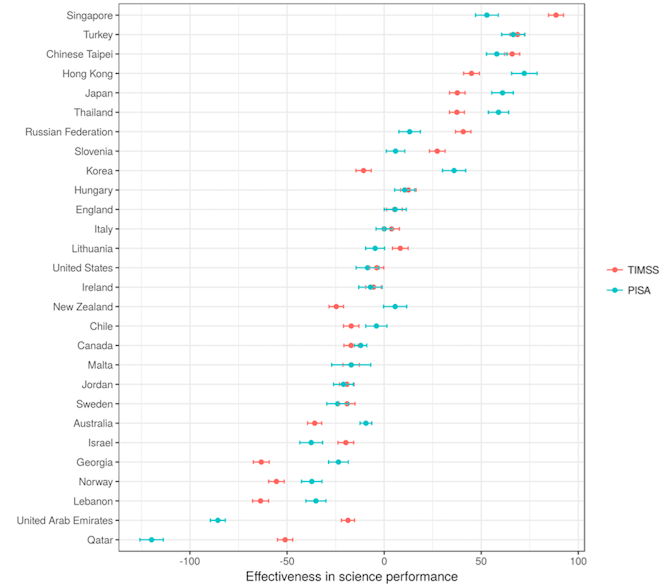
The graph below shows how countries are ranked in their effectiveness. At the top of the effectiveness ranking, we find education systems such as Singapore and Japan, which are also generally high performing in PISA and TIMSS.

TIMSS-PISA 2015. Values higher than zero (towards the right-hand side) indicate that students in those education systems perform above expectations, meaning the education system is effective. Those values below zero, to the left, indicate ineffective education systems.
Author provided

But our analysis also revealed that countries such as Turkey and Thailand are actually highly effective and perform above expectations in terms of education. This is despite both countries having an overall lower performance score in the global education rankings.

As the graph shows, the performance of education systems in Turkey and Thailand is underestimated if guided by country rankings alone. This is because although these countries perform below average and rather poorly in PISA, they are as effective as high performing Asian countries.

This means that Turkey and Thailand would be ranked among the highest performing countries in the world – if there was no socio-economic differences between countries.

TIMSS-PISA 2015. Effectiveness vs performance according to rankings. The horizontal line at 0 separates effective from ineffective systems and the vertical line at 500 indicates average performance for TIMSS and OECD education systems.
Author provided

Our analysis also shows education systems in Norway are ineffective, and the same was found to be true of Australia. So while these countries are ranked highest in human development in the world, they are not among the highest performing in these international tests when we level the playing field.

On the lower end of the effectiveness ranking, we find Qatar and the United Arab Emirates. These countries are also among the lowest performing in PISA rankings and could be doing much better for their high income per capita levels.

Fair comparison

It is clear then that overall performance rankings alone do not make a fair comparison when it comes to judging the quality of education in different countries. And our analysis shows how the socioeconomic conditions of a country are vitally important when comparing global performance in education rankings.

The ConversationUsing our data, there would certainly be a case for countries like Chile, Malta, Georgia, the United Arab Emirates and Qatar to look to Turkey and Thailand to work out how to improve their education systems. And as our analysis shows, global education rankings are probably not the best measure of educational performance after all.

Daniel Caro, Research Fellow, Oxford University Centre for Educational Assessment, University of Oxford and Jenny Lenkeit, Research Fellow, Oxford University Centre for Educational Assessment, University of Oxford

This article was originally published on The Conversation. Read the original article.
Case Study: ASB Online School

“We like VHS courses because they have a very high quality of content. VHS provides a very good range of courses. The student-teacher interaction levels are high which contributes to our students’ success.”

− Debbie Grieve, Consilience Director – Online and Blended Learning Services


Case Study: ASB Online School

Located in Mumbai, India, the American School of Bombay (ASB) is a college preparatory, coeducational independent day school that serves students from over 50 countries. The school has earned a prestigious reputation in the region for its results, which are based on continuous inquiry-based and collaborative learning as well as the use of technology to enhance the learning and academic achievements of its students.

In 2011, ASB founded its own virtual school. The ASB Online Academy offers a range of curated online learning opportunities to ASB students as well as other schools (via its Institutional Enrollment Program). While some of the courses are designed and taught by ASB Online Academy instructors, others are offered in conjunction with accredited content providers such as The Virtual High School (VHS, Inc.) based in Massachusetts (USA). ASB Online Academy students first took VHS courses in 2012; all students enrolled in technology-related courses.

Coordinating studies in a global classroom did not come without its issues. Nikhil Dandekar, the ASB Online Academy Coordinator in India found that some ASB Online Academy students struggled to get used to deadlines set in an online worldwide class. “Our students have many after-school activities: sports or school events. So, sometimes finding the time to finish their assignments within the deadline was challenging,” he said. “Sometimes, the time zone difference adds more challenge when we try to meet deadlines.

Consequently, many students had to hone their skills in planning, prioritizing, and organizing time and materials. “To first-time online learners, I would say the learning curve can be demanding,” Nikhil continued. “However, I meet with the students every day to guide them through the process, so we don’t have a problem with it.”

Nikhil likes the VHS course emphasis on interpersonal communication. “The interaction is definitely the strongest point of VHS courses,” he said. “Students use the discussion boards and the private topic feature to communicate with teachers and other students during learning and they like it.”

Debbie Grieve, Consilience Director of Online and Blended Learning Services based in the United Kingdom likes the rigor of the VHS courses and sees them as an invaluable resource in their efforts to expand general interest in online learning. “Online education is well developed in the United States; however, in international schools, it is still very new,” she said. “In fact, we would like to help more international schools start online education programs.”

Debbie added, “We want to continue to work with both Indian and international schools in other parts of the world, expanding students’ opportunities to select course topics they may not otherwise have been able to take, and helping prepare them for college where more and more students are taking at least one course, online”.


Black Boys in Crisis: “Black People Can’t Be Doctors”

In this series, appropriately titled “Black Boys in Crisis,” I highlight the problems facing black boys in education today, as well as provide clear steps that will lead us out of the crisis.

When I was in elementary school (the mid-1980’s) one of my teachers periodically brought professionals from the area to our class to talk about their careers. On one occasion, she brought in a black male doctor from a local hospital. He spoke for about fifteen minutes and then opened up the floor for questions. One of my friends (also a black male) raised his hand. “Are you really a doctor?” he asked. The man replied that he was, and my friend retorted, “Black people can’t be doctors!” To be honest, my friend echoed what the entire class must have been thinking. I know that thought had surfaced in my own mind.

Sure, we had seen black doctors on television and movies, but we thought they were make-believe, like the cartoons we watched on Saturday mornings. We only believed what we could experience or see for ourselves. And since we had been to plenty of family clinics and hospitals and had never seen a black doctor there, we automatically believed that he was not being truthful. That was how brainwashed we were.

Recognizing the Crisis

There is a crisis in America today. It’s a crisis in education; a crisis that predominantly affects minorities. And perhaps the most affected subgroup is young African-American males. This is my background: I was a black boy growing up in one of the poorest counties in America, in a school district so dismal it was eventually taken over by federal authorities. Though I succeeded in pulling free of the mire, many of my classmates did not. Shortchanged by their education and left with few prospects, they fell into a cycle of criminal activity, drug use, and jail time. From my time as a student and, later, as a teacher in the Mississippi public school system, I know firsthand the struggles, temptations, and apathy black boys face. But I also know what it takes to turn a life around; I know what it means to watch a flower spring from trampled ground.

One out of three black men in America will be incarcerated in his lifetime, and more than a third of the prison population is black. But this unequal rate of discipline does not begin at adulthood: it has its roots in the schools. Federal data indicate that black students account for 15 percent of the total K-12 population but make up over one-third of those students who are suspended once from school, nearly half of students who are suspended more than once, and over one-third of students expelled.

Over half of black young men who attend urban high schools do not earn a diploma. And of those dropouts, nearly 60 percent will go to prison at some point. It should be apparent that this crisis does not just affect the African-American community: the enormous costs associated with retaining students, supporting dropouts who cannot find a job, and incarcerating large numbers of young men are borne by society as a whole.

This series aims to serve as both mirror and roadmap. I have pulled out the seven issues that I feel are most critical in the lives of young African-American males: income inequality, incarceration, racial stereotypes, anti-intellectualism, etc. The series will begin by addressing those issues with statistics and stories culled both from my personal experience and from the experiences of others. They will move on to a more general discussion of the topic and examine efforts to overcome the difficulties. I intend to hone in on what works; on practical steps to move us from the current crisis to a future of parity and promise.

Black Boys in Crisis: The Intersection of Poverty and Education

In this series, appropriately titled “Black Boys in Crisis,” I highlight the problems facing black boys in education today, as well as provide clear steps that will lead us out of the crisis.

 My understanding of the black male crisis is deeply personal. In the articles in this series, I will tell a few stories from my past that illustrate what life is like for the average black male growing up in America.

At the elementary school, I attended, most of the students came from families with incomes at or below the poverty line. Our neighborhoods provided us with few resources for learning and even fewer role models of educational and economic success. Because of this, we believed that no other way of life was possible for us. Furthermore, we were alienated by peers who enjoyed a higher economic status; who lived in better neighborhoods and had newer clothes, nicer TVs, computers . . . all the things we craved. Both the better-off students and the teachers expected us to exhibit behavioral problems and academic failure. Far too often, this expectation became a self-fulfilling prophecy.

Unfortunately, failing schools go hand in hand with life in poor neighborhoods. The schools I attended did not have the resources to compete with areas that had more money for books, computers, salaries, and so on. As a result, they had difficulty attracting well-trained teachers and administrators. The upshot was that many of my African-American classmates were written off, ignored, or simply passed from grade to grade without having done the required work. Many who did graduate were ill prepared for college or the working world.

I saw a lot of my fellow black male classmates limiting themselves. Instead of surrendering to the typical standards of a school environment that they viewed as cruel and oppressive, they ended up rejecting European-American speech patterns and devaluing high academic achievement. They fell victim to anti-intellectualism and academic disengagement. They were culturally conditioned to exacerbate a “cult of victimhood.” This phenomenon is all too common and leads many scholars to aim solutions to the black male crisis at victimhood rather than recognize that this problem of poor academic performance and academic disengagement is a product of poverty and cultural indoctrination.

However, some black boys in my school, including me, responded in the opposite way. We used our awareness of racism and prejudice as motivation to do well, thus preparing ourselves to fight these evils.

Black Boys in Crisis: Teachers, the Good and the Appalling

In this series, appropriately titled “Black Boys in Crisis,” I highlight the problems facing black boys in education today, as well as provide clear steps that will lead us out of the crisis.

 One of the most influential teachers I had was my high school biology teacher, Mrs. Minor. She was the wife of my former elementary school principal, and mother to one of my classmates. Mrs. Minor approached her job as a teacher from the standpoint of love and caring. She recognized that, for many of us, her smile was the only one we would see each day. She wanted to be a beacon of hope, letting us know that our situations were only temporary.

Mrs. Minor did not care who your parents were or what you looked like; everyone had a fair shake with her. Because of this, many of us tried our best in her class. She had a deep and abiding love for the subject of biology, and her excitement was infectious. Even those of us who hated science loved biology after taking her class. She related the subject to our everyday lives and let us know why we needed to learn it.

Unfortunately, not every teacher was as caring, diligent, and capable as Mrs. Minor. My high school physics teacher, for example, did not know anything about physics. For an entire year, we would simply show up for class and do nothing. When it was time for him to be evaluated, he would have us go around the room and read aloud from our physics textbook. To my chagrin, he received a great evaluation.

But that was not even my worst experience. As a sophomore, I was slated to take chemistry. For the first month of the year, we had a fairly capable teacher, though he lacked pedagogical and classroom management skills. By the end of the first month, he had quit. For the rest of the semester, we had substitute teachers who knew nothing about teaching.

At the beginning of the second semester, we got a new teacher. She had a master’s degree in chemistry but was not a licensed teacher. For the entire semester, she simply let us do as we pleased and did not teach a single lesson. When it was time for her to be evaluated, she did what my physics teacher had done: she made us go around the room and read from our chemistry textbook. That was the only time we opened our book the entire year. She too received a great evaluation.

When I received my report card that summer, I was shocked to find out that I had received an F in chemistry. I was so upset! We had only completed a couple of assignments all year, and those were during the first month of school. I told my father, and he explained that I could take it again the next year. I tried to get him to go to the school to advocate for me, but he did not feel comfortable doing so.

He asked my cousin’s wife, who was an elementary school teacher in the school district, to accompany me to the school. Together we explained the situation to an administrator, and they agreed to change my grade to a B. I was thankful that I did not have to repeat the class; however, I’m embarrassed to have a B in chemistry on my high school transcript, though I know nothing about the subject!

Though I didn’t decide to become a teacher until several years later, I remember thinking during these disastrous high school experiences that something had to change. The students were getting cheated of an education, and thus a livelihood.

Black Boys in Crisis: Completing the Journey

In this series, appropriately titled “Black Boys in Crisis,” I highlight the problems facing black boys in education today, as well as provide clear steps that will lead us out of the crisis.

When I was an undergraduate at the University of Southern Mississippi, I had the pleasure of taking a class under Dr. John Koeppel entitled “The History of Psychology.” He was a superb professor and encouraged his students to maximize their potential. For one of our class research papers, a classmate and I decided to study the subject of race and intelligence. We uncovered startling studies funded by racists and white supremacists concluding that race determined a person’s level of intelligence. According to these findings, European Americans were genetically predisposed to be intellectually superior while African Americans were intellectually inferior. Some of the studies and articles we found were shockingly offensive. One study that particularly horrified me concluded that the darker a person’s skin, the less intelligent he or she was.

During our presentation, I pointed out that, according to these studies, since I was the darkest person in the room, I was intellectually inferior to everyone else. However, I had one of the highest averages in my class. I also highlighted some studies conducted by African-American psychologists that offered empirically based rebuttals, and their studies concluded that race does not determine a person’s cognitive abilities or level of functioning and that the previous studies had no scientific merit. That research paper was an eye opener.

I subsequently devoured all the information I could on the subject of race, genetics, and intelligence. That research was a major impetus for my decision to become a teacher, and also a basis for this series. I started telling my friends that when I graduated, I wanted to return to my hometown of Hazlehurst, Mississippi, to teach to ensure that African-American children in the place where I grew up would not fall prey to stereotypes, self-fulfilling prophecies, and institutional racism.

When I graduated, I was true to my word: I took a teaching position in Hazlehurst. Hazlehurst had a system of de facto segregation that still exists: a public school for blacks, a private school for whites. Determined to make a difference in the lives of minority children, I spent my free time studying and researching strategies for educating African-American youth. By the time I began my first year as a teacher I was ready for the challenge, even though at times I felt overwhelmed. By my second year, my colleagues frequently commented on how well behaved my students were. I owed a great deal of my success to believing that all youth, regardless of their background, could learn.

After receiving my doctorate from Jackson State University, I took a position as an assistant professor of education at Widener University in Chester, Pennsylvania. Moving from Mississippi to the East Coast was quite an adjustment, but I was up for the challenge. Later I took a position at Langston University in Oklahoma. In August of 2014, I moved to Virginia to take a position as dean of the Syphax School of Education, Psychology and Social Work at Virginia Union University.

The US educational system must recognize that the black male is constantly bombarded with racial stereotypes and unfair assumptions that manifest themselves in the form of self-fulfilling prophecies. We see ourselves portrayed as drug-dealing buffoons with few redeemable qualities. When teachers, administrators, and parents encourage us to transcend our conditioning and let our actions speak louder than our words, many African-American boys will do almost anything to live up to those high expectations.

Some white, Latino, Asian, and even black teachers perpetuate theories of black intellectual inferiority (consciously and subconsciously) by treating the black boy as though he is incapable of academic success. Black boys don’t need to be treated differently than students from other races; however, it is important for the educational system to recognize the cultural differences that exist between them for African-American students to thrive academically.

My educational journey from one of the most impoverished and intellectually downtrodden regions of the country to the halls of academia has taught me what it takes for a black boy in America to surmount the obstacles in front of him. It has also taught me that I am one of the fortunate few: many of my classmates fell by the wayside, victims of poverty, the drug trade, violence, an anti-intellectual culture, or an unfair justice system. In the following series, I hope to highlight the problems facing the black boy in education today, as well as provide clear steps that will lead us out of the crisis.

Can the crisis in educating the black boy in America be solved? Yes, it can: I am living proof. However, it’s going to take more than platitudes; more than speeches by politicians; more than one or two outstanding teachers . . . it’s going to take an entire culture that decides it’s time to do something. So let’s roll up our sleeves and dive in. We have work to do.

Black Boys in Crisis: A Grim Beginning and a Bleak Future

In this series, appropriately titled “Black Boys in Crisis,” I highlight the problems facing black boys in education today, as well as provide clear steps that will lead us out of the crisis.

 In 1619, at the ironically named Point Comfort, Virginia, “twenty and odd” Africans were taken off an English warship, The White Lion, and exchanged for food. Most of their names have long been forgotten. What we do know is that the Africans were probably from what is now Angola, on the southwest coast of Africa. They were in transit to Mexico on the Portuguese São João Bautista when that ship was boarded by the English and were then carried to Virginia.

That disembarkation represented the first footstep on the grimmest odyssey in the annals of the United States. Over the next two and a half centuries, until the Emancipation Proclamation in 1862, the number of African-American slaves on American soil would swell to nearly 4 million. In total, more than 12 million Africans were captured and ferried across the Atlantic, though at least 10 percent died on the dreaded Middle Passage. Of those 12 million, less than half a million were transported directly to the fledgling United States, but the numbers of people of African descent burgeoned over time; as of the last census in 2010, there were around 40 million inhabitants with African ancestry in the US.

The chilling realities of slavery in the US have been explored in depth in various media; here it will suffice to note that, for the first time in history, a deliberate wholesale disenfranchisement of a race took place. Africans were stripped of their homes, names, languages, cultures, and dignity. They were physically and emotionally abused and denigrated, and their “subhuman” status was codified in the new laws of the country.

Sadly, the struggles of African Americans to achieve equal status did not end with the Emancipation Proclamation. Though there was an initial period of euphoria, which led to blacks taking political leadership positions (I examined these personages in my two-volume Before Obama: A Reappraisal of Black Reconstruction Era Politicians), the advances were soon erased by the Jim Crow laws. It was not until Martin Luther King, Jr., and others ushered in the Civil Rights Era in the 1960s that nominal equality was achieved. In 1964, Lyndon B. Johnson signed the Civil Rights Act, which outlawed discrimination based on race, color, religion, sex, or national origin. For the first time in the history of the United States, segregation on racial grounds became illegal.

However, though the law of the land now mandated equality, African Americans had been disenfranchised for so long that a de facto inequality now existed. Because African Americans lived in poorer neighborhoods and did not have access to the same jobs and opportunities as their white counterparts, they found it extraordinarily difficult to pull themselves out of their impoverished existence. This remains true to this day. As we will see in this series, income inequality is a key factor hampering the progress of black youth in this country.

This background is intended neither as an excuse nor as a complaint. Rather, it is presented as a reminder that there is a historical reason for the current crisis in educating young black men. We must recognize that just half a century has passed since the last laws governing inequality were removed and that we are still reaping the bitter fruit of nearly four centuries of profound injustice.


Black Boys in Crisis: The Quest for a Chance to Learn

In this series, appropriately titled “Black Boys in Crisis,” I highlight the problems facing black boys in education today, as well as provide clear steps that will lead us out of the crisis.

 Though African Americans have achieved remarkable gains—exemplified by the election in 2008 of Barack Obama to the highest office in the land—our progress remains stymied by endemic racism, political barriers, and a legal and policing system still heavily biased against African Americans. In this article, we will look at one of the most important strands of the African-American struggle for freedom: the quest for education, which was initially simply a quest to learn to read.

Masters early on recognized the dangers of allowing slaves to read; in fact, in many parts of the South, the punishment for learning to read was the severing of a finger. Similarly, anyone caught teaching a slave to read was fined or whipped. Nevertheless, many slaves did learn to read. Some of these were taught by compassionate whites, especially those who were intent on Christianizing slaves. Others learned on their own.

Perhaps the most famous example of a slave who learned to read was Frederick Douglass, who asked his mistress to teach him. She obliged in a spirit of entertainment, teaching him the alphabet, but as soon as she realized he was actually learning to read sentences, and then books, she panicked and tried to stop him. As he writes in his autobiography: “But this was too late: the first and never-to-be-retraced step had been taken. Teaching me the alphabet had been the ‘inch’ given, I was now waiting only for the opportunity to ‘take the ell.”  Douglass, of course, escaped from slavery to become a famous orator and author, a monumental figure in the march toward abolition.

Early Educational Efforts

In the North, escaped slaves and free blacks were given instruction in reading by various sympathetic individuals and groups. Notable among these was a Philadelphia Quaker, Anthony Benezet, who began tutoring black boys in his home in the mid-1700s. It was immediately apparent to him that, given a genuine opportunity to learn, African Americans were intellectually equal to whites (this was not commonly assumed at the time, even among sympathetic Northern whites). Prominent African-American personalities James Forten, Richard Allen, and Absalom Jones all received their education in Benezet’s house. However, Benezet’s most influential role was in converting the luminaries of the day, including Benjamin Franklin, Patrick Henry, and Benjamin Rush. He was able to convince these figures that “black inferiority” arose not from any innate attributes, but from the institution of slavery itself. Benezet’s tutoring sessions became the Raspberry Street Schools, which were a Philadelphia institution for more than a century.

Following Benezet’s and others’ pioneering efforts, schools and institutes devoted to educating blacks cropped up across the North, many of them created by the American Missionary Association. However, it is important to note that, even as black boys were beginning to make inroads in education, black girls were given short shrift: women of all races were still treated as inferior to men in US society.

Following Emancipation, the Freedmen’s Bureau, a governmental agency set up in 1965 to help blacks assimilate, started promoting and fostering education for blacks. Under its aegis, and until the Bureau was disbanded in 1872, over a thousand schools were established across the South. The teachers included some free blacks (about half were black men), and some Northern whites, who were mostly women. At the time, public education was opposed by many Southern whites; the establishment and funding of schools for blacks by the Freedmen’s Bureau tilted the balance for public education, and this led to widespread publically funded schools by the early 1900s. Though there were some integrated schools at this time (notably in New Orleans), the majority of public schools were segregated.

The Jim Crow laws and white violence against black schools and teachers took an inevitable toll on schools for African Americans, which were generally underfunded, understaffed, and in disrepair. However, a substantial number of black men completed their education and attended the fledgling black colleges: Howard, Fisk, the Hampton Institute, and the Tuskegee Normal School for Colored Teachers.

The black boy in America started out with a grim beginning. Even pursuing an education was considered a crime. It’s ironic that hundreds of years later, it is illegal for him not to attend school, and in many cases, he squanders this opportunity.

Black Boys in Crisis: Washington and Du Bois Are Turning Over In Their Graves

In this series, appropriately titled “Black Boys in Crisis,” I highlight the problems facing black boys in education today, as well as provide clear steps that will lead us out of the crisis.

 Two figures loom large over the early stages of African-American education: Booker T. Washington and W. E. B. Du Bois. Washington, who was born into slavery in 1856, became the leader of the above-mentioned Tuskegee Institute. He advocated for accommodation and encouraged blacks to bolster themselves through educational and business opportunities, rather than by defying the Jim Crow laws that were taking effect at the time. Though his public statements were somewhat at odds with his intentions (he secretly funded court challenges to segregation, for example), he was seen by some in the African-American community as too feeble in confronting the racist apparatus. As an educator, Washington promoted what would now be viewed as a vocational school model: he wanted blacks to study “useful” topics such as agricultural and mechanical skills.

W. E. B. Du Bois was one of those who felt Washington was selling his people short by compromising with the Southern political establishment. Du Bois was raised in the North, in a Massachusetts community that enjoyed relative equality, and he was incensed by what was happening in other parts of the country. Du Bois was an extraordinary writer, and his 1903 collection of essays, The Souls of Black Folk, had an electrifying effect on his African-American readership. He later became heavily involved in the National Association for the Advancement of Colored People, and his editorship of the NAACP’s monthly magazine, The Crisis, gave him a platform to disseminate his ideas.

Du Bois disagreed fundamentally and publically with Booker T. Washington on education (though he later expressed regret for his vocal criticism). While Washington favored a vocational school model, Du Bois desired nothing less than the full complement of classics, arts, and humanities classes that upper-level white schools enjoyed at the time. In this, he followed the progressive educational thinking of John Dewey and others. Du Bois wrote: “Men we shall have only as we make manhood the object of the work of the schools—intelligence, broad sympathy, knowledge of the world that was and is, and of the relation of men to it—this is the curriculum of that Higher Education which must underlie true life. On this foundation, we may build bread winning, the skill of hand and quickness of brain, with never a fear lest the child and man mistake the means of living for the object of life.”

Du Bois’s cultivation and championing of a black elite, which he termed the “talented tenth,” had long-lasting implications for black society. On the one hand, it highlighted the intellectual achievements of university professors and the indelible creative output of the Harlem Renaissance; on the other, it failed to fully recognize that the majority of African Americans were still floundering within an inadequate and unequal educational system. As we shall see later on in the series, this partition still lingers within the African-American community and continues to have a dampening effect on the ability to engage black boys in education.

Du Bois, counter to conventional wisdom at the time, insisted that the Reconstruction Era was not a failure (a notion furthered in my Before Obama books). One of the positive areas he highlighted was the opening of public schools, which created a small but growing stratum of educated black men.

Dubois and Washington fought fiercely against oppression and left a legacy of greatness for those who would come after them. If they were alive today, what do you think they would say about the black boy crisis and more importantly the state of black America?
