In this multi-part series, I provide a dissection of the phenomenon of retention and social promotion. Also, I describe the many different methods that would improve student instruction in classrooms and eliminate the need for retention and social promotion if combined effectively.
While reading this series, periodically ask yourself this question: Why are educators, parents and the American public complicit in a practice that does demonstrable harm to children and the competitive future of the country?
When it comes to getting rid of our current pass-fail system, I have developed six strategies (click to see them all). A rehaul of design in our K-12 schools is a big component in making this shift a reality.
Redesigning America’s schools involves many levels of change and would take a considerable amount of time. Nonetheless, there is immense potential in the effort, including the opportunity to identify and learn from those aspects of the American education system that have been successful in the past, as well as those that continue to be successful today. There is also the opportunity to learn from systems used in other parts of the world, and to look at alternative assessment models, such as those found in various European countries. The multi-age classroom approach has a great deal to offer as a model that would reduce some of the most negative elements in the current system, especially the anxiety many students experience in the school setting and their lack of excitement regarding the experience of learning.
The ultimate goal of a redesigned system is the revival of the passion for learning within this nation. One of the qualities the founding fathers had was curiosity and a love for intellectual development and study. The talent that existed among those who founded this nation is something that could, even today, help rekindle a national passion for learning, innovation, and creativity. The need for such a rekindling is becoming ever more crucial because of the importance of knowledge and innovation in a global economy.
Inspiring students to be creative, analytical, and resourceful in their thinking will likely have many other effects. The cost of retention and social promotion policies includes high unemployment rates, reliance on public benefits, high dropout rates, and many social and emotional issues that manifest as problems of self-esteem. Creating a passion and a capacity for learning would help to teach American students to take care of themselves, boosting their self-esteem.
A characteristic of our times is that new ideas and new technologies are rapidly making old systems obsolete. Depending on the quality of his or her education, this can either be depressing or an inspirational challenge to the American worker. An individual who has enjoyed a high-quality and inspiring education that fosters critical thinking and an appreciation of knowledge will be able to overcome the challenges of a global marketplace instead of being left behind by change.
An interesting application of this notion is offered in a report on the knowledge economy itself. Powell and Snellman suggest that the modern automobile is becoming less of a dumb collection of nuts and bolts and more of a smart machine that applies computer technology to improve safety, economy, and environmental friendliness at the same time as it provides more entertainment and better automotive performance. Although the technology that supported the initial development of the car, the innovations of Henry Ford and the pioneers of the assembly line, are now almost entirely obsolete, innovations are rapidly transforming a relatively limited piece of technology into a sophisticated product with multiple functions.
The innovators of the future will be those who can take existing products and transform them into something so new as to be almost unrecognizable. This is abundantly clear with the car and numerous other products, like cell phones or computers. Ultimately, the American education system should be focused on preparing Americans to be capable of this order of innovation. Even within the education system itself, we should be striving to do more with the resources that are already available, becoming more efficient and aiming for a higher purpose.
In this multi-part series, I provide a dissection of the phenomenon of retention and social promotion. Also, I describe the many different methods that would improve student instruction in classrooms and eliminate the need for retention and social promotion if combined effectively.
While reading this series, periodically ask yourself this question: Why are educators, parents and the American public complicit in a practice that does demonstrable harm to children and the competitive future of the country?
When it comes to getting rid of our current pass-fail system, I have developed six strategies (click to see them all). One change that I think will make substantial improvements is a shift to multi-age classroom arrangements.
All of the strategies for ending retention and social promotion presuppose a substantial and systemic change to the American educational system. Indeed, the strategies discussed in this series are not exclusively or even primarily focused on retention and social promotion, which are seen merely as symptoms of a greater disease. The true focus is upon putting an end to the graded education model and the related problems of standardized assessments and a graded curriculum. These are the factors that undermine our educational system most insidiously, often leaving the most vulnerable and the most talented of our students without a place in the educational system.
Multi-age classrooms can promote developmentally appropriate, innovative, and engaging educational opportunities. The multi-age classroom has tremendous potential as an educational approach if supported by skilled, qualified, and dedicated professionals in various capacities. However, it bears repeating that many different elements must be successfully integrated if a multi-age classroom is to attain its full potential.
Human development entails an interrelated sequence of changes in socialization, behavior, communication, and physical development. Students need the opportunity to work on these other areas of development as much as they need the opportunity to develop intellectually and academically. Students need to be able to interact appropriately with their peers and with adults. Behavioral considerations are related to both emotional and social development. In light of the evidence that multi-age classrooms provide benefits in these specific areas, graduates from multi-age programs can be expected show social and emotional maturity as well as academic achievement. Behavioral problems can be more effectively addressed in a multi-age classroom because of the regular exposure of younger students to their more mature peers.
Rather than basing the minimum acceptable grade on a child’s age, mixed age classrooms would take developmental differences into account. Mixed age classrooms would group children in developmentally equivalent groups spanning two or more years to optimize the learning potential of each child.
In this multi-part series, I provide a dissection of the phenomenon of retention and social promotion. Also, I describe the many different methods that would improve student instruction in classrooms and eliminate the need for retention and social promotion if combined effectively.
While reading this series, periodically ask yourself this question: Why are educators, parents and the American public complicit in a practice that does demonstrable harm to children and the competitive future of the country?
When it comes to getting rid of our current pass-fail system, I have developed six strategies (click to see them all). The last strategy is the provision of intervention opportunities.
Under this program, assessments, as well as many other indicators, would trigger one or more remedial interventions. To implement this strategy teachers need clear-cut ways to identify a child who needs extra help, as well as the knowledge and training to be able to make use of the extra resources required. There is strong evidence that such intervention programs can prevent more serious academic problems from occurring in later grades.
A system for intervening early and often has already established to some extent. Across the country, there are already many school districts that make employ early-intervention services, including intermediate unit support systems, early childhood support systems and, of course, school-aged support systems that help children in school as early as the first time a child walks through the school door.
The changes needed to promote intervention are like those we have already suggested for improving teacher quality: measures that intensify policies and procedures that have worked well in the past, perhaps modifying them somewhat to meet specific, contextual requirements.
Research has overwhelmingly supported the notion that early intervention – and the earlier, the better – is truly the key to helping students achieve school-readiness and to developing strategies for success. The early-intervention model proposed in this book not only embraces that principle but seeks to celebrate it as a focus of collaboration between those responsible for the early interventions (preschool-age interventions) and the schools, which take charge as a child transitions to school-age programming.
Promoting collaboration as well as early and frequent interventions is a strategy that seeks to build community support for education, and for public education specifically. It seeks to emphasize the need for support across all settings and the benefits of a comprehensive support model. The strategy seeks to eliminate the need for children to be segregated based on special needs. Rather, the only segregation or streaming allowed in education should be based on academic abilities and learning preferences. Schools can easily support the streaming of groups with certain abilities without having to target students with special needs.
The proposed model of frequent and intensive interventions, especially in the early years, allows for a broad, quality education that addresses far more than performance on tests. If the goal is truly to prepare students for a lifetime of learning, the emphasis on early education, in particular, should be more on the acquisition of learning skills than on the on the accumulation of knowledge. The primary goal of K-12 education really ought to be the development of the ability to think critically and to learn how to function effectively within a school environment.
In this multi-part series, I provide a dissection of the phenomenon of retention and social promotion. Also, I describe the many different methods that would improve student instruction in classrooms and eliminate the need for retention and social promotion if combined effectively.
While reading this series, periodically ask yourself this question: Why are educators, parents and the American public complicit in a practice that does demonstrable harm to children and the competitive future of the country?
It is the contention of this blog series that ending retention, and social promotion are justified by both practical and theoretical considerations. Doing so does, however, also entail ending graded education and standardization. Collectively, these changes require a substantial overhaul of the entire system of public education in the United States as well as the re-education of the vast majority of its stakeholders.
The 6-pronged approach described above provides insight into the most promising plan for replacing retention, social promotion, graded classrooms and standardized tests with a fundamentally more effective educational system. If the stakeholders in the public education system are to be brought on board in support of this plan, the campaign to re-educate them must begin as soon as possible. This plan must emphasize how we have got to the point we are now at in our education system, so that it will be clearer where we might go if we make the changes the plan suggests.
It is time for the public education system to take an honest look at itself. The benefits of our current strategies are negligible. The United States is losing the knowledge and innovation battle and will ultimately lose the war unless reform begins soon. The tragedy of handicapping our children with a clearly second-rate education is all the worse because it is so unnecessary. As a nation, we have the information that justifies the changes outlined in this blog series. As citizens and parents, we also have the duty to provide our children the high-quality education envisaged by our Founding Fathers, and education that stimulates creativity and a love of learning.
Returning to the issues of retention and social promotion, the evidence is overwhelming that both of these strategies damage the children they are supposed to help. They are damaging not only to individual students but also society as a whole. The large-scale, long-term effects of retention are that individuals lose educational opportunities, job opportunities, and opportunities to make cultural and economic contributions to their communities.
Retention and social promotion also represent a tremendous burden on the state. The likelihood of an individual requiring welfare or being unemployed is greatly increased when they are affected by retention or social promotion. And as grave as these consequences are for an individual, they are dwarfed by the crippling effect of a personality stunted by a pernicious educational environment. Because a child who has been held back or socially retained is likely to be inhibited and stunted intellectually and creatively, the public school system really should be considered a clear and present danger to the nation’s future.
Only by acknowledging the harm done by grade retention, graded classrooms, and standardized tests can the American public education system can rise to the challenge of the modern world and provide a world-class education that is free, effective, and fair to all segments of society. Even if the American public education system is not completely transformed, there should at least be a shift in the approach to assessment. American schools should at least put an end to the use of restrictive, standardized testing and the use of retention and social promotion policies.
Coding is becoming one of the biggest trends to hit education since virtual reality. Because of this, parents and schools all over the globe are interested in teaching children to code. While teaching children to code may not turn them into a billionaire like Mark Zuckerberg, it certainly comes with a lot of benefits. Many of the advantages that I speak of are unknown to general public.
So instead of watching people jump on the coding bandwagon because we said so, we decided to write an article that discusses the benefits of learning how to code as a child. That way parents and schools can make an informed decision. Believe it or not, some of the advantages that we are about to share may shock you. Well, without further ado, here is our list of the benefits of learning to code as a child.
Enhances their computational thinking. The ability to express your thoughts in a rational and sequenced way is called computational thinking. It is a coveted higher order thinking skill, one that many students have difficulty acquiring. This type of thinking is rigid and is analogous to the step by step coding that allows computers to think. It can also be thought of as the process of conjuring up and then solving issues in a logical way. Computer coders, also called programmers use this way of thinking to solve problems and issues that may appear.
Computational thinking intersects the disciplines of logic, mathematics, and the development of algorithms. When students learn computational thinking, they learn how to ponder a problem and then reduce it to individual action steps. Computational thinking also teaches efficiency, as students have to break down problems in the most efficient way possible. Also, they learn abstract thought, as they learn to take a problem and its solution and generalize it to other situations. This is a very powerful skill to have. It completely changes the way that you view the world and how it works. Suddenly, everything else in your life becomes a little easier.
Coding is the new literacy. To be successful in the future, people will need to be fluent in basic technologies. New workers will be expected to express themselves and create new possibilities using digital technologies. Coding will be necessary because its possibilities go far beyond creating websites and apps. Here is an example: In 2014, several software engineers found themselves stuck in Boston during a blizzard and quickly figured out that they could use their knowledge of coding to improve the cities safety. They figured out that one issue was that firefighters spent a lot of time finding and digging out fire hydrants. When a fire emergency occurs, firefighters simply do not have the time to find and dig out a fire hydrant. In response, these enterprising engineers created an app that cataloged all of the fire hydrants in Boston. They then used this information to create a website called Adopt-a-Hydrant. By visiting this site, Boston residents could volunteer to clear off hydrants in their neighborhood during snow emergencies. Now, the streets of Boston are a little safer during snow season.
Facilitates creativity. Children have creative minds that allow them to think outside of the box. The endless variations of coding and finding solutions can motivate children to maximize their creative potential. Kids who are learning to code quickly make the connection to coding and storytelling, which releases their imaginations and unlocks many possibilities. Think about it, with both coding and storytelling, each one follows a logical pattern (beginning, middle, ending, etc.). This newly found creative inspiration can assist children in being successful in public speaking, writing, etc.
Career opportunities. To compete in the global economy of now and the future, students need to possess a comprehensive skill set when it comes to technology. Not knowing how to code in the future may be comparable to not knowing how to read. Most jobs require that you have at least basic technology skills, even restaurants and clothing boutiques use some kind of computer device. People who specialize in coding make a lot of money and are frequently contacted by headhunters. The opportunities for individuals who know how to code will explode in the future.
Did we miss any of the benefits of teaching children to code?
As coding becomes an increasingly coveted skill, schools all over the world are deciding to teach their students how to code. This is a excellent idea, as having coding skills could pay huge dividends later on in life. However, pre-service teachers do not usually learn how to teach coding in their college teacher education programs. Many teachers have difficulty learning and then teaching coding skills to their students. In response, we decided to write an article that gives teachers some practical suggestions on how to teach coding in a classroom.
Do your research. There are literally thousands of organizations that promote or provide resources for teaching coding in schools. One of the best websites to find comprehensive resources for teaching coding in schools, code.org is the gold standard. To find more resources and support for adding coding to your elementary school curriculum, do a basic google search. Just type in “coding resources” or “coding in the classroom,” and you will get hundreds of thousands of articles. Also, the cool thing about a Google search is the fact that Google search results are listed in the order of perceived importance. Meaning, if you click on the first 30-50 search results on coding, you can be sure that collectively these sites will provide a comprehensive view of the subject.
Your students can handle it. Some people operate under the opinion that teaching young kids to code is not a developmentally appropriate activity. This could not be further from the truth. Teach your students the basics of coding, guide them through increasingly challenging activities, and get out of the way. Do this, and you will be surprised at what they can accomplish.
You don’t need a 1:1 classroom. To teach coding in your classroom, every student does not need a device. This should be good news for schools that are short on funds but want to provide a top notch coding experience. As a matter of fact, several coding activities don’t require a device at all. Coding is a skill that relies on problem-solving, so it is fine for students to work in pairs. This is actually an excellent way to teach teamwork and develop leadership skills among your students. Collaboration and teamwork is a skill that is needed in the adult world, so you actually kill two birds with one stone.
Don’t be the Lone Ranger. If you are a teacher who wants to add coding to your curriculum, don’t go it alone. Ask around and see who else in your school is teaching or is interested in teaching This way you can share ideas, resources and celebrate successes. The road to becoming an innovator is lonely, but with the support of your colleagues, that changes.
Learning to code should be fun and engaging. We all know that kids learn best when what we are teaching is fun and engaging. When most people think of coding, they think of monotonous repetition. Thankfully, there are a lot of online resources that turn coding into an exciting activity that kids can’t get enough of. All of a sudden, something boring and monotonous is transformed into an amusement park activity.
Don’t just talk it, do it. We know that it takes a lot of brainpower to learn how to code, but the skill is fully realized without hands on That is why when teaching kids to code involves one part teaching and one part hands-on practice. After you teach them about variables, functions, and loops, staring at a blank editor is a bit scary. You may have to hold their hand and teach them how to code line by line. If you choose to use online resources, find the source code for simple games. Find something with less than a hundred or so lines of code.
Once you take the training wheels off, leave them off. When teaching students how to code, you can provide them as much one on one help as possible. However, once you take the training wheels off, and allow them to practice and complete problems on their own, keep them off. Why, because if you are always coming to the rescue when they get stuck, it will take them longer to learn how to code. Something magical happens when we tackle activities and problems that are just outside of our comfort level. We usually rise to the occasion and push through until we conquer the task. This doesn’t mean that you cannot offer advice and intervene occasionally, you will know when it’s appropriate.
Remember, kids, learn at different rates. In a normalized classroom, you will have students who at different levels intellectually. Some students are gifted, and learn to code quickly. Most students will be of average intellectual ability and will learn to code at a steady pace, just not as fast as the gifted students. The below average students in your classroom, some of whom may have one or more learning disabilities. Can they learn to code? Absolutely. However, you will need to be patient with them. This also means that to pull all of this off, you will need to know how to differentiate instruction. This just means that you will need to provide instruction, activities, and assessments to at least 3 groups at various times. Differentiating instruction is a requisite skill for any teacher who wants to teach coding or anything for that matter. This is easier said than done.
Don’t position yourself as an expert. It is very easy for teachers to think of themselves as experts. As a matter of fact, it’s the reason why we entrust them with educating our children. However, when teaching children how to the code, you should not position yourself as an expert. Instead, position yourself as a guide or even better a coach. Teach them the fundamentals of coding, and let them play the game. Think of the activities that you assign them as plays, and when they complete them, everybody wins.
In 1939, the fictional professor J. Abner Pediwell published a curious book called “The Saber-Tooth Curriculum.”
Through a series of satirical lectures, Pediwell (or the actual author, education professor Harold R. W. Benjamin) describes a Paleolithic curriculum that includes lessons in grabbing fish with your bare hands and scaring saber-toothed tigers with fire. Even after the invention of fishnets proves to be a far superior method of catching fish, teachers continued teaching the bare-hands method, claiming that it helps students develop “generalized agility.”
Pedwill showed how curricula can become entrenched and ritualistic, failing to respond to changes in the world around it. In math education, the problem is not quite so dire – but it’s time to start breaking a few of our own traditions. There’s a growing interest in emphasizing problem-solving and understanding concepts over skills and procedures. While memorized skills and procedures are useful, knowing the underlying meanings and understanding how they work builds problem-solving skills so that students may go beyond solving the standard book chapter problem.
As education researchers, we see two different ways that educators can build alternative mathematics courses. These updated courses work better for all students by changing what they teach and how they teach it.
New paths in math
In math, the usual curricular pathway – or sequence of courses – starts with algebra in eighth or ninth grade. This is followed by geometry, second-year algebra and trigonometry, all the way up to calculus and differential equations in college.
This pathway still serves science, technology, engineering and mathematics (STEM) majors reasonably well. However, some educators are now concerned about students who may have other career goals or interests. These students are stuck on largely the same path, but many end up terminating their mathematics studies at an earlier point along the way.
In fact, students who struggle early with the traditional singular STEM pathway are more likely to fall out of the higher education pipeline entirely. Many institutions have identified college algebra courses as a key roadblock leading to students dropping out of college altogether.
Another issue is that there is a growing need for new quantitative skills and reasoning in a wide variety of careers – not just STEM careers. In the 21st century, workers across many fields need to know how to deal effectively with data (statistical reasoning), detect trends and patterns in huge amounts of information (“big data”), use computers to solve problems (computational thinking) and make predictions about the relationships between different components of a system (mathematical modeling).
New technology offers unprecedented mathematical capabilities. kosheahan/flickr, CC BY
What’s more, sophisticated computational tools provide us with mathematical capabilities far beyond arithmetic calculations. For example, large numerical data sets can be visually examined for patterns using computer graphing software. Other tools can derive predictive equations that would be impractical for anyone to compute with paper and pencil. What’s really needed are people who can make use of those tools productively, by posing the right questions and then interpreting the results sensibly.
The quest to improve student retention has led schools to consider other pathways that would provide students with the quantitative skills they need. For example, courses that use spreadsheets extensively for mathematical modeling and powerful statistical software packages have been developed as part of an alternative pathway designed for students with interests in business and economics.
The Carnegie Foundation for the Advancement of Teaching has created alternative math curricula called Quantway and Statway as examples of alternative pathways – used primarily in community colleges – that focus on quantitative reasoning and statistics/data analysis, respectively.
Lectures aren’t enough
These alternative pathways involve activities that go beyond students writing examples down in their notebooks. Students might use software, build mathematical models or exercise other skills – all of which require flexible instruction.
Both new and old pathways can benefit from new and more flexible methods. In 2012, the President’s Council of Advisors on Science and Technology called for a 34 percent increase in the number of STEM graduates by 2020. Their report suggested current STEM teaching practices could improve through evidence-based approaches like active learning.
In a traditional classroom, students act as passive observers, watching an expert correctly work out problems. This approach doesn’t foster an environment where mistakes can be made and answers can be questioned. Without mistakes, students lack the opportunity to more deeply explore how and why things don’t work. They then tend to view mathematics as a series of isolated problems for which the solution is merely a prescribed formula.
“No matter how engaging the lecturer may be, sitting still, listening to someone talk, and attempting to transcribe what they have said into a notebook is a very poor substitute for actively engaging with the material at hand, for doing mathematics.”
Conversely, classrooms that incorporate active learning allow students to ask questions and explore. Active learning is not a specifically defined teaching technique. Rather, it’s a spectrum of instructional approaches, all of which involve students actively participating in lessons. For example, teachers could pose questions during class time for students to answer with an electronic clicker. Or, the class could skip the lecture entirely, leaving students to work on problems in groups.
While the idea of active learning has existed for decades, there has been a greater push for widespread adoption in recent years, as more scientific research has emerged. A 2014 analysis looked at 225 studies comparing active learning with traditional lecture in STEM courses. Their findings unequivocally support using active learning and question whether or not lecture should even continue in STEM classrooms. If this were a medical study in which active learning was the experimental drug, the authors write, trials would be “stopped for benefit” – because active learning is so clearly beneficial for students.
The studies in this analysis varied greatly in the level of active learning that took place. In other words, active learning, no matter how minimal, leads to greater student achievement than a traditional lecture classroom.
Regardless of pathway, all students can benefit from active engagement in the classroom. As mathematician Paul Halmos put it: “The best way to learn is to do; the worst way to teach is to talk.”
In 2001, Texas-based energy giant Enron shocked the world by declaring bankruptcy. Thousands of employees lost their jobs, and investors lost billions.
As a scholar who studies the legal and policy issues pertaining to school choice, I’ve observed that the same type of fraud that occurred at Enron has been cropping up in the charter school sector. A handful of school officials have been caught using the Enron playbook to divert funding slated for these schools into their own pockets.
As school choice champions like Secretary of Education Betsy DeVos push to make charter schools a larger part of the educational landscape, it’s important to understand the Enron scandal and how charter schools are vulnerable to similar schemes.
What is a related-party transaction?
Enron’s downfall was caused largely by something called “related-party transactions.” Understanding this concept is crucial for grasping how charter schools may also be in danger.
Related-party transactions are business arrangements between companies with close associations: It could be between two companies owned or managed by the same group or it could be between one large company and a smaller company that it owns. Although related-party transactions are legal, they can create severe conflicts of interest, allowing those in power to profit from employees, investors and even taxpayers.
This is what happened at Enron. Because Enron wanted to look good to investors, the company created thousands of “special purpose entities” to hide its debt. Because of these off-the-books partnerships, Enron was able to artificially boost its profits, thus tricking investors.
Enron’s Chief Financial Officer Andrew Fastow managed several of these special purpose entities, benefiting from his position of power at the expense of the company’s shareholders. For instance, these companies paid him US$30 million in management fees – far more than his Enron salary.
Fastow also conspired with other Enron employees to pocket another $30 million from one of these entities, and he moved $4.5 million from this scheme into his family foundation.
Enron’s collapse revealed the weaknesses of the gatekeepers – including boards of directors and the Securities and Exchange Commission – that are responsible for protecting the markets. Because of lax accountability and federal deregulation, these watchdogs failed to detect the dangers posed by Fastow’s conflict of interest until it was too late. Congress responded by passing the Sarbanes-Oxley Act, which tightened the requirements for oversight.
Enron employees lost their jobs and billions of dollars in pension benefits. AP Photo/Pat Sullivan
How do related-party transactions occur in charter schools?
Without strict regulation, some bad actors have been able to take advantage of charter schools as an opportunity for private investment. In the worst cases, individuals have been able to use related-party transactions to fraudulently funnel public money intended for charter schools into other business ventures that they control.
Such was the case with Ivy Academia, a Los Angeles-area charter school. The co-founders, Yevgeny Selivanov and Tatayana Berkovich, also owned a private preschool that shared facilities with the charter school. The preschool entered into a sublease for the facilities at a monthly rent of $18,390 – the fair-market value. The preschool then assigned the sublease to the charter school at a monthly rent of $43,870.
The Los Angeles district attorney’s office charged the husband-and-wife team with multiple counts of fraud. Selivanov was sentenced to nearly five years in jail in 2013.
Fraudulent related-party transactions can also occur between education management organizations (EMOs) and their affiliates. EMOs are for-profit or nonprofit entities that sometimes manage charter schools, and might also own smaller companies that could provide services to those schools.
For example, Imagine Schools is a nonprofit EMO that runs 63 charter schools enrolling 33,000 students across the country. It also owns SchoolHouse Finance, a for-profit company that, among other things, handles real estate for many of Imagine’s charter schools. Though charter schools typically spend around 14 percent of their funding on rent, some of the Imagine Schools were paying SchoolHouse Finance up to 40 percent of their funding for rent.
One of the charter schools operated by Imagine Schools, Renaissance Academy in Kansas City, sued the company for charging it excessive rent. In 2015, a federal judge agreed, ordering Imagine Schools to pay almost $1 million in damages to Renaissance. The court’s ruling suggested that Imagine Schools was essentially taking advantage of the charter school: The EMO profited from the excessive rent and failed to tell the school’s board of directors how the cost might disrupt the school’s ability to pay for textbooks and teacher salaries.
Students at Renaissance Academy charter school work on a paper recycling project. Renaissance Academy shut down in 2012 and was later ordered to receive $1 million in damages from its EMO, Imagine Schools. AP Photo/Orlin Wagner
The problem could get worse
Because of insufficient oversight, Fastow’s fraudulent use of related-party transactions at Enron was not stopped until it was too late. Similarly, the Ivy Academia and Renaissance Academy examples reveal insufficient checks and balances in the charter school sector. In both cases, the monitors responsible for protecting charter schools found nothing wrong with the rental agreements.
It might be tempting to conclude that Ivy Academia and Renaissance Academy stories are anecdotal – that fear of widespread abuse of related-party transactions is overblown. However, there have been dozens of allegations of similar transgressions, including against industry giants such as K12 Inc. and Pennsylvania Cyber Charter School. Though only a handful of these allegations have resulted in the removal of the charter school operators, related-party fraud in the charter school sector is an emerging issue.
The report also made several recommendations for additional oversight. Such protection could come at the state level (e.g., providing guidance to states regarding charter school contractual agreements with EMOs) or at the federal level (e.g., improving the Department’s own monitoring of charter school-EMO relationships).
However, Trump has generally expressed a dislike of federal regulations, and DeVos, who played a major role in the development of Michigan’s charter school law, has successfully fought attempts to increase oversight of Michigan’s charter school sector. With such anti-regulatory stances, it seems unlikely that Trump or DeVos will support the kind of oversight that’s needed to protect charter schools.
This aversion to regulation at the federal level could cost taxpayers millions of dollars and could result in the closing or disruption of schools – potentially damaging the education of students they serve. Since charter schools are growing fastest in low-income and minority communities, these children stand to be hurt the most.
As Republican lawmakers craft a tax reform bill, there’s speculation on the import taxes, value-added taxes and tax cuts it may usher in. Meanwhile, it’s likely that the bill will also include a major education policy initiative from the Trump administration: a tax credit designed to fund private school vouchers.
These new vouchers (or “neovouchers”) are similar to conventional vouchers in many ways, but there are some important differences. It’s those differences that neovoucher advocates most care about and that everyone should understand.
President Donald Trump and Education Secretary Betsy DeVos tour Saint Andrew Catholic School in Orlando, Florida. AP Photo/Alex Brandon
All vouchers subsidize tuition with tax dollars. This can be accomplished in many ways, and the nuances matter.
Conventional voucher policies use the relatively straightforward method of allocating state money to give vouchers directly to eligible parents. The parents, in turn, give the vouchers to a private school of their choice. These schools are sometimes secular, but are usually religious.
The private schools then redeem these vouchers to obtain money from the state. In the 16 states where conventional voucher policies exist, they produce about 175,000 vouchers annually. This amounts to 3.3 percent of the nation’s private school population.
Yet, these direct vouchering programs present four major problems for school choice advocates.
First, they’re typically available only to lower-income families; wealthier families are usually not eligible.
Second, when governments directly provide voucher money, participating schools are generally required to comply with a variety of guidelines, such as accreditation requirements, anti-discrimination regulation, minimum teacher qualifications, financial reporting and/or the administration of a standardized test to students receiving the voucher.
Finally – and importantly – state constitutions often prohibit the channeling of state money to religious institutions. In many states, this means that conventional voucher programs cannot exist if the program includes religious schools. Although the Supreme Court has ruled that vouchers don’t violate federal law, state constitutions can create legal obstacles that are more formidable than those under the U.S. Constitution.
St. Joseph Academy, a Catholic school in Cleveland, is one of the top three schools to benefit from Ohio voucher dollars. Ohio’s conventional vouchers can be applied to secular and nonsecular schools alike, but 97 percent go to religious schools. Oarbogast / Wikimedia Commons, CC BY-SA
Vouchers on steroids
To sidestep these issues, many state lawmakers have embraced a new kind of voucher policy that gets essentially the same result but changes the state’s role from paying for vouchers to issuing tax credits.
This approach was first adopted in Arizona, in 1997, where the legislature passed a law setting up a system in which any taxpayer could “donate” money to a special, private nonprofit corporation. That corporation then issues vouchers to parents, who use them to pay for private school tuition. The taxpayers then get the money back from the state in the form of a tax credit.
Arizona’s constitution – typical of language in state constitutions – requires that “No public money or property shall be appropriated for or applied to any religious worship, exercise, or instruction, or to the support of any religious establishment.” But Arizona’s elaborate mechanism keeps the specific dollars out of state coffers. Consequently, state funding only indirectly supports religious institutions. The Arizona Supreme Court found this distinction sufficient, ruling that the tax credits did not violate the state’s constitutional prohibition against spending public money for religious support.
Beyond this legal advantage, advocates favor this sort of tax-credit-voucher method because it appears less likely to be regulated. It’s also likely to be open to a wider range of parents – not just lower-income or special needs families. And the complexity of the neovoucher approach obscures the fact that it’s really a voucher program, making it less of a political lightning rod.
Some wealthy taxpayers can even receive tax benefits exceeding the value of their donations. This baffling outcome is because of a loophole tied to the Alternative Minimum Tax (AMT), an extra tax imposed on some wealthier taxpayers to ensure that they pay their fair share. The AMT limits certain tax breaks, such as the ability to deduct state tax payments from federal taxes. However – and here’s the twist – these AMT taxpayers can deduct charitable contributions. And so, these wealthier taxpayers can shift their state tax payment into a “charitable” contribution and instantly transform the payment into a federal deduction. In the six states that give a full tax credit for voucher donations, those taxpayers can get back the full value of their voucher plus a deduction for the donation.
A decade ago when I wrote a book explaining these tax credit policies and labeling them “neovouchers,” they existed in only six states and generated about 100,000 vouchers. Today, 17 states have tax-credit policies similar to Arizona’s on their books, generating a quarter-million vouchers and growing every year.
Students at The King’s Academy in West Palm Beach, Florida. Florida is one of the states that issues tax-credit-style vouchers. Randal Martin / Wikipedia, CC BY
These new vouchers aren’t likely to help kids
Do these vouchers improve student achievement? The research suggests that we shouldn’t expect children’s learning to be affected.
Similarly, research focused on conventional vouchers has tended to reach this same conclusion, finding no significant change in student test scores. More recent studies, looking at conventional vouchers in Louisiana, Ohio and Indiana actually find that test scores have declined – in some cases, by surprisingly large margins.
What to expect
While, thus far, neovoucher policies have existed only on the state level, proposals are now appearing at a federal level.
In February of 2017, Rep. Todd Rokita of Indiana and three Republican colleagues introduced a bill (H.B. 895) that sets forth the basic structure for a federal neovoucher policy.
But the particulars of the neovoucher policy that ultimately emerges in the Republicans’ tax reform bill are up for grabs. Based on the wide variety of existing state neovoucher policies, it is possible that the federal proposal will provide a full 100 percent credit (as does H.B. 895) or a credit of only 50 or 65 percent. It might limit eligibility to children in families at the poverty level, or it might have expanded or even universal eligibility.
It also remains to be seen whether federal neovouchers would be allocated only in states with existing programs or might be distributed in all states, including those with no such laws.
Interestingly, some of the staunchest advocates of state-level neovouchers have expressed concern and even opposition to a federal initiative. Beyond general conservative resistance to federal overreach in education policy, they voice familiar concerns about the likelihood of regulations following money, particularly from future Democratic leadership in Washington, D.C.
And, of course, a federal neovoucher program would face significant fiscal obstacles as well. Absent large cuts elsewhere, these policies would strain the federal budget, requiring some creative work on the part of lawmakers – particularly since the tax reform bill will have to be revenue neutral. The cost of vouchers for even a fraction of the nation’s 57 million K-12 students could easily cost tens of billions.
This daunting price tag, however, probably won’t deter President Trump or Education Secretary Betsy DeVos, who have stated their opposition to the “public” part of public schools, with Trump even denigrating them as socialistic “government schools” that are part of the “American carnage” that “leaves our young and beautiful students deprived of all knowledge.”
It seems unlikely that they will forego their chance to give tax dollars to private education.
Zuckerberg said, “They know we didn’t actually graduate, right?”
To which Gates replied, “Oh, that is the best part! They actually give you a degree!”
This recent exchange between two famous Harvard dropouts might lead you to think college doesn’t matter. Numerous media stories and even famous billionaires are glamorizing dropouts or encouraging kids to skip college entirely.
While it’s true there are successful college dropouts, statistically speaking, they are not the norm. As researchers in education and talent, we found that the vast majority of the country’s success stories are college graduates, such as Sheryl Sandberg (Harvard), Jeff Bezos (Princeton) and Marissa Mayer (Stanford).
The myth of the mega-successful college dropout
In a recent study, we investigated how many of the wealthiest and most influential people graduated college. We studied 11,745 U.S. leaders, including CEOs, federal judges, politicians, multi-millionaires and billionaires, business leaders and the most globally powerful men and women.
We also examined how many people graduated from an “elite school.” (Our definition included the eight Ivy League schools, plus many of the top national universities and liberal arts colleges consistently high in the U.S. News rankings for both undergraduate and graduate education.)
We found about 94 percent of these U.S. leaders attended college, and about 50 percent attended an elite school. Though almost everyone went to college, elite school attendance varied widely. For instance, only 20.6 percent of House members and 33.8 percent of 30-millionaires attended an elite school, but over 80 percent of Forbes’ most powerful people did. For whatever reason, about twice as many senators – 41 percent – as House members went to elite schools.
For comparison, based on census and college data, we estimate that only about 2 to 5 percent of all U.S. undergraduates went to one of the elite schools in our study. The people from our study attended elite schools at rates well above typical expectations.
Do elite schools matter?
This year, elite schools saw an increase in applications and selectivity. Research suggests there is no difference in adult income between students who attended highly selective schools and students with similar SAT scores who attended less selective schools. At least for long-term earnings, where you go may not be critical, as long as you attend and graduate.
Yet, our data show that for students with talent and motivation to make it to the top of U.S. society, an elite college might just help you get there – whether it’s the networks you acquire or the brand on your resume.
While looking at over 11,000 successful leaders, we rarely encountered people who came from extremely poor or disadvantaged backgrounds. Helping disadvantaged talented students enter elite schools could promote diversity among future leaders.
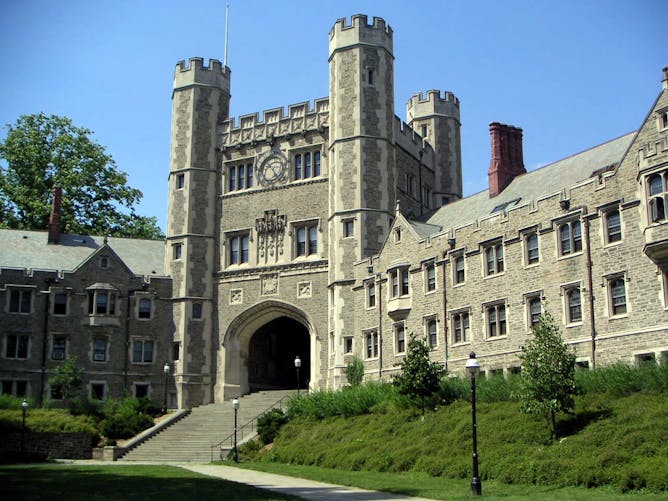
Princeton University had a record-setting number of applicants for its class of 2021. Sindy Lee / flickr, CC BY-NC-ND
College matters
Admittedly, the educational path of the cream of the crop may not apply to most people. So, going to college may not be the right or even the best path for everyone. However, if you’re a student thinking about not going to college or considering dropping out, remember that even Gates and Zuckerberg got into college. Even if you’re not aiming for mega success, doing the work to get into and graduate from college today may open important doors.
Perhaps in the future, college may not be as important to employers. But for now, college dropouts who rule the world are rare exceptions – not the rule.



 Regardless of pathway, all students can benefit from active engagement in the classroom. As mathematician


 This aversion to regulation at the federal level could cost taxpayers



 It seems unlikely that they will forego their chance to give tax dollars to private education.
 Perhaps in the future, college may not be as important to employers. But for now, college dropouts who rule the world are rare exceptions – not the rule.


