
“`html
Teaching pragmatics for elementary students with autism is a crucial component of their education. Understanding the subtleties of communication—like tone, context, and nonverbal cues—can be particularly challenging for children on the autism spectrum. As educators and caregivers strive to foster social skills within these students, it’s essential to explore effective teaching strategies while also considering the unique needs of each child.
Understanding Pragmatics and Its Importance
Pragmatics refers to the branch of linguistics that concerns the use of language in social contexts. It encompasses the rules and conventions that govern how language interacts with social situations. For elementary students with autism, mastering pragmatics is vital, as it directly influences their ability to engage in conversations, form relationships, and navigate various social environments.
Children with autism might demonstrate strong cognitive skills but can struggle with understanding the intricacies of social communication. They may find it difficult to interpret social cues, understand jokes, or grasp the meanings behind idiomatic expressions. This gap in pragmatic skills can lead to isolation and misunderstanding in peer interactions, emphasizing the need for targeted interventions.
The Impact of Autism on Pragmatics
Autism Spectrum Disorder (ASD) affects individuals in various ways, often leading to challenges in social communication. While every child is unique, common issues faced by elementary students with autism regarding pragmatics include:
- Difficulty interpreting nonverbal cues: Body language, gestures, and facial expressions may not be easily recognized or understood.
- Challenges with turn-taking: Conversations require a fluid exchange of ideas, which can be difficult for children on the spectrum.
- Literal interpretations: Students with autism may take language very literally, missing out on humor, sarcasm, or metaphors.
- Limited perspective-taking: Understanding that others have different thoughts and feelings can be a challenge, affecting their ability to empathize.
Given these challenges, educators must focus on developing pragmatic skills tailored to each student’s needs. The goal is to create an inclusive environment where students can thrive socially and emotionally.
Key Strategies for Teaching Pragmatics
Teaching pragmatics for elementary students with autism requires a multifaceted approach. Here are some effective strategies educators can implement:
1. Role-Playing and Social Stories
Role-playing is an interactive method that allows children to practice social scenarios in a safe environment. By simulating different social situations, students can learn how to initiate conversations, respond appropriately, and interpret social cues. For instance, educators can create role-playing exercises where students take turns being speakers and listeners, helping them understand the dynamics of dialogue.
Social stories, which are short narratives that describe social situations and expected behaviors, can also be beneficial. Developing customized social stories can help students visualize and internalize appropriate responses in various contexts. For example, a story about joining a group game can illustrate the steps involved in initiating interaction and understanding group dynamics.
2. Visual Supports and Cues
Visual aids can significantly enhance learning for students with autism. Incorporating visual supports, such as charts, diagrams, and images that illustrate social situations, can provide clarity. For example, a visual cue depicting the steps of a conversation—such as greeting, asking questions, and saying goodbye—can serve as a tangible reference during interactions. (See: Autism Spectrum Disorder Fact Sheet.)
Additionally, using visual timers can help students understand the concept of turn-taking. By visually displaying when it’s their turn to speak or listen, students can develop an awareness of timing in conversations.
3. Explicit Instruction and Modeling
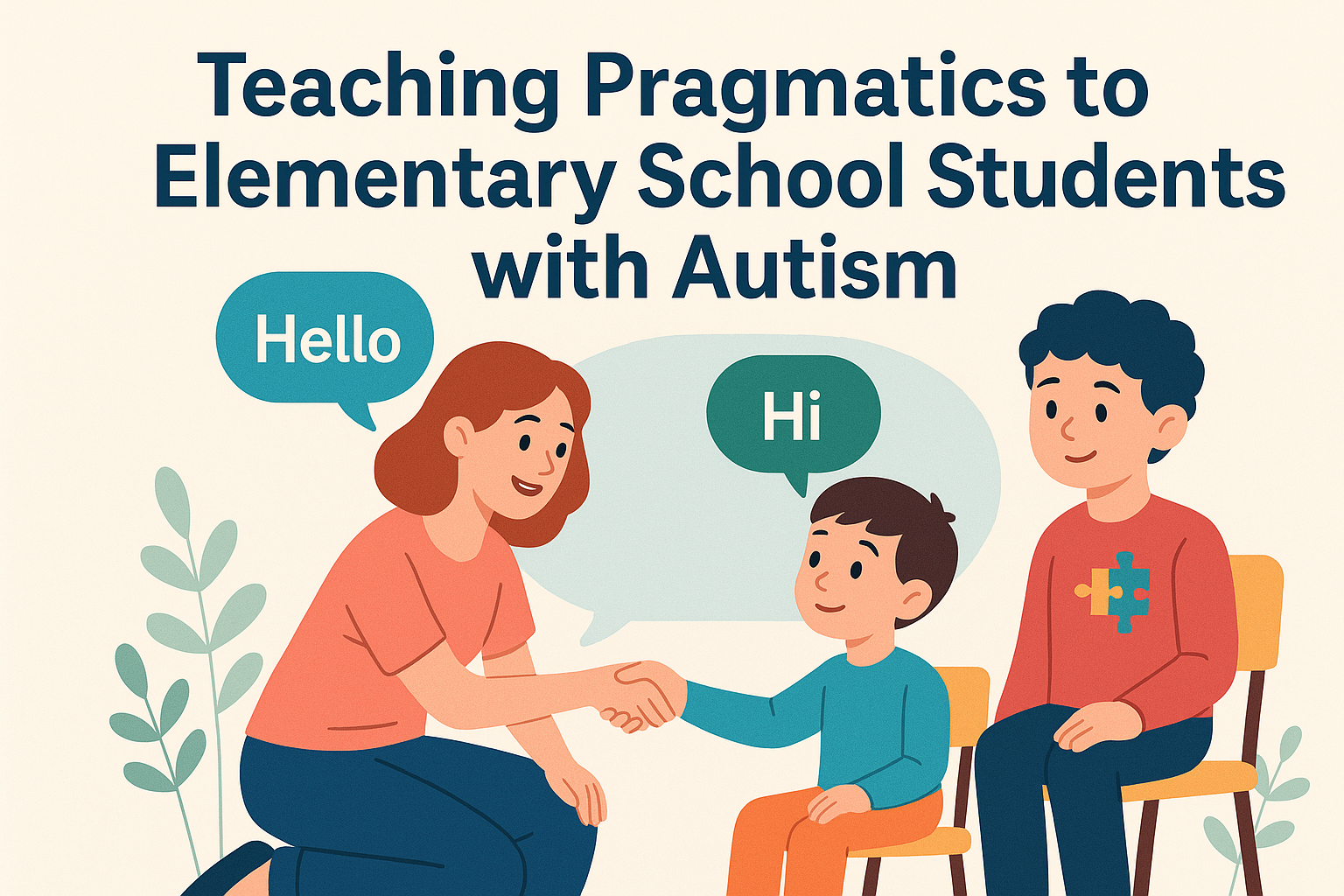
Explicit instruction is critical when teaching pragmatics. Educators should directly teach social communication rules, such as how to introduce oneself or how to ask for help. This approach can be supplemented with modeling to demonstrate appropriate behaviors in real-time.
For instance, an educator can model a conversation by demonstrating eye contact, body posture, and tone of voice. This visual demonstration helps students understand the expected behavior in a social context. After modeling, educators can invite students to practice the skill in a structured setting.
4. Peer Interaction and Collaboration
Encouraging peer interactions can provide students with valuable opportunities to practice pragmatic skills in a natural setting. Facilitating small group activities or partner exercises can foster collaboration and make socializing less intimidating. For example, collaborative projects, group games, or structured discussions can create an environment where students feel comfortable practicing their skills.
Furthermore, pairing students with neurotypical peers who can model appropriate social behavior can enhance learning. Teaching peers how to support their classmates with autism can create inclusive learning environments that benefit everyone involved.
The Role of Technology in Teaching Pragmatics
In today’s digital age, technology can play a significant role in teaching pragmatics for elementary students with autism. Various apps and software programs are designed to enhance social skills and communication. These tools often use engaging graphics and interactive elements to capture students’ attention and promote learning.
For example, apps that simulate social scenarios can provide students with opportunities to practice their skills in a controlled environment. They can receive immediate feedback on their responses, allowing for self-reflection and improvement. Furthermore, video modeling software can record students’ interactions, enabling them to review and analyze their social behavior.
Measuring Progress and Success
Assessing the effectiveness of teaching pragmatics involves tracking student progress over time. Educators can implement various methods to gauge improvement, such as observational assessments, checklists, and self-reflection logs. For example, teachers can use observational assessments to document students’ participation in social activities and interactions with peers.
Additionally, self-reflection tools can encourage students to evaluate their social interactions, promoting self-awareness and personal growth. Providing regular feedback and celebrating small successes can motivate students and foster a sense of accomplishment as they develop their skills.
Building a Supportive Environment
Creating a supportive environment is essential for teaching pragmatics for elementary students with autism. This includes fostering open communication among educators, parents, and support staff to ensure a consistent approach in teaching social skills. (See: CDC Autism Facts and Statistics.)
Engaging parents in the process can enhance learning both at school and at home. Providing parents with resources and strategies to reinforce pragmatic skills outside of the classroom can create a more cohesive support system for the child. Regular check-ins with families can help monitor progress and address any concerns.
Current Relevance and Future Directions
The relevance of teaching pragmatics for elementary students with autism continues to gain recognition in educational settings. As schools focus on inclusivity and social-emotional learning, understanding the importance of pragmatic skills is becoming more mainstream. Initiatives promoting training for educators in special education practices are on the rise, equipping teachers with the tools they need to effectively support their students.
In the future, continued advancements in technology and a better understanding of autism will likely enhance instructional methods for teaching pragmatics. Research into effective strategies, combined with input from educators and families, will contribute to evolving best practices.
Ultimately, the goal is to empower students with autism to develop the social skills they need to thrive in their communities. By focusing on teaching pragmatics, we can help these children navigate social situations more confidently, fostering positive relationships and a sense of belonging.
Examples of Effective Pragmatic Interventions
Some schools have implemented specific programs that focus on teaching pragmatics to students with autism. One such example is the use of “Social Skills Groups,” where small groups of students meet regularly to learn and practice social skills in a structured environment. These groups often include role-playing and activities that reinforce the lessons learned, providing students with continual exposure and practice.
Another effective approach is using “Peer Buddies” programs, where neurotypically developing students are paired with students on the autism spectrum. This pairing allows for guided social interactions, where the peer buddy can help model social behaviors and provide immediate feedback. Research indicates that these peer interactions enhance both social understanding for the student with autism and empathy development for the peer buddy.
Statistics on Autism and Pragmatics
Research shows that approximately 70% of children with autism display difficulty with pragmatic language skills. Understanding and interpreting social communication is a crucial aspect of their interactions, which can lead to challenges in forming friendships and engaging in group activities. According to a study published in the Journal of Autism and Developmental Disorders, children who receive targeted pragmatic language interventions show marked improvements in social skills and overall communication effectiveness.
Expert Perspectives on Teaching Pragmatics
Experts in the field, such as speech-language pathologists and special education teachers, emphasize the need for individualized approaches when teaching pragmatics. Dr. Karen P. Kuhlthau, a noted researcher in autism communication, advises that educators should integrate play-based learning to make pragmatic lessons engaging. “Children learn best when they are actively involved in the learning process. Using games and interactive activities can make learning about social interactions enjoyable,” she states. (See: Communication Challenges in Autism.)
Additionally, Dr. David Mandell, director of the Center for Mental Health Policy and Services Research, suggests that schools should consider the child’s interests when designing pragmatic instruction. “If we can connect social skill lessons to things children are passionate about, they’re more likely to engage and learn,” he explains.
Frequently Asked Questions (FAQ)
1. What are some common signs that a child with autism struggles with pragmatics?
Common signs include difficulty initiating or maintaining conversations, misunderstanding jokes or sarcasm, and showing trouble interpreting body language or facial expressions. If a child frequently misses social cues or appears isolated from peers, these may be indicators that they need additional support in pragmatic skills.
2. How can parents reinforce pragmatic skills at home?
Parents can reinforce pragmatic skills by creating opportunities for social interactions, such as playdates, family gatherings, or community events. Engaging in discussions about social situations—like recounting experiences from school—can also help children practice their skills in a comfortable environment.
3. Is there a specific age when teaching pragmatics should begin?
While it’s beneficial to start teaching pragmatic skills as early as possible, especially in preschool, it’s important to remember that learning is a continuous process. Children can benefit from pragmatic instruction throughout their elementary years as they face new social situations and challenges.
4. Are there any resources available for teaching pragmatics to children with autism?
Yes, there are various resources available, including storybooks that address social skills, worksheets, and online programs focused on social communication. Additionally, organizations like the Autism Society and the National Autism Center provide valuable information and resources for both educators and parents.
5. How can educators measure the effectiveness of their pragmatic teaching methods?
Educators can measure effectiveness through both qualitative and quantitative methods. This may include tracking improvements through observational assessments, anecdotal records, and standardized testing focused on social skills. Regular feedback from the students and their peers can also provide insight into the success of the interventions.
“`
Trending Now
Frequently Asked Questions
What is pragmatics in communication?
Pragmatics is the branch of linguistics that studies how language is used in social contexts. It involves understanding the rules and conventions that govern communication, including tone, context, and nonverbal cues, which are essential for effective social interactions.
How does autism affect communication skills?
Children with Autism Spectrum Disorder (ASD) often face challenges in social communication, including difficulties interpreting nonverbal cues, turn-taking in conversations, and understanding figurative language like jokes or metaphors, which can hinder their social interactions.
Why is teaching pragmatics important for students with autism?
Teaching pragmatics is crucial for students with autism as it helps them develop essential social skills. Mastering pragmatic skills enables these children to engage in conversations, build relationships, and navigate various social settings more effectively.
What are effective strategies for teaching pragmatics to children with autism?
Effective strategies include using role-playing scenarios, visual aids, and modeling appropriate social interactions. Tailoring approaches to each child's unique needs can significantly enhance their understanding and application of pragmatic skills in real-life situations.
What are common pragmatic challenges faced by children with autism?
Common challenges include difficulty recognizing nonverbal cues, issues with turn-taking during conversations, and a tendency to interpret language literally. These challenges can lead to misunderstandings and social isolation, highlighting the need for targeted interventions.
What did we miss? Let us know in the comments and join the conversation.