
Uncategorized

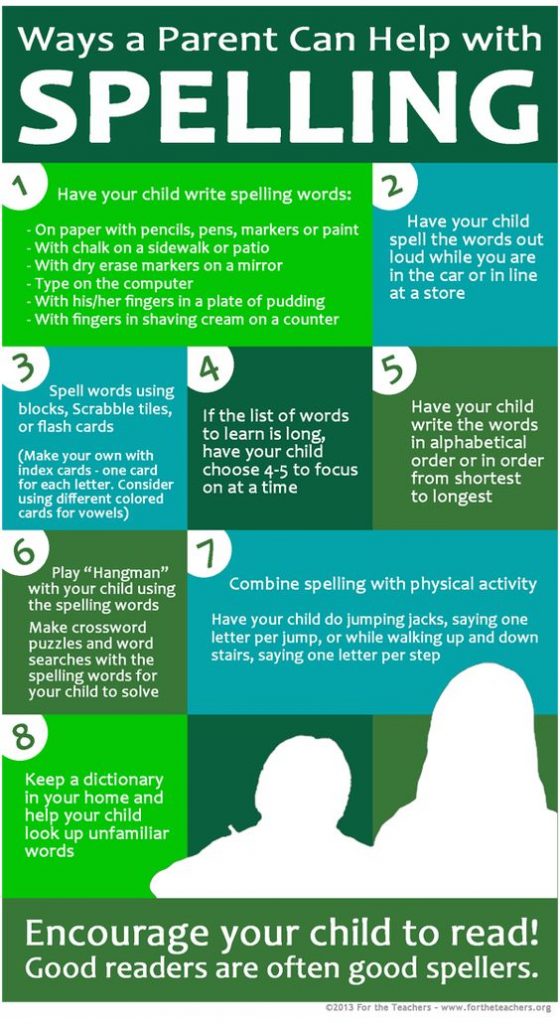
8 Ways Parents Can Help with Spelling

As a parent, you are your child’s first teacher, and the education that you give them lays the foundation for the future. However, many parents take a hands-off approach once their child enters formal schooling. I suspect that many parents believe that their child is better off in the hands of experts, and they can take a backseat. Well, this is a myth that we need confront. When your child enters formal schooling, your role as your child’s first teacher does not end; it gets more intense. Why? Because as the years pass, your child will be exposed to an increasingly tougher curriculum.

You may think to yourself, “I am not a trained educator.” That doesn’t matter. You have to become assertive and seek out resources that will make you the best parent-educator that you can be. Take spelling for instance. In the elementary grades, your child will be expected to learn how to spell a plethora of words. To assess how well they are doing, their teacher will usually have weekly spelling tests. Parents are expected to help their child prepare for these tests. You don’t have to be a trained educator for this, and there are plenty of resources that will help you choose the best strategies. For instance, we found this fantastic graphic that lists 8 ways parents can help their child with spelling. These tips and strategies will turn you into a world class spelling coach and may turn your child into a spelling bee champion.

As you can see, helping your child academically is not as hard as it seems. Remember, you don’t have to be perfect, you have to be committed.
10 Easy Ways to Show Students You Care

To teach a child, you must first show that child that you care about them and their well-being. How to accomplish this? I am glad you asked. Below you will find a cool graphic that lists 10 easy ways to show students that you care.


27 Ways to Teach Your Students to Be Good Digital Citizens

With the increased importance of technology in society, digital literacy is gaining recognition as the most valuable tool for lifelong learning. What does this mean? Essentially, as citizens of a global society, the influence of social media, technology, and online resources is massive. For children, the access to a home computer with internet increases their likelihood of college attendance exponentially. For adults, the ever evolving tech world can either help them succeed or hold them back.

Society has changed over the last 15 years. It has become increasingly important to continue education after entering the workforce. The influence of technology on business is the main reason for this new mandate. In early learning through adulthood, digital literacy is showing the most promise for success. The edtech industry has long-focused on the value of digital competency for children. It’s time digital literacy was incorporated into adult education in the same way.

How do you accomplish this? Easy. The graphic below list 27 ways to teach your students be good digtial citizens.

27 Ways to Spice Up a Faculty Meeting

When I was an educator, I hated faculty meetings. They were boring and often used to push out things that could be disseminated via email or memo. Also, if the time was used for professional development, it was usually something I was already well versed in. I often spent my time wishing I was somewhere else. As an education administrator, how can you change the narrative on faculty meetings? I am glad you asked. I found a fantastic graphic that lists 27 ways to spice up a faculty meeting. I hope this helps.

27 Strategies for Managing Your Classroom

While conceptualizing this article, I reminisced about my first teaching job. It was as a fifth-grade social studies teacher in my hometown. To be honest, my first year wasn’t necessarily a stellar one. In some ways, I felt overwhelmed, even inadequate in the classroom, especially when it came to classroom management. But with the help of veteran teachers and an understanding principal, I completed that year and became a master teacher by my third year.

My experiences are not at all uncommon. Ask any teacher what their biggest challenge is on a daily basis, and most will say classroom management. Consider, the following classroom scenario. You are a fifth grade English teacher who has just started a lesson on action verbs, but your students have other plans. Matthias interrupts you with a question or an opinion about an unrelated topic, Rebecca is talking to her friend while you are attempting to redirect Matthias, and Susie, who is worried about her mother in the hospital, starts to cry incessantly. On top of that, while you are distracted, Alfred is posting hurtful comments about Rebecca on Facebook. This episode is just the tip of the iceberg, as sometimes these scenes get even more convoluted.

Are you struggling to manage your classroom? Don’t panic, as it happens to the best of us. So how do you get your class back under control? I am glad you asked. Below I am sharing a graphic that lists 27 ideas about how to manage your classroom.


17 Ways to Prevent Cognitive Overload in Your Students

Have you ever been working on a task so long or intensely that your brain begins to shut down? That moment when you feel like you couldn’t possibly process any new information. This feeling is called cognitive overload, and it happens when we put to much stress on our working memory as we learn new content or skills.

You know how cognitive overload makes you feel, so imagine what your students go through. How can you reduce cognitive overload in your students? The graphic below provides a starting point.

24 Digital Leadership Responsibilties for Students

The responsibility for teaching citizenship has always fallen on schools. Teachers show students how to be citizens of their communities, cities, and the world. Classroom instruction in social autonomy also includes digital citizenship. Today’s modern world demands that students become digital citizens. This citizenship requires that participants be respectful in communications, cautious in accepting all content as true, and attentive to safety and security. Digital citizenship teaches positive habits in using technology.

Digital citizenship is about responsible technology use, but citizenship alone is not enough. As the way in which students engage with technology changes, the role of the connected student must also change. Students should be taught to be digital leaders instead of digital citizens. How do you teach your students to become digital leaders? Don’t worry; we have you covered. The graphic below lists 24 digital leadership responsibilities for students. If you teach them these skills and responsibilities, they will be digital leaders in no time.
