
“`html
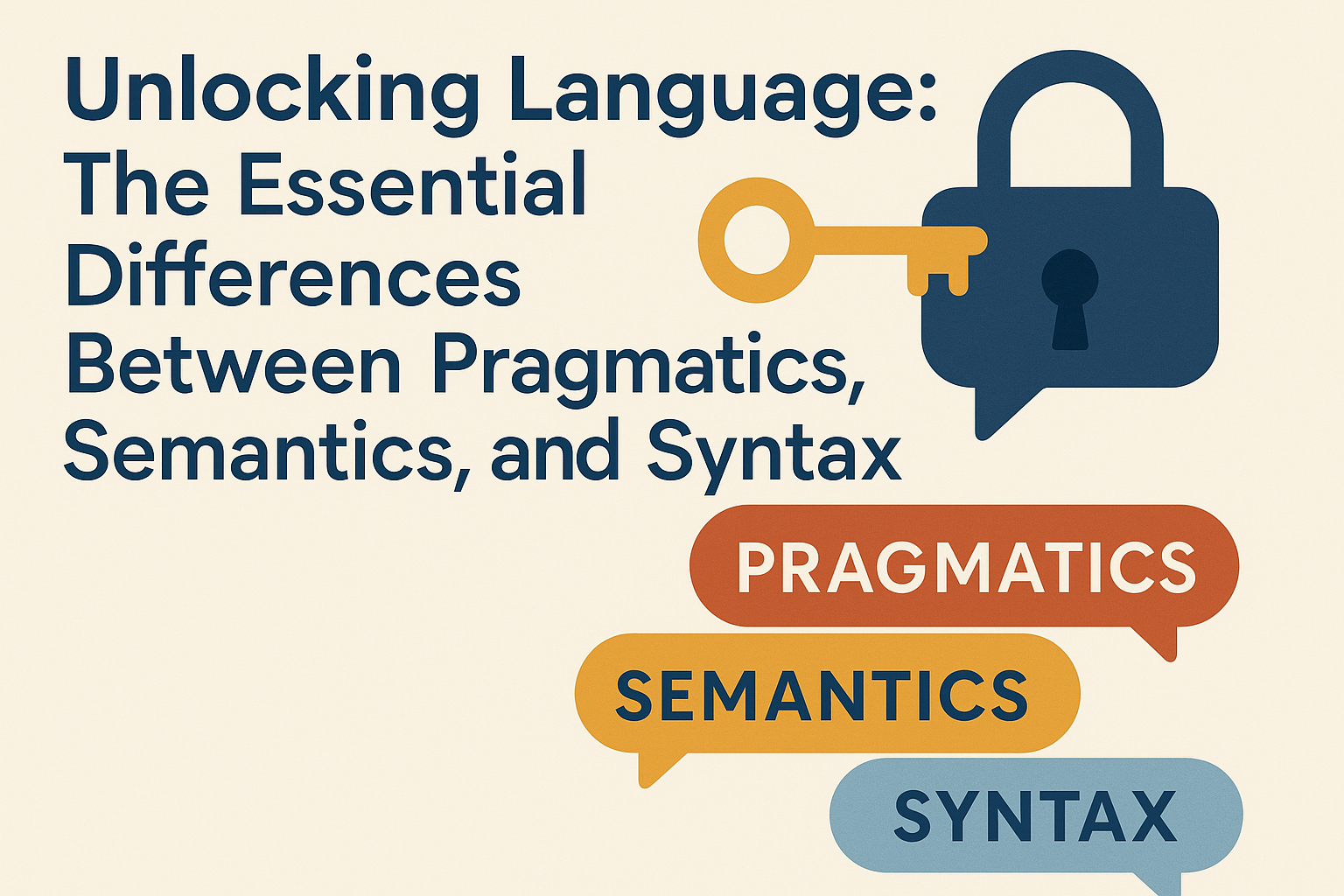
Language is a fascinating field that encompasses a multitude of components, each interacting to create the rich tapestry of human communication. Among these components, three crucial elements stand out: pragmatics, semantics, and syntax. Understanding these three pillars of language not only enhances our grasp of linguistic mechanics but also enriches our ability to communicate effectively. In this article, we’ll dive deep into these essential areas, providing you with practical insights, examples, and current relevance in the world of linguistics.
1. What is Syntax?
Syntax refers to the set of rules and principles that govern the structure of sentences in a language. Essentially, it deals with how words combine to form phrases and sentences, determining the grammatical relationships among words. For example, in English, a simple syntactic rule dictates that a basic sentence structure is formed by a subject, verb, and object (SVO). Thus, the sentence “The cat (subject) chased (verb) the mouse (object)” follows the syntactic rules of English.
Understanding syntax is critical because it influences clarity and meaning. For instance, the difference between “The man bites the dog” and “The dog bites the man” is purely syntactic. Both sentences contain the same words, yet their meanings shift dramatically based on their arrangement. This highlights why syntax is often considered the backbone of language; without it, meaning can easily become ambiguous or entirely lost.
2. Diving into Semantics
While syntax is focused on structure, semantics is concerned with meaning. It studies how words, phrases, and sentences convey meaning and how these meanings can change in different contexts. For instance, the word “bank” can refer to a financial institution or the side of a river, depending on the context in which it is used. This ambiguity illustrates the dynamic nature of semantics.
Moreover, semantics breaks down further into subfields like lexical semantics, which examines the meaning of words themselves, and compositional semantics, which explores how individual meanings combine to form sentence meanings. Understanding semantics is vital for several reasons: it helps us parse complex sentences, appreciate nuances in language, and grasp idioms or metaphors that do not follow literal meanings. A classic example is the phrase “kick the bucket,” which means to die. Here, semantics allows us to transcend the literal interpretation and grasp the underlying meaning.
3. Exploring Pragmatics
Pragmatics extends beyond the words and structures of language to consider the context in which communication occurs. It involves the social aspects of language use, focusing on how context influences meaning. For example, if someone says, “Can you pass the salt?” in a dinner setting, pragmatically, it’s understood as a request rather than a literal question about one’s ability to pass salt.
This context-driven aspect of pragmatics makes it particularly rich and complex. Factors such as cultural background, shared knowledge, and situational context all play a role. Pragmatic knowledge helps speakers navigate subtleties like sarcasm, politeness, and implicature—where the implied meaning differs from the literal meaning. For instance, saying “It’s chilly in here” might imply a request to close a window or turn up the heat, depending on the context and relationship between the speakers.
4. The Interplay of Pragmatics, Semantics, and Syntax
While pragmatics, semantics, and syntax can be studied in isolation, they are inherently interconnected components of language. Syntax sets the framework for sentence structure, semantics adds layers of meaning, and pragmatics situates that meaning within a specific context. This interplay is crucial for effective communication. (See: Understanding syntax in linguistics.)
For example, consider the sentence “I’ll meet you at the bank.” The syntax dictates how the words are arranged, the semantics reveals that this refers to a location, and the pragmatics informs us that the speaker and listener likely share an understanding of which bank is being referred to. If a speaker were to use “bank” in a sentence about fishing, the listener might interpret it differently based on context. This highlights how these three pillars work together to convey a coherent message.
5. Practical Applications in Language Learning
Understanding pragmatics, semantics, and syntax is not only essential for linguists; it has practical implications for language learners as well. When learning a new language, grasping syntax helps students form correct sentences, while semantics allows them to understand and use vocabulary accurately. Pragmatics, on the other hand, equips learners with the skills to navigate social interactions and cultural nuances.
For instance, a non-native speaker may know the correct syntax and semantics of a request but might struggle with appropriate pragmatic responses. Consider the difference between a direct request like “Give me the book” versus a more polite form like “Could you please hand me the book?” Understanding these differences can significantly impact communication effectiveness and interpersonal relationships.
6. Current Relevance and Future Directions
In today’s globalized world, the relevance of pragmatics, semantics, and syntax is more pronounced than ever. As communication becomes increasingly digital, understanding these pillars can enhance clarity and reduce misinterpretations in written communication. Moreover, with the rise of artificial intelligence and natural language processing, these linguistic principles guide developers in creating more intuitive systems that can understand and generate human-like responses.
Future research in these areas may focus on how technology influences language use and the development of new norms in communication. For instance, how do emojis impact the semantics of a message? What role does context play in interpreting AI-generated text? As language continues to evolve, the study of pragmatics, semantics, and syntax will remain crucial in understanding and adapting to these changes.
7. Cultivating Your Linguistic Skills
As individuals looking to improve your own language skills, focusing on the interplay of pragmatics, semantics, and syntax can provide a comprehensive framework for effective communication. Start by paying attention to the syntax in the sentences you construct. Are they clear and grammatically correct? Next, delve into the semantics of the words you choose. Are there better synonyms or phrases that convey your intended meaning more accurately?
Finally, consider the pragmatic aspects of your communication. Context matters—how can you adjust your language to suit the audience and situation? Engaging in active listening and being open to feedback will further sharpen your skills. By embracing these three pillars of language, you’ll not only enhance your own understanding but also become a more effective communicator.
8. Examples of Syntax, Semantics, and Pragmatics in Everyday Life
To better illustrate the differences and connections among syntax, semantics, and pragmatics, let’s look at some everyday examples. (See: Harvard University linguistics resources.)
Consider the phrase “Let’s eat, Grandma.” Here, the syntax clearly indicates the structure of the sentence, allowing it to be understood as a direct invitation. If we change the punctuation to “Let’s eat Grandma,” the meaning shifts dramatically, signaling the importance of both syntax and semantics in conveying our intentions. In this case, the semantics involve understanding that the first sentence is an invitation to dine together, while the second suggests something far more macabre.
Another example can be drawn from greetings in different cultures. In many Western countries, saying “How are you?” is often a polite greeting with no expectation of a detailed response. However, in some cultures, such as in parts of the Middle East or Africa, the same phrase may require a genuine response about one’s well-being, showcasing the pragmatic differences influenced by cultural expectations.
9. Statistics and Research on Language Use
Recent studies have shown that understanding pragmatics, semantics, and syntax can significantly impact effective communication. For instance, a study conducted by the American Speech-Language-Hearing Association found that individuals who are proficient in pragmatics are more successful in social interactions, leading to improved relationships and lower rates of social anxiety.
Moreover, research in applied linguistics has shown that children who are taught explicit grammar rules (syntax) alongside vocabulary development (semantics) and social language skills (pragmatics) perform better in language acquisition compared to those who are taught in isolation. This underscores the need for a holistic approach to language education that integrates all three components.
10. Common Misconceptions about Pragmatics, Semantics, and Syntax
There are many misconceptions surrounding these three pillars of language. One common belief is that syntax is the most important element. While syntax provides the structural foundation, it’s the combination of all three components that enables effective communication. Without semantics, a syntactically correct sentence might convey the wrong meaning, and without pragmatics, the intended message may not be clear to the listener.
Another misconception is that semantics and pragmatics are the same. While they are closely related, semantics focuses on meaning independent of context, whereas pragmatics deals with meaning as influenced by context. Understanding this distinction is essential for a comprehensive grasp of language use.
11. FAQ: Understanding Pragmatics, Semantics, and Syntax
What is the main difference between semantics and pragmatics?
Semantics deals with the meaning of words and sentences, while pragmatics focuses on how context influences the interpretation of those meanings. For example, the word “bank” may mean something different based on the context, showcasing the role of pragmatics.
How does syntax affect the meaning of a sentence?
Syntax affects meaning by determining how words are arranged in a sentence. For instance, “The cat chased the mouse” has a different meaning than “The mouse chased the cat,” despite using the same words. The order changes the relationships among the subjects and objects. (See: CDC's communication guidelines.)
Why is understanding these concepts important for language learners?
Grasping the interplay of syntax, semantics, and pragmatics helps language learners communicate more effectively. It aids in forming correct sentences, understanding meanings, and navigating social nuances, making interactions smoother and more meaningful.
Can pragmatics change over time?
Yes, pragmatics can evolve, particularly as cultural norms and social contexts change. For example, informal language and emojis have become more accepted in digital communication, transforming how meaning is conveyed in written form.
How can I improve my understanding of these linguistic components?
Engaging in reading diverse materials, participating in discussions, and practicing writing can enhance your understanding. Additionally, studying different languages can provide insights into the various ways syntax, semantics, and pragmatics operate across cultures.
What role do context and culture play in language use?
Context and culture significantly impact how language is interpreted. For instance, idiomatic expressions that might make sense in one culture may not be understood in another. This underscores the importance of pragmatics in effective communication, especially in multicultural settings.
Are there tools to help learn pragmatics, semantics, and syntax?
Yes, there are various online platforms, apps, and resources dedicated to language learning that focus on these aspects. Language games, interactive exercises, and conversational practice with native speakers can strengthen understanding. Additionally, studying linguistic theory through textbooks or MOOCs can provide a more academic approach to these topics.
“`
Trending Now
Frequently Asked Questions
What is the difference between pragmatics and semantics?
Pragmatics focuses on how context influences the interpretation of meaning in communication, while semantics deals with the inherent meaning of words and sentences. Essentially, semantics provides the meaning, whereas pragmatics considers the context in which that meaning is conveyed.
What is syntax in linguistics?
Syntax refers to the rules and principles that dictate how words are arranged to form phrases and sentences. It governs the grammatical relationships among words, which is crucial for clarity and understanding in communication.
How do semantics and syntax work together?
Semantics and syntax interact closely in language. Syntax provides the structure needed for sentences, while semantics imparts meaning to those structures. Together, they ensure that sentences are not only grammatically correct but also meaningful.
Why is understanding syntax important?
Understanding syntax is vital because it influences the clarity and meaning of sentences. Misarranging words can lead to ambiguity, as seen in the difference between 'The man bites the dog' and 'The dog bites the man,' which are syntactically identical yet convey opposite meanings.
What role does pragmatics play in communication?
Pragmatics plays a crucial role in communication by examining how context affects the interpretation of meaning. It helps us understand not just the words used, but also the intentions, implications, and social dynamics involved in conversations.
Agree or disagree? Drop a comment and tell us what you think.