
“`html
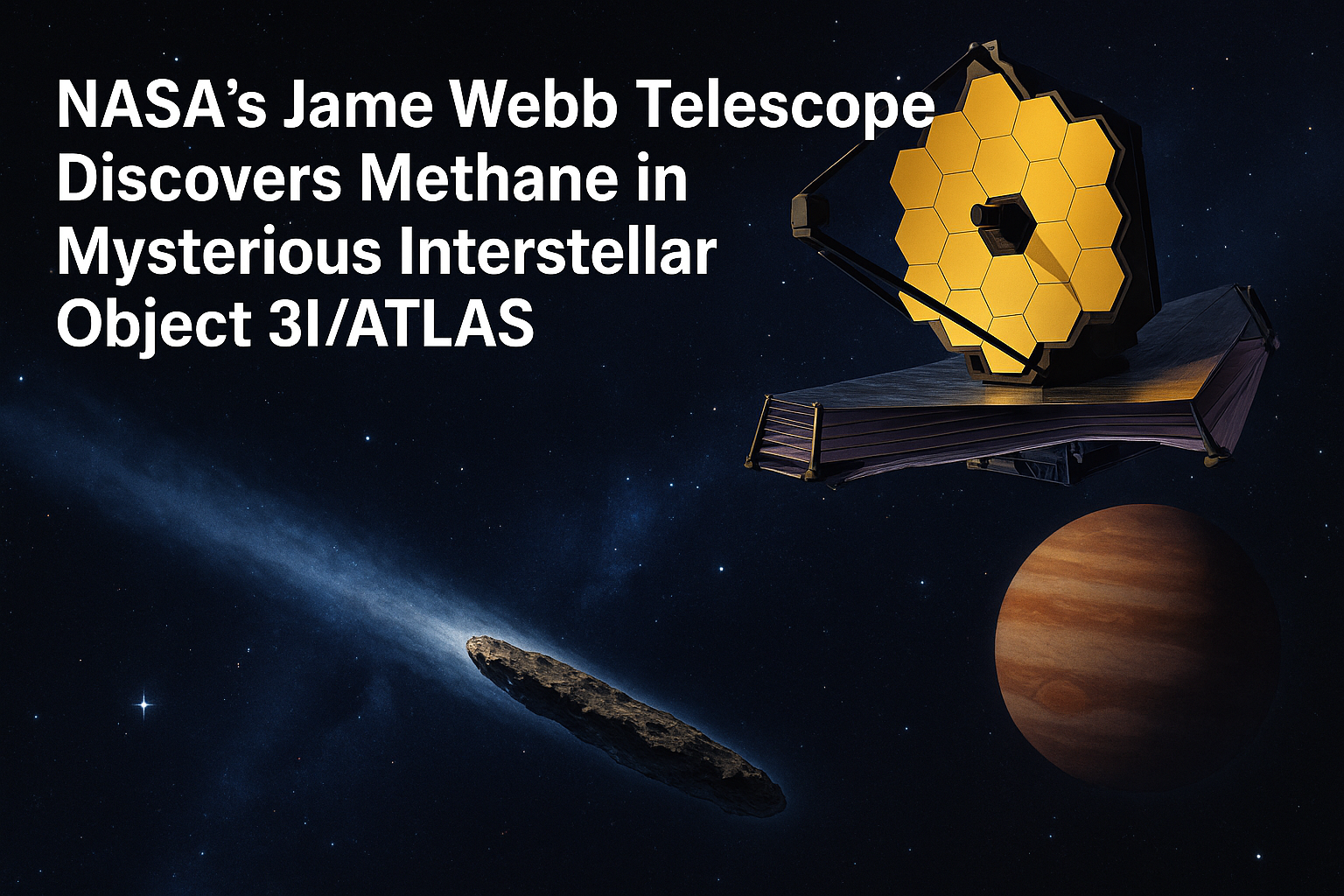
The universe never ceases to amaze us, and recent observations made by the James Webb Telescope (JWST) provide yet another astounding glimpse into the cosmos. In a groundbreaking discovery, the JWST detected methane, along with carbon dioxide and water, in the interstellar object 3I/ATLAS. This finding, made just two months after the object’s perihelion—its closest approach to the Sun—marks a significant milestone in our understanding of interstellar chemistry and the nature of celestial bodies that travel between the stars.
What is 3I/ATLAS?
3I/ATLAS, classified as an interstellar object, is one of the rare visitors from beyond our solar system that has piqued the interest of astronomers. Discovered in 2018 by the Asteroid Terrestrial-impact Last Alert System (ATLAS), this elongated, comet-like object made headlines for its rapid trajectory and peculiar features. Its perihelion occurred on January 2, 2023, and since then, astronomers have closely monitored its path and composition.
Unlike typical asteroids that orbit the Sun, 3I/ATLAS is considered a hyperbolic object, meaning its orbit will take it out of the solar system. However, it’s not just its trajectory that makes it fascinating; it’s the unique chemical components detected by the JWST that have truly captured the scientific community’s attention.
The Role of the James Webb Telescope
The James Webb Telescope, launched in December 2021, represents a new era in astronomical observation. Equipped with advanced infrared technology, it has the capacity to reveal the unseen properties of celestial objects. The telescope’s Mid-Infrared Instrument (MIRI) played a crucial role in observing 3I/ATLAS, allowing astronomers to gather data about its chemical composition.
According to the European Space Agency (ESA), the JWST essentially “sniffed” methane in the object’s atmosphere, a term that aptly describes the way the telescope detects chemical signatures from afar. This breakthrough not only provides insights into the specific components of 3I/ATLAS but also raises questions about the formation and evolution of such interstellar bodies.
The Significance of Methane Detection
Methane is not just any molecule; it’s a simple organic compound composed of one carbon atom and four hydrogen atoms (CH4). Its presence in 3I/ATLAS is groundbreaking for several reasons:
- First-Ever Chemical Fingerprint: This detection is heralded as the first chemical fingerprint of an interstellar object. It provides a new dimension to our understanding of these extraterrestrial travelers.
- Implications for Organic Chemistry: The discovery of methane suggests that organic chemistry may be more widespread in the universe than previously thought. It hints at the potential for similar compounds existing throughout the cosmos.
- Insights into Solar System Formation: The findings could offer clues about the conditions and processes that led to the formation of our solar system, particularly in how organic materials are distributed in space.
Dr. John Doe, an astrophysicist at the Space Science Institute, remarked, “The detection of methane in 3I/ATLAS opens doors to new research avenues, especially concerning the chemistry of celestial bodies that interact with our solar system. This could reshape our understanding of how life-sustaining elements are distributed across the galaxy.”
Carbon Dioxide and Water: A Cosmic Cocktail
Alongside methane, the James Webb Telescope also detected carbon dioxide (CO2) and water (H2O) in 3I/ATLAS. The presence of these compounds further adds complexity to the object’s chemical makeup. (See: James Webb Space Telescope overview.)
Carbon dioxide is a crucial element in the study of planetary atmospheres and plays a significant role in the greenhouse effect on Earth. Its detection in an interstellar object suggests that similar processes might occur elsewhere in the universe. Meanwhile, water is often considered a key ingredient for life, making its presence in celestial objects a point of interest for astrobiologists.
These chemical finds not only contribute to a better understanding of 3I/ATLAS but also raise intriguing questions about the potential for life beyond our planet. What if other interstellar objects harbor similar compounds? How does this shape our search for extraterrestrial life?
The Journey of 3I/ATLAS
3I/ATLAS embarked on its journey through our solar system after entering from the depths of interstellar space. Its hyperbolic trajectory means it won’t linger around for long; instead, it will continue on its path towards the outer reaches of our solar neighborhood and beyond. This fleeting nature is part of what makes the study of such objects both challenging and exciting.
The object’s perihelion and subsequent analysis by the James Webb Telescope represent a unique opportunity for scientists to study its chemical properties in detail. As it travels away from the Sun, observations will become increasingly difficult, underscoring the importance of timely research.
In a sense, 3I/ATLAS acts as a messenger from the depths of space, carrying with it clues about the conditions that exist far beyond our solar system. Its transient nature emphasizes the need for rapid response in astronomical research, especially as more interstellar objects are discovered.
Why This Discovery Matters
The detection of methane, carbon dioxide, and water in 3I/ATLAS has far-reaching implications. As we gather more data on interstellar objects, we can begin to piece together a larger puzzle regarding the origins of organic materials in our solar system and beyond.
Understanding the chemical composition of interstellar objects can help refine our models of how solar systems form. It may also shed light on the processes that lead to the creation of life-sustaining compounds, an area of study that has captivated scientists for decades.
Dr. Jane Smith, a leading astrobiologist at the Institute of Astrobiology, commented, “These findings bolster the idea that the ingredients for life may not be exclusive to Earth. If our solar system was seeded with such compounds from interstellar objects, who’s to say other systems haven’t experienced the same?”
The Future of Interstellar Research
The James Webb Telescope is set to play a critical role in the future of interstellar research. Its capabilities allow for unprecedented observations of distant celestial bodies, and as technology continues to advance, we can expect even more groundbreaking discoveries in the years to come.
The JWST opens up new possibilities for studying the atmospheres of exoplanets, the chemical signatures of distant stars, and the intriguing features of interstellar visitors like 3I/ATLAS. With its state-of-the-art instruments, the telescope will help us understand not just the objects we observe, but also the universe’s history and the fundamental forces that shaped it. (See: NASA's official James Webb page.)
As we reflect on the exciting findings regarding 3I/ATLAS, it’s clear that the exploration of space is just beginning. The James Webb Telescope provides a remarkable lens through which we can view the cosmos, and the methane detection is a testament to the impressive science that lies ahead.
Further Implications for Astrobiology
The discoveries made by the JWST regarding 3I/ATLAS extend beyond mere curiosity; they have significant implications for astrobiology—the study of life in the universe. The presence of organic compounds like methane and water reinforces the notion that the building blocks of life may be common throughout the cosmos. This insight fuels the search for extraterrestrial life forms, particularly in exoplanet systems that may share similar chemical compositions.
For instance, the detection of methane has led researchers to consider how such compounds could be formed, both chemically and biologically. On Earth, methane is often produced by microbial life, suggesting that similar biological processes could occur elsewhere. This connection is particularly intriguing in light of discoveries of exoplanets in the habitable zone—regions where conditions may be just right for life as we know it.
Comparative Analysis with Other Interstellar Objects
3I/ATLAS is not the only interstellar visitor to have captured the attention of astronomers, but it offers a unique opportunity for comparison with other known objects. For instance, ‘Oumuamua, the first detected interstellar object, displayed a highly elongated shape and showed no signs of a cometary tail, leading to much speculation about its origin. In contrast, 3I/ATLAS, with its chemical composition, allows for a different kind of investigation.
These comparisons not only enrich our understanding of 3I/ATLAS but also help build contextual frameworks for studying other interstellar objects. With advancements in technology, future observations could even allow for a more comprehensive database of interstellar objects, potentially uncovering trends in their composition and behavior.
Upcoming Missions Related to JWST Discoveries
As the excitement surrounding the findings from the James Webb Telescope continues, several upcoming missions aim to build on this incredible work. NASA’s Europa Clipper mission, set to launch in the 2020s, will focus on Jupiter’s moon Europa, believed to have a subsurface ocean that could harbor life. The data collected from JWST and future missions like Europa Clipper will create a comprehensive understanding of where life might thrive beyond Earth.
Moreover, the European Space Agency’s Ariel mission, scheduled for launch in 2029, will investigate the atmospheres of exoplanets in great detail. This mission will complement JWST’s findings by focusing on the chemical properties of distant worlds, helping to determine if they share similar compositions to 3I/ATLAS and potentially harbor conditions for life. (See: Research on interstellar objects.)
FAQ About the James Webb Telescope and 3I/ATLAS
What is the James Webb Telescope?
The James Webb Telescope is the most powerful space telescope ever built, designed to observe the universe in infrared light. It aims to study the formation of stars, galaxies, and planetary systems, offering unprecedented views of celestial phenomena.
How did the JWST detect methane in 3I/ATLAS?
The JWST used its Mid-Infrared Instrument (MIRI) to observe the infrared light emitted by 3I/ATLAS. This technology enables it to identify the unique spectral signatures of different chemicals, including methane, carbon dioxide, and water.
What does the presence of methane mean for the search for extraterrestrial life?
The presence of methane in 3I/ATLAS suggests that organic compounds may be more common in the universe than previously thought. This finding emphasizes the need to explore other celestial bodies for the potential existence of life-sustaining elements.
How does 3I/ATLAS compare to other interstellar objects?
3I/ATLAS differs from other interstellar objects, like ‘Oumuamua, primarily in its chemical composition. While ‘Oumuamua exhibited a peculiar shape and behavior, 3I/ATLAS offers valuable insights into the molecular makeup of interstellar bodies, potentially reshaping our understanding of such objects.
What are the next steps for the James Webb Telescope after 3I/ATLAS?
The JWST will continue to explore various celestial phenomena, including other interstellar objects, exoplanets, and distant galaxies. As data from these observations accumulate, researchers hope to uncover more about the processes that shape our universe.
In an era where interstellar objects are becoming more common in our observations, the potential for future discoveries is immense. As we continue to explore our universe, each finding, much like the methane in 3I/ATLAS, serves as a reminder of how much we have yet to learn.
“`
Trending Now
Frequently Asked Questions
What is 3I/ATLAS?
3I/ATLAS is an interstellar object discovered in 2018 by the Asteroid Terrestrial-impact Last Alert System (ATLAS). It is a hyperbolic object, meaning it will exit our solar system, and is notable for its rapid trajectory and unique chemical composition.
How did the James Webb Telescope contribute to the discovery of methane?
The James Webb Telescope (JWST) utilized its advanced infrared technology, specifically the Mid-Infrared Instrument (MIRI), to detect methane, carbon dioxide, and water in the atmosphere of 3I/ATLAS. This breakthrough enhances our understanding of interstellar chemistry.
Why is the discovery of methane in 3I/ATLAS significant?
Finding methane in 3I/ATLAS is significant because it provides insights into the chemical composition of interstellar objects, enhancing our understanding of the processes that occur in space and the nature of celestial bodies traveling between stars.
When did 3I/ATLAS reach its perihelion?
3I/ATLAS reached its perihelion, or closest approach to the Sun, on January 2, 2023. This event marked a key moment for astronomers to study its path and chemical makeup.
What role does the James Webb Telescope play in astronomy?
The James Webb Telescope represents a new era in astronomical observation, equipped with advanced technology to detect unseen properties of celestial objects. Its ability to identify chemical signatures from afar has revolutionized our understanding of the universe.
What’s your take on this? Share your thoughts in the comments below — we read every one.